

Most residential asphalt driveways get 2–3 years per coat before resealing makes sense. Penetrating concrete sealers can last for several years under suitable conditions. The gap between those two numbers comes down to sealer type, traffic load, and how hard a Canadian winter hits your pavement.
The practical rule is: don’t reseal on a calendar. Watch the surface instead.
- Fading to grey means the binder is oxidising and UV protection is gone.
- Water no longer beads after rain signals the sealer film has broken down.
- Visible aggregate or surface porosity means moisture and road salt are getting in.
- New asphalt needs a cure window of 6–12 months before any sealer goes down.
- High-traffic driveways (delivery vehicles, heavy trucks, frequent turning) wear sealer roughly twice as fast as a standard two-car residential driveway.
Condition-based maintenance is the industry-preferred approach. A water-beading test and a visual check for fading tell you more than any fixed schedule. Use the 2–3 year baseline as a backstop, not a trigger.
For most Calgary homeowners, that means a spring inspection every year, a reseal every 2–3 years for asphalt, and a longer watch-and-wait for quality penetrating concrete products.
Key takeaways
Most asphalt driveways in Canada need resealing every 2–3 years; penetrating concrete sealers can last 3–10 years. The condition of the surface, not the calendar, should be the primary trigger.
| Point | Details |
|---|---|
| Lifespan by sealer type | DIY asphalt emulsion lasts 1–2 years; professional two-coat jobs last 2–4 years; penetrating silane/siloxane lasts 3–10 years. |
| Condition-based reseal rule | Reseal when water stops beading, the surface fades to grey, or aggregate becomes visible, not on a fixed annual schedule. |
| New asphalt wait | Wait 6–12 months before sealing new asphalt; sealing too early traps oils and destabilises the surface. |
| Coverage and cost | A 600 sq ft driveway needs roughly 4 pails for two coats; professional two-coat jobs typically run $200–$600 depending on product. |
| Yearlong for Calgary | Yearlong offers two-coat commercial-grade concrete and driveway sealing with surface prep, crack assessment, and a satisfaction guarantee across Calgary. |
Table of Contents
- How long does driveway sealer last by product type?
- What does your driveway surface tell you about resealing?
- What shortens sealer life faster than expected?
- When is the right time of year to seal your driveway in Canada?
- How much sealer do you need and what does it cost?
- How to make each coat of sealer last as long as possible
- Health, environment, and Canadian regulatory considerations
- When should you hire a professional instead of doing it yourself?
- A sensible reseal rhythm for Canadian homeowners
- Yearlong handles driveway sealing in Calgary so you don’t have to
- Sources
How long does driveway sealer last by product type?
Driveway sealer lifespan varies more by product category than most homeowners expect. A bag-store asphalt emulsion and a professional-grade penetrating siloxane are not even playing the same game.
| Sealer type | Expected lifespan | Best for / primary benefit | Typical recoat interval | Main drawbacks | Typical coverage |
|---|---|---|---|---|---|
| Asphalt emulsion (standard) | 1–2 years (DIY); 2–3 years (pro) | General asphalt protection, UV resistance | 2–3 years | Shortest DIY lifespan; thins easily | ~75 sq ft/gal per coat |
| Polymer-modified asphalt emulsion | 2–4 years | Improved flexibility, better freeze–thaw resistance | 2–4 years | Higher cost than standard emulsion | ~75 sq ft/gal per coat |
| Coal-tar emulsion | 3–5 years | Oil and fuel resistance | 3–5 years | High PAH content; health/env. concerns; banned in some municipalities | ~75 sq ft/gal per coat |
| Topical acrylic (concrete) | 1–3 years | Wet look, colour enhancement | 1–3 years | Slippery when wet; film buildup over time | ~200–300 sq ft/gal |
| Penetrating silane/siloxane (concrete) | 3–10 years | Deep moisture and salt protection; no surface film | 5–10 years | No visual change; higher upfront cost | ~150–200 sq ft/gal |
| Penetrating silicate (concrete) | 5–10+ years | Densifies concrete; permanent in some cases | Rarely recoated | Works only on porous concrete; no water-repellent effect alone | ~200 sq ft/gal |
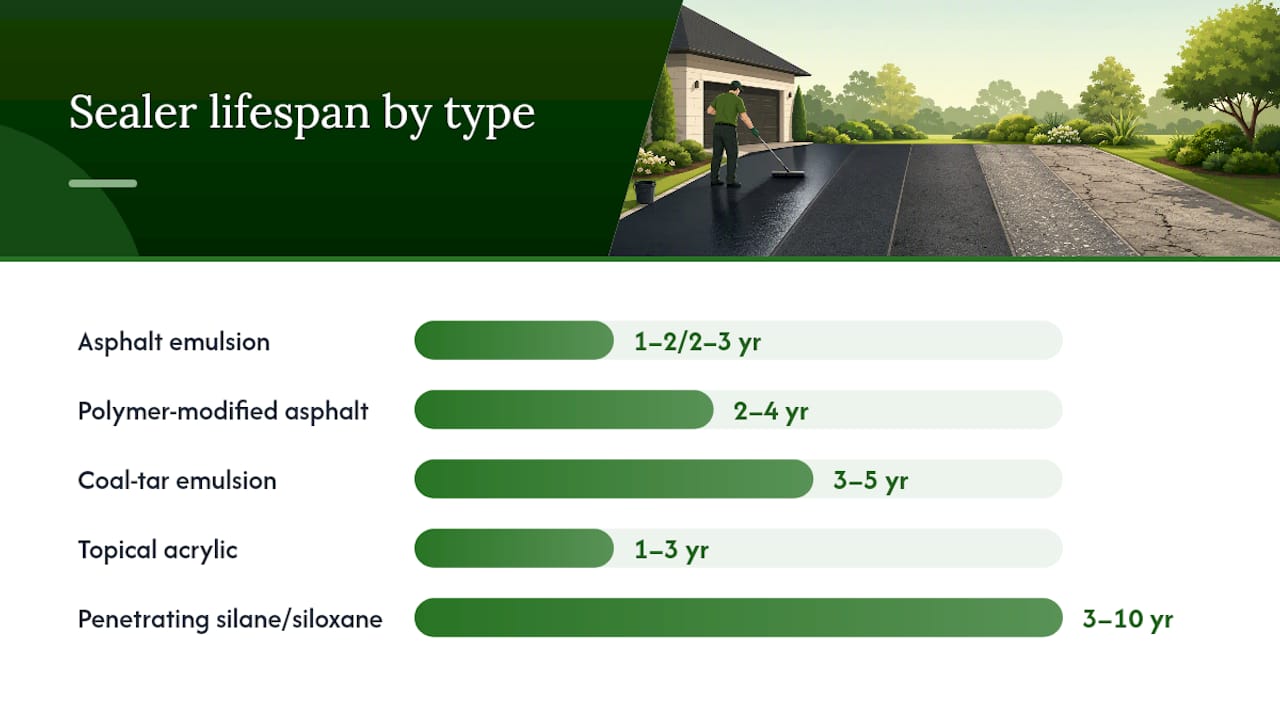
Penetrating silane/siloxane products commonly last 3–10 years depending on site conditions, while topical acrylics need reapplication far more often. The difference is structural: penetrating products bond inside the concrete matrix rather than sitting on top as a film.
For asphalt, the DIY vs. professional gap is significant. Consumer-grade DIY products typically last 1–2 years, while a professional two-coat commercial application delivers 2–4 years. Polymer additives and proper solids content are the main reasons.
A few points worth noting:
- Coal-tar emulsion is still sold in some Canadian markets but carries health and environmental flags (covered in the safety section below). Many professionals now default to polymer-modified asphalt emulsion instead.
- Single-coat DIY jobs applied too thin are the most common reason homeowners reseal every year rather than every two or three.
- Concrete sealer choice matters more than most people realise. A topical acrylic looks great on day one but can peel in freeze–thaw conditions if moisture gets trapped beneath the film.
What does your driveway surface tell you about resealing?
The most reliable reseal trigger is what you see and feel underfoot, not the date on your last invoice.
Visual checks to run each spring:
- Walk the full surface in good light. Grey or brown colouration where the driveway used to be black means the sealer binder has oxidised.
- Look for exposed aggregate. If you can see the stones in the asphalt mix clearly, the sealer film is gone.
- Check for hairline cracking in the sealer layer itself (not the asphalt beneath). A network of fine cracks, sometimes called sealer alligatoring, means the film has become brittle, often from oversealing or age.
- Scan for surface porosity: small pits or a rough, open texture mean moisture is getting direct access to the base material.
Functional tests:
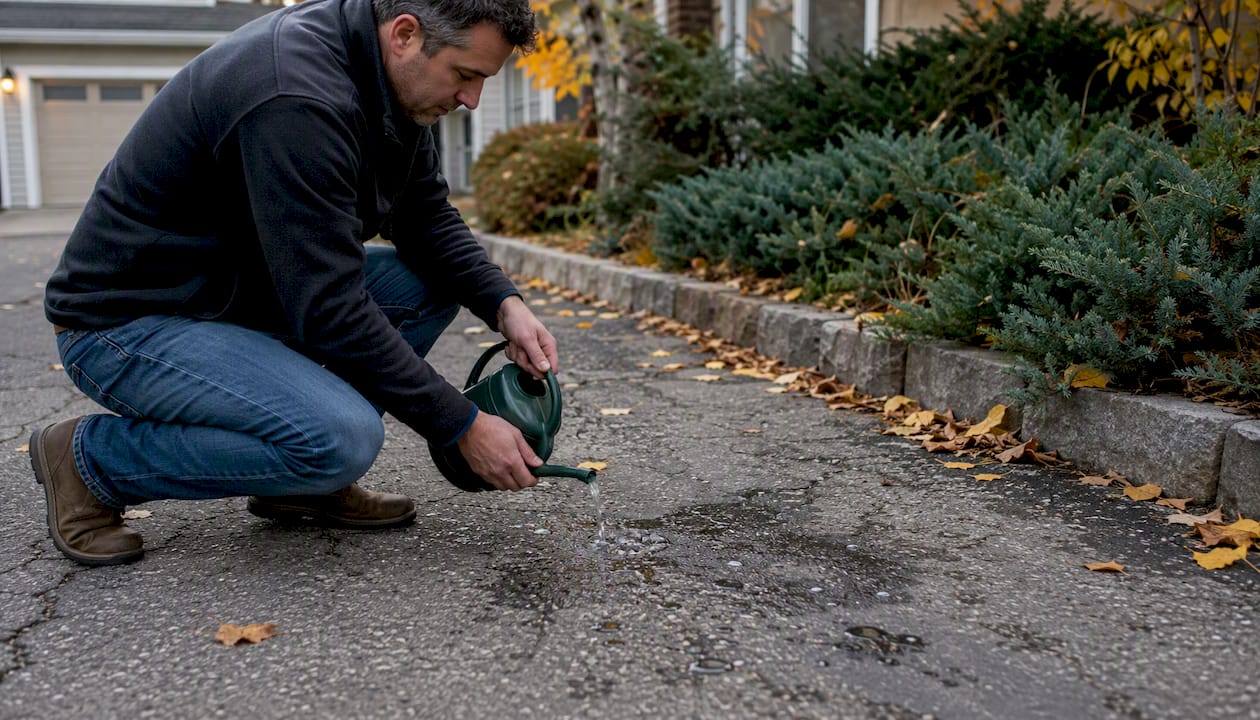
- Water-beading test: Pour a cup of water on the surface. If it beads and rolls, the sealer is still working. If it soaks in within a few seconds, the film is spent.
- Scuff check: Look for tyre marks or scuffs that won’t wash off. These indicate the sealer has softened or worn through in high-stress zones.
- Spot-press test: On a warm day, press your thumb firmly on a sun-exposed area. Softness or tackiness suggests the sealer has degraded or was applied too thick.
Pro Tip: Check the wheel paths and the apron at the garage entry first. These areas wear 2–3 times faster than the centre of the driveway. If the wheel paths have lost their sheen but the centre still looks fine, you can spot-treat those strips and defer a full reseal by a season.
Combining two or more of these signals gives you a much clearer picture than any single check. Fading alone in a shaded area might just be dust. Fading plus failed water-beading plus visible aggregate is a clear call to act. A spring inspection routine that takes 10 minutes can save you a full reseal job done a year too late.
What shortens sealer life faster than expected?
Understanding what accelerates wear helps you set a realistic reseal cadence rather than being surprised when a two-year-old seal looks five years old.
Climate factors (especially relevant in Calgary):
- Freeze–thaw cycles are the biggest culprit in most Canadian cities. Water infiltrates micro-cracks, freezes, expands, and pries the sealer film apart from below. Calgary’s chinook cycles, where temperatures swing dramatically in a single day, are particularly hard on surface coatings.
- Road salt and de-icers accelerate chemical breakdown of both asphalt binders and sealer films. Sodium chloride and calcium chloride are both corrosive to unsealed and thinly sealed surfaces.
- UV exposure oxidises the binder in asphalt emulsion sealers, turning them grey and brittle. South-facing driveways in Calgary’s high-altitude sun take a harder UV hit than most homeowners expect.
- Persistent moisture from poor drainage or shaded areas keeps the sealer film saturated, which softens it and promotes adhesion failure.
Traffic and use patterns:
- Heavy vehicles (delivery trucks, RVs, trailers) concentrate load on a small contact patch and shear the sealer film faster than passenger cars.
- Frequent tight turns and hard acceleration zones, like the apron in front of a garage, wear through sealer at a rate that can be double the flat driveway surface.
- Parked loads left in one spot for extended periods, especially in summer heat, can cause softened sealer to deform.
Application and prep faults:
- Sealing over oil or grease contamination prevents proper adhesion and creates soft spots that peel within months.
- Applying sealer to new asphalt before the oils have fully cured traps volatiles beneath the film and destabilises the surface. The recommended wait is 6–12 months for new asphalt.
- Over-dilution beyond manufacturer limits reduces the solids content and produces a thin, weak film. Some manufacturers void warranties if dilution exceeds 30–40%.
- Applying a new coat before the existing film has worn adequately builds up a brittle multilayer stack that alligators and peels.
Harsher freeze–thaw or heavy UV regions push the reseal interval toward 2 years rather than 3, which matches what most Calgary contractors recommend for exposed driveways.
When is the right time of year to seal your driveway in Canada?
Timing an application correctly is almost as important as choosing the right product. A sealer applied in the wrong conditions can fail within a single season.
Temperature rules:
- Most asphalt emulsion sealers require a minimum surface temperature of 10°C (50°F) and an air temperature that is rising, not falling.
- Overnight lows matter as much as daytime highs. If temperatures are forecast to drop below 5°C within 24 hours of application, the sealer will not cure properly.
- The upper limit is also real: applying on a surface above 35°C causes the sealer to dry too fast, leaving a brittle film with poor penetration.
- Concrete sealers, particularly penetrating products, have similar temperature floors. Check the manufacturer’s Technical Data Sheet (TDS) for the specific product.
Dry-window requirements:
- The surface must be completely dry before application. Allow at least 24–48 hours after any rain.
- After application, the surface needs 24–48 hours without rain for most asphalt emulsion products. Some commercial-grade products specify 48 hours minimum.
- In cool or humid conditions (common in Calgary’s shoulder seasons), extend that window. A sealer that looks dry on the surface may still be curing underneath.
- Keep foot traffic off for at least 24 hours and vehicle traffic off for 48–72 hours for most commercial products.
Seasonal timing for Canadian driveways:
- Best window: Late May through early September in most Canadian regions. This gives you warm nights, low humidity, and enough summer ahead for the sealer to fully cure before the first frost.
- Early fall (August to mid-September): Acceptable in Calgary if overnight lows stay above 10°C consistently. Avoid late September or October applications, as a hard frost within weeks of application can crack a partially cured film.
- Spring (April to May): Possible once overnight temperatures stabilise above 10°C, but Calgary’s late-spring snowfalls make April a gamble. Late May is safer.
- New asphalt: Wait the full 6–12 months regardless of season. Most residential driveways benefit from waiting closer to 12 months before the first seal.
Booking tip: Spring and early summer are the busiest periods for professional sealcoating in Calgary. If you want a contractor, book in March or April for a May or June application date. Waiting until July means competing with every other homeowner who had the same idea.
How much sealer do you need and what does it cost?
Getting the quantity right matters for two reasons: too little means thin coverage that fails early, and too much means wasted product or an over-thick film that alligators.
Coverage math for a typical two-car driveway:
A standard two-car driveway in Canada runs roughly 600 sq ft. At a mixed application rate of approximately 0.11–0.13 gallons per square yard per coat, that works out to roughly 75 sq ft per gallon per coat.
- 600 sq ft ÷ 75 sq ft/gal = 8 gallons per coat
- Two coats = 16 gallons total
- Standard pails are typically 4–5 gallons each, so you need approximately 4 pails for two coats on a 600 sq ft driveway.
Buy one extra pail. Driveways are rarely perfectly rectangular, and you will want material for touch-ups on the wheel paths in year two.
Typical cost ranges in Canada:
| Application type | Product cost (approx.) | Labour (if hired) | Total per job |
|---|---|---|---|
| DIY asphalt emulsion (2 coats) | $80–$150 | $0 | $80–$150 |
| Professional asphalt emulsion (2 coats) | Included | $200–$400 | $200–$400 |
| Professional polymer-modified (2 coats) | Included | $300–$600 | $300–$600 |
| Topical acrylic concrete sealer (DIY) | $60–$120 | $0 | $60–$120 |
| Penetrating silane/siloxane (professional) | Included | $400–$800 | $400–$800 |
These are approximate ranges for a standard residential driveway in Calgary. Larger driveways, crack repair, or degreasing add to the total.
A few things that affect your final cost:
- Solids content in the product directly affects durability. Higher-solids commercial products cost more per pail but last longer per coat.
- Dilution shortcuts that push beyond the manufacturer’s recommended ratio reduce film strength and shorten service life, effectively making a cheaper product even cheaper in the worst sense.
- Two-coat jobs always outperform single-coat applications on longevity, even when using the same product.
How to make each coat of sealer last as long as possible
The difference between a seal that lasts 18 months and one that lasts 3 years often comes down to what happens before and between applications.
- Fill cracks before you seal. Any crack wider than 6 mm (¼ inch) needs a proper crack filler, not just sealer poured over it. Sealer bridges small cracks but does not bond across larger ones. Unfilled cracks let water in, which freezes and widens the gap through winter.
- Degrease oil spots thoroughly. Petroleum-based contamination prevents sealer adhesion. Use a dedicated degreaser, scrub, rinse, and let the area dry completely before sealing. Sealing over an oil stain creates a soft, non-adhering patch that peels within months.
- Confirm the structure is sound. Sealer is a surface treatment, not a repair. Alligatoring in the asphalt itself (a network of interconnected cracks from base failure) means the driveway needs repair or repaving, not another coat of sealer. Sealing over structural failure wastes money and delays the inevitable.
- Apply two coats, not one. A single coat applied at the correct rate is better than two thin coats, but a proper two-coat commercial application at the right solids content consistently outperforms single-coat DIY work. Professional two-coat jobs deliver 2–4 years versus 1–2 years for consumer single-coat applications.
- Respect the cure time. Keep vehicles off for at least 48 hours after application. Driving on a partially cured seal embeds tyre marks and breaks the film before it has fully hardened.
- Clean oil and fuel spills promptly. Once the sealer is cured, treat it like a finished surface. Petroleum spills left to soak through the sealer film will eventually reach the asphalt binder beneath.
- Inspect each spring. A 10-minute walk in May, checking the wheel paths and the garage apron, catches small problems before they become expensive ones. Spot-fill any new cracks before winter.
Pro Tip: Resealing just the wheel paths and the high-wear apron strip, rather than the full driveway, can extend the time before a full reseal by one to two seasons. Use the same product and apply at the correct rate. The colour match won’t be perfect, but the protection will be.
The year-round property maintenance approach that works best for Calgary homeowners treats sealing as one part of a broader seasonal cycle, not a standalone event.
Health, environment, and Canadian regulatory considerations
Not all sealers carry the same risk profile. Product choice has real implications for your health, your household, and your municipality’s stormwater system.
Coal-tar emulsion: the key concern
Coal-tar sealers contain polycyclic aromatic hydrocarbons (PAHs) at concentrations far higher than asphalt-based alternatives. Public health literature links PAH exposure to elevated health risks, and coal-tar products have drawn regulatory scrutiny in North America as a result. The International Agency for Research on Cancer (IARC) classifies coal-tar pitch volatiles as a Group 1 carcinogen.
Coal-tar sealers release PAHs into the environment through runoff and dust, contaminating nearby soil, water, and indoor spaces tracked in on shoes. For residential driveways where children play and pets walk, the risk-to-benefit case for coal-tar is difficult to justify when asphalt-emulsion alternatives perform comparably.
Several U.S. municipalities have banned coal-tar sealers outright. In Canada, no national ban exists as of 2026, but some municipalities restrict or discourage their use. Check with your local municipality before purchasing.
VOCs and disposal:
- Solvent-based concrete sealers (some topical acrylics) carry higher VOC content than water-based products. Check the product’s Safety Data Sheet (SDS) before buying.
- Leftover sealer and contaminated rags are considered hazardous waste in most Canadian provinces. Do not pour unused product down a drain or into a storm sewer. Take it to a household hazardous waste (HHW) facility. Most Calgary residents can use the City of Calgary’s Eco Stations for this.
Worker and resident safety during application:
- Wear nitrile gloves, safety glasses, and old clothing. Sealer stains are permanent.
- Apply in a well-ventilated area. Do not seal in an enclosed space or directly against a garage door that is open to living areas.
- Keep children and pets off the surface for at least 24 hours after application, and longer for solvent-based products. The SDS will specify the safe re-entry window.
- Asphalt emulsion and polymer-modified products are generally lower-risk than coal-tar or solvent-based sealers, which is one reason professionals in residential settings increasingly favour them.
When should you hire a professional instead of doing it yourself?
DIY sealing is reasonable for a straightforward residential driveway in good condition. But there are situations where hiring a professional is the smarter call, and knowing the difference saves you money and frustration.
Signs that a professional is the better choice:
- The driveway is larger than 800 sq ft or has an irregular shape with multiple grades.
- There is visible structural cracking (alligatoring, edge crumbling, or base heaving) that needs assessment before sealing.
- Heavy vehicles use the driveway regularly and you want a commercial-grade two-coat application with a warranty.
- You have never done surface prep before and are unsure about degreasing, crack filling, or dilution ratios.
- You want the job done with proper traffic management, correct disposal of waste material, and a guarantee on the work.
What a professional brings that a DIY kit does not:
- Commercial-grade product with higher solids content than retail pails.
- Proper squeegee or spray application equipment that achieves consistent coverage rates.
- Experience identifying structural issues that make sealing premature or inappropriate.
- Correct handling and disposal of waste product in compliance with provincial requirements.
- A warranty or follow-up guarantee on the application.
The gap between a professional two-coat job and a consumer single-coat application is not just about the product. It is about surface prep, application rate, and knowing when not to seal. A professional who tells you the driveway needs crack repair first is giving you more value than one who seals over the problem.
For Calgary homeowners and property managers, Yearlong’s concrete cleaning and sealing services cover the full process: surface prep, degreasing, crack assessment, and two-coat commercial-grade application. If you manage multiple properties or an HOA, Yearlong also offers structured maintenance plans that schedule sealing as part of a broader seasonal cycle rather than a reactive one-off.
A sensible reseal rhythm for Canadian homeowners
The conventional advice to “reseal every year” is wrong for most driveways, and so is the opposite extreme of waiting until the surface looks destroyed. The right answer sits in the middle, and it is condition-based.
For a typical Calgary asphalt driveway, a 2–3 year baseline backed by an annual spring inspection is the most cost-effective approach. Run the water-beading test in May. Check the wheel paths. Fill any cracks wider than 6 mm before winter. If the surface passes the beading test and shows no visible aggregate, leave it alone. Resealing too often builds up a brittle multilayer film that eventually alligators and has to be stripped, which costs far more than a missed season.
Prevention is almost always cheaper than remediation. A $50 crack filler applied in spring costs a fraction of what it takes to repair a crack that has let water in through two freeze–thaw cycles. The same logic applies to sealing: catching the surface at the right moment, before the binder oxidises completely, extends the life of the underlying asphalt by years.
Yearlong handles driveway sealing in Calgary so you don’t have to
Yearlong has been maintaining Calgary properties since 2017, and concrete sealing is one of the services where local climate knowledge makes a real difference. Calgary’s freeze–thaw cycles, chinook swings, and high UV exposure mean the timing and product choices that work in Ontario or B.C. don’t always translate here.

Yearlong’s driveway sealing service includes surface cleaning and degreasing, crack assessment, and a two-coat commercial-grade application with a satisfaction guarantee. For property managers and HOAs, Yearlong also offers year-round maintenance packages that pair sealing with seasonal cleanups, so nothing falls through the cracks between seasons. Get a free estimate by contacting Yearlong directly through Yearlong.
Sources
The following sources were used to support this guide. They are worth bookmarking if you want to go deeper on product specs, application rates, or health considerations.
- How to Sealcoat a Driveway: Coverage, Cracks & Cost
- How Long Do Concrete Sealers Last?
- How Long Does Asphalt Emulsion Sealcoating Last?
- Ncbi
For regulatory and disposal guidance, check your provincial environment ministry and your local municipality for current rules on coal-tar products, VOC limits, and hazardous waste drop-off locations. In Calgary, the City’s Eco Stations accept leftover sealer and contaminated materials.
3 Responses