

Yes, salt accelerates concrete deterioration. It pulls moisture into the pores, changes how that moisture freezes, and can trigger chemical reactions that break the paste apart from the inside. The fix isn’t complicated: shovel before you salt, use less deicer than you think you need, and rinse residue off once temperatures allow. The mechanisms behind that damage, plus how to prevent and repair it, follow below.
TL;DR:
- Proper concrete mix design and full curing time significantly improve resistance to salt damage, especially against freeze-thaw cycles and chemical reactions.
- Sealers should be applied on schedule, with penetrating sealants lasting two to three years and surface coatings like polyurethane providing better salt protection.
- Salt damage typically manifests as scaling, spalling, pitting, or efflorescence, with visible cracks and exposed rebar indicating more severe deterioration.
- Cleaning and repairing minor damage with low-pressure washing and patching can extend lifespan, but structural issues require professional assessment and intervention.
- Professional sealing and maintenance are most effective when combined with proper winter habits, such as early snow removal and limiting deicer application to hotspots.
Table of Contents
- How salt damages concrete: freeze–thaw, chemical reactions, and salt weathering
- What salt damage looks like on a driveway or patio
- How to prevent salt damage before it starts
- How to fix salt-damaged concrete, and when to call a professional
- Yearlong’s approach to salt-damaged concrete in Calgary
- Why most salt-damage advice misses the real problem
- Get professional help before winter does more damage
- Sources
How salt damages concrete: freeze–thaw, chemical reactions, and salt weathering
Salt doesn’t just sit on a driveway looking messy. It gets absorbed into the concrete’s pore structure and changes how water behaves inside the slab.
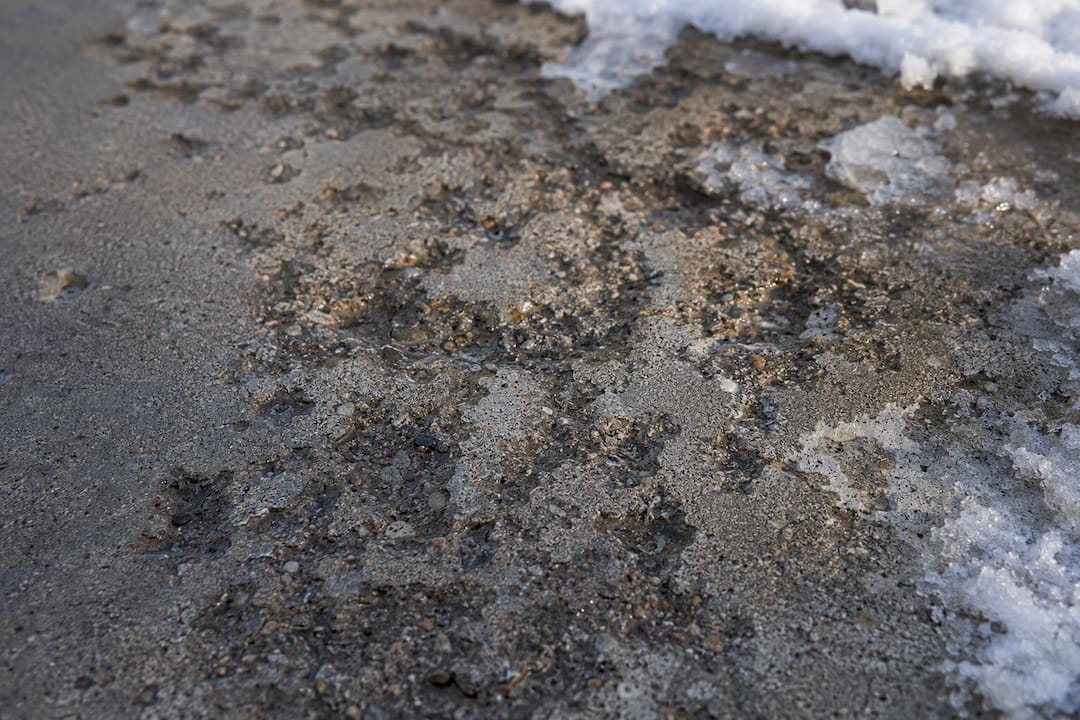
Physically, dissolved salt lowers the freezing point of water trapped in the pores, so the concrete cycles through freezing and thawing more times per winter than it would with plain water. Each cycle creates hydraulic and osmotic pressure inside the material, and that pressure builds micro-cracks that eventually surface as visible damage.
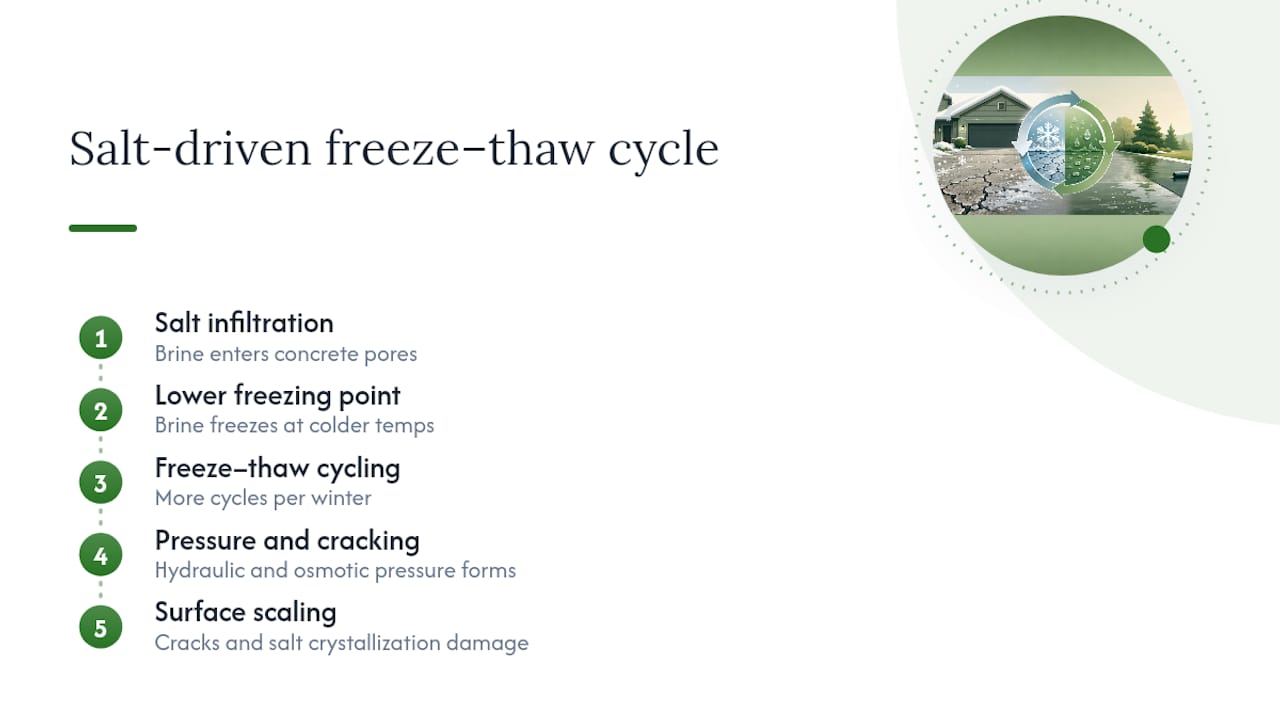
Chemically, it’s worse with certain products. Calcium chloride and magnesium chloride, both common in fast-acting deicers, can react with cement compounds to form calcium oxychloride and Friedel’s salt. These reaction products expand as they form, and that expansion pries the paste apart from within, independent of any freeze cycle.
Then there’s the wet-dry cycle. Salt solutions evaporate at the surface, leaving concentrated salt behind, which crystallizes and re-dissolves every time moisture returns. This concentrates stress right at the surface zone where scaling happens. Oddly, testing on deicing salt concentrationsmt.1943-5533.0001106) found that mid-range concentrations often cause worse surface scaling than very strong solutions, because dilute brine gets absorbed more readily before it freezes and expands.
The concrete itself matters just as much as the salt. Accelerated freeze–thaw testing found that higher-strength mixes held up dramatically better than weaker ones: C50 concrete survived roughly 160 freeze–thaw cycles compared with about 95 for C30, and adding 5% silica fume or 1% high-efficiency air-entraining agent improved scaling resistance substantially in both.
What salt damage looks like on a driveway or patio
Not every crack or discolouration is salt-related, but certain patterns are hard to mistake once you know what to look for.
- Scaling: thin flakes of the surface layer peel or flake away, exposing rougher, more porous concrete underneath. This differs from ordinary hairline cracking, which stays intact and shows no material loss.
- Spalling and pitting: chunks or small craters break out, often near joints or edges where moisture pools longest.
- Roughened texture and discolouration: the surface feels gritty or sandy underfoot and may look blotchy or lighter than surrounding concrete.
- White deposits (efflorescence): a chalky residue that rinses off easily usually means dissolved minerals migrating to the surface, not necessarily salt damage. If deposits return quickly after cleaning and the concrete underneath feels soft or crumbly, that’s a stronger sign of ongoing salt attack.
- Exposed rebar or deep, widening cracks: this signals the damage has moved past cosmetic. That’s your cue to get a professional assessment rather than patch it yourself.
How to prevent salt damage before it starts
Prevention works on two levels: what you do every winter, and what’s built into the concrete itself. Both matter, and neither substitutes for the other.
- Shovel and sweep first. Clear snow before it compacts, and sweep up leftover salt granules once the surface dries. Less salt sitting on the concrete means fewer wet-dry cycles working against it.
- Limit deicer to hotspots. Apply chloride-based products only where ice actually forms, such as shaded steps or slopes, rather than blanketing the whole driveway.
- Choose traction over volume. Sand or fine gravel gives grip without adding chemical load. If you do need a deicer, follow label rates and avoid stacking repeated heavy applications of calcium chloride or magnesium chloride on the same spot.
- Seal the surface. Penetrating sealers (silane or siloxane) soak into the pores and repel water without changing the surface look, typically lasting two to three years. Surface coatings like polyurethane or epoxy sit on top and form a physical barrier; lab simulations found polyurethane coatings held up better against salt and water penetration than some comparable coatings, making it a solid pick for high-exposure areas like driveway aprons.
- Check drainage. Water pooling at joints or low spots is exactly where wet-dry cycling concentrates. Slope should carry water away from joints, not into them, and joints themselves need to stay filled and clear rather than acting as reservoirs.
- Reseal on a schedule, not a guess. High-traffic driveways typically need resealing every two to three years; lower-traffic patios can stretch longer. Yearlong’s guide on driveway sealer lifespan breaks down how to judge when a reseal is actually due versus premature.
For anyone pouring new concrete or planning a replacement slab, the construction details matter more than any winter habit. ACI guidance consistently points to entrained air and low w/c ratios as the two most reliable levers against deicer scaling, and proper curing time locks in that resistance before the concrete ever meets its first winter.
Pro Tip: New concrete needs time before it can handle deicers. Avoid salting a fresh driveway or patio for at least its first winter or two. The slab is still gaining strength and closing off its pore structure, and salting it too early undoes a lot of that natural hardening.
How to fix salt-damaged concrete, and when to call a professional
Minor damage often responds well to cleaning and patching. Severe damage doesn’t, and trying to patch over structural problems usually wastes money.
- Cleaning first: rinse with plain water, or pressure-wash on a low setting to lift loose salt and grime. A poultice or mild cleaner handles efflorescence and salt staining without attacking the concrete itself. Yearlong’s guide to removing salt stains walks through the process step by step. Skip harsh acids on concrete that’s already weakened; they can eat into paste that’s barely holding together.
- Small patches: bonding primers and patching compounds work for shallow scaling or isolated spalls, but they’re a cosmetic fix with a limited lifespan if the underlying cause (drainage, sealing, deicer habits) isn’t addressed too.
- Resurfacing or overlays: broader scaling across a driveway or patio often calls for a thin overlay rather than dozens of individual patches, restoring a uniform surface at lower cost than a full tear-out; see Recent driveways & patios in Bristol for examples of resurfacing options.
- Full replacement: warranted when delamination runs deep or reinforcing steel has started corroding, since rust expands and cracks concrete from the inside regardless of what’s done to the surface.
- Call a professional when you see exposed rebar, cracks that keep widening season over season, or scaling that returns within a year of repair. That pattern usually points to a mix or drainage problem, not a one-off winter.
Cost depends heavily on area, depth of damage, and access. A small patch job runs far less than a full resurfacing, and both are cheaper than a repour that also needs to address the structural cause. Professional concrete cleaning before any repair also gives a clearer look at how far the damage actually extends, since salt stains can mask the true condition underneath.
Yearlong’s approach to salt-damaged concrete in Calgary
Calgary winters put concrete through more freeze–thaw cycles than most Canadian cities see in a season, which is exactly why Yearlong treats concrete cleaning and sealing as a year-round job, not a spring afterthought. Beyond the DIY resources above, Yearlong offers professional concrete sealing using products matched to local climate demands, plus pressure washing that clears salt buildup without damaging weakened surfaces.
Hiring a professional makes the most sense for new concrete needing its first proper seal, driveways or patios large enough that DIY sealing risks uneven coverage, or any surface showing repeat damage despite good winter habits. A professional assessment can also catch drainage or joint issues a homeowner might miss, which matters since those details often explain why one driveway scales badly while the neighbour’s holds up fine.
Why most salt-damage advice misses the real problem
Most guidance on this topic obsesses over deicer brand and application rate, and while that matters, it treats the symptom, not the cause. The research points somewhere less convenient: a lot of salt damage is baked in at the pour. Concrete with proper air entrainment, a tight water-to-cement ratio, and full curing time shrugs off the same winter that destroys a poorly mixed slab three doors down.
That’s the gap conventional advice leaves. Homeowners get told to buy a “concrete-safe” deicer and call it done, when the bigger lever, especially for anyone pouring new concrete or considering a full replacement, is demanding proper mix design and adequate cure time before that slab ever meets salt. Winter habits like shovelling early and sealing on schedule genuinely help, and they’re worth doing consistently. But they’re damage control on top of what the concrete itself was built to handle. Get the construction right first, then treat the winter tactics as maintenance, not rescue.
— Lewie
Get professional help before winter does more damage
Sealing and cleaning are two of the most cost-effective ways to add years to a driveway or patio, but they only work if they’re done right and on schedule, which is exactly where a lot of homeowners fall behind. Yearlong handles concrete cleaning and sealing as part of its year-round outdoor maintenance work across Calgary, alongside snow removal that keeps salt use down in the first place by clearing snow before it compacts into ice.

If your driveway or patio is already showing scaling or staining, start with a professional cleaning to see how much of it is surface residue versus real damage. And since salt exposure is a winter problem at its root, booking snow removal service now means less deicer on your concrete all season, which is one of the simplest ways to protect the investment you’ve already made in your driveway. Reach out to get a quote on cleaning, sealing, or seasonal snow service tailored to your property.
One Response