

Wait at least 28 days after a fresh pour before applying most conventional sealers, and never seal without a clear, dry weather window ahead. Cure-and-seal products are the exception since some can go down sooner, but check the manufacturer’s technical data sheet before assuming that applies to your product. Existing concrete needs a different test: clean, dry, and sound, not a calendar date. When timing gets tricky, a professional like Yearlong can confirm the slab is actually ready.
TL;DR:
- Wait at least 28 days after pouring concrete before sealing, unless a cure-and-seal product explicitly states a shorter application window.
- Test surface readiness with a plastic sheet, water droplet, or moisture meter before sealing, as cure times vary with weather and mix design.
- Seal new concrete during moderate temperatures between 10°C and 32°C and avoid applying just before rain or during extreme heat or cold.
- Use penetrating sealers for salt resistance and durability under winter conditions on driveways, while film-forming sealers suit decorative patios requiring appearance enhancement.
- Conduct professional inspections to accurately assess moisture levels, surface condition, and weather window suitability before sealing, especially for older slabs with stains or damage.
Table of Contents
- When to seal new concrete after pouring
- How do you know if existing concrete is ready for resealing?
- What’s the best weather window for applying sealer?
- Which sealer type fits your concrete?
- What are the most common concrete sealing mistakes?
- What does a professional inspection actually check?
- The 28-day rule is right, but it’s not the whole story
- Book a concrete sealing inspection with Yearlong
- Sources
When to seal new concrete after pouring
Curing and sealing are two separate processes, and confusing them is where most DIY sealing jobs go wrong. Curing is the slow chemical reaction that hardens concrete and drives out excess water. Seal too early and that trapped moisture has nowhere to go. The result is blushing, a hazy white film under the sealer, or outright adhesion failure where the coating peels off in sheets within weeks.
The industry benchmark is 28 days, and it’s not an arbitrary number. Concrete reaches roughly 60% of its compressive strength around that point, which is enough for the surface to handle a sealer without trapping problematic moisture, according to National Research Council Canada.
28-day milestone: Concrete hits about 60% of its full compressive strength by day 28, the point most sealer manufacturers use as their minimum wait time.
Cure-and-seal products are the notable exception. They’re formulated to go down sooner, sometimes within a week, but only when the manufacturer’s technical data sheet says so explicitly. Never assume one product’s early-application window applies to another, since general timing rules always defer to the product label.
Before you commit to a date, run a quick readiness check:
- Plastic sheet test: Tape a small sheet of plastic to the slab overnight. Condensation underneath means moisture is still escaping.
- Water droplet test: Splash water on the surface. If it beads and sits rather than soaking in evenly, the slab may still be too wet or already sealed elsewhere.
- Moisture meter: A reading below roughly 4% is a common threshold before certain sealers can go on, based on practical field tests.
Hot, dry, windy weather accelerates curing; cold or humid conditions stretch it out. A rich mix design with more cement also cures faster than a lean one, so two driveways poured the same week can be ready on different days.
How do you know if existing concrete is ready for resealing?
Older slabs don’t follow a calendar. Readiness comes down to condition, not age, and that means a short inspection before you buy a single can of sealer.
- Confirm the surface is clean. Oil, grease, dirt, and old coatings all block adhesion. Pressure washing or a degreasing treatment usually handles this.
- Check for efflorescence. That white, chalky residue is mineral salt pushed to the surface by moisture. It has to be removed, not sealed over, or the new coat will fail from underneath.
- Test for old sealer compatibility. Apply a small test patch. If it beads, fisheyes, or won’t bond, you’re dealing with an incompatible product and likely need to strip before recoating.
- Assess cracks and spalling. Hairline cracks and minor surface pitting can usually be spot-repaired. Wider cracks or crumbling edges need proper patching first, or the sealer will just highlight the damage.
- Let it dry fully. After pressure washing, give the slab 24 to 48 hours to dry depending on humidity and sun exposure, per general concrete prep guidance.
Pro Tip: If you’re unsure whether stains will lift with cleaning alone, treat efflorescence and salt staining as separate problems from grease. Salt residue often needs a specific rinse-and-neutralize approach, not just a pressure washer.
What’s the best weather window for applying sealer?
Temperature controls how well a sealer bonds and cures, and it’s the single most common reason DIY sealing jobs fail. Most products perform best when both air and surface temperatures sit between 10°C and 32°C (50°F to 90°F). Below that range, curing slows and bonding weakens. Above it, the sealer can flash dry before it forms a proper film, leading to bubbling or a cloudy finish, according to W. R. Meadows.
Temperature window: 10°C to 32°C is the working range most manufacturers specify. Outside it, bonding problems become far more likely.
You also need a dry-weather runway, not just a dry day. Most sealers require at least 24 hours without rain after application, and some technical data sheets call for 48, since curing depends on solvent or water evaporating cleanly.
A few scheduling habits make a real difference:
- Skip peak afternoon heat in summer. Early morning application keeps the surface cooler and slows flash drying.
- Avoid applying late in the day if nights are dropping below 10°C, since the sealer may not finish curing before the cold sets in.
- Check the extended forecast, not just tomorrow’s, since a stray afternoon shower two days out can undo the whole job.
In most regions, late spring and early fall offer the most reliable stretches of moderate temperatures and lower rain risk, which is why those seasons book up fastest for professional crews.
Which sealer type fits your concrete?
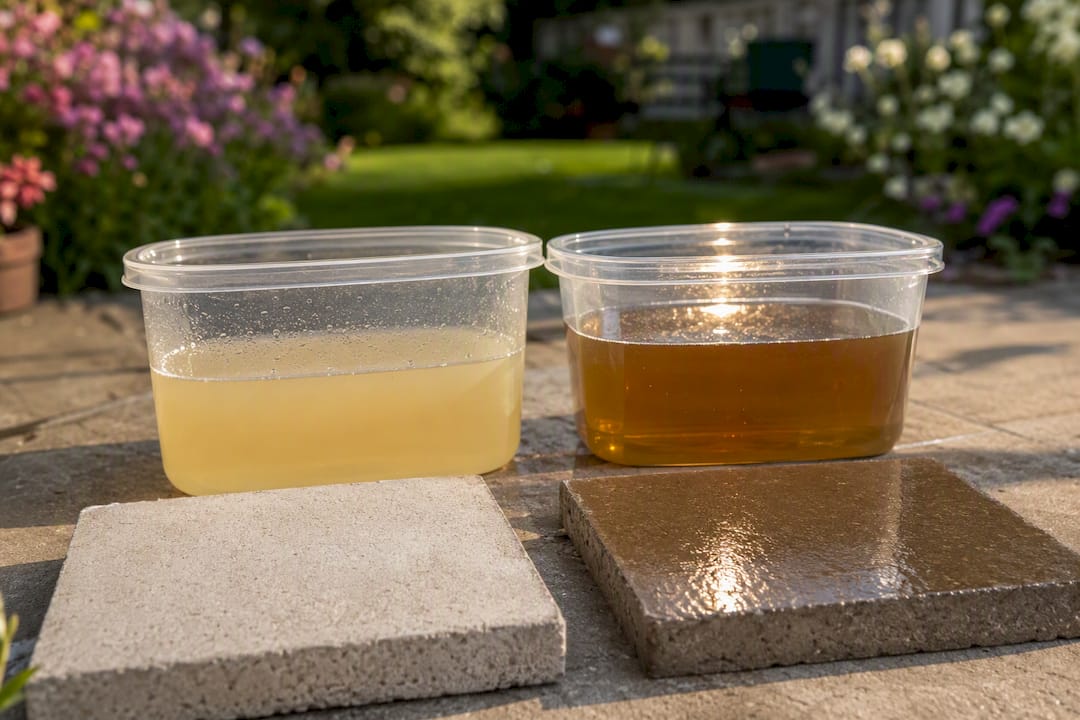
Not all sealers behave the same way, and picking the wrong family for your surface causes more timing headaches than any weather mistake.
Penetrating sealers soak into the concrete’s pores rather than sitting on top. They preserve a natural look, let the slab breathe, and handle freeze-thaw cycles well, which makes them a strong pick for driveways exposed to winter deicing salt.
Film-forming sealers, usually acrylic-based, sit on the surface and enhance colour with a light sheen. They’re common on decorative or stamped patios where appearance matters, but they trap moisture more than penetrating products and generally need that full 28-day cure window before application.
Coating systems like epoxy and polyurethane are the heavy-duty option, typically reserved for garage floors that see vehicle traffic and chemical spills. These often require a longer, stricter cure and surface prep, so check the guidance on coating older concrete before assuming your slab is ready.
Matching sealer to use matters as much as timing:
- Driveways: penetrating sealers for salt resistance, or film-forming acrylics for a refreshed look.
- Stamped or decorative patios: film-forming sealers to protect colour and pattern definition, following approaches that hold up on decorative concrete.
- Garage floors: epoxy or polyurethane coatings for durability under tires and tools.
- Exposed aggregate: penetrating sealers that highlight texture without leaving a glossy film.
Reseal frequency follows the same split. Penetrating sealers often last 3 to 5 years, while film-forming acrylics typically need reapplication every 1 to 3 years depending on traffic and UV exposure, based on driveway sealing cost and lifespan comparisons.
What are the most common concrete sealing mistakes?
Bad timing shows up on the surface eventually, and the symptoms usually point straight back to the mistake that caused them.
- Hazing or a white film almost always means moisture was trapped underneath, usually from sealing too soon after a pour or a wash.
- Bubbling or fisheyes point to temperatures that were too hot, causing the sealer to flash dry before it could level out.
- Peeling within months signals poor surface prep, an incompatible old sealer left in place, or rain hitting before the cure finished.
Resealing too often causes its own problems. Stacking coat after coat without stripping the old layer first leads to a thick, brittle film that loses adhesion and can peel in sheets. Check how long a given sealer type should realistically last before adding another coat out of habit.
Pro Tip: If a small test patch peels, bubbles, or hazes within 48 hours, stop. Strip that section and reassess, rather than finishing the whole driveway and discovering the same failure everywhere.
As a rule of thumb: for new concrete, hold to 28 days unless the product label says otherwise; for existing concrete, judge the surface, not the season.
What does a professional inspection actually check?
Yearlong’s crews run through the same core checklist on every job before a drop of sealer goes down:
- Moisture check on the slab, using surface tests rather than guessing based on how long it’s been since the pour or the last rain.
- Visual scan for efflorescence, oil staining, and hairline cracking that needs attention first.
- Adhesion test patch to confirm compatibility with any existing sealer.
- Weather window confirmation against the extended forecast, not just the day of the job.
Calgary properties bring their own recurring issues: salt stains from winter deicing, efflorescence on shaded north-facing slabs that never fully dry out, and stamped patios where the wrong sealer flattens the pattern’s contrast. DIY sealing works fine for a small, simple patio slab with no visible staining or cracking. Once salt damage, efflorescence, or decorative finishes are involved, a professional inspection usually saves more in redo costs than it charges upfront.
The 28-day rule is right, but it’s not the whole story
The 28-day guideline earns its place because it’s grounded in actual concrete chemistry, not superstition. But treating it as the only variable that matters is where a lot of homeowners get tripped up. I’ve seen plenty of guides that repeat the common guideline of about 28 days, recognizing that curing time varies based on concrete mix and local weather conditions.
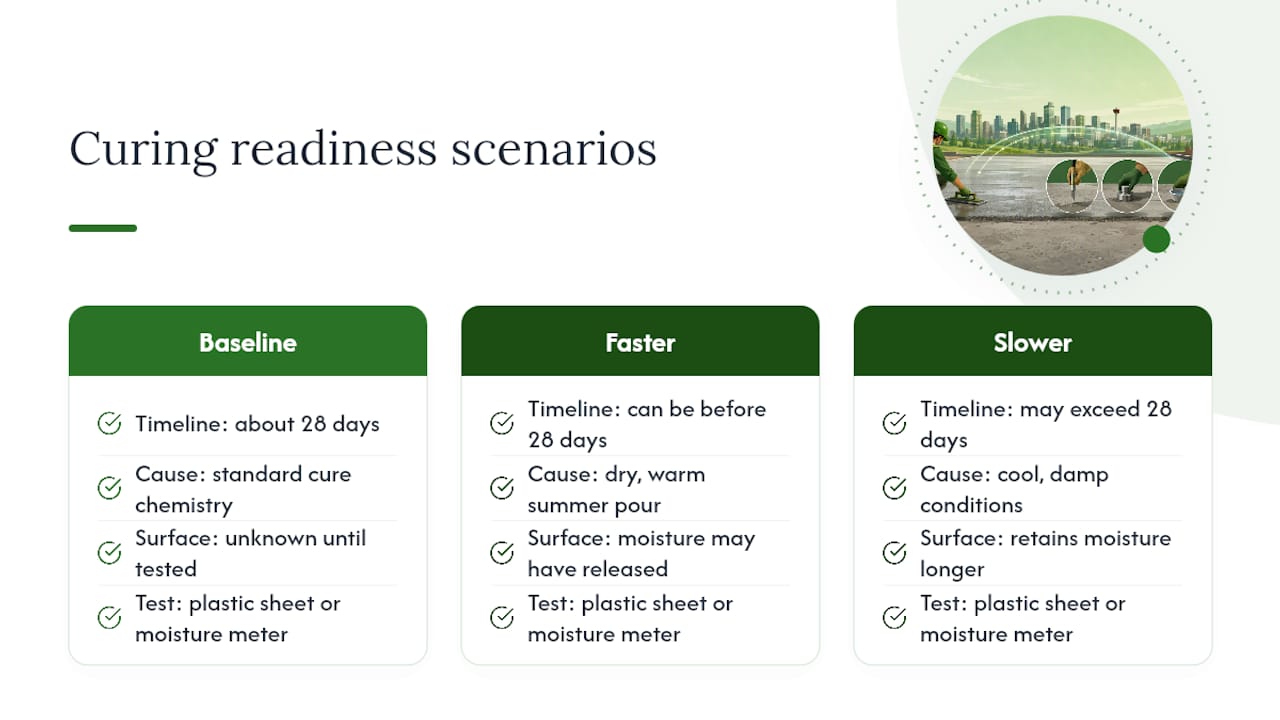
What the evidence actually supports is a two-part rule: respect the cure timeline as a floor, then let surface condition and weather set the actual date. A slab poured in a dry, warm July can be genuinely ready before day 28 in terms of moisture release, but you’d never know that without a plastic sheet test or a moisture meter. Conversely, a slab poured into a cool, damp September might need longer than 28 days regardless of what the calendar says.
The real priority for homeowners isn’t memorizing a number. It’s building the habit of testing before sealing, every time, on new pours and old slabs alike.
— Lewie
Book a concrete sealing inspection with Yearlong
Skipping the guesswork is the real advantage of hiring it out. Yearlong tests moisture, checks the forecast, and matches the right sealer to your slab instead of you having to run plastic sheet tests and hope the weekend stays dry. Every job comes with a satisfaction guarantee, which takes the risk out of getting the timing wrong on your own.

Booking is straightforward: a quick inspection to check surface condition and moisture, a written quote, then scheduling within the next reliable dry weather window Calgary’s forecast offers. Spring and early fall book up fast because those are the seasons when temperature and rain line up best, so getting on the calendar early matters more than most homeowners expect. Visit the concrete sealing page to request an inspection and see current availability for your property.
Sources
- National Research Council Canada — publication on concrete curing and strength
- W. R. Meadows — guidance on acrylic sealer application temperatures and timing
- ConcreteCalculate — comprehensive how-to on sealing concrete
5 Responses