

Reseal stamped concrete in Calgary regularly every few years, and never skip the prep. That single rule prevents most of the damage homeowners blame on “bad sealer” or “bad weather.” High-traffic driveways lean toward the shorter end of that window; sheltered patios can last longer between resealing. The real risk isn’t the reseal itself. It’s applying new sealer over a failing one, or reaching for rock salt and a metal shovel the first time it snows.
TL;DR:
- Reseal stamped concrete in Calgary every 2 to 3 years for driveways and high-traffic areas, and every 3 to 4 years for patios with penetrating sealers.
- Apply sealer during stable, dry weather in late spring or early fall, avoiding temperatures below 10°C and rain to prevent early failure.
- Use a moisture meter to confirm the surface is fully dry before sealing, as surface dryness can be misleading when moisture is trapped underneath.
- Regularly clean surfaces in spring and summer to prevent staining and remove de-icer residue, and avoid metal shovels and rock salt during winter to prevent damage.
- Reapplication of sealer on schedule is significantly cheaper and more effective than costly repairs and full restoration after neglect.
Table of Contents
- How often should you reseal stamped concrete in Calgary?
- How do you know your stamped concrete sealer has failed?
- What’s the right seasonal cleaning and winter care routine?
- Should you choose a penetrating or film-forming sealer?
- Which stamped concrete tasks are safe to DIY?
- What does Calgary-specific stamped concrete maintenance look like?
- How do you prevent stains and efflorescence in Calgary’s climate?
- How do Calgary’s freeze-thaw cycles affect long-term maintenance?
- Why maintenance beats waiting for a full redo
- Get your stamped concrete sealed and protected before winter
- Sources
- FAQ
How often should you reseal stamped concrete in Calgary?
Stamped concrete maintenance in Calgary runs on a shorter clock than most homeowners expect. A driveway or entryway pad sees vehicle weight, boot traffic, and de-icing chemicals, so it wears through its protective layer faster than a patio tucked behind the house.
Here’s the breakdown most Calgary contractors work from:
- Driveways and high-traffic pads: reseal every 2 to 3 years, based on local resealing timelines for exterior slabs.
- Patios and low-traffic walkways: 3 to 4 years is realistic if you’re using a penetrating sealer.
- New concrete pours: wait 30 to 60 days before sealing at all, giving the slab time to cure and release excess moisture.
Timing the job matters as much as the schedule itself. The sweet spot is a stable stretch of late spring or early fall, with daytime temperatures sitting around 10°C to 25°C and no rain in the forecast for at least 24 hours. Sealer applied below 10°C, or right before a rain system rolls in, tends to fail early through hazing, blistering, or poor adhesion, a pattern Calgary sealing guides consistently flag. Skipping sealing altogether through a Calgary summer isn’t a shortcut either. Sun exposure and heat accelerate colour fade and surface stress on unprotected stamped concrete.
If you’re staring at a brand new pour and wondering when the clock starts, use the 28-day cure guidance as your baseline, then confirm with a simple moisture test before committing to a sealing date.
How do you know your stamped concrete sealer has failed?
Sealer failure rarely announces itself with a dramatic crack overnight. It shows up in smaller, easy-to-miss signals first, and catching them early saves you from a much bigger repair bill.
Watch for these signs:
- Water stops beading. Splash some water on the surface. If it soaks in instead of forming beads, the sealer’s protective barrier is gone.
- Colour looks dull or chalky. UV exposure breaks down the topcoat, leaving a faded, powdery finish instead of the original sheen.
- Flaking or peeling patches appear. This usually means moisture got trapped under the sealer, or the last coat went on too thick.
- New pitting or hairline cracking shows up. This can point to something deeper than sealer wear, more on that below.
If you see peeling, mechanical stripping is not optional. Applying fresh sealer over a failing layer just traps the problem underneath, and you’ll be back to peeling within a season, a failure pattern confirmed by concrete sealer specialists. Strip first, always.
Before any reseal job, whether you’re doing it yourself or hiring it out, run through this order of operations:
- Degrease any oil or rust stains with a concrete-safe cleaner.
- Power-wash gently to lift grit, dirt, and old de-icer residue without eroding the surface.
- Fill and repair any cracks so moisture can’t work its way underneath the new coat.
- Inspect the substrate for sinking, unevenness, or widespread dusting.
- Let the surface dry fully, ideally 24 to 48 hours in dry weather, before applying anything.
Pro Tip: Skip the garden hose test and use a moisture meter if you have access to one. Stamped concrete can look bone dry on the surface while holding trapped moisture underneath, and sealing over that guarantees a hazy finish.
What’s the right seasonal cleaning and winter care routine?
Stamped concrete care in Calgary follows the seasons more than any calendar reminder. Spring is cleanup season. Summer is stain response. Winter is damage prevention, full stop.
Every spring, once the snow’s gone and the ground has dried out, give your stamped concrete a proper power-wash. This clears out the sand, grit, and leftover de-icer residue that built up over winter, all of which grinds away at your sealer if left sitting. Keep the pressure moderate. Aggressive settings can strip sealer or chew into a surface that’s already weakened.
Through summer, deal with oil drips, food spills, and tannin stains from leaves the day you spot them. A concrete-safe degreaser and a full rinse usually handle it. Left to set, those same stains can etch into the sealer and become permanent.
Winter is where most Calgary stamped concrete actually gets damaged, and it’s almost always preventable:
- Use sand or fine traction grit instead of rock salt or calcium chloride.
- Skip metal-edged shovels entirely, since they scratch sealer and chip stamped pattern edges.
- Use a plastic-bladed shovel, and lift snow rather than scraping it.
Rock salt and calcium chloride accelerate surface degradation on sealed decorative concrete, and metal shovel edges leave scratches that show up as dull streaks the following spring, based on winter care guidance for stamped concrete. One winter of rock salt can undo two years of careful sealing. For a step-by-step approach to keeping surfaces intact through snow season, our guide to removing salt stains from concrete covers what to do if damage already happened.
Should you choose a penetrating or film-forming sealer?
This decision shapes your entire maintenance schedule going forward, so it’s worth getting right the first time rather than switching sealer families every few years.
Penetrating sealers, the silane and siloxane types, soak into the concrete rather than sitting on top of it. They’re breathable, which matters enormously in a freeze-thaw climate like Calgary’s because trapped moisture is what causes blistering and pitting. They also barely change the surface appearance, so if you like your stamped concrete’s natural look, this is the safer long-term pick. Reapplication sits around every 3 to 5 years, based on durability data for Calgary decorative concrete.
Film-forming sealers, acrylics and urethanes, sit on the surface and create that glossy, wet look that makes stamped colour patterns pop. The trade-off is a shorter lifespan, typically 1 to 2 years, and a real risk of peeling if the prep work was rushed or the concrete had residual moisture. Contractors in Calgary often reach for film-forming sealers specifically because a client wants that wet-look finish, not because it’s a mistake. It’s a conscious appearance-versus-maintenance trade, not an error in judgment.
Here’s how they stack up side by side:
| Sealer type | Reapply every | Appearance | Freeze-thaw risk |
|---|---|---|---|
| Penetrating (silane/siloxane) | 3 to 5 years | Natural, low sheen | Low, breathable |
| Film-forming (acrylic/urethane) | 1 to 2 years | Glossy, colour-enhanced | Higher, can trap moisture |
If your stamped concrete surrounds a pool, sits near steps, or gets wet often, slip resistance matters as much as sealer type. Broadcasting fine grit or mixing polymer sand into the sealer before it cures adds real traction without changing the pattern’s look.
Pro Tip: Test any anti-slip additive on a small, hidden patch first. Grit ratios that look fine in the bucket can turn gritty or uneven once cured across a full driveway.
Which stamped concrete tasks are safe to DIY?
Some of this work is genuinely fine to handle yourself. Some of it isn’t, and getting that distinction wrong is how a small maintenance job turns into an expensive repair.
Tasks you can reasonably tackle on your own:
- Regular sweeping and debris removal to keep grit from grinding into the sealer.
- Spot-cleaning fresh spills before they set into stains.
- Light recoats on small, structurally sound areas where the old sealer is worn but not peeling.
- Seasonal power-washing, as long as you’re using moderate pressure and the right nozzle.
Call a professional when you’re dealing with:
- Mechanical stripping of failed or peeling sealer across a large area.
- Full driveway resealing, since it needs to handle vehicle weight and traffic wear evenly.
- Substrate repairs like sinking sections, growing cracks, or uneven settling.
- Colour restoration work that needs to match an existing stamped pattern.
Sinking slabs that pool water, visible height differences at crack lines, and cracks that keep expanding are signs of a substrate problem, not a sealer problem, and Calgary concrete specialists note that these need diagnosis before any reseal makes sense. No amount of sealer fixes a base that’s failing underneath.
Before hiring anyone, ask what stripping method they use, which sealer they’d recommend for your specific slab, whether they offer a satisfaction guarantee, and how much Calgary-specific winter experience they actually have. That last question matters more than it sounds. A contractor who’s only worked in milder climates may not account for our freeze-thaw cycles properly.
What does Calgary-specific stamped concrete maintenance look like?
Generic sealing advice written for a milder climate misses the details that actually matter here. Calgary swings from summer heat spikes to hard winter freezes within the same calendar year, and that swing is what wears down stamped concrete faster than almost anywhere else in the country.
The pattern is consistent across seasons: jobs scheduled around the weather window last longer than jobs squeezed in on a tight timeline. Planning a reseal for a stable stretch of late spring or early fall, rather than whenever a contractor happens to have an opening, is one of the simplest ways to extend a sealer’s working life. New pours need that 30 to 60 day cure window respected, no exceptions, before any sealer goes down.
A practical Calgary-specific plan looks like this:
- Book resealing for late May through early June, or mid-September through early October, when temperatures and moisture levels are most predictable.
- Treat winter as damage-prevention season, not maintenance season. Save the heavier work for spring.
- Pair your reseal with a proper strip-and-clean if the old coat shows any flaking, rather than patching over it.
- Set a recurring reminder tied to your specific surface type, driveway on the shorter cycle, patio on the longer one.
Some concrete services cover mechanical strip-and-reseal, stain removal, and recurring maintenance packages built around this kind of seasonal planning, sometimes backed by a satisfaction guarantee. For homeowners who’d rather not track cure windows and weather forecasts themselves, that’s exactly the gap this kind of local service fills.
How do you prevent stains and efflorescence in Calgary’s climate?
Efflorescence, that white, powdery residue that shows up on concrete, is caused by mineral salts migrating to the surface as moisture evaporates. Calgary’s freeze-thaw cycles make this worse than in milder climates because water gets pulled in and pushed out of the concrete’s pores repeatedly through the colder months, carrying dissolved minerals with it each time.
A properly applied penetrating sealer reduces how much moisture gets into the slab in the first place, which limits efflorescence before it starts. Once it appears, though, sealing over it doesn’t fix anything. It needs to be removed with a mild acidic cleaner or a specialty efflorescence remover before any new sealer goes down, otherwise you’re locking the discolouration in permanently.
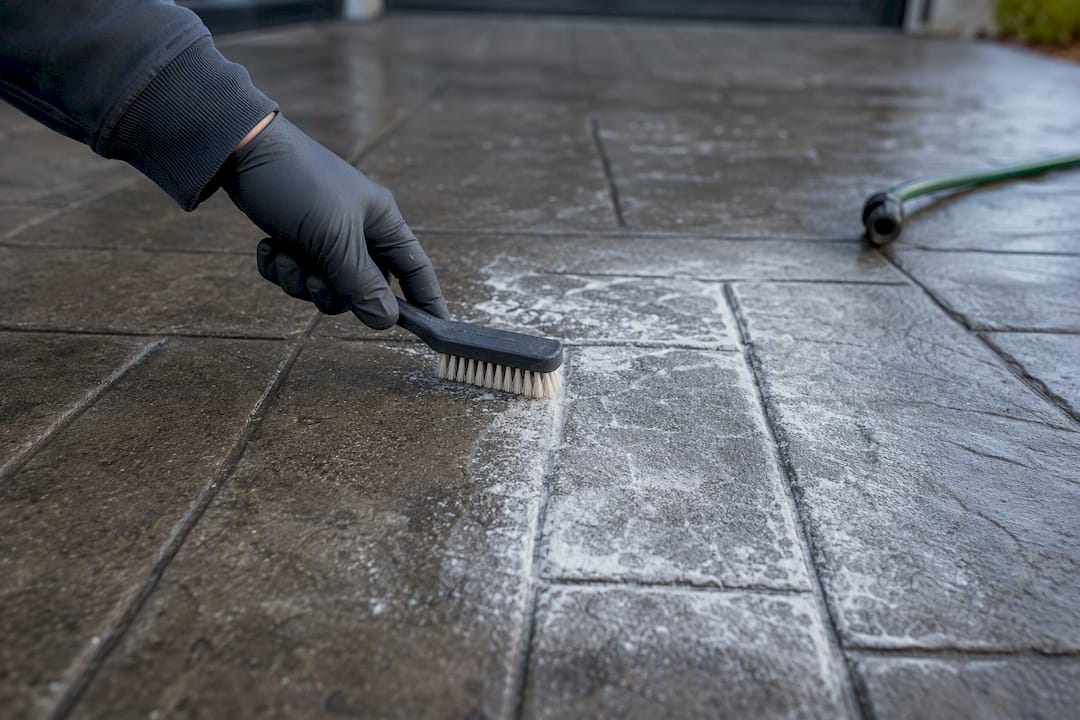
Stains follow a similar logic. Oil, rust, and tannin stains from leaves or mulch all set faster on Calgary concrete during the shoulder seasons, when the surface is damp from melting snow or fall rain and more porous than usual. Catching a spill within a day or two, rather than waiting for a dry weekend to deal with it, is the difference between a five-minute cleanup and a permanent discolouration you’re stuck disguising with a darker sealer tint.
Rock salt residue deserves its own mention here since it’s so specific to this climate. Salt tracked in from sidewalks or driveways leaves a chalky white film that looks a lot like efflorescence but is really just mineral buildup from de-icer. A thorough rinse after every salt exposure prevents that residue from working into the surface over a full winter.
How do Calgary’s freeze-thaw cycles affect long-term maintenance?
Calgary can swing from above zero to well below freezing within a single week, sometimes within a single day thanks to chinook winds. That’s the real driver behind why stamped concrete maintenance schedules here run shorter than in most of the country.
Water that gets into hairline cracks or under a compromised sealer expands when it freezes, then contracts again as temperatures rise. Repeated dozens of times over a winter, that cycle widens small cracks into bigger ones and lifts sealer at the edges where it’s already thin. This is why a sealer that looks perfectly fine in October can show visible wear by March, even without any single dramatic weather event causing it.
Over several years, unmanaged freeze-thaw stress shows up as three things: surface pitting where water pooled and froze repeatedly, network cracking that spreads outward from an original small crack, and colour fading concentrated at slab edges where moisture exposure is highest. None of these are cosmetic-only problems. Each one gives water a new entry point, accelerating the next winter’s damage.
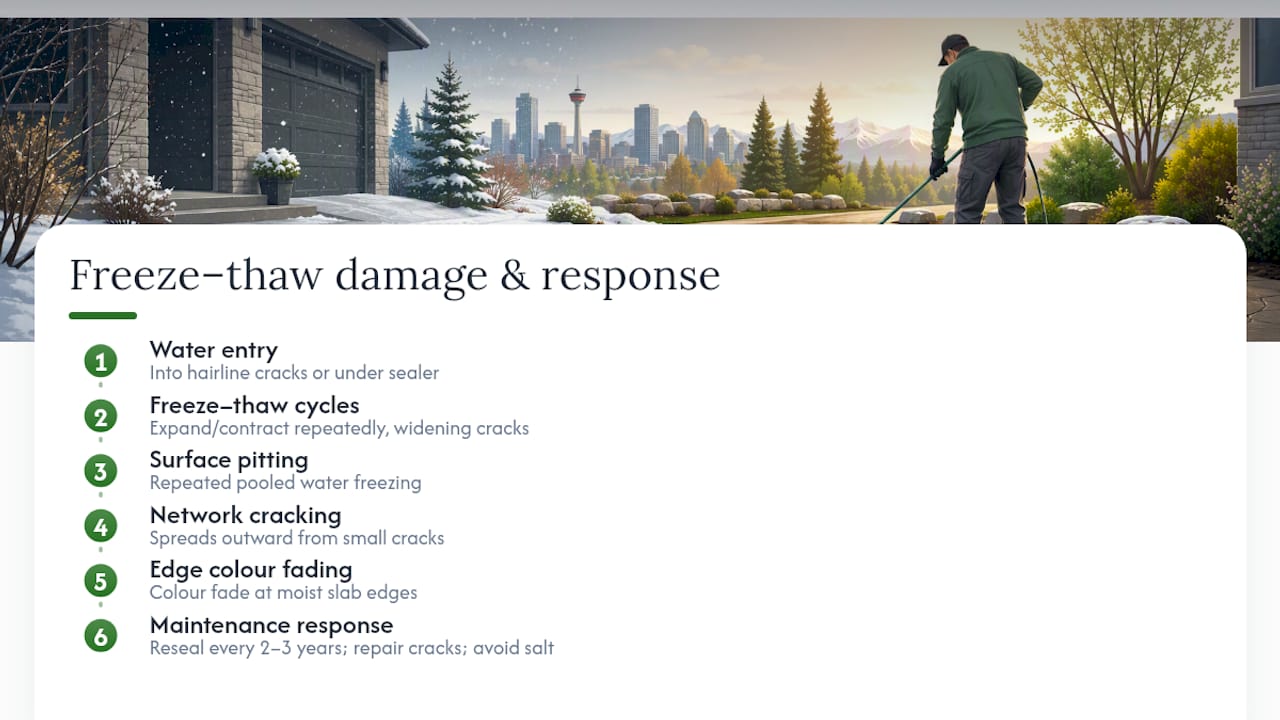
The defence against this isn’t a stronger sealer. It’s a shorter, more consistent maintenance cycle. Staying on the 2 to 3 year reseal schedule for driveways, addressing cracks the season they appear rather than waiting, and keeping salt off the surface entirely does more to protect stamped concrete long term than any single premium product. Calgary’s climate punishes neglect faster than it punishes an average sealer choice.
Why maintenance beats waiting for a full redo
Most homeowners I talk to about stamped concrete think about sealing as a one-time investment they can forget about for a decade. That mindset is exactly backwards, and it’s the single most expensive assumption in this whole topic.
A slab resealed on schedule every 2 to 3 years costs a fraction of what it takes to strip, repair cracking, and fully restore colour on a slab that’s been ignored for eight or ten years. The math isn’t close. Small, regular maintenance wins every time over waiting for visible failure and then doing a full rework.
The other underrated factor is timing knowledge specific to this city. Calgary’s weather doesn’t follow a tidy calendar, and a sealer applied during a lucky warm stretch in March can outperform one applied on a “correct” date that happened to see rain roll in. Reading the local forecast matters as much as reading the manufacturer’s spec sheet.
— Lewie
Get your stamped concrete sealed and protected before winter
Professionals can handle tracking cure windows, weather forecasts, and sealer families for Calgary properties. Beyond sealing, the crew covers concrete cleaning, mechanical strip-and-reseal for surfaces with failing sealer, colour restoration for faded stamped patterns, and recurring maintenance packages that keep your schedule on track without you having to remember it.

When you request a quote, ask specifically what prep steps are included (stripping, degreasing, crack repair), which sealer family they’re recommending for your slab and why, what weather window they’re planning around, and whether the work comes with a satisfaction guarantee. Those four questions separate a contractor who’s actually accounting for Calgary’s climate from one running a generic playbook.
Stamped concrete cleaning and sealing services in Calgary often include packages for both one-off resealing jobs and ongoing seasonal upkeep. Book an inspection through the concrete sealing service page to get a schedule and quote built around your specific driveway or patio, or explore the full guide to sealing stamped concrete in Calgary for more detail before you commit.
Sources
- Concrete Services Calgary : Sealing Guide to Protect Slab
- How to fix concrete sealer
- How often should I seal my stamped concrete?
FAQ
What is the downside of stamped concrete?
Stamped concrete needs more frequent sealing than plain concrete, roughly every 2 to 3 years for driveways in Calgary, and it’s more visibly affected by chips, salt damage, or peeling sealer because the pattern and colour make imperfections stand out.
How much would a 20×20 stamped concrete patio cost?
Pricing varies significantly based on pattern complexity, colour work, and site prep, and isn’t consistently published across Calgary contractors, so the most reliable number comes from a direct quote for your specific site and design.
How much does it cost to reseal stamped concrete?
Reseal pricing depends on square footage, sealer type chosen, and whether mechanical stripping is needed first, since stripping and repairing a failing surface adds meaningfully more labour than a straightforward recoat on sound sealer.
Who are the best concrete contractors in Calgary?
Look for a contractor with documented Calgary winter experience, a clear stripping and prep process, and a satisfaction guarantee. Yearlong specializes in concrete cleaning and sealing services across Calgary with exactly that focus.
How do I know if my stamped concrete needs resealing or full repair?
If water stops beading and colour looks dull, that’s typically a resealing job. If you see sinking sections, growing cracks, or height differences at crack lines, that points to a substrate problem needing repair before any sealer is applied.