

TL;DR:
- Implementing a structured, seasonal maintenance checklist helps HOAs ensure consistent outdoor care, accountability, and legal protection. Calgary’s climate demands post-storm inspections and proactive tasks to prevent costly damage and liability issues. Proper documentation, contractor management, and expert support are essential for sustainable community outdoor space management.
Managing outdoor spaces for an entire community is one of the most demanding responsibilities an HOA board takes on. When maintenance gaps appear, the consequences range from unhappy residents and faded curb appeal to costly property damage and serious liability exposure. Calgary’s climate adds a sharp edge to this challenge, delivering heavy snowfall, freeze-thaw cycles, and unpredictable spring storms that can undo months of careful upkeep overnight. This article gives your board a practical, structured approach to year-round outdoor maintenance, so nothing gets missed and your community stays protected in every season.
Table of Contents
- Why a structured, seasonal maintenance checklist is indispensable
- Common outdoor maintenance challenges for Calgary HOAs
- Essential outdoor maintenance tasks for every season
- How to ensure accountability and reduce liability risk
- The uncomfortable truth about HOA outdoor maintenance no one talks about
- Get expert help for your HOA’s outdoor maintenance needs
- Frequently asked questions
Key Takeaways
| Point | Details |
|---|---|
| Use seasonal checklists | Systematic checklists keep outdoor maintenance on track year-round. |
| Document everything | Thorough records boost accountability and protect your HOA from legal risk. |
| Address Calgary’s climate | Plan for local weather, including snow, storms, and rapid seasonal shifts. |
| Prioritise communication | Share schedules and updates with all board members and contractors. |
| Partner with experts | Reliable professionals ensure consistent quality and peace of mind. |
Why a structured, seasonal maintenance checklist is indispensable
Having set the stage for why maintenance matters, let’s explore why structure is your most critical tool.
Most HOA boards handle outdoor maintenance reactively. Something breaks, someone complains, the board scrambles to fix it. This approach is expensive, stressful, and leaves real vulnerabilities. A structured, seasonal checklist flips that model entirely.
A formal maintenance checklist creates consistency, accountability, and protection for your association. Consistency means the same tasks happen on the same schedule, season after season. Accountability means every completed and outstanding task is documented and reviewable by the full board. Protection means your maintenance records become evidence if a liability claim is ever filed against the association. That last point is something many Calgary HOA boards underestimate until it is too late.
Checklists also make budget planning dramatically easier. When you know exactly what tasks are required in each season, you can forecast costs, collect appropriate maintenance fees, and avoid the unpleasant surprise of emergency repairs draining your reserve fund.
Here is a snapshot of how a checklist-based approach compares to informal maintenance management:
| Factor | Checklist-based system | Informal system |
|---|---|---|
| Task completion rate | High and consistent | Variable and unreliable |
| Documentation quality | Detailed and reviewable | Sparse or non-existent |
| Liability protection | Strong | Weak |
| Budget predictability | Accurate | Unpredictable |
| Continuity during board changes | Maintained | Often lost |
Key benefits of a seasonal checklist system include:
- Task ownership: Every item is assigned to a responsible party, whether a board member or a contractor.
- Deadline clarity: Seasonal timelines prevent tasks from drifting into the wrong period.
- Contractor management: Written schedules hold service providers accountable to agreed timelines.
- Audit trail: A running record makes annual reviews and insurance conversations straightforward.
You can explore seasonal property care examples specific to Calgary’s climate to start building your first checklist. A detailed lawn maintenance checklist is also a practical starting point for the warmer months, while a broader review of outdoor cleaning service types will help you identify gaps in your current programme.
Common outdoor maintenance challenges for Calgary HOAs
Now that you know the impact of structured maintenance, understand the key issues that make it vital for Calgary HOAs.
Calgary HOAs face a specific set of pressures that boards in milder climates simply do not encounter. Recognising these challenges is the first step to designing a maintenance system that actually holds up.
Board member turnover and contractor variability are two of the most disruptive forces in HOA maintenance. When a long-serving board treasurer steps down, they often take years of informal knowledge with them. Which contractor repaired that section of fencing? When was the irrigation system last inspected? Without documented schedules and records, that institutional memory disappears entirely. A checklist approach preserves it in writing, regardless of who is currently sitting on the board.
Calgary’s weather is a maintenance multiplier. A single harsh winter event, a sudden chinook followed by a deep freeze, can crack concrete, block storm drains, and damage tree limbs in a matter of hours. If your maintenance programme does not account for post-storm inspections and rapid response, small problems become expensive ones quickly. A well-developed property upkeep workflow that includes trigger-based tasks (tasks that activate after specific weather events) dramatically reduces the risk of storm-related damage escalating.
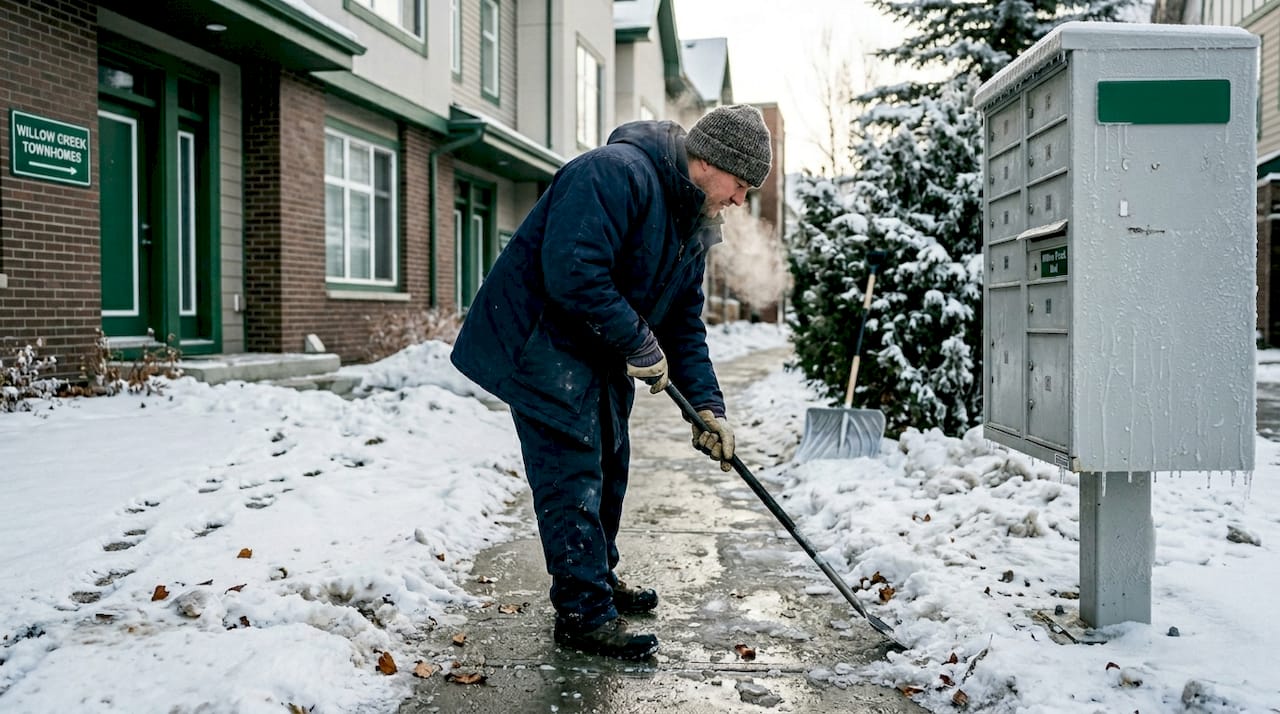
Unaddressed tasks also create compounding costs. A gutter that overflows in autumn because no one cleared it of leaves can cause foundation damage by spring. A pathway crack left unsealed through winter widens under frost heave and becomes a tripping hazard. The benefits of outdoor maintenance are not just aesthetic. They are financial and legal.
Here is a comparison of common maintenance challenges and their best-practice solutions:
| Challenge | Risk if ignored | Best-practice solution |
|---|---|---|
| Board member turnover | Lost task history | Documented checklists shared digitally |
| Post-storm damage | Escalating repair costs | Scheduled post-event walk-throughs |
| Contractor variability | Inconsistent service quality | Written scope of work with sign-off |
| Seasonal task slippage | Safety hazards and liability | Calendar-based maintenance reminders |
Follow these steps to get ahead of the most common HOA maintenance pitfalls:
- Build a shared digital maintenance log accessible to all active board members.
- Assign a dedicated maintenance liaison to manage contractor communication.
- Review and update your checklist at the start of every season.
- Schedule a post-storm inspection within 48 hours of any significant weather event.
- Keep dated records, including photographs, of all completed work.
“Boards that document nothing are boards that have no defence when something goes wrong. A simple written record can be the difference between a resolved claim and a costly lawsuit.”
Pro Tip: Use a free shared spreadsheet or property management app to log completed tasks in real time. This is one of the simplest and most effective accountability tools available to any HOA board.
Essential outdoor maintenance tasks for every season
With challenges in mind, let’s get specific about what Calgary HOAs should do year-round.
Calgary’s four seasons each demand a distinct set of outdoor maintenance actions. Missing the right task in the right window can create problems that persist for months.
Spring tasks
Spring in Calgary can feel rushed. The ground thaws quickly, residents start using outdoor spaces, and everything needs attention at once. Seasonal risk reduction begins with clearing gutters and storm drains of winter debris before the first major rainfall. Left blocked, these systems back up and direct water toward foundations, walkways, and landscaping.
Key spring tasks include:
- Clear all gutters, downspouts, and storm drains of sand, leaves, and ice debris.
- Inspect and start irrigation systems, checking for winter damage to lines and heads.
- Remove remaining winter debris, including sand, gravel, and dead plant material, from lawn and bed areas.
- Survey pathways, curbs, and steps for frost heave damage or new cracking.
- Check and reseed any bare or damaged lawn patches.
Pro Tip: Schedule your spring irrigation inspection before mid-May so any repairs can be completed before the dry season begins. Calgary summers can arrive quickly, and a non-functioning irrigation system puts lawns under immediate stress.
You can find more detail on spring yard clean-up essentials to build out your spring checklist further.
Summer tasks
Summer is about maintaining what spring set up. The main objectives are lawn health, bed appearance, and ongoing safety inspections.
- Mow common areas on a regular schedule, adjusting frequency based on rainfall and growth rate.
- Edge all lawn borders, pathways, and curb lines for clean, professional appearance.
- Fertilise lawns according to a programme suited to Calgary’s soil composition.
- Inspect and refresh mulch in all garden beds to retain moisture and suppress weeds.
- Trim overhanging branches near pathways and lighting fixtures.
Well-maintained summer grounds directly support resident satisfaction and property values. Your board can reference these lawn care tips for more targeted guidance on common area turf management.
Fall tasks
Fall is arguably the most critical season for HOA maintenance. What you do in September and October directly affects how your community weathers the next five months.
- Complete full leaf removal from lawns, drains, and pathways to prevent slipping hazards and blocked drainage.
- Aerate and overseed lawns to support root recovery after summer use.
- Cut back perennial plantings in all common beds.
- Drain and winterise irrigation systems before the first hard frost, typically in October for Calgary.
- Service and test all snow removal equipment before the first snowfall.
- Prune trees and remove any dead or structurally compromised branches before winter storms can bring them down.
Winter tasks
Winter in Calgary is not a slow season for outdoor maintenance. It is one of the most demanding.
- Clear snow from all pathways, entries, and parking areas promptly after every significant snowfall.
- Apply sand or ice melt to high-traffic areas immediately after freezing rain or freeze-thaw events.
- Inspect entry points and stairways after each storm for ice accumulation.
- Monitor drainage areas during chinooks for ice dam formation.
How to ensure accountability and reduce liability risk
After understanding seasonal tasks, focus on sustaining process and accountability.
Completing tasks is only half the work. The other half is proving they were completed. This distinction matters enormously when an incident occurs and your HOA is asked to demonstrate due diligence.
A maintenance checklist creates consistency and documented accountability that boards can rely on when facing insurance reviews or legal questions. Without records, “we always do that” is an unverifiable claim. With records, it becomes a defensible fact.
Practical steps to build a strong accountability and documentation system:
- Maintain both digital and paper records of all maintenance activities. Cloud-based logs are accessible and timestamped. Paper backups add redundancy.
- Photograph completed work at least monthly. Before-and-after images are particularly useful for seasonal changeovers.
- Schedule post-storm walk-throughs within 24 to 48 hours of any weather event. Log findings and any corrective actions taken.
- Share checklists with all board members and active contractors at the start of each season. Transparency reduces misunderstandings and missed handoffs.
- Hold a quarterly maintenance review meeting to assess what was completed, what slipped, and what needs adjustment going into the next season.
“Documentation is not bureaucracy. For an HOA board, it is your most practical tool for protecting the association and the residents you serve.”
Detailed property care tips can help your board identify which tasks most benefit from formal documentation based on risk level and frequency.
The uncomfortable truth about HOA outdoor maintenance no one talks about
With practical processes covered, it’s time for a reality check drawn from local experience.
Here is something most articles on this topic will not say plainly: the majority of HOA outdoor maintenance failures are not caused by a lack of effort. They are caused by a lack of system. Boards try hard. Volunteers show up. Contractors are hired. But without a disciplined, transparent process, effort alone does not protect your community.
The pattern we see repeatedly across Calgary properties is this: a board inherits a loose informal system from the previous group, things seem fine for a season or two, then a key board member leaves or a contractor is swapped out, and suddenly nobody knows what was done last fall, which company handled that pathway repair, or whether the storm drains were cleared after the last major snowfall. One unlogged event becomes a pattern, and before long, the property is operating on guesswork.
The ripple effect of small missed tasks is real and it compounds. A single icy walkway incident can result in legal costs that dwarf a full year’s maintenance budget. A gutter overflow that damages a fence line is suddenly a contractor dispute and an insurance claim rather than a routine repair. And when the board cannot produce records showing regular upkeep, your association’s credibility in those conversations is undermined from the start.
Real accountability means the checklist is a living document, not a document that gets created in January and forgotten by March. It means every board member can pull up the maintenance log and see exactly what was completed last week. It means your contractors know they will be asked to confirm completed work in writing.
Shortcuts feel efficient in the moment. Informal systems feel easier when the board is stretched thin. But they break down at exactly the worst times, during leadership transitions, contractor disputes, and insurance events. The boards that master outdoor cleanup strategies and formalise their maintenance programmes consistently outperform those that rely on memory and good intentions.
Get expert help for your HOA’s outdoor maintenance needs
With the right system in place, the final step is ensuring you’re supported by experts year-round.
Building a solid maintenance programme is a strong foundation, but partnering with reliable professionals makes it sustainable. YearLong Property Maintenance has been serving Calgary communities since 2017, with deep local knowledge of the seasonal demands your association faces.

From professional lawn care that keeps common areas looking their best through the growing season, to attentive bed maintenance services that preserve your landscaping investment, to dependable Calgary snow removal that keeps pathways safe all winter, YearLong offers flexible service packages built around your community’s specific needs. Our satisfaction guarantee and consistent year-round coverage mean your board can focus on governance, not groundskeeping. Contact us to discuss a maintenance programme designed for your HOA.
Frequently asked questions
What are the biggest risks when HOAs skip outdoor maintenance tasks?
The biggest risks are costly property damage, increased liability exposure, and unsightly grounds that lower property value. A formal maintenance checklist is the most direct way to prevent these outcomes through consistent documentation and accountability.
How can HOAs in Calgary reduce the impact of harsh winters on outdoor spaces?
Proactive snow removal, timely inspections, and off-season preparation are key to preventing winter damage. Seasonal storm readiness tasks such as clearing drains and inspecting structures before the cold season significantly reduce emergency repair costs.
What should be included in an HOA’s outdoor maintenance checklist?
Include mowing, bed upkeep, debris removal, gutter cleaning, seasonal inspections, and snow and ice management. A structured HOA checklist ensures your programme is consistent and covers all risk areas across every season.
How does effective documentation help HOAs avoid legal claims?
Documented maintenance records provide proof of diligence and can reduce the HOA’s liability if an accident occurs on common property. As the HOA maintenance guidance confirms, maintenance records serve directly as evidence in liability claims.