

TL;DR:
- Proper yard maintenance reflects your brand’s standards and enhances curb appeal for your commercial property.
- Implementing measurable standards, scheduled inspections, and clear contracts ensures consistent, high-quality outdoor care.
Your commercial property’s exterior is the first thing clients, partners, and potential customers see. For business owners, yard maintenance is not a weekend hobby. It is a direct reflection of your brand, your standards, and how seriously you take your operation. Yet most business owners are stretched thin, and outdoor upkeep often slides to the bottom of the list until something embarrassing forces the issue. This guide gives you the practical strategies you need to keep your commercial property looking sharp, stay compliant, and get real value from every dollar spent on outdoor care.
Table of Contents
- Key takeaways
- What makes yard maintenance work for business owners
- 1. Master mowing with the one-third rule
- 2. Water efficiently and at the right time
- 3. Fertilise strategically, not conveniently
- 4. Understand pesticide compliance before you spray
- 5. Set a maintenance schedule that fits your landscape type
- 6. Write clear contracts and SOPs for outsourced care
- My take on what actually drives results in commercial yard care
- Keep your commercial property looking its best with Yearlong
- FAQ
Key takeaways
| Point | Details |
|---|---|
| Follow the one-third mowing rule | Never remove more than one-third of the blade at once to reduce turf stress and weed pressure. |
| Time your fertilizer applications | Apply fertiliser during dry weather using phosphorus-free products to protect local waterways. |
| Build measurable service standards | Use documented performance benchmarks in any contract to avoid disputes and gaps in care. |
| Schedule maintenance by landscape type | Weekly visits suit formal lawns while low-input gardens may only need monthly attention. |
| Licence and label compliance matter | Restricted-use pesticides require licensed applicators and strict label adherence by law. |
What makes yard maintenance work for business owners
Effective yard maintenance for business owners is not about doing the most work. It is about doing the right work, at the right time, with measurable results. Before you hire a crew or set up a schedule, you need clear performance standards.
Consider these criteria when planning your commercial property’s outdoor care:
- Mowing height and frequency: Your lawn type dictates the correct cutting height. Mowing too short opens the turf to weed invasion and drought stress.
- Environmental compliance: Fertiliser and pesticide applications must meet local regulations. Runoff from commercial properties is heavily scrutinised.
- Cost-efficiency: Over-servicing is as wasteful as neglect. Know what your property actually needs each season.
- Curb appeal benchmarks: Set a visual standard and document it with photos. This gives contractors a clear target and gives you proof when standards slip.
- Documentation: A written service log protects you legally and operationally. Track every visit, task completed, and product applied.
Pro Tip: Take a photo of your property at peak condition and use it as the baseline standard in your service agreement. Contractors perform better when “good enough” has a visual reference.
For Calgary business owners, local climate knowledge is non-negotiable. A commercial property maintenance guide specific to the region will save you from applying Alberta-inappropriate practices borrowed from warmer climates.
1. Master mowing with the one-third rule
Mowing sounds straightforward until you see what happens to turf that gets cut wrong for two seasons straight. Mowing more than one-third of the leaf blade at one time stresses the turf and directly increases weed problems. This is not a guideline. It is a physiological reality.
For commercial properties with high foot traffic or formal entrances, cutting too aggressively during spring recovery or after a missed week creates patchy, stressed turf that takes weeks to recover. If your lawn has gotten long between visits, plan a recovery schedule with gradual height reductions rather than a single hard cut.
Changing mowing patterns each visit also reduces soil compaction and turf wear, which matters on commercial lawns that see consistent foot traffic. Alternate diagonal, horizontal, and vertical passes across the same area.
Pro Tip: Sharp mower blades provide clean cuts that reduce grass tip damage and visible whitening. Dull blades tear the grass rather than cut it, leaving the lawn looking stressed even after a fresh mow. Inspect blade sharpness before every commercial job.
2. Water efficiently and at the right time
Irrigation is one of those things that looks like it is working until it suddenly is not. For business owners, the cost of overwatering is not just on the water bill. It shows up in fungal disease, compacted soil, and a lawn that needs constant recovery.
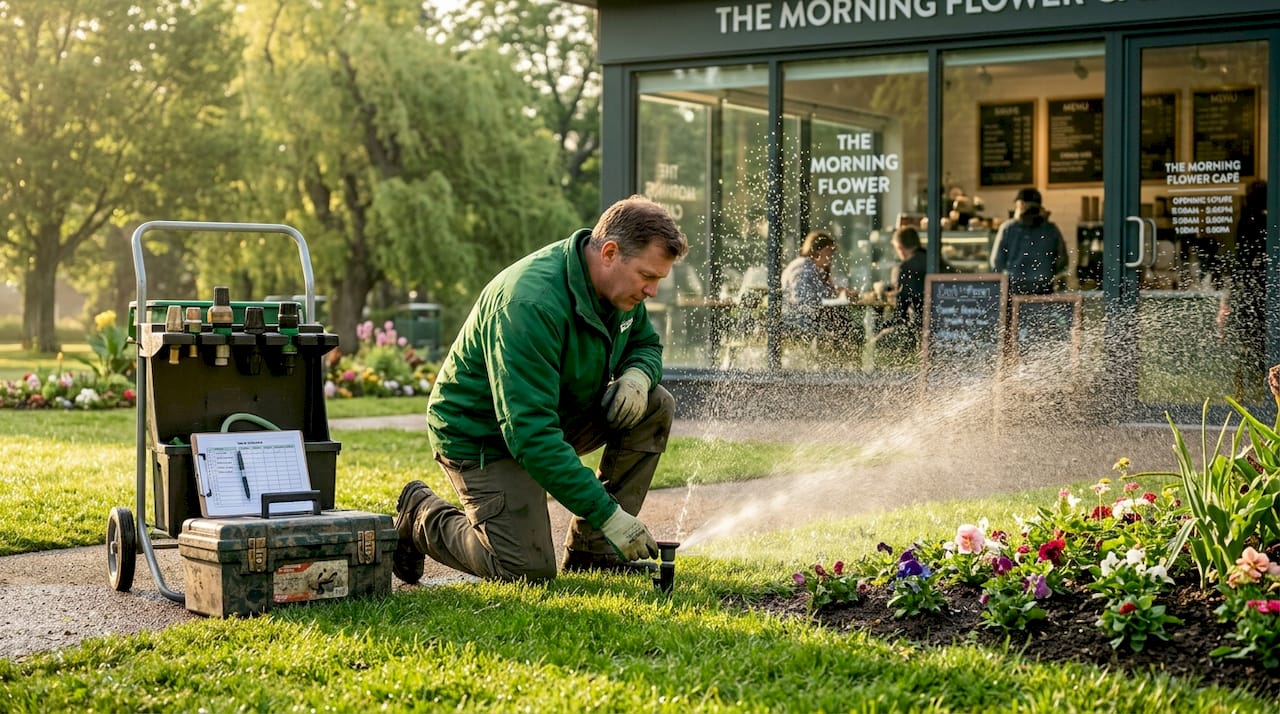
Water early in the morning, roughly once every 7 to 10 days, applying enough to reach 6 to 8 inches of soil depth. Nighttime watering is one of the most common mistakes on commercial properties. It leaves moisture sitting on the turf through the cool hours, creating ideal conditions for disease.
An irrigation survey should be part of any commercial landscaping services contract you sign. Coverage gaps, broken heads, and inefficient timing are extremely common on commercial properties that have grown incrementally over the years.
3. Fertilise strategically, not conveniently
Walk into any hardware store in spring and you will find bags of “weed and feed” products promising to handle two jobs at once. The University of Illinois Extension advises against these combined spring products for cool-season lawns. Weed control and fertilising require different timing windows. Combining them means one task gets done at the wrong time, reducing the effectiveness of both.
For commercial properties, the environmental stakes are also higher. Excessive phosphorous and nitrogen from lawn fertiliser can contribute to harmful algae blooms in local waterways. Applying fertiliser per label during dry weather, and using phosphorus-free products where appropriate, is standard practice in responsible property upkeep for businesses.
Avoid fertilising early in spring before the soil has warmed. Nutrient uptake is poor in cold soil, and the product washes off into stormwater rather than feeding the turf. Time your applications correctly and you will get better results with less product.
4. Understand pesticide compliance before you spray
This is where many business owners create serious risk without realising it. Restricted-use pesticides require applicator licensing. The pesticide label is a legally enforceable document, not a suggestion. Using the wrong product, applying it at the wrong rate, or hiring an unlicensed contractor to do it creates regulatory exposure for your business.
For business yard care, here is what to get right:
- Verify your contractor’s licence. Before any chemical application on your property, confirm the applicator holds the appropriate provincial or state licence for commercial grounds maintenance.
- Read the label together. Walk through the product label with your contractor before the first application. Confirm target pests, application rates, and buffer zone requirements.
- Document every application. Keep a log of what was applied, when, at what rate, and by whom. This is your protection if a complaint or incident arises.
- Choose products aligned with your brand values. A medical clinic, childcare centre, or food business has different risk tolerances than a warehouse. Align your pest control programme to your business context.
Pro Tip: Ask contractors for proof of pesticide applicator insurance as well as their licence. Liability exposure from improper chemical applications on commercial property can be significant.
5. Set a maintenance schedule that fits your landscape type
Not every commercial property needs weekly visits. Not every property can survive on monthly care. The right maintenance frequency depends entirely on your landscape type, the season, and the standards your business requires.
| Landscape type | Recommended frequency | Key seasonal focus |
|---|---|---|
| Formal lawn with high visibility | Weekly | Spring recovery, summer irrigation, fall aeration |
| Mixed beds and borders | Fortnightly | Weeding, pruning, edge maintenance |
| Low-input or drought-adapted garden | Monthly | Weed control, mulch topping, seasonal cleanup |
| Large commercial grounds with turf and trees | Weekly to fortnightly | Mowing, tree inspection, pest monitoring |
The table above gives you a starting framework. Adjust it based on how quickly your grass grows, how much foot traffic the area receives, and what your clients and visitors actually see first.
Seasonal intensives are separate from routine visits. Spring and fall cleanups, deep-bed edging, and pre-winter fertilising are scheduled additions that sit outside your regular cadence. Treat them as fixed line items in your seasonal yard care budget rather than optional extras.
6. Write clear contracts and SOPs for outsourced care
If you are hiring a landscaping contractor rather than managing it in-house, the contract is your most important tool. Vague agreements lead to vague results. Performance-based service agreements with measurable work standards are what separate consistently maintained properties from ones that look great one week and neglected the next.
Your service scope should include:
- Specific mowing heights for each turf area
- Edging and waste removal expectations after each visit
- Irrigation system survey requirements and frequency
- Soil testing and pest control inspection intervals
- Documentation and sign-off requirements per visit
- Clear escalation procedures for missed visits or quality issues
Review your contractor’s work against these standards monthly at minimum. A brief walkthrough with photos takes fifteen minutes and keeps contractors accountable. For multi-site businesses, a simple spreadsheet tracking visit dates, tasks completed, and any flagged issues is enough to catch problems before they become expensive.
Pro Tip: Include a clause in your contract requiring photo documentation of completed work. Many professional grounds maintenance services now offer this as standard. It costs nothing extra and removes any ambiguity about what was done.
My take on what actually drives results in commercial yard care
I have worked with enough business owners to know the pattern. The property looks great when a new contract starts. By month four, the mowing height creeps up, the edging gets skipped “just this once,” and suddenly the front entrance looks like nobody cares. That is not a contractor problem. It is a standards problem.
What I have learned is that the business owners who consistently have the best-looking properties are not the ones who spend the most. They are the ones who treat yard maintenance like any other operational function. They set measurable standards, they inspect regularly, and they communicate clearly. It is the same discipline they bring to everything else in their business.
The hidden cost people miss is the mowing and fertiliser mistakes. A lawn that gets scalped in May will struggle all summer. A property that gets fertilised at the wrong time will throw nutrients into the stormwater and need a corrective application six weeks later. You end up paying twice for one task done carelessly.
My honest advice: do not let the outdoor space be the thing you manage least thoughtfully. Clients notice a crisp, well-maintained entrance. They also notice a patchy lawn and overgrown beds, even if they never say anything out loud.
— Lewie
Keep your commercial property looking its best with Yearlong
Running a business gives you enough to think about. Your outdoor space should not be a constant source of concern.

Yearlong has been providing professional yard care and commercial landscaping services across Calgary since 2017. From scheduled mowing and bed maintenance to seasonal cleanups and snow removal, Yearlong handles the full scope of outdoor property upkeep for businesses. Their team understands Calgary’s climate and builds service plans around your property’s actual needs, not a generic package that looks good on paper. If you want consistent results without micromanaging a contractor, Yearlong offers flexible service agreements with a satisfaction guarantee. Get in touch to discuss a maintenance plan that works for your property and your schedule.
FAQ
How often should a commercial property be mowed?
Most commercial lawns with high visibility need weekly mowing during the growing season. Low-input or drought-adapted landscapes can be maintained fortnightly or monthly depending on growth rate and foot traffic.
What is the one-third mowing rule and why does it matter?
The one-third rule means you should never cut more than one-third of the grass blade in a single mow. Cutting more than this stresses the turf and increases weed pressure, which raises long-term maintenance costs.
Do I need a licensed contractor for pesticide applications on my commercial property?
Yes. Restricted-use pesticides require a licensed applicator, and the pesticide label is a legally binding document. Hiring an unlicensed contractor for chemical applications creates regulatory and liability risk for your business.
When is the best time to water a commercial lawn?
Early morning irrigation, roughly once every 7 to 10 days, reaching 6 to 8 inches of soil depth, is the recommended approach. Nighttime watering promotes disease by leaving moisture on the turf during cooler hours.
What should a commercial yard maintenance contract include?
A solid contract should specify mowing heights, edging standards, waste removal, irrigation survey requirements, pest control intervals, documentation procedures, and a clear escalation process for missed or substandard work.