

No mandatory outdoor watering ban is required to exist year round in Calgary. Most of the time, the only rule in play is the standard lawn and landscape watering schedule, which sets your allowed days and hours based on your address. Temporary staged restrictions only kick in during drought, low river flows, or infrastructure emergencies, and they override the regular schedule completely while active.
Because status can change fast, the only reliable move is to check before you turn on a sprinkler:
- Visit calgary.ca/savewater or the City’s drought and water restrictions page for the current stage.
- Call 311 if you want a quick verbal confirmation or need to report a violation.
- Check the City of Calgary newsroom for emergency notices, especially after major feeder-main incidents like the Bearspaw South repairs that triggered Stage 4 restrictions.
If nothing has been declared, follow your odd/even address day and stick to the allowed hours. If a stage has been declared, that stage’s rules take precedence over everything below.
Key Takeaways
Calgary residents must check current restriction status before watering, since staged rules override the standard odd/even address schedule whenever they’re declared active.
| Point | Details |
|---|---|
| Check before watering | Visit calgary.ca/savewater or call 311 to confirm whether a temporary stage is active. |
| Know your address day | Odd addresses water Wednesday/Friday/Sunday, even addresses Tuesday/Thursday/Saturday, year round. |
| Stages override the schedule | Stage 1 to 4 restrictions replace your normal watering day entirely while declared. |
| Document your exemptions | Keep sod or seed receipts and dated photos to prove new plantings during the 21 or 45 day windows. |
| Fines escalate with severity | Penalties range from roughly $200 to as much as $3,000 for severe violations. |
Table of Contents
- Calgary lawn watering law: the year-round schedule explained
- Outdoor water restriction stages: what Stages 1 to 4 actually restrict
- Exemptions: new sod, food gardens, and hand-watering rules
- Watering restriction fines in Calgary: enforcement and penalties
- When and why Calgary declares outdoor water restrictions
- How much water your lawn actually needs each week
- Getting professional help to stay compliant
- What Calgary residents get wrong about watering rules
- Sources
Calgary lawn watering law: the year-round schedule explained
Calgary’s baseline rule for outdoor watering is not a drought measure. It is a permanent, year-round schedule designed to spread out demand so the water system does not spike every evening at the same time. City council formally approved this as part of a broader water efficiency plan that made the schedule mandatory rather than a voluntary suggestion.
The mechanics are simple once you know your address:
- Odd-numbered addresses water on Wednesday, Friday, and Sunday.
- Even-numbered addresses water on Tuesday, Thursday, and Saturday.
- Watering is limited to set morning and evening windows outside of peak midday heat, when evaporation wastes the most water.
- The schedule allows up to 45 hours of watering per week under those windows, which is far more than any healthy lawn actually needs.
This schedule applies broadly across single-family homes, multi-family properties, and City-operated green spaces like parks and boulevards. Everyone plays by the same address-based clock.
The point isn’t conservation for conservation’s sake. It’s about system capacity. When every homeowner in a neighbourhood runs a sprinkler at 7 p.m. on a hot July evening, the pressure demand on Calgary’s water infrastructure can spike hard. Spreading that demand across different days for different addresses keeps pipes, pumps, and reservoirs operating within a manageable range, so the year-round schedule functions more like traffic management than rationing.
Worth repeating: this schedule is not a substitute for staged restrictions. It runs quietly in the background every week of the year, drought or no drought. If Calgary ever declares Stage 1 through Stage 4 restrictions, that stage’s rules override your normal address day entirely, sometimes down to zero outdoor watering.
Outdoor water restriction stages: what Stages 1 to 4 actually restrict
When drought conditions, low reservoir levels, or an infrastructure failure force the City’s hand, it moves through a staged system. Each stage tightens the rules further than the last, and the jump from Stage 3 to Stage 4 is dramatic rather than incremental.
Stage 1 typically limits automatic sprinkler and irrigation use to specific days and hours, similar to a tightened version of the standard schedule, while still allowing hand-watering with a shut-off nozzle at most times.
Stage 2 usually cuts sprinkler days further and adds requests for indoor conservation, though hand-watering exceptions generally remain in place for gardens and containers.
Stage 3 restricts outdoor watering much more heavily. Sprinklers and automatic irrigation systems are commonly banned outright, and activities like filling a new pool or topping one up get suspended.
Stage 4 is the most severe: the 2026 Bearspaw South feeder main emergency pushed Calgary here, and it meant a full ban on outdoor watering of any kind, paired with urgent requests to cut indoor use, and even river water pickup stations set up for non-potable uses like construction sites.
Across every stage, several categories of outdoor water use get hit first:
- Automatic sprinkler systems and in-ground irrigation
- Hose-end sprinklers left running unattended
- Filling or topping up outdoor pools and hot tubs
- Washing driveways, sidewalks, and other hard surfaces with a hose
The single most important thing to remember about staged restrictions: they override the year-round schedule completely while they’re active. Your normal Tuesday watering day means nothing if the City has declared Stage 3 or Stage 4. Check status before you assume your regular routine still applies, because guessing wrong during a declared stage is exactly how homeowners end up with a bylaw notice.
Exemptions: new sod, food gardens, and hand-watering rules
Restrictions aren’t absolute, and the exemptions matter almost as much as the rules themselves, especially if you’ve just landscaped or you’re growing your own vegetables.
New sod gets a 21-day establishment window for extra watering, and new seed gets 45 days, both tied to the Water Utility Bylaw’s documented allowed and prohibited uses. Bylaw officers can ask for proof, so keep your sod invoice, seed receipt, or dated photos of the install on hand.
A few other categories stay permitted even when stricter stages are in force:
- Hand-watering with a hose fitted with a spring-loaded shut-off nozzle
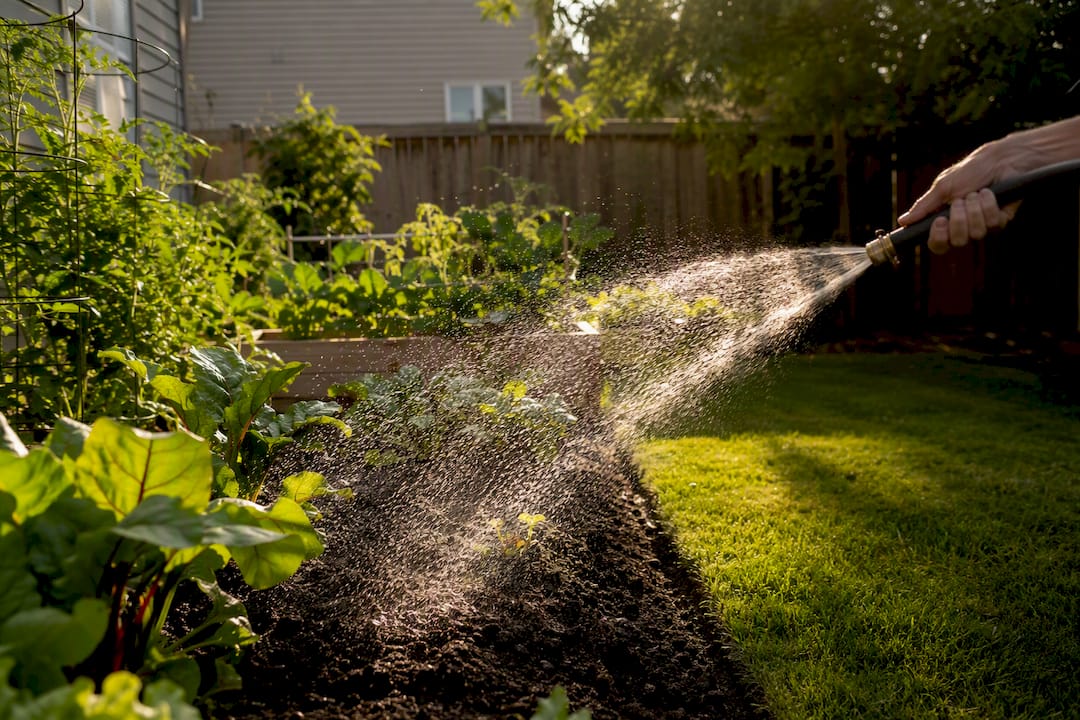
- Watering edible crops and vegetable gardens
- Using rain barrel water for any outdoor purpose, since it isn’t drawn from the treated municipal supply
- Drip irrigation and soaker hoses in garden beds, in most stages
Larger commercial and institutional properties have their own path. A Water Managed Site certification allows qualifying industrial, commercial, or institutional landscapes to keep extended watering hours, recognizing that a large corporate campus or sports field has different needs than a residential lawn.
Pro Tip: If you’re managing a rental property or HOA common area, snap dated photos of every new sod or seed installation the day it goes in. That single habit turns a potential dispute with bylaw enforcement into a five-second conversation.
Watering restriction fines in Calgary: enforcement and penalties
Calgary’s enforcement approach leans on education first. Bylaw officers typically issue a warning or informational notice before jumping to a ticket, particularly for a first-time or minor infraction under Stage 1 or Stage 2. That said, fines are real and they escalate quickly with severity.
Reported penalty ranges run from roughly $200 to $400 for lower-stage violations, climbing to as much as $3,000 in the most severe cases, such as ignoring a Stage 4 outdoor watering ban during an active infrastructure emergency.
Enforcement runs through the City’s bylaw services, and 311 is your point of contact whether you’re reporting a suspected violation or trying to confirm what’s currently allowed at your address.
If you do get a notice:
- Respond promptly rather than letting it sit, since ignoring it rarely improves the outcome.
- Have your exemption documentation ready, whether that’s a sod receipt or proof of a Water Managed Site certification.
- Call 311 directly if the notice is unclear or you believe it was issued in error.
When and why Calgary declares outdoor water restrictions
The City doesn’t flip the switch on staged restrictions arbitrarily. Officials track a handful of specific signals, and when those cross a threshold, restrictions follow.
The main triggers are Bow and Elbow river flow levels, storage levels at the Glenmore Reservoir, and major infrastructure failures. The Bearspaw South feeder main repair is the clearest recent example: a critical piece of water delivery infrastructure went offline, and the City had no choice but to declare Stage 4 restrictions while crews worked on repairs.
For live status, these are your go-to sources, in order of usefulness, including helpful tips from smart renovations for Calgary homes that support efficient outdoor water use practices:
- calgary.ca/savewater for the current stage and headline rules.
- calgary.ca/water/drought for the detailed breakdown of what’s allowed under whatever stage is active.
- The City of Calgary newsroom for breaking updates on emergencies and infrastructure outages.
- 311 for a direct human answer if the website leaves you uncertain.
If you want advance warning rather than checking manually, watch the City’s official social media channels and newsroom for sign-up or alert options during active events.
How much water your lawn actually needs each week
Most Calgary lawns typically need about one inch of water per week, rain included, to stay green through summer. You don’t need fancy equipment to measure that. A tuna can or a straight-sided container set out during a watering cycle works fine, or you can pick up a cheap rain gauge from any hardware store.
Here’s a practical sequence that keeps you compliant and your lawn healthy:
- Track rainfall first. If it rained half an inch this week, you only need to make up the other half.
- Water early morning or evening, ideally within your allowed schedule window, since midday watering loses a meaningful chunk to evaporation before it reaches the roots.
- Cut automatic run-times by 5 to 10 minutes across each zone. Most irrigation controllers are set generously, and this small trim rarely shows up as stress on the lawn.
- Switch garden beds to drip or soaker hoses where possible, since they put water directly at the root zone instead of into the air.
- Mulch exposed soil around shrubs and perennials to slow evaporation and reduce how often you need to water at all.
- Check soil moisture with a screwdriver test before watering. If it slides in easily six inches down, skip that cycle.
Outdoor watering can drive Calgary’s summer water consumption up by 30 to 40 percent compared to other seasons, which is exactly why small per-household trims add up to a real system-wide difference. During a higher-stage restriction, shift temporarily to hand-watering only your highest-value plants, established trees and new perennials, rather than trying to keep the whole yard at full green.
Pro Tip: Water deeply but less often. Three long soaks a week beat seven quick sprays, because deep watering pushes roots downward where they’re more drought-resistant.
Getting professional help to stay compliant
Keeping a Calgary lawn healthy inside a shifting set of rules is genuinely more work than it looks, especially for property managers juggling multiple addresses on different watering days. Yearlong handles this exact problem for homeowners and commercial clients across Calgary, adjusting service schedules around whatever stage is currently active.
Services that matter most during restriction periods include:
- Establishment watering support for new sod or seed within the 21 and 45 day exemption windows
- Irrigation system tuning to cut wasted run-time without stressing the lawn
- Seasonal cleanups and bed maintenance that reduce a landscape’s overall water demand
If you’re evaluating any property maintenance provider during a restriction period, ask directly whether they track current stage rules, how they document exemption cases like new sod installs, and whether they keep dated visit records you can produce if bylaw enforcement ever asks. Yearlong has operated across Calgary since 2017 and backs its work with a satisfaction guarantee.
What Calgary residents get wrong about watering rules
Most confusion here isn’t about the rules themselves. It’s about people assuming the year-round schedule is a drought measure, when it’s really a demand-levelling tool that exists whether or not Calgary is in a dry spell. That distinction changes how you should think about compliance day to day.
Conventional advice treats “check the schedule once” as good enough. It isn’t. Council’s own approval of a mandatory schedule shows the rules are getting more structured, not less, and infrastructure events like Bearspaw prove that stages can appear with almost no warning. The habit that actually protects you is a thirty-second check before every watering session, not a one-time memorization of your address day.
If you take one thing from this guide, prioritize the exemption paperwork. New sod, new seed, and edible gardens carry real protections, but only if you can back them up. A dated photo costs nothing and settles most disputes before they start.
— Lewie
Sources
- Lawn and landscape watering schedule — City of Calgary
- Stage 4 water restrictions now in effect as Bearspaw South feeder main repairs begin — City newsroom (2026-03-09)
- Council approves water efficiency plan, including mandatory outdoor watering schedule — CBC News (2026-04-29)
- Calgary water restrictions: rules, tickets and fines — CityNews (2024)
One Response