

Calgary’s year-round watering schedule splits the city by address: even-numbered properties (ending in 0, 2, 4, 6, 8) water Tuesday, Thursday, and Saturday, while odd-numbered properties (ending in 1, 3, 5, 7, 9) water Wednesday, Friday, and Sunday. Permitted hours run 12 a.m. to 10 a.m. and 7 p.m. to 11:59 p.m., giving every household up to 45 hours of watering time per week. One catch: temporary outdoor water restrictions can override all of it without notice.
TL;DR:
- Homeowners should focus on measuring weekly watering with a container test, which confirms they are applying about 2.5 centimeters per week.
- Watering days depend solely on the last digit of the address, with specific windows from midnight to 10 a.m. and 7 p.m. to midnight, never changing seasonally.
- Temporary outdoor water restrictions can override the schedule during drought, poor water quality, or treatment capacity issues, often without notice.
- New sod, seed, and plants are exempt from the schedule for 21 to 45 days or up to five years for trees and shrubs, with hand watering permitted anytime.
- Proper lawn mowing height and cycle timing effectively reduce water needs and prevent runoff, supporting healthy growth during dry periods.
Table of Contents
- Calgary’s lawn watering schedule: days, times and weekly allowance
- Who follows the rule, and what happens with condos and new plantings
- When temporary water restrictions override the schedule
- How much water your lawn actually needs, and when to apply it
- YearLong’s local checklist for staying on schedule and avoiding waste
- Where to check the current rules before you water
- What actually matters here, and what homeowners get wrong
- Sources
Calgary’s lawn watering schedule: days, times and weekly allowance
If your address ends in an even number, your watering days are Tuesday, Thursday, and Saturday. Odd-numbered addresses water Wednesday, Friday, and Sunday. This isn’t a seasonal rule that resets every spring. It runs year-round, which means the same address parity applies throughout the year.
The permitted windows matter as much as the days themselves. You can water between 12 a.m. and 10 a.m., then again from 7 p.m. to 11:59 p.m. Add those two blocks together across your three eligible days and you get up to 45 hours of watering time per week, which is plenty for a standard residential lot even with a modest sprinkler system.
Why these specific windows? Early morning and late evening keep evaporation losses down, since the sun isn’t beating on wet grass and cooking off half the water before it reaches the roots. It also spreads demand on the city’s water treatment and delivery system instead of everyone in a neighbourhood running sprinklers at 6 p.m. on a hot afternoon.
Here’s a quick way to confirm your own schedule before you set a timer:
- Check the last digit of your street address, not your unit number or postal code.
- Even last digit (0, 2, 4, 6, 8) means Tuesday, Thursday, Saturday.
- Odd last digit (1, 3, 5, 7, 9) means Wednesday, Friday, Sunday.
- Watering is allowed only in the two daily windows: 12 a.m. to 10 a.m. and 7 p.m. to 11:59 p.m.
- Businesses, city parks, and civic properties follow the same address-based rule.
The schedule applies broadly across residential and commercial properties, and to the city’s own operations too. There’s no separate rulebook for businesses or renters. If you’re watering a lawn in Calgary, the address on the building decides your days, full stop.
Who follows the rule, and what happens with condos and new plantings
The address-based schedule covers residences, businesses, and municipal properties alike. Your official street address, the one on file with the city, not a suite number, determines whether you’re an odd-day or even-day waterer.
Condo complexes and multi-building sites cause the most confusion. When several units or buildings share one irrigation system, the rule is simple: use the lowest street address in the complex to set the watering day. A unit number never factors into the calculation. If your building’s mailing address includes a unit number stacked on a shared street address, that shared address, at its lowest value, is what counts. Property managers running shared systems should confirm the exact street address with municipal records rather than guessing from a strata document, since a wrong assumption here means watering on the wrong day for an entire complex.
New plantings get breathing room the standard schedule doesn’t allow for established lawns:
- New sod can be watered outside the schedule for its first 21 days.
- New seed gets 45 days of unrestricted watering to establish germination.
- Newly planted trees and shrubs can be watered outside the schedule for up to five years after planting.
- Hand watering with a hose fitted with a spring-loaded shutoff nozzle is permitted anytime, on any day, regardless of your scheduled watering days.
That last point is worth underlining. A watering can or a hose nozzle you have to hold and squeeze isn’t the same as a sprinkler running on autopilot, and the city treats them differently for good reason: hand watering is slower, more targeted, and harder to waste.
When temporary water restrictions override the schedule
The year-round schedule assumes normal conditions. It doesn’t assume drought, a spike in river turbidity after heavy rain, or a treatment plant running at reduced capacity for repairs. When any of those things happen, Calgary can declare temporary outdoor water restrictions, and those restrictions take precedence over everything described above.
Three situations typically trigger a temporary restriction:
- Drought conditions reduce river flow or reservoir levels below safe operating thresholds.
- Intake water quality drops, often after heavy rain washes sediment into the Bow or Elbow rivers.
- Treatment capacity is strained by equipment issues, planned maintenance, or unexpected repairs.
A temporary restriction can mean shorter windows, fewer days, or in a severe case, a full ban on outdoor watering until conditions improve. It’s not a permanent replacement for the address-based schedule. It’s a layer that sits on top of it when the system needs relief, and it lifts once conditions normalize.
Here’s what to actually do if a restriction gets declared:
- Check the city’s outdoor water restrictions page before you water anything, since this is updated the moment a restriction status changes.
- Sign up for or monitor local emergency alerts, which typically carry the fastest notice of a new restriction.
- Suspend automatic irrigation immediately if a ban is in effect, even if your controller is still set to your normal schedule.
- Shift to hand watering with a shutoff nozzle for anything that absolutely needs moisture, since that method usually stays permitted even under tighter rules.
- Cut indoor water use where you can. Shorter showers and fuller laundry loads take pressure off the same system that’s straining outdoors.
If you’ve ever wondered why the city bothers publishing an entire schedule and then reserves the right to override it, think of it like a speed limit that drops during a snowstorm. The posted number is the default. Conditions on the ground decide what’s actually safe.
How much water your lawn actually needs, and when to apply it
A healthy Calgary lawn needs roughly 1 inch, or about 2.5 centimetres, of water per week, counting rainfall. That’s the number to build your entire watering routine around, not a guess based on how the grass looks on a given Tuesday.
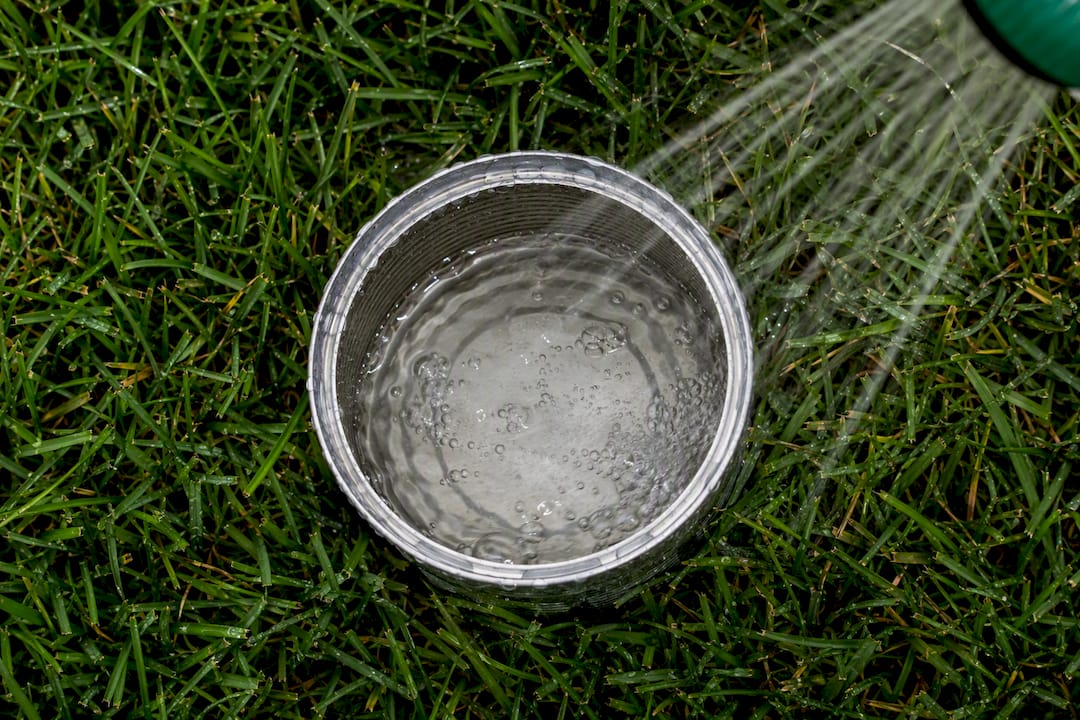
Pro Tip: Set an empty tuna can or a straight-sided container on your lawn during a watering cycle. Once it collects about 2.5 centimetres, you’ve hit the weekly target, whether that took one long cycle or three shorter ones.
Timing inside your permitted windows still matters. Watering at 5 a.m. or 9 p.m. beats watering at 8 a.m. on a bright July morning, because less water evaporates before it soaks in. Given the choice between the two daily windows, the overnight to early-morning block (12 a.m. to 10 a.m.) tends to work best for cooling, wind-free application, especially in July and August when Calgary sees long, hot afternoons.
Runoff is the enemy of an efficient lawn, and it happens when you dump too much water on the surface faster than the soil can absorb it. That’s especially common on Calgary’s clay-heavy soils, which are common across many older neighbourhoods. The fix is short cycles instead of one long soak:
- Run each zone for 5 to 8 minutes, then let it rest before repeating.
- Repeat two or three short cycles rather than one 20-minute blast, since split cycles let water soak in between applications instead of sheeting off toward the sidewalk.
- Watch for water pooling on driveways or sidewalks. That’s your signal to shorten the cycle, not lengthen it.
Mowing height changes how much water your lawn needs, and it’s the easiest lever most homeowners never touch. Keep grass around 3 inches tall, and follow the one-third rule: never cut more than a third of the blade length in a single mow. Taller grass shades its own root zone, holds moisture longer, and grows deeper roots that reach water lower in the soil profile. A lawn mowed down to 1.5 inches every week is working against itself, drying out faster and needing more frequent watering just to survive the same stretch of dry weather. If you’re mapping out lawn mowing frequency around your watering days, mow the day after watering, once the blades have firmed back up, rather than right before.
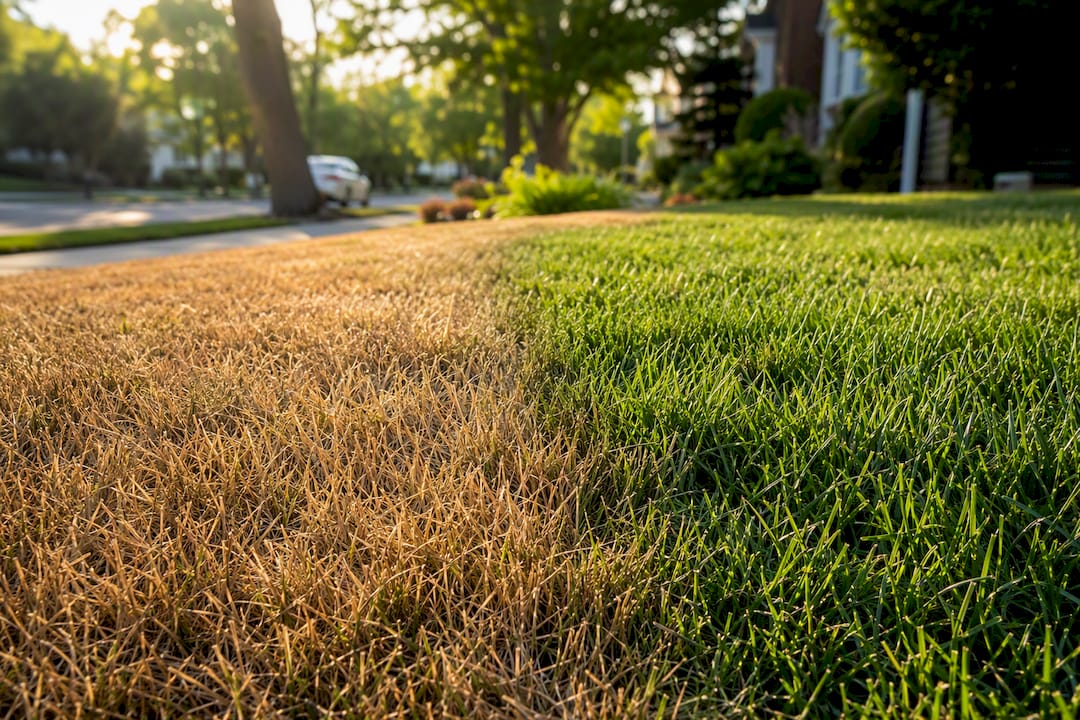
During extended heat, some lawns go dormant, turning brown and stopping active growth as a survival strategy. That’s not necessarily a lawn dying. Grass that goes dormant during a hot stretch usually greens back up once regular moisture resumes, and letting it happen instead of panic-watering outside your allowed windows is often the more sensible choice. Fighting dormancy with extra water rarely helps and sometimes just adds stress from overwatering on top of heat stress.
YearLong’s local checklist for staying on schedule and avoiding waste
Following Calgary’s watering rules is one thing. Actually getting a green, even lawn out of your permitted hours is another, and that’s where a lot of homeowners lose the thread. YearLong works with irrigation systems across Calgary all season, and the same handful of issues come up again and again.
Start with a short day-of checklist before you trust your system to run itself:
- Confirm your controller’s start times actually fall inside 12 a.m. to 10 a.m. or 7 p.m. to 11:59 p.m., not just close to it.
- Walk the yard during a cycle at least once a season to check for heads spraying onto pavement instead of grass.
- Run the container test described earlier to confirm you’re hitting close to 2.5 centimetres a week, not guessing.
- Adjust cycle length in small increments rather than doubling run time the first time you see a dry patch.
Establishment watering is where the exemptions in the city’s rules actually get used in practice. When YearLong installs new sod or seeds a lawn, watering happens well outside the standard address-based days for those first 21 or 45 days, exactly as the exemption allows, then transitions back to the standard schedule once the lawn is established. Skipping that transition, watering a two-month-old lawn like it’s still in its establishment window, is a common way homeowners end up overwatering long after the exemption should have ended.
Some problems are worth calling a professional for rather than troubleshooting alone: persistent runoff that won’t resolve with shorter cycles, a controller that won’t hold its programmed schedule, or a shared irrigation system across a multi-building complex where nobody’s sure which zones cover which units. Those situations usually need a proper diagnostic, not another guess.
| Situation | What to check | Action |
|---|---|---|
| Runoff on driveway or sidewalk | Cycle length and head spacing | Shorten to 5–8 minute cycles with soak breaks |
| New sod or seed | Days since planting | Water outside schedule for 21 (sod) or 45 (seed) days |
| Shared complex irrigation | Lowest street address on file | Confirm with property records, not unit numbers |
| Dry patches despite watering | Container test result | Adjust cycle count, not just duration |
For lawns that need more than a schedule fix, whether that’s uneven coverage, a system due for a tune-up, or seasonal care built around Calgary’s climate, YearLong’s lawn care services and bed maintenance work cover both the watering side and the broader upkeep that keeps a yard looking sharp between waterings.
Where to check the current rules before you water
Rules change with conditions, so the schedule you read last summer might not be the one in effect this week. Check these sources directly rather than relying on secondhand summaries:
- The City of Calgary’s lawn and landscaping watering schedule for the current address-based days and windows.
- The city’s outdoor water restrictions page for any active temporary measures.
- YearLong’s watering restrictions guide for a plain-language rundown and local context.
What actually matters here, and what homeowners get wrong
The schedule itself isn’t complicated. What trips people up is treating it as a fixed rule instead of a floor that can drop without warning. Most homeowners set their sprinkler timer once in May and never touch it again, which ignores the fact that a temporary restriction can hit in the middle of July and quietly override everything they’ve programmed.
The bigger miss, though, is mowing height. Everyone fixates on watering volume and forgets that a lawn cut to 3 inches needs meaningfully less water than one scalped to an inch and a half. You can follow the city’s schedule perfectly and still struggle with a brown, stressed lawn if you’re mowing wrong.
My advice: get the container test right before you worry about anything else. Most watering problems in this city come down to people guessing at volume instead of measuring it. Once you know you’re actually hitting 2.5 centimetres a week, the schedule stops feeling like a restriction and starts feeling like exactly the amount of structure a Calgary lawn needs to survive a dry prairie summer.
— Lewie
Sources
- Lawn and landscaping watering schedule
- Understanding outdoor water restrictions
- Lawn care guidance (regional resource)
- Calgary water restrictions — establishment exemptions (Landscape Alberta)