

TL;DR:
- Calgary property owners must clear snow and ice from sidewalks within 24 hours of snowfall ending.
- Proper tools like ergonomic shovels and snow blowers enhance safety and efficiency.
- Planning ahead and teamwork help manage unpredictable winter conditions and meet legal obligations.
Calgary winters don’t ease you in gently. One morning you’re walking on bare pavement, and by afternoon you’re facing 20 centimetres of snow and a 24-hour bylaw clock already ticking. For homeowners and property managers across the city, snow removal is not just a chore — it’s a legal obligation, a safety responsibility, and a physical challenge all rolled into one. This guide walks you through everything you need to know: what Calgary’s rules actually require, which tools work best, proven clearing techniques, and how to plan ahead so you’re never caught scrambling after a storm.
Table of Contents
- Understand Calgary snow removal bylaws and obligations
- Choose and use the right tools for the job
- Smart techniques for efficient snow and ice management
- Proactive planning: Stay ahead of storms and keep your property safe
- A Calgary expert’s perspective: What most guides miss about snow removal
- Take winter off your to-do list: Reliable Calgary snow removal services
- Frequently asked questions
Key Takeaways
| Point | Details |
|---|---|
| Clear sidewalks quickly | Calgary bylaws require removal within 24 hours after snowfall ends. |
| Pick the right tools | Ergonomic shovels, snow pushers, and blowers can make tasks safer and easier. |
| Use safe techniques | Push instead of lift and de-ice proactively to avoid injuries and re-freezing. |
| Plan ahead for storms | Stock supplies, arrange backup, and monitor forecasts to stay compliant and safe all winter. |
Understand Calgary snow removal bylaws and obligations
Before you pick up a shovel, it pays to know exactly what the city expects of you. Calgary bylaws require property owners to clear snow and ice from sidewalks adjacent to their property within 24 hours after snowfall ends, with a minimum cleared width of 1.5 metres for public walkways. That’s not a suggestion — it’s an enforceable rule.
Here’s what compliance looks like in practice:
- Clear the full 1.5-metre width of your adjacent sidewalk within 24 hours of the snowfall ending
- Remove ice as well as snow — a thin glaze counts as a hazard
- Keep pathways clear of debris, not just snow
- Check again after Chinook melt-refreeze cycles, which can create new ice hazards overnight
One area where people often go wrong is where they put the snow they’ve removed. Snow from sidewalks can be moved to public areas, but you must avoid blocking drains, crosswalks, or your neighbours’ cleared paths. Critically, you cannot shovel snow from your private driveway onto a public road. That’s a separate offence and one that catches many homeowners off guard.
Remember: The 24-hour window starts when snowfall ends, not when it begins. During a long storm, you are not yet in violation — but the clock starts the moment the snow stops.
Fines for non-compliance can add up quickly, and the city does respond to complaints from neighbours and pedestrians. Beyond fines, the liability risk is real. If someone slips on an uncleared sidewalk adjacent to your property, you could be held responsible. Understanding snow removal standards helps you stay on the right side of both the law and common sense.
For ongoing snowfall, the practical approach is to make a first pass midway through the storm to keep pathways manageable, then do a thorough clearance once the snow stops. This is especially useful for heavy accumulations. If you’re managing a larger property, it’s worth reading up on snow plowing explained to understand when mechanical equipment becomes the smarter option.
Choose and use the right tools for the job
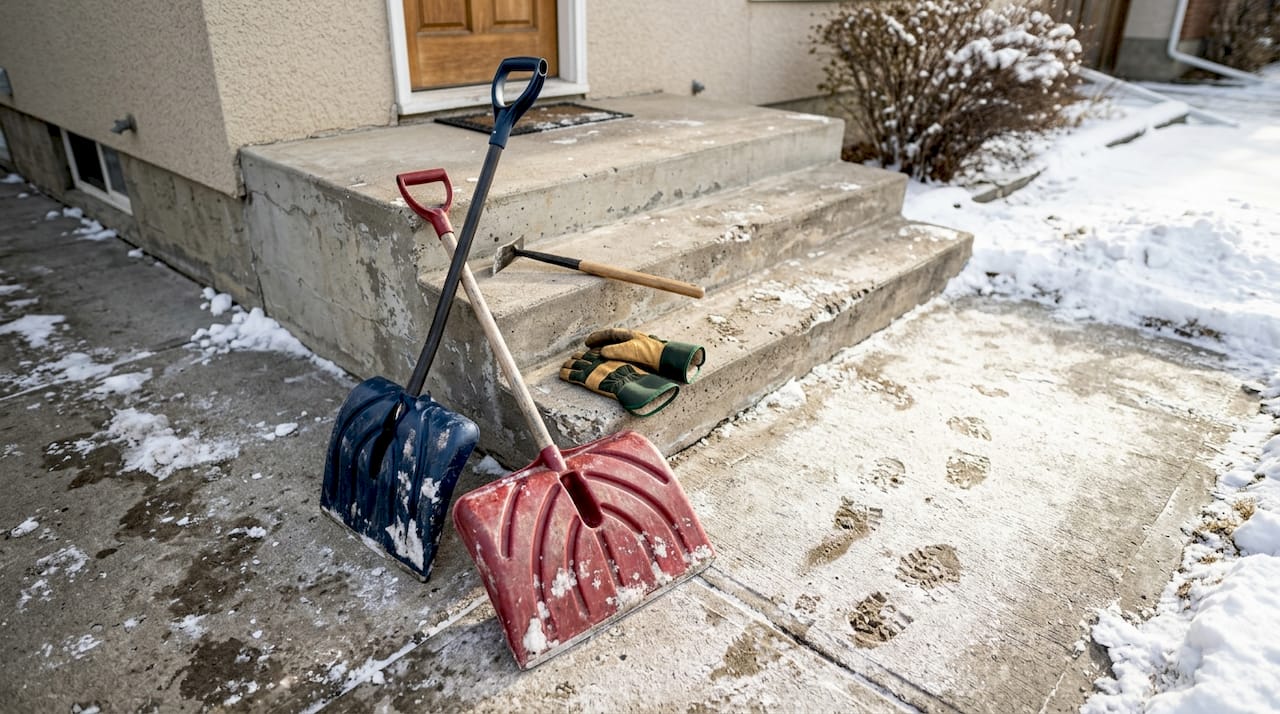
Having the right equipment makes a genuine difference, both in how quickly you clear snow and how safely you do it. The wrong tool for the conditions can mean extra trips outside, a sore back, or worse.
| Tool | Best for | Key feature |
|---|---|---|
| Ergonomic shovel | Light to moderate snowfall | Curved handle reduces back strain |
| Snow pusher | Flat driveways, dry snow | Wide blade moves large volumes fast |
| Snow blower | Heavy accumulation, large areas | Saves significant time and effort |
| Ice chopper | Frozen layers, post-Chinook ice | Breaks through compacted ice |
| Sand spreader | Icy walkways | Improves traction without chemicals |
For most Calgary homeowners, a quality ergonomic shovel paired with a wide pusher covers the majority of winter situations. Snow blowers are worth the investment if you have a long driveway or manage multiple properties. When choosing a shovel, look for a blade made from lightweight plastic or aluminium and a handle long enough that you don’t need to bend deeply to push.
Pro Tip: Before the season starts, coat your shovel blade lightly with cooking spray or silicone lubricant. Snow slides off far more easily and you spend less energy per scoop.
Accessories matter too. An ice chopper is essential for post-Chinook conditions when melt-refreeze leaves a stubborn layer that a shovel simply can’t break. A sand spreader or a simple bucket of sand gives you traction control without the chemical damage that some de-icers cause to concrete or landscaping. If you’re managing equipment at scale, a snow plow joystick kit can help keep mechanical plowing systems in reliable working order.
One critical safety note: heavy or wet snow increases heart strain risk significantly, particularly for those who are not regularly active. If you have cardiovascular concerns, delegate the heavy lifting or consider a snow blower. This is not overstating the risk — cardiac events during shovelling are a documented winter health issue in Canada.
For a broader look at how equipment fits into your overall property upkeep, outdoor cleaning services can complement your winter toolkit with professional-grade options.
Smart techniques for efficient snow and ice management
Equipment only takes you so far. Technique is what separates an exhausting two-hour slog from a quick, effective clearance.
- Start early, not late. Fresh snow is lighter and easier to move. Waiting until it compacts or gets walked on makes every scoop heavier.
- Push, don’t lift. Whenever possible, push snow to the side rather than scooping and throwing it. Lifting heavy snow repeatedly is where injuries happen.
- Work in layers during heavy falls. If 30 centimetres has accumulated, don’t try to take it all at once. Remove the top half first, then the bottom layer.
- Clear in rows, not random patterns. Start from the centre of the driveway and push to the sides, or work from one edge across. Organised rows prevent you from moving snow twice.
- Apply de-icer before a storm, not after. Pre-treating walkways with a calcium chloride product prevents bonding between ice and the surface, making post-storm clearing far easier.
- Use sand or gravel as a traction aid. On existing ice, sand gives immediate grip without the wait time of chemical melters.
Pro Tip: Shovel in the morning before foot traffic packs snow down, and again after the storm ends. Two shorter sessions are safer and more effective than one long one.
Calgary’s melt-refreeze cycles after Chinook events are genuinely tricky. Temperatures can swing 20 degrees in a day, turning cleared walkways into skating rinks by nightfall. After any significant warm spell, check your pathways in the evening and again in the morning. A thin layer of ice is nearly invisible and extremely dangerous. Your snow removal guide can help you build a routine that accounts for these unpredictable conditions. Pairing good technique with smart outdoor cleanup strategies keeps your whole property in better shape through the season.
Proactive planning: Stay ahead of storms and keep your property safe
Consistency through a Calgary winter comes down to preparation, not willpower. Having a plan before the first major snowfall means you’re never scrambling for supplies at 7am or realising your shovel handle cracked last March.
Your pre-season supply checklist:
- Two shovels (one ergonomic, one pusher)
- Ice chopper
- Bag of calcium chloride or sand
- Spare gloves and waterproof boots stored near the door
- Fully fuelled snow blower (if applicable), with a spare spark plug
| Storm scenario | Recommended action | Timing |
|---|---|---|
| Light dusting under 5cm | Single pass with pusher | Within 12 hours |
| Moderate 5 to 15cm | Full shovel and de-ice | Within 18 hours |
| Heavy over 15cm | Layer-by-layer removal | Begin during storm, complete within 24 hours |
| Post-Chinook refreeze | Ice chop and sand | Check morning and evening |
Arranging backup help is something many homeowners put off until they actually need it. Talk to a neighbour now about covering for each other during travel or illness. Even a simple agreement to check in after major storms can prevent a bylaw violation or a slip-and-fall incident. If you manage multiple properties or have mobility limitations, hiring a reliable service is often the most practical solution to avoid fines this winter.
Set weather alerts on your phone for Environment Canada forecasts. Knowing a storm is coming 24 hours in advance lets you pre-treat walkways and clear any debris that would be harder to find under snow. Seasonal planning with experts can also help you think about your property’s needs across the full year, not just in reactive bursts. During ongoing snowfall, make initial passes to keep pathways manageable, then complete a thorough clearance once conditions allow.
A Calgary expert’s perspective: What most guides miss about snow removal
Most snow removal guides are written for ideal conditions. They assume a clean snowfall, a healthy homeowner, and a straightforward rectangular driveway. Calgary doesn’t work that way.
The real test of any snow removal routine is how it holds up through a Chinook cycle — when temperatures swing wildly, ice forms in unexpected places, and the sidewalk you cleared yesterday becomes a hazard again by morning. We’ve seen this pattern repeat every single winter since we started operating in 2017, and the homeowners who handle it best are not the ones who shovel hardest. They’re the ones who check conditions consistently and act early.
There’s also a health dimension that gets glossed over. Shovelling heavy, wet snow is genuinely strenuous physical work. Treating it like a quick errand is how people end up injured. Knowing your limits and having a backup plan is not laziness — it’s good judgement.
Finally, neighbours working together is underrated. A street where everyone clears promptly is safer for everyone, reduces complaint-driven bylaw enforcement, and builds the kind of community trust that makes winter more manageable. Reviewing industry snow removal standards together with your neighbours can set a shared baseline that benefits the whole block.
Take winter off your to-do list: Reliable Calgary snow removal services
If managing all of this on your own feels like too much — especially during a demanding week or after a major storm — that’s exactly what we’re here for. At YearLong Property Maintenance, we’ve been keeping Calgary properties clear, safe, and bylaw-compliant since 2017.

Our professional snow removal service handles everything from routine sidewalk clearing to full driveway and parking area maintenance, so you never have to worry about the 24-hour window again. We’re insured, reliable, and we know Calgary winters. When the season turns, we’re also ready to help with bed maintenance and expert lawn care to keep your property looking its best year-round. Get in touch today and let us take one big thing off your plate this winter.
Frequently asked questions
How quickly do I need to clear snow from sidewalks in Calgary?
You must clear snow and ice from sidewalks adjacent to your property within 24 hours after snowfall ends, with a minimum cleared width of 1.5 metres.
Can I put snow from my driveway onto the public street?
No. Shovelling snow onto public roads from private driveways is not permitted under Calgary bylaws, though snow from sidewalks can be moved to public areas if drains and crosswalks remain unobstructed.
What if it keeps snowing and I already cleared my sidewalk?
During ongoing snowfall, make initial passes to keep pathways clear and manageable, then complete a thorough removal once the weather stops.
What are tips for preventing slip hazards after a Chinook melt?
Spread sand or gravel immediately for traction, apply de-icer to prevent refreezing, and use an ice chopper to break up any post-Chinook ice that forms after the thaw-refreeze cycle.