

TL;DR:
- Consistent property care involves scheduled maintenance that preserves a property’s value, safety, and curb appeal. It leads to higher long-term valuations, reduced maintenance costs, and longer system lifespans. Implementing a system with documented, automated routines safeguards asset value against staffing and market changes.
Consistent property care is defined as the ongoing, scheduled maintenance that preserves a property’s value, safety, and curb appeal across every season. Property owners and managers who treat upkeep as a capital investment rather than a recurring cost protect their assets from silent value erosion. The role of consistent property care goes far beyond appearances. 2026 industry analysis shows that proactively maintained properties carry up to 15% higher long-term valuations than those managed reactively. For Calgary property owners facing harsh winters and short growing seasons, that gap is not theoretical. It shows up at resale, at refinancing, and in every lease renewal conversation.
What measurable benefits does consistent property care bring?
Consistent property upkeep produces financial returns that reactive maintenance simply cannot match. The most direct benefit is valuation. Properties with proactive care programmes achieve up to 15% higher long-term valuations than comparable properties managed on a break-fix basis. That premium reflects lower deferred maintenance risk, better curb appeal, and documented upkeep history.

The cost savings are equally significant. Automated recurring maintenance work orders reduce emergency calls by 90% and cut annual maintenance costs by 73%. Emergency repairs carry premium labour rates, expedited material costs, and tenant disruption. Eliminating them through scheduled care is one of the highest-return decisions a property owner can make.
Building systems last longer under consistent care. Proactive maintenance extends the functional life of major systems by 30–50%. A furnace serviced annually outlasts one that runs until it fails. The same principle applies to roofing, concrete, irrigation, and landscaping beds.
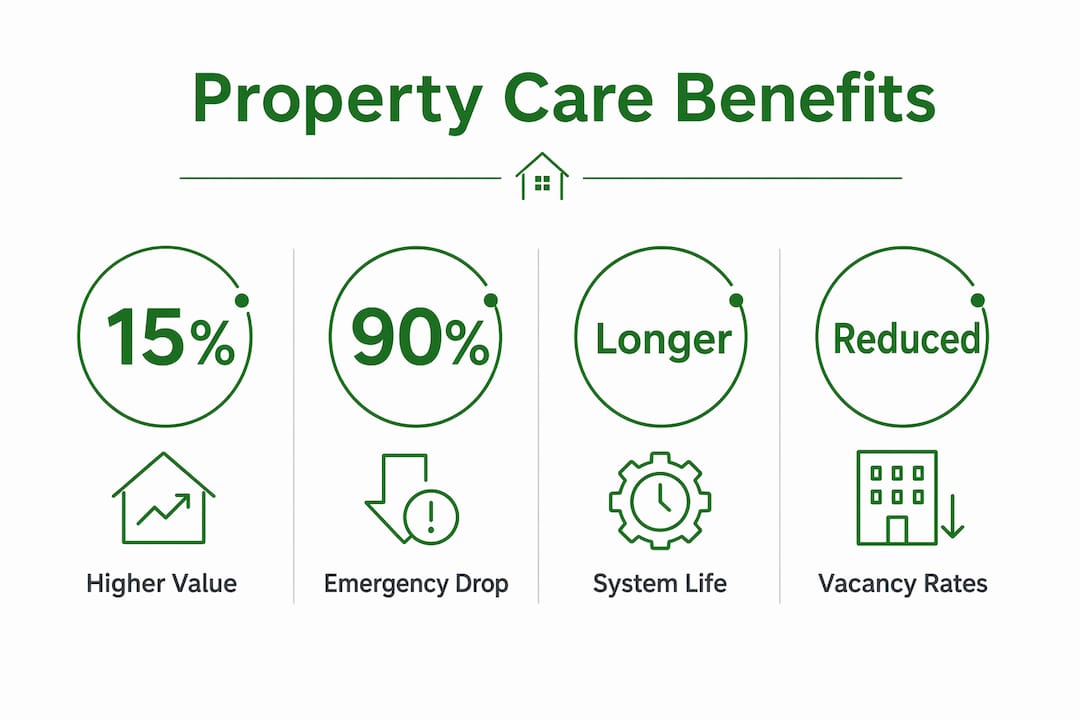
The benefits of regular property care extend to tenant relationships as well. Well-maintained properties attract quality tenants and keep them. Lower turnover means fewer vacancy periods, fewer make-ready costs, and more predictable cash flow. These outcomes compound over time, which is why the industry increasingly frames maintenance as a capital investment rather than an operating expense.
Key benefits at a glance:
- Up to 15% higher property valuations from proactive care
- 90% reduction in emergency maintenance calls
- 73% lower annual maintenance costs through scheduled work orders
- 30–50% longer functional lifespan for major building systems
- Reduced tenant turnover and more stable rental income
How does operational consistency in maintenance protect asset value?
Operational consistency in property management means the property performs to the same standard regardless of who is on staff that week. Most maintenance failures are not caused by negligence. They are caused by relying on human memory instead of process infrastructure. When a maintenance coordinator leaves, the informal knowledge they carried often leaves with them.
The fix is systems, not people. Automated recurring work orders create a scheduled, verifiable workflow that runs independently of any individual. Tasks trigger on a calendar, get assigned, get completed, and get recorded. The property performs consistently because the system demands it, not because a particular employee remembered.
Documentation is the second pillar of operational consistency. Undocumented maintenance is treated as never done in audits and warranty claims. If a roof warranty requires annual inspections and you cannot produce the records, the warranty is void. The same applies to insurance claims and resale due diligence. Every service visit needs a date, a description, and ideally a photo.
Pro Tip: Set up a shared digital folder organised by property and system. After every service visit, drop in a dated photo and a one-line note. This takes two minutes and builds a paper trail that protects you in every future negotiation.
A structured approach to consistent property upkeep looks like this:
- Audit your current state. List every building system and outdoor feature. Note the last service date for each.
- Build a recurring schedule. Assign each item a service frequency: monthly, quarterly, seasonal, or annual.
- Automate the triggers. Use a property management platform or calendar reminders to generate tasks automatically.
- Assign accountability. Every task needs a named owner and a completion deadline.
- Record every completion. Log the date, the person who completed the work, and any findings.
Consistent systems produce reliable outcomes regardless of staffing changes, market shifts, or seasonal fluctuations. That reliability is what separates properties that hold value from those that quietly erode.
What practical steps implement consistent property care?
A calendar-driven preventive maintenance plan is the foundation of consistent property upkeep. Without a written schedule, maintenance defaults to reactive. With one, every task has a date, an owner, and a record.
For Canadian properties, the seasonal structure is non-negotiable. Calgary’s climate creates four distinct maintenance windows, each with specific priorities:
- Spring (april to may): Post-winter inspection of concrete, drainage, and lawn beds. Power raking, aeration, and fertilisation. Check for frost heave damage on walkways and driveways.
- Summer (june to august): Regular lawn mowing, bed maintenance, irrigation checks, and concrete cleaning. This is the highest-visibility season for curb appeal.
- Fall (september to october): Leaf removal, bed preparation, and seasonal yard cleanup before freeze-up. Seal concrete before the first frost.
- Winter (november to march): Snow removal, ice management, and walkway safety. Document every service visit for liability purposes.
Technology removes the memory burden from this process. Calendar apps, property management software, and automated reminders all serve the same function: they make the schedule run without requiring someone to remember it. The specific tool matters less than the habit of using one consistently.
Pro Tip: Photograph your property at the start of each season before any work begins. These baseline images document condition over time and are invaluable if a warranty or insurance dispute arises.
Records are the proof that care actually happened. Equipment warranties and insurance claims often require proof of regular professional servicing. Lacking those records risks denial of coverage. A simple log with dates, photos, and service notes satisfies most requirements and takes minutes to maintain.
Partnering with a professional service provider adds a layer of accountability that self-managed schedules often lack. Yearlong has operated in Calgary since 2017, delivering lawn and bed maintenance on a scheduled basis that keeps outdoor spaces healthy through every season. Their local climate knowledge means the schedule is calibrated to Calgary conditions, not a generic national template.
For property owners managing multiple sites, proactive property care strategies that enhance valuations and curb appeal follow the same principles regardless of geography: schedule, document, and verify.
How does consistent property care influence tenant experience and financial performance?
Tenant retention is the most direct financial outcome of reliable property care. Higher tenant satisfaction from consistent maintenance leads to longer tenancies and stabilised rental income. A tenant who never waits weeks for a repair and whose building always looks well-kept has little reason to leave.
Turnover is expensive. Between vacancy periods, cleaning, repainting, and marketing, a single tenant departure can cost thousands of dollars. Consistent upkeep reduces the frequency of those events. It also supports higher asking rents. A well-maintained property commands a premium because prospective tenants can see the evidence of care before they sign.
The financial logic connects directly to net operating income (NOI). Lower vacancy rates, reduced turnover costs, and higher achievable rents all increase NOI. Higher NOI drives higher asset valuations. The impact of property care on value is not abstract. It flows through a clear financial chain from maintenance decision to balance sheet.
Viewing maintenance as a capital investment rather than a cost changes how property owners make budget decisions. A $500 seasonal cleanup that prevents a $5,000 drainage repair is not an expense. It is a return on investment with a measurable payback period. Property managers who frame it this way make better decisions and face fewer budget cuts that lead to expensive emergencies.
Key takeaways
Consistent property care is the single most reliable way to protect and grow property value over time, and the financial evidence from 2026 industry data makes the case without ambiguity.
| Point | Details |
|---|---|
| Valuation premium | Proactively maintained properties achieve up to 15% higher long-term valuations than reactively managed ones. |
| Cost reduction | Automated recurring work orders cut emergency calls by 90% and annual maintenance costs by 73%. |
| System lifespan | Consistent care extends the functional life of major building systems by 30–50%. |
| Documentation matters | Undocumented maintenance is treated as never done in audits, warranty claims, and insurance disputes. |
| Tenant retention | Reliable upkeep reduces turnover, stabilises rental income, and supports higher achievable rents. |
Why I think most property owners are solving the wrong problem
Most property owners I talk to are focused on finding better tradespeople. They want faster response times, lower quotes, and more reliable contractors. That is a reasonable goal, but it is the wrong problem to solve first.
The real issue is the absence of a system. When maintenance runs on memory and informal habits, it fails the moment any variable changes. A staff member leaves. A busy season hits. A budget gets cut. Without a documented, automated schedule, those disruptions become deferred maintenance. Deferred maintenance becomes value erosion. Value erosion is silent until it is not.
The property owners who protect their assets most effectively are not the ones with the best contractors. They are the ones with the best records. They can prove every service visit. They can show a buyer or an insurer exactly what was done and when. That paper trail is worth more than any single repair.
My advice is to stop optimising for the cheapest fix and start building the infrastructure that makes fixes less necessary. A preventive maintenance approach that runs on a calendar rather than a crisis is the most underused tool in property management. The properties that hold value through market cycles, staff changes, and harsh Calgary winters are the ones where someone built that system and stuck to it.
— Lewie
Yearlong’s property care services for Calgary owners
Consistent outdoor upkeep is one of the hardest parts of property management to maintain without professional support. Schedules slip, seasons change fast, and the gap between a healthy lawn in june and a neglected one in august is narrower than most owners expect.
Yearlong has delivered scheduled lawn care and yard cleanup across Calgary since 2017. Their services cover every season: lawn mowing and bed maintenance through summer, seasonal cleanups in spring and fall, and snow removal through winter. Every visit is documented, every schedule is calibrated to Calgary’s climate, and every service comes with a satisfaction guarantee. For property owners and managers who want consistent upkeep without managing it themselves, Yearlong is the local provider built for that exact need.
FAQ
What is consistent property care?
Consistent property care is the ongoing, scheduled maintenance of a property’s systems, structures, and outdoor spaces to preserve value, safety, and appearance. It differs from reactive maintenance in that tasks are planned in advance rather than triggered by failure.
How does consistent upkeep affect property value?
Proactively maintained properties achieve up to 15% higher long-term valuations than reactively managed ones, according to 2026 industry analysis. The premium reflects lower deferred maintenance risk and a documented upkeep history.
Why does documentation matter in property maintenance?
Undocumented maintenance is treated as never done in audits, warranty claims, and insurance disputes. Keeping dated records with photos protects your coverage and supports resale negotiations.
How often should property owners schedule maintenance?
Most building systems and outdoor features require service on a monthly, quarterly, or seasonal basis. A calendar-driven preventive maintenance plan assigns each task a frequency and an owner, removing the reliance on memory.
What are the biggest risks of inconsistent property care?
Inconsistent upkeep leads to deferred maintenance, higher emergency repair costs, reduced tenant satisfaction, and lower property valuations. The financial impact compounds over time, making early intervention far less costly than delayed action.