

TL;DR:
- Most homeowners set their mower to a default middle height, unknowingly causing significant lawn damage.
- Matching mowing height to grass type, following the one-third rule, and seasonal adjustments promote healthier, greener lawns.
- Consistent, informed mowing practices strengthen root systems, prevent weed invasion, and improve resilience against Calgary’s climate.
Most homeowners set their mower to a comfortable middle position and never think about it again. That one habit causes more lawn damage than drought, pests, and weeds combined. This lawn mowing height guide covers the mowing heights that actually match your grass type, how to shift those heights through the seasons, and the fundamental rule that every lawn care professional relies on. Get these things right, and your grass will be thicker, greener, and far more resilient through Calgary’s unpredictable summers and cool springs.
Table of Contents
- Key takeaways
- Your lawn mowing height guide starts with grass type
- The one-third rule: how to cut without stressing your grass
- Seasonal height adjustments for year-round results
- Practical tips and common mistakes to avoid
- Signs your height is right and when to adjust
- My honest take on mowing height
- Let Yearlong take the guesswork out of lawn care
- FAQ
Key takeaways
| Point | Details |
|---|---|
| Match height to grass type | Cool-season grasses like Kentucky bluegrass thrive at 6–10 cm; warm-season types need lower settings. |
| Follow the one-third rule | Never remove more than one-third of the blade length in a single cut to protect root health. |
| Adjust height by season | Raise your cutting height in summer heat and lower it slightly going into winter to prevent snow mould. |
| Sharp blades matter | Dull blades tear grass rather than cut it, leading to browning tips and disease risk. |
| Clippings feed your lawn | Leaving clippings on the lawn after a proper cut returns nutrients worth one to one and a half fertilisations per season. |
Your lawn mowing height guide starts with grass type
Before you touch a mower setting, you need to know what kind of grass you’re growing. This is the step most homeowners skip entirely. Different grass species have genuinely different ideal cutting heights, and treating them all the same is like giving everyone the same prescription eyeglasses.
Canadian lawns are dominated by cool-season grasses, which grow most vigorously in spring and autumn. The most common types you’ll encounter in Calgary and surrounding areas include Kentucky bluegrass, creeping red fescue, tall fescue, and perennial ryegrass. Warm-season varieties like Bermuda or Zoysia grass appear occasionally, but they are rare this far north.
Here’s a quick reference table for the most common grass types and their recommended mowing heights:
| Grass type | Season type | Ideal cutting height |
|---|---|---|
| Kentucky bluegrass | Cool-season | 6–9 cm (2.5–3.5 in) |
| Creeping red fescue | Cool-season | 5–9 cm (2–3.5 in) |
| Tall fescue | Cool-season | 7–10 cm (2.75–4 in) |
| Perennial ryegrass | Cool-season | 5–8 cm (2–3 in) |
| Bermuda grass | Warm-season | 2.5–5 cm (1–2 in) |
| Zoysia grass | Warm-season | 2.5–5 cm (1–2 in) |
A few things stand out in that table. Cool-season grasses, which make up nearly every Calgary lawn, prefer to be kept longer than most people assume. Mowing below 5 cm reduces drought tolerance and opens gaps for weeds to take hold. Taller grass shades the soil, keeps moisture in, and allows deeper root development. That’s not a coincidence. It’s biology working in your favour.
Warm-season grasses are genetically designed for heat and tolerate shorter cuts because they store energy in their stems and root systems differently. If you’re one of the rare Calgary gardeners growing a warm-season variety, you’ll find regional turfgrass guides helpful for scheduling and mower settings specific to those species.
The one-third rule: how to cut without stressing your grass
The one-third rule is the single most important concept in turf management. It is also the most consistently ignored one.
The rule is straightforward: never cut more than one-third of the grass blade’s current height in a single mowing session. So if your lawn is 9 cm tall, you should only remove 3 cm in one pass. If your grass has grown to 12 cm while you were away on holiday, cutting it straight down to 4 cm in one session is too aggressive. That kind of scalping stresses turf, reduces root depth, and creates exactly the conditions weeds love.
Why does this matter so much? Grass blades are the engine of the plant. They capture sunlight and convert it to energy through photosynthesis. Remove too much at once and the plant goes into shock, redirecting energy from root development to blade recovery. You end up with shallow roots, poor drought tolerance, and a lawn that looks pale and patchy within days.
Here’s how to handle different mowing situations using this rule:
- Normal growth period: Mow before the grass reaches one-third above your target height. For a target of 7 cm, mow once the grass hits about 9.5 cm.
- After a missed session: Raise the mower height and remove only one-third. Then mow again a few days later at a lower setting. Never drop to your target height in one cut.
- Very overgrown grass: Use the recovery interval approach, spacing mowing sessions two to three days apart and lowering the height gradually over multiple cuts.
- Fast spring growth: Bluegrass and fescue lawns may need cutting every three to four days during peak spring growth. Don’t skip sessions just because it seems inconvenient.
Pro Tip: Sharpen your mower blade at least once per season, and check it again mid-summer. A sharp blade makes a clean cut; a dull one tears the grass and leaves ragged, brown-tipped blades that are vulnerable to disease.
Seasonal height adjustments for year-round results
Your mower setting should not stay the same from April to October. The best lawn mowing height changes with the season, and understanding why helps you make smarter decisions at each point in the year.
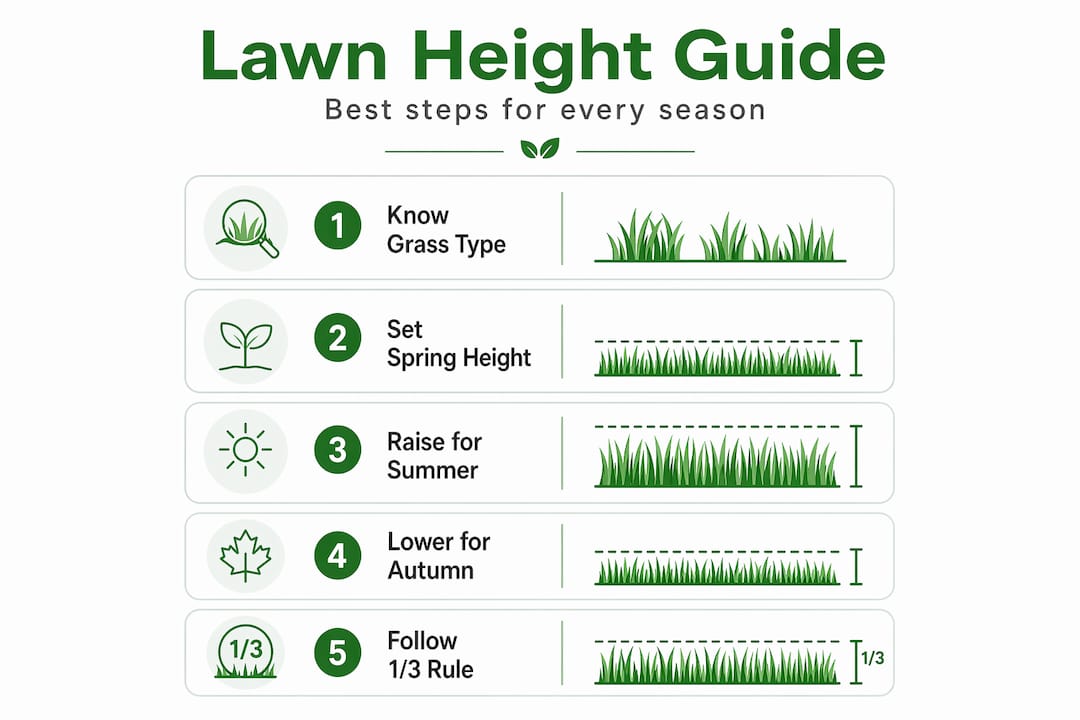
Here is a practical seasonal reference for Canadian cool-season lawns:
| Season | Recommended height | Key reason |
|---|---|---|
| Early spring | 5–6 cm (highest setting) | Protects waking turf from scalping |
| Late spring | 6–8 cm | Encourages dense growth and root depth |
| Summer (hot periods) | 8–10 cm | Shades soil, reduces moisture loss |
| Autumn | 6–8 cm | Maintains vigour before dormancy |
| Pre-winter final cut | 5–6 cm | Reduces snow mould risk under snow cover |
The first cut of the year should always be at the highest mower setting. Grass emerging from winter dormancy is vulnerable, and a low cut at this stage sets it back significantly. Come in high, let the lawn establish itself, and gradually work toward your season target over two or three cuts.
Summer is where most homeowners make their biggest mistake. They keep mowing at their spring height right through July and August, then wonder why their lawn turns brown and thin. Raising your cutting height by 2 to 3 cm during hot stretches is one of the most effective lawn cutting height tips you can apply. The extra blade length shades the root zone, significantly reducing surface temperature and slowing moisture evaporation.
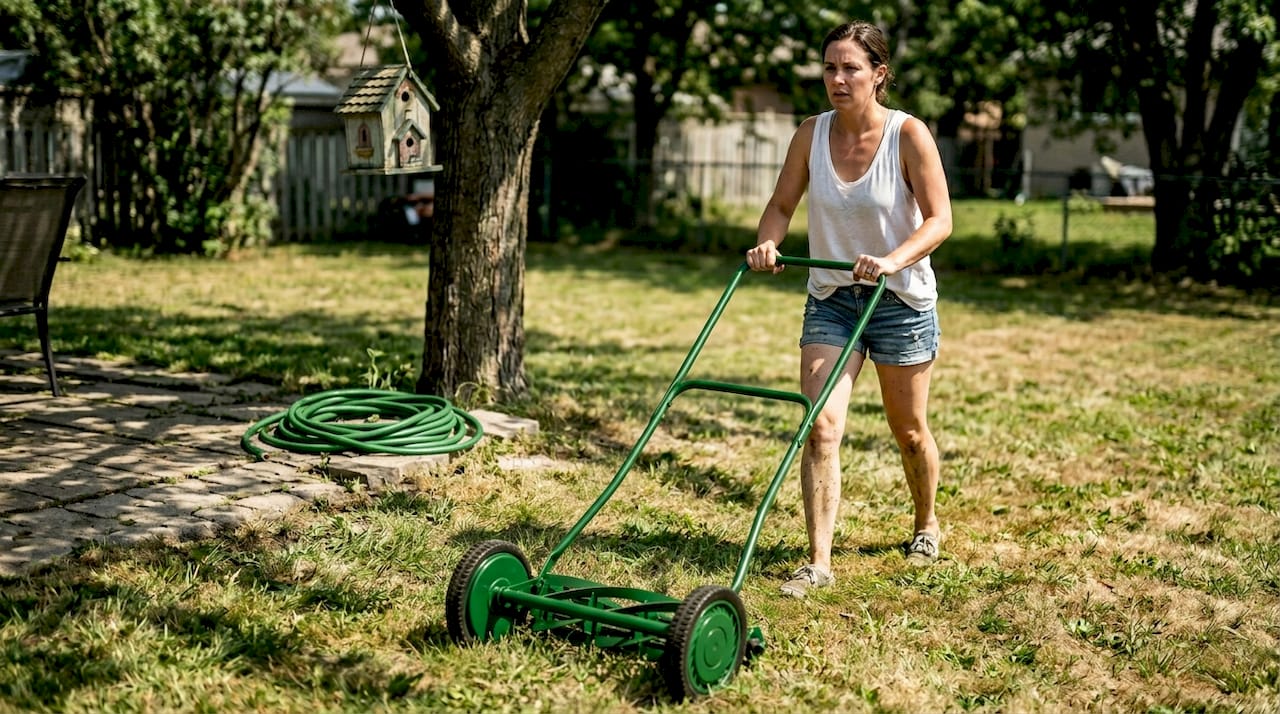
Going into autumn, bring the height back down gradually and make your last cut of the season slightly shorter than your summer setting. The goal is to reduce the volume of grass that will sit matted under snow. Leaving grass too long over winter creates a humid microclimate at the soil surface, which is the perfect environment for snow mould fungus. For Calgary homeowners especially, where snow can arrive before the lawn has fully hardened off, this final cut makes a real difference to how your lawn looks come spring.
Practical tips and common mistakes to avoid
Even with the right height in mind, the execution matters. Here are the most common issues and how to fix them.
Measuring your mower height properly. Most homeowners trust the numbers on their mower’s height lever without ever verifying them. Those markings are approximate at best. For accurate settings, place your mower on a flat surface and measure from the ground to the blade with a ruler. Actual blade measurement is the only way to be sure you’re cutting at the right height.
Avoiding wet and frosty conditions. Mowing wet grass causes clumping, uneven cuts, and compacts your soil as you walk over it. Mowing frosty grass causes physical damage to frozen blades. Both situations lead to the kind of ragged cuts that leave your lawn stressed and vulnerable. Wait until the grass is dry and the temperature is above freezing before you start.
Making the most of clippings. When you follow the one-third rule consistently, the clippings you leave behind are short enough to fall through the grass canopy and decompose quickly. Recycled grass clippings return nutrients equivalent to one to one and a half fertilisations per season. That’s free fertiliser, and most homeowners bag it up and throw it away.
Pro Tip: Once per season, walk your entire lawn before mowing and look for any low patches or bumps. Uneven ground causes your mower to scalp highs and miss lows, making a consistent cutting height nearly impossible without levelling first.
Signs your height is right and when to adjust
A healthy lawn gives you clear visual feedback. When your mowing height is dialled in correctly, the grass looks consistently dense and even, has a rich, uniform colour, and shows very little weed activity. The surface feels resilient underfoot and recovers quickly after foot traffic.
Here’s what to look for if something is off:
- Browning or scorched tips shortly after mowing indicate the grass was cut too short, exposing tender tissue.
- Thin, patchy areas that seem to spread over weeks often signal chronic scalping or mowing below the grass type’s minimum threshold.
- Excessive thatch buildup, a spongy layer between grass blades and soil, can develop when clippings are too long to decompose naturally, usually because mowing sessions are too infrequent.
- Weed invasion is frequently a symptom of cutting too low. Low grass gives weeds the light and space they need to germinate. Taller grass outcompetes them.
- Slow recovery after hot periods suggests root depth has been compromised. Raising your ideal grass cutting length for the next several cuts can help the root system rebuild.
Keep a simple note in your phone or a small lawn journal with dates, heights, and observations. Over two or three seasons, those notes will tell you more about your specific lawn than any generic guide.
My honest take on mowing height
I’ve watched homeowners do everything right on paper and still end up with a struggling lawn, and I’ve seen the reverse too. A neighbour who mows on a Thursday without fail, never changes his height, and wonders why the south side of his yard turns to dust every August.
In my experience, the one-third rule isn’t interesting enough to remember but it’s too costly to forget. It seems like a minor technical detail until you skip it four weeks in a row during a warm spring and suddenly your fescue is stressed, thin, and riddled with crabgrass. The rule isn’t complicated. It just requires that you pay attention to how fast your particular grass is growing, which changes week to week.
What actually transformed my approach was accepting that mowing height isn’t a set-and-forget decision. It’s a dial you adjust like a thermostat. When the weather changes, the height changes. When growth slows, frequency drops and height stays a little higher. When autumn comes, you bring it down gradually before the snow flies.
The mistake I see most often is homeowners treating their lawn like a cosmetic surface, something to tidy up once a week. Turf is a living system. The height you mow at affects root depth, moisture retention, heat resilience, and even the microbial life in your soil. Treating the mower height as an afterthought is like choosing your watering schedule at random and wondering why the results are inconsistent.
Patience and consistency beat every quick fix I’ve ever tried.
— Lewie
Let Yearlong take the guesswork out of lawn care
Getting your mowing height right season after season takes knowledge, the right equipment, and consistency. Yearlong has been helping Calgary homeowners do exactly that since 2017.

Whether your lawn needs a fresh start this spring or you want a reliable crew maintaining correct cutting heights all season long, Yearlong’s Calgary lawn care services are built around what your specific yard needs. The team also offers professional bed maintenance to keep your full property looking sharp from the first thaw to the final cut of autumn. Every service is backed by local climate knowledge and a satisfaction guarantee. Contact Yearlong today for a personalised lawn care plan that takes the guesswork out of your mowing routine.
FAQ
What is the best lawn mowing height for Calgary?
For most Calgary lawns, which are typically cool-season grasses like Kentucky bluegrass or fescue, the best cutting height is between 6 and 10 cm, with the taller end recommended during summer heat. Adjust slightly lower for your final cut before winter.
What is the one-third rule in mowing?
The one-third rule means you should never remove more than one-third of the grass blade’s current height in a single mowing session. Cutting more than that at once stresses the plant, reduces root depth, and increases weed vulnerability.
When should I lower my mowing height?
The best time to lower your mowing height is during the cooler months of spring and autumn, when grass is actively growing and can recover well. Avoid lowering height during summer heat or drought conditions, and make the change gradually over two or three cuts.
How do I know if I’m mowing at the wrong height?
Browning tips immediately after mowing, thin patchy areas, and visible weed spread are the clearest signs your cutting height is too low. A lawn that recovers slowly after hot weather also suggests the root system has been weakened by cutting too short.
Can I leave grass clippings on the lawn?
Yes, as long as you follow the one-third rule and mow before the grass gets too tall. Short clippings decompose quickly and return valuable nutrients to the soil, reducing your need for supplemental fertiliser throughout the season.