

TL;DR:
- Lawn health monitoring involves regularly assessing soil pH, moisture, root strength, and thatch depth to prevent problems. Consistent monthly checks using simple tools help homeowners catch early signs of stress, enabling targeted and cost-effective maintenance. This proactive approach, combined with professional support, leads to healthier lawns capable of withstanding Calgary’s demanding growing conditions.
Lawn health monitoring is the practice of regularly evaluating soil condition, grass density, moisture levels, and root strength to prevent problems before they damage your turf. Done consistently, it is the single most effective way to maintain a vibrant, sustainable lawn through Calgary’s short but demanding growing season. A 10-minute monthly check during the growing season is enough to catch early signs of distress such as yellowing, thinning, or pest activity. The tools you need are inexpensive, the process is straightforward, and the payoff is a lawn that stays healthy year after year without expensive emergency fixes.
How to monitor lawn health: key indicators to watch
Knowing how to monitor lawn health starts with understanding what a healthy lawn actually looks like. Signs of healthy grass include consistent green colour, dense growth with no visible soil between blades, and a uniform height across the turf. When any of these signals shift, something in the soil or root zone has changed.
Soil pH is the most commonly overlooked indicator. Most lawn grasses thrive when soil pH sits between 6.0 and 7.0. Outside that range, grass cannot absorb nutrients properly, no matter how much fertiliser you apply. A pH test costs less than a restaurant meal and takes five minutes with a consumer kit.
Moisture levels are equally telling. Established lawns generally need 1 inch of water per week, delivered through deep, infrequent cycles rather than light daily watering. Shallow watering produces shallow roots, which are the first to fail during a dry Calgary summer.
Root health is assessed with the tug test. Grip a small handful of grass and pull firmly. Healthy grass resists being pulled up easily. If it lifts with little resistance, root damage from grubs or disease is likely. This single test takes 30 seconds and can save you from a full lawn replacement.
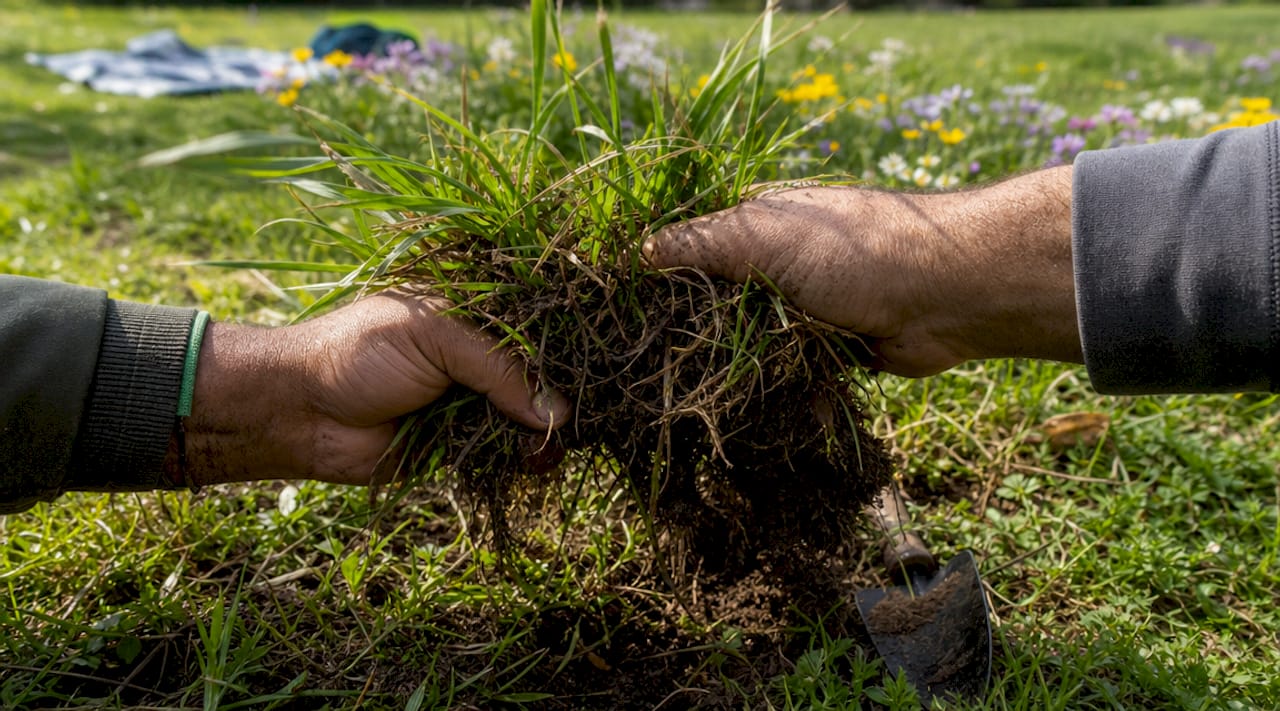
Thatch depth rounds out the core indicators. Thatch is the layer of dead organic matter between the grass blades and the soil surface. The ideal thatch layer is ½ inch or less. Anything thicker blocks water and nutrients from reaching the root zone, creating drought stress even when you are watering regularly.
Pro Tip: Part your grass with your fingers in several spots across the lawn. If you can see a spongy brown layer thicker than your thumbnail, you have a thatch problem worth addressing before the next growing season.
- Consistent green colour and dense growth signal a well-nourished lawn
- Soil pH between 6.0 and 7.0 is the target range for nutrient uptake
- 1 inch of water per week supports drought-resistant root development
- Grass that lifts easily during the tug test indicates root damage
- Thatch over ½ inch thick restricts water and nutrient absorption
What tools do you need to assess lawn quality?
The right tools make monitoring grass health fast and reliable. You do not need a professional kit. A small set of affordable items covers every core assessment.
- Soil test kit or lab submission. Consumer kits from garden centres measure pH and basic nutrient levels in minutes. For a deeper picture, a professional soil test every 2 to 3 years reveals micronutrients and organic matter content that consumer kits miss. Lab tests prevent the common mistake of over-applying amendments based on guesswork.
- Moisture metre. A basic probe metre costs under $20 at most hardware stores. Insert it 3 to 4 inches into the soil to get a reading. Anything below the “moist” range means your watering schedule needs adjustment.
- Screwdriver or soil probe. Push a standard screwdriver 6 to 8 inches into the soil. If it penetrates easily to that depth, compaction is not a problem. Resistance before 4 inches signals compaction that is blocking root growth and water infiltration.
- Lawn care scheduling app. Apps like Yardcast or Google Calendar reminders keep your monthly checks on schedule. Consistency matters more than any single test result.
| Tool | Purpose | Frequency of use |
|---|---|---|
| Soil test kit | Measures pH and basic nutrients | Every season |
| Professional lab test | Full nutrient and organic matter profile | Every 2 to 3 years |
| Moisture metre | Checks soil water content | Weekly during dry periods |
| Screwdriver or probe | Assesses soil compaction | Monthly |
| Tug test (hands only) | Evaluates root health | Monthly |
Pair these tools with a lawn care schedule built around Calgary’s growing season, and you will never miss a critical window for treatment or prevention.
How to conduct a monthly lawn health check
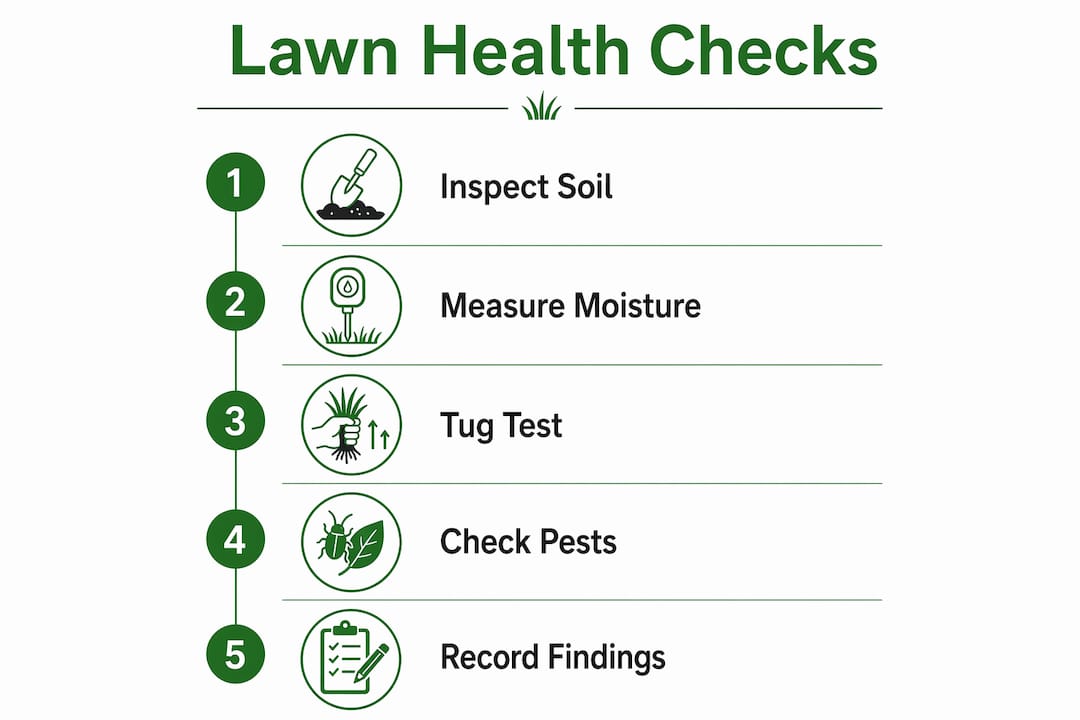
A monthly lawn health check does not need to be complicated. Follow these steps in order and you will cover every major indicator in under 15 minutes.
- Walk the full perimeter and interior. Look for bare patches, yellowing zones, or areas where grass is noticeably thinner. Note the location of any weeds, since heavy weed pressure often signals a nutrient or pH imbalance rather than a weed problem alone.
- Check grass colour and height uniformity. Pale yellow or lime-green patches often indicate nitrogen deficiency. Dark blue-green grass that wilts quickly in heat is a sign of drought stress. Refer to a lawn mowing height guide to confirm you are cutting at 3 to 4 inches, the optimal height for cool-season grasses in Calgary.
- Test soil compaction with a screwdriver. Push it into the soil in three to four locations across the lawn. Mark any spots where resistance stops the blade before 6 inches. Those areas need aeration.
- Measure soil moisture. Use your moisture metre in the same locations you tested for compaction. Compare readings to your recent watering schedule and adjust if the soil is consistently dry or waterlogged.
- Perform the tug test. Select five random spots and pull a small clump of grass firmly. Resistance means healthy roots. Easy lift-off means you need to investigate for grubs, fungal disease, or drought damage.
- Check thatch depth. Use a small trowel to cut a 2-inch cross-section of turf. Measure the brown spongy layer above the soil. Anything over ½ inch warrants dethatching before the next growing season.
Pro Tip: Keep a simple notes app or a paper log with the date, weather conditions, and findings from each monthly check. Patterns across three or four months reveal problems that a single inspection would miss entirely.
Spotting early signs of pest or disease damage is the final step. Circular brown patches, irregular discolouration, or a sudden increase in insect activity are all red flags. The Yearlong guide on identifying lawn pests covers Calgary-specific species and what to look for in each season.
How to interpret your findings and take action
Monitoring only delivers value when you act on what you find. Each indicator points to a specific response.
Nutrient deficiency shows up as yellowing or pale grass, particularly in patches. The fix is targeted fertilisation based on your soil test results, not a blanket application. Early spring nitrogen fertilisation often hurts root development, so timing matters as much as product choice. Use your soil test data to guide what you apply and when. A fertilisation guide for Calgary yards breaks down the timing and product types that work best in this climate.
Soil compaction requires aeration. Core aeration pulls small plugs of soil from the lawn, restoring air, water, and nutrient flow to the root zone. Schedule aeration in early spring or early fall for cool-season grasses. Do not aerate during drought stress or extreme heat.
Over- or under-watering is corrected by adjusting your cycle length and frequency. Deep, infrequent watering encourages roots to grow downward, which builds drought resistance over time. Shallow daily watering does the opposite.
Thatch over ½ inch calls for dethatching with a rake or a power dethatcher. The best time in Calgary is late summer or early fall, giving the lawn time to recover before winter. Dethatching in spring is possible but leaves the lawn vulnerable during its most active growth period.
When pest or disease damage is confirmed, professional treatment is often the most cost-effective response. Misidentifying the problem and applying the wrong product wastes money and can make the damage worse.
For persistent or widespread problems, a professional lawn care assessment gives you a precise diagnosis and a treatment plan grounded in your specific soil and grass type.
Key takeaways
Consistent monthly monitoring is the most cost-effective lawn care practice a homeowner can adopt, because it turns reactive fixes into planned maintenance.
| Point | Details |
|---|---|
| Start with core indicators | Check grass colour, soil pH, moisture, root health, and thatch depth every month. |
| Use the right tools | A soil test kit, moisture metre, and screwdriver cover every essential assessment. |
| Follow a monthly routine | A 10 to 15 minute monthly check during the growing season catches problems early. |
| Act on your findings | Match each finding to a specific response: aerate, fertilise, dethatch, or adjust watering. |
| Test soil professionally | Send a lab sample every 2 to 3 years for a full nutrient and organic matter profile. |
What consistent monitoring has taught me about lawn care
Most homeowners treat lawn care as a reaction to visible problems. The grass turns yellow, so they fertilise. It dries out, so they water more. That approach costs more and delivers worse results than a simple monthly routine.
What I have seen working with Calgary properties is that the lawns that look best in August are the ones whose owners paid attention in May. A single soil test in spring, combined with a monthly walk-through, tells you almost everything you need to know. You stop guessing and start making decisions based on what the soil and grass are actually telling you.
The most common pitfall I see is skipping the tug test and the compaction check because they feel unnecessary when the lawn looks fine. Those two tests catch the problems that are invisible on the surface but destructive underneath. Grub damage, for example, looks like drought stress until the turf peels back like a carpet. By then, the repair cost is significant.
The other mistake is treating monitoring as a one-time event. A single soil test from three years ago does not tell you what your lawn needs today. Calgary’s freeze-thaw cycles, variable rainfall, and clay-heavy soils shift conditions from year to year. A routine built around your complete lawn maintenance checklist keeps you ahead of those shifts rather than behind them.
Monitoring is not complicated. It is just consistent attention, applied at the right times.
— Lewie
Yearlong lawn care in Calgary: professional support for your monitoring

Yearlong provides professional lawn care services across Calgary that complement everything you do between monthly checks. Whether you need a soil assessment, seasonal aeration, or a full lawn care programme tailored to your property’s specific conditions, the Yearlong team brings local climate knowledge and hands-on experience to every visit. For homeowners managing larger properties or simply short on time, Yearlong’s bed maintenance and mowing services keep your lawn in peak condition through every stage of the growing season. Contact Yearlong to discuss a service plan that works alongside your monitoring routine.
FAQ
What are the signs of a healthy lawn?
Signs of healthy grass include consistent green colour, dense growth with no visible soil between blades, and turf that resists the tug test. Soil pH between 6.0 and 7.0 and a thatch layer under ½ inch are also strong indicators of good lawn health.
How often should I test my lawn soil?
Use a consumer soil test kit once per season to monitor pH and basic nutrients. Send a sample to a professional lab every 2 to 3 years for a detailed nutrient and organic matter profile that guides precise fertilisation decisions.
How do I know if my lawn has a compaction problem?
Push a screwdriver into the soil in several spots. If it meets resistance before reaching 6 inches, the soil is compacted and needs core aeration to restore water and nutrient flow to the root zone.
What is the best time to perform a lawn health check in Calgary?
Monthly checks during the growing season, from May through September, give you the most useful data. Early spring and early fall checks are the most critical, as they inform your aeration, fertilisation, and dethatching decisions for the season ahead.
How much water does a lawn need each week?
Established lawns need approximately 1 inch of water per week, applied in deep, infrequent cycles rather than light daily watering. Deep watering encourages roots to grow downward, which builds drought resistance through Calgary’s dry summer periods.