

TL;DR:
- Calgary’s year-round outdoor watering restrictions, combined with its short growing season and dry climate, make traditional lawns difficult to maintain. Homeowners are encouraged to choose drought-tolerant groundcovers and adapt their watering routines within city rules to ensure lawn health and compliance. Using proper species, soil amendments, and smart irrigation techniques can significantly improve drought resilience and reduce water use.
Calgary’s 2026 outdoor watering schedule now applies year-round, with fines for anyone who waters on the wrong day or at the wrong time, and a surprising number of homeowners are finding out the hard way. Between a short growing season, persistent dry spells, and stricter city rules, keeping your lawn green and healthy is genuinely harder here than in most Canadian cities. But the right knowledge and approach make all the difference. This guide breaks down exactly what you need to know about Calgary’s climate realities, how current regulations affect your watering routine, and which practical strategies give you the best results through every season.
Table of Contents
- Understanding Calgary’s unique lawn care climate
- The impact of city watering restrictions on local lawns
- Comparing traditional vs water-wise lawns in Calgary
- Practical solutions: Making your lawn thrive
- What most Calgary lawn guides don’t tell you
- Expert help for Calgary’s toughest lawn challenges
- Frequently asked questions
Key Takeaways
| Point | Details |
|---|---|
| Climate is a top challenge | Calgary’s cold zone and low rainfall make traditional lawns hard to sustain. |
| 2026 watering rules matter | Residents face new year-round restrictions and fines for improper watering. |
| Drought-tolerant lawns thrive | Choosing fescue or microclover reduces water needs and keeps yards healthy. |
| Adapting is essential | Practical changes like xeriscaping and smart irrigation are key for success. |
Understanding Calgary’s unique lawn care climate
Calgary is not your average Canadian city when it comes to lawn care. The city sits firmly in climate zone 3a, which means a short growing season, frequently cool nights, and dry stretches that can last for weeks. These aren’t minor inconveniences. They’re structural challenges that shape every single decision you make about your yard.
Most homeowners start with the same assumption: plant some grass, water regularly, fertilise in spring, and the lawn looks after itself. In Calgary, that model breaks down fast. The combination of low annual rainfall, intense summer sun, and chinook winds creates stress on lawns that many grass varieties simply aren’t built to handle.
The numbers tell the story clearly. Calgary’s average annual rainfall sits at just 412mm per year, which is significantly less than Toronto’s roughly 830mm or Vancouver’s 1,150mm. That gap is enormous when you’re trying to keep turf alive through a dry July or August.
Key climate facts every Calgary homeowner needs to know:
- Growing season: Roughly 120 to 140 frost-free days, shorter than most Canadian cities
- Rainfall: 412mm annually, concentrated unevenly across spring and summer months
- Chinook winds: Warm, dry winds that can strip moisture from soil rapidly in winter and early spring
- Temperature swings: Overnight lows can drop well below freezing even in May, stressing newly seeded lawns
- Hail risk: Late spring and early summer hail can physically damage established turf
“Calgary’s short Zone 3a growing season means traditional lawns face an uphill battle every year. The city actively promotes drought-tolerant alternatives like fescue, microclover, and xeriscaping for a reason.”
The practical upshot is that a standard Calgary maintenance checklist for Calgary will look very different from advice aimed at homeowners in milder climates. Your spring clean up advice needs to account for late frosts, and your seasonal care guide should be built around local realities, not generic national templates.
The impact of city watering restrictions on local lawns
Knowing the climate context, it’s easier to understand why Calgary’s new watering rules hit so hard. The 2026 watering schedule assigns watering days based on your street address: even-numbered addresses water on Tuesday, Thursday, and Saturday, while odd-numbered addresses water on Wednesday, Friday, and Sunday. Watering hours are restricted to 7 pm through 10 am to reduce evaporation. No watering is permitted midday, and the rules now apply throughout the year, not just in peak summer.
This matters more than it might first appear. If a dry stretch hits in late July and you can only water every second or third day within specific hours, your lawn is genuinely at risk. Traditional turf grasses, particularly Kentucky bluegrass, need consistent moisture to stay healthy. Restricted watering, layered on top of low rainfall, creates real drought stress.
The penalty structure makes compliance essential:
| Offence stage | Outcome |
|---|---|
| First offence | Educational warning issued |
| Second offence | $200 fine |
| Ongoing non-compliance | Additional fines and possible enforcement action |
The fine structure reflects the city’s serious approach to water conservation. A $200 penalty for watering on the wrong day is painful enough to pay attention to, and bylaw officers actively patrol neighbourhoods during summer months.
Here’s how to adapt your watering routine to stay compliant and protect your lawn:
- Install a smart irrigation timer that can be programmed to start at 7 pm and stop before the midday cutoff
- Water deeply and less frequently rather than lightly every day; this encourages deeper root growth
- Check your address number and post your watering days somewhere visible so the whole household knows the schedule
- Inspect your irrigation system at the start of each season; a leaking sprinkler running on the wrong day still counts as a violation
- Consider collecting rainwater in approved barrels to supplement on off-days without violating city rules
Pro Tip: Deep, infrequent watering trains roots to grow downward in search of moisture. Lawns with deep root systems tolerate dry stretches far better than those watered lightly every day. This single habit change can dramatically improve your lawn’s drought resilience without increasing your water use.
Consistent year-round maintenance that works within the city’s schedule is not just about compliance. It’s about building a lawn that can tolerate the gaps between watering sessions. Review lawn care basics regularly to ensure your routine matches the current regulatory environment.
Comparing traditional vs water-wise lawns in Calgary
Now that the watering challenge is clear, the natural next question is whether traditional lawns are even the right choice for Calgary properties anymore. The honest answer: for many homeowners, they’re not the best fit.
Traditional lawns, dominated by Kentucky bluegrass, are visually attractive and feel wonderful underfoot. But they’re also water-hungry, high-maintenance, and poorly adapted to Calgary’s dry, short growing season. Calgary’s climate pushes even well-maintained Kentucky bluegrass lawns toward drought stress every summer.
The city actively promotes alternatives for good reason. Here’s how the two main approaches compare:
| Feature | Traditional lawn (Kentucky bluegrass) | Water-wise lawn (fescue/microclover/xeriscaping) |
|---|---|---|
| Weekly water needs | High: 25mm or more | Low: 12mm or less |
| Tolerance for dry periods | Low to moderate | High |
| Mowing frequency | Weekly or more often | Every 2 to 3 weeks or less |
| Fertiliser requirements | High | Low to moderate |
| Seasonal colour retention | Good when well-watered | Consistent without heavy input |
| Suitability for Zone 3a | Moderate, with significant inputs | Excellent |
| City YardSmart recommendation | Not recommended | Strongly recommended |
The water savings alone are compelling. A water-wise lawn can use roughly half the water of a traditional Kentucky bluegrass lawn over a full growing season. Given Calgary’s watering restrictions and the lawn care benefits of reducing inputs, this matters both for your water bill and your lawn’s long-term health.
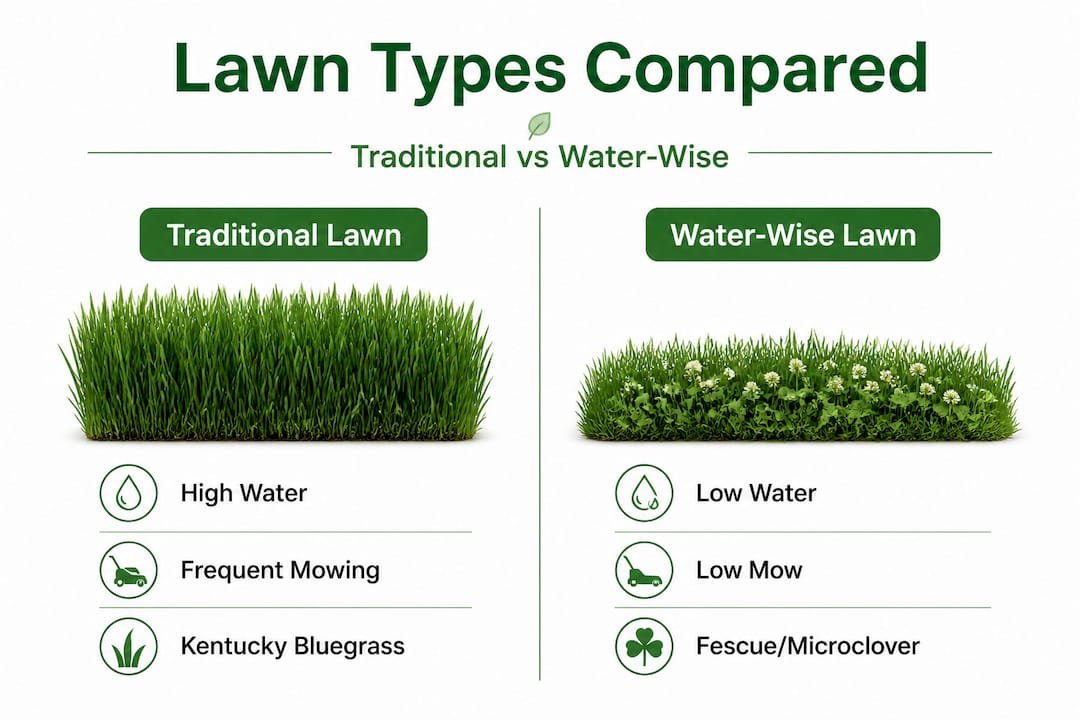
The most common misconception about drought-tolerant lawns is that they look scrappy or unkempt. That’s simply not true when properly established and maintained. Fine fescue blends are soft, attractive, and hold colour well through dry periods. Microclover mixed into an existing lawn adds nitrogen, suppresses weeds, and stays green even during dry stretches. Xeriscaped areas with native plants and decorative rock can genuinely improve your property’s kerb appeal.
Lawns that thrive in Calgary typically share a few important characteristics:
- Deeper roots: Encouraged by infrequent deep watering and appropriate mowing height (never below 7cm in summer)
- Adapted species: Grass types matched to Zone 3a conditions
- Healthy soil: Organically amended soil that retains moisture between watering sessions
- Minimal thatch: Regular dethatching prevents the spongy layer that blocks water penetration
“The reality in Calgary is that the lawns that look the best by late August are almost never the ones that were watered the most. They’re the ones that were set up to handle dryness from the beginning.”
Practical solutions: Making your lawn thrive
Armed with an understanding of Calgary’s challenges, here’s how to actually put better practices into place.
Start with your soil. Most Calgary yards have clay-heavy or alkaline soil that drains poorly or compacts easily. A basic soil test, available at local garden centres, tells you whether you need to amend with compost, sand, or a pH-balancing product. Healthy soil holds moisture better, which means less watering between your assigned days.
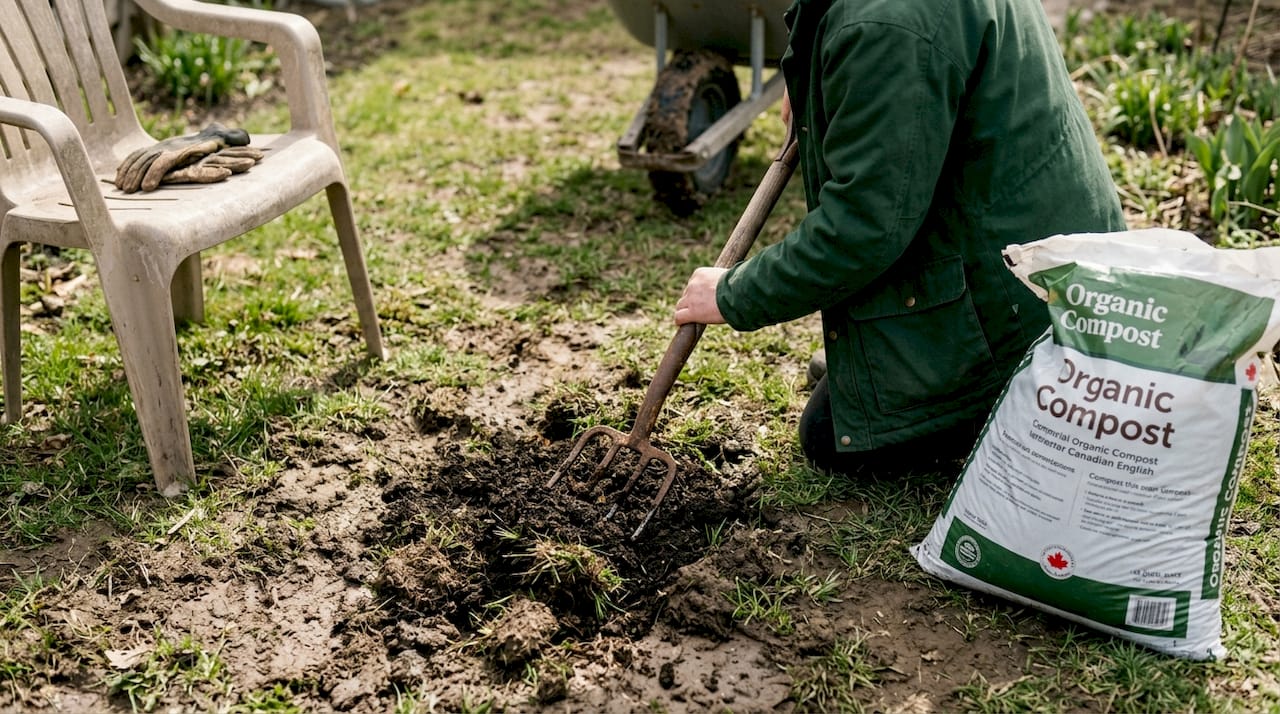
Choose the right groundcover. The City of Calgary’s YardSmart programme actively promotes microclover and fescue as superior choices over Kentucky bluegrass for local conditions. These aren’t compromises. They’re genuinely better options for this climate.
Practical recommendations for Calgary properties:
- Creeping red fescue or hard fescue for shaded or partially shaded areas
- Fine fescue blends for full-sun front lawns with good drainage
- Microclover mix (5 to 10% microclover seeded into existing lawns) to naturally fix nitrogen and improve drought tolerance
- Native groundcovers like buffalo grass or blue grama for very exposed, dry areas
- Xeriscaping zones near fences, pathways, or south-facing slopes where turf struggles most
Pro Tip: Overseed bare or thin patches in late August or early September rather than spring. Soil temperatures are still warm, which supports germination, and newly established grass has the entire cooler fall season to root in before winter arrives.
Plan your irrigation properly. Drip irrigation and soaker hoses are far more efficient than overhead sprinklers, and they work especially well for garden beds and low-growing groundcovers. For traditional turf areas, impact sprinklers set on timers reduce runoff and ensure water reaches the root zone rather than evaporating from the surface.
Eco-friendly Calgary tips worth adopting include leaving grass clippings on the lawn (grasscycling) to return moisture and nutrients to the soil, and mulching garden beds deeply (7 to 10cm) to reduce surface evaporation between watering sessions.
Don’t skip seasonal care. Spring and fall are the two most important maintenance windows for Calgary lawns. Seasonal landscaping tips should guide your spring prep and fall shutdown. A thorough spring yard clean up removes winter debris, aerates compacted soil, and gives new growth the best possible start. Fall prep tips for Calgary homeowners include overseeding, a final fertilisation with a low-nitrogen product, and cutting back ornamental plants before the first hard frost.
What most Calgary lawn guides don’t tell you
Here is what we’ve learnt from years of working on Calgary properties: most of the advice circulating online about lawn care is written for somewhere else. It assumes reliable summer rain, mild winters, and soil that cooperates. Calgary is none of those things, and following generic advice here often sets homeowners up for frustration.
The biggest myth we encounter is that a struggling lawn just needs more product: more fertiliser, more water, more weed killer. In reality, lawns that struggle in Calgary usually have a structural problem, whether that’s the wrong grass species, compacted soil, or a watering routine that doesn’t build root depth. Adding more product on top of a structural mismatch just creates additional expense without solving the underlying issue.
The lawn care benefits of getting the fundamentals right are compounding. A lawn that’s properly set up for Zone 3a conditions requires noticeably less time, money, and water to maintain than one constantly being rescued from stress. The best-looking yards in Calgary we’ve worked on are almost always blended landscapes, mixing some turf with native plants, mulched beds, and drought-tolerant groundcovers. Purists who insist on wall-to-wall Kentucky bluegrass spend the most and often see the worst results by late summer.
Timing is everything here. An action that makes perfect sense in May can be damaging in July. Fertilising during a heat wave, mowing too short before a dry stretch, or aerating during active drought stress can all set a lawn back significantly. Attentive observation and flexible timing outperform rigid schedules every single time.
Expert help for Calgary’s toughest lawn challenges
Calgary’s combination of strict watering rules, a short growing season, and demanding climate means there’s real value in working with someone who knows local conditions from the ground up.

At YearLong Property Maintenance, we’ve been helping Calgary homeowners and property managers navigate exactly these challenges since 2017. Our team understands the city’s watering bylaws, knows which grass varieties thrive in Zone 3a, and builds care programmes that work within the regulatory framework while keeping your property looking its best. Whether you need Calgary lawn care services, seasonal bed maintenance options, or want to follow a proven Calgary maintenance checklist with professional support, we’re ready to help. Contact us today to get your yard on the right track for the season ahead.
Frequently asked questions
How often can I water my lawn in Calgary under the 2026 rules?
You can water based on your street address: even numbers on Tuesday, Thursday, and Saturday; odd numbers on Wednesday, Friday, and Sunday, from 7 pm to 10 am.
What types of grass are best for Calgary’s dry climate?
Fescue and microclover are drought-tolerant alternatives that outperform Kentucky bluegrass in Calgary’s short, dry growing season.
What are the penalties for violating the watering schedule in Calgary?
After an initial educational warning, fines start at $200 for non-compliance with Calgary’s outdoor watering rules.
Is xeriscaping a good option for Calgary properties?
Yes, xeriscaping is actively recommended by the City of Calgary as a water-conservation strategy that suits the region’s short, dry growing season very well.