

TL;DR:
- Understanding property maintenance terms helps Calgary homeowners manage costs and meet legal requirements.
- Key terms like CAM, work orders, and true-up affect budgeting and contract clarity.
- Being informed enables proactive property management and better communication with service providers.
Not knowing the right property maintenance terms can cost you real money. In Calgary, fines up to $500 apply to homeowners who miss sidewalk snow clearing deadlines, and vague contract language leaves property managers exposed to unexpected bills every year. Whether you are dealing with a snow removal quote, a condo CAM charge, or a work order from a contractor, the words on that page carry serious weight. This guide walks you through the most important industry terms you will encounter in Calgary, breaks down what they mean in plain language, and shows you how to use that knowledge to protect your property, your budget, and your peace of mind.
Table of Contents
- What are industry terms in property maintenance?
- Essential terms every Calgary property owner should know
- How terminology impacts contracts, compliance, and costs
- Applying your knowledge: From confusion to confidence
- Our take: Why understanding the language is your secret advantage
- Ready to simplify your property maintenance?
- Frequently asked questions
Key Takeaways
| Point | Details |
|---|---|
| Know the top terms | Understanding property maintenance language prevents mistakes and surprises when managing Calgary properties. |
| Use terms to save money | Mastering concepts like CAM, preventive maintenance, and emergency response helps you budget, comply, and avoid fines. |
| Apply terms in practice | Leverage your new vocabulary to read contracts, talk with contractors, and make informed service choices. |
| Stay compliant | Timely snow clearing and maintenance compliance protects you legally and financially in Calgary. |
What are industry terms in property maintenance?
Property maintenance has its own vocabulary. Contractors, property managers, and city officials all use specific terms in their documents, and if you are not familiar with them, it is easy to sign something you do not fully understand or miss an obligation you did not know existed.
These terms appear in:
- Service contracts with lawn care and snow removal providers
- Bylaws and compliance notices from the City of Calgary
- Work orders and repair requests
- Condo or strata fee statements covering shared area costs
- Annual budget reports from property management companies
Familiarity with this language puts you in a stronger position. You can ask better questions, catch red flags in proposals, and hold your service providers accountable when something falls short. Think of it the same way you would approach reviewing a home insurance policy. The details matter and ignoring them does not make them go away.
A work order, for example, is a formal tenant or owner request for repairs that gets logged and tracked within a maintenance system. It sounds simple, but without a proper work order process, repair requests can fall through the cracks and leave you with no paper trail if something goes wrong.
“Knowing what you are signing is not about being difficult. It is about being informed enough to get the service you paid for.”
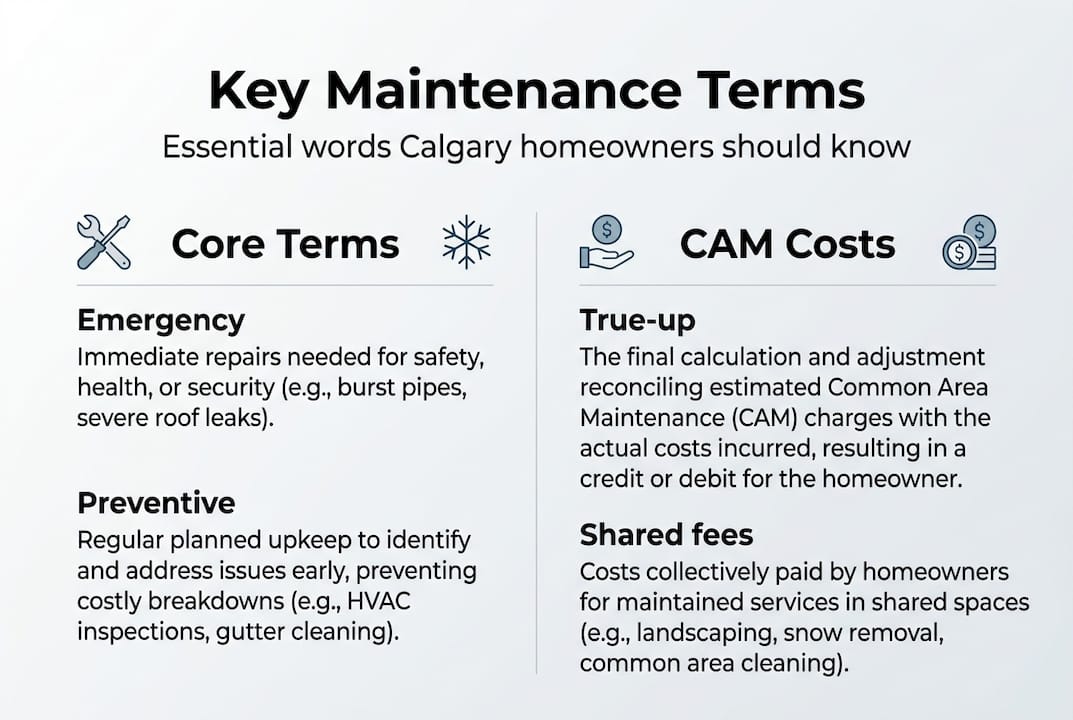
Other foundational terms include preventive maintenance (scheduled upkeep done before problems arise), emergency maintenance (urgent repairs needed immediately), and CAM (Common Area Maintenance, a cost-sharing arrangement common in condos and managed communities).
The good news is that once you learn these terms, applying them becomes second nature. You start spotting gaps in contracts, asking the right follow-up questions, and building better relationships with your service providers. For a strong starting point, review some property care tips specific to Calgary homeowners, and consider running through a maintenance checklist to see where your current gaps are.
Essential terms every Calgary property owner should know
Let us go deeper into the terms you are most likely to encounter when managing a Calgary property.
Key terms at a glance
| Term | What it means | Why it matters |
|---|---|---|
| Emergency maintenance | Urgent repairs for safety or habitability | Requires fast action and often costs more |
| Work order | Formal repair request tracked in a system | Creates accountability and a paper trail |
| CAM | Shared cost of maintaining common areas | Can affect your annual bill significantly |
| True-up | Reconciling estimated vs. actual costs | May result in unexpected year-end charges |
| Preventive maintenance | Scheduled upkeep before problems arise | Reduces emergencies and keeps costs stable |
Emergency maintenance is any repair that cannot wait. Burst pipes and gas leaks are classic examples and must receive a 24-hour response to protect safety and habitability. Emergency calls are almost always more expensive than planned repairs, which is exactly why understanding the term helps you budget and prepare accordingly. If your contract with a snow removal provider does not include emergency service terms, you may be left scrambling after a major storm. Learn more about snow removal tips to understand what a solid winter service plan looks like.
CAM (Common Area Maintenance) is the portion of shared outdoor costs, including landscaping and snow removal, that tenants or condo owners contribute to. CAM charges are estimated at the start of the year, then reconciled against actual expenses at year-end in what is called a true-up. If actual costs exceeded the estimate, you owe the difference. This can catch property managers off guard if they are not tracking it.
For urgent plumbing situations, bookmark a reliable emergency plumbing guide so you are never left guessing under pressure.
Pro Tip: Always ask your snow removal or lawn care provider for a written breakdown of what qualifies as an emergency under your contract. Not every company defines it the same way.
How terminology impacts contracts, compliance, and costs
The stakes become very real when you look at how these terms connect to money and legal responsibility.
Compliance risk: Snow removal in Calgary
Calgary’s sidewalk snow clearing rules are strict. Fines up to $500 apply when homeowners fail to clear adjacent sidewalks to a minimum width of 1.5 metres within 24 hours of snowfall ending. If your service contract does not explicitly include post-storm clearing timelines, you could be held responsible even if you hired a professional. Review snow removal standards to understand what a compliant service agreement should include.
CAM and year-end surprises
| Scenario | Estimated CAM | Actual CAM | True-up impact |
|---|---|---|---|
| Light winter | $1,200 | $980 | Credit of $220 |
| Heavy snowfall year | $1,200 | $1,750 | Owes $550 more |
CAM true-up caps on controllable expenses typically range from 3 to 5 percent annually, but if those caps are not written into your agreement, you have no protection against larger overruns. For multi-family property managers, this can translate to thousands of dollars in unexpected costs at year-end.
Preventive maintenance gaps
Skipping scheduled maintenance to save money in the short term almost always leads to higher emergency costs later. The lawn maintenance checklist approach applies here: doing the small stuff consistently prevents the big, expensive surprises.
Pro Tip: When reviewing a service contract, look for clauses that define response times, billing methods, and who is responsible for compliance-related tasks. Vague language in these areas is a red flag. You may also want a plumbing maintenance checklist on hand so your indoor systems stay as well managed as your outdoor ones.
Applying your knowledge: From confusion to confidence
Armed with this awareness, here is how to put these terms to work for your property starting today.
- Read every contract carefully. Before signing with any lawn care or snow removal provider, look for terms like emergency response time, CAM billing structure, and true-up procedures. If something is vague, ask for it to be defined in writing.
- Request formal work orders. Every repair or maintenance request should be documented. This protects you if a job is incomplete and gives you a record for future reference.
- Build a preventive maintenance schedule. Preventive maintenance should make up 65 to 80 percent of your total maintenance activity. That ratio keeps emergency calls low and your budget predictable.
- Check bylaw compliance independently. Do not assume your service provider is tracking Calgary’s snow clearing rules on your behalf. Confirm it is in the contract.
- Ask questions before problems arise. Talk to your contractor about what happens during a storm that falls outside regular service hours. Are extra charges involved? Is there an emergency line?
For a seasonal reset, the outdoor cleanup guide for Calgary homes is a practical resource to get your property prepared for each season. You might also find it useful to review how experienced landlords approach rental property prep so you can adapt those strategies to your own situation.
Pro Tip: Keep a simple binder or digital folder with copies of all your service contracts, work orders, and maintenance receipts. When a dispute arises or a bylaw notice arrives, you will have everything you need in one place.
Our take: Why understanding the language is your secret advantage
After years of working with Calgary homeowners and property managers, one pattern stands out clearly. Most fines, billing disputes, and missed maintenance tasks are not caused by negligence. They happen because of communication gaps, specifically because someone signed a contract without understanding what it said.
Knowing terms like CAM, true-up, and work order is not about sounding impressive at a meeting. It is about having the right leverage to demand accountability, question a bill, or push back on a service provider who is not meeting their obligations. Most contractors respect clients who know what they are talking about.
The real advantage is this: when you understand the language, you stop being reactive and start being proactive. You plan for the true-up before it hits. You confirm snow clearing timelines before the first storm arrives. You set up work orders so nothing slips through.
This is exactly the kind of thinking that preventative landscaping supports. Getting ahead of problems is always less expensive than responding to them. The vocabulary you have learned today is the first tool in that approach.
Ready to simplify your property maintenance?
Understanding industry terms puts you in control, but having a dependable team behind you makes the difference between stress and confidence every season.

At YearLong Property Maintenance, we keep our communication straightforward and our service consistent. Whether you need Calgary lawn care through the growing season or reliable Calgary snow removal every winter, we work with you to build a programme that matches your property’s needs and your budget. No confusing jargon, no surprise charges. Just dependable outdoor maintenance from a team that has been serving Calgary since 2017. Reach out today and let us take the guesswork out of property upkeep.
Frequently asked questions
What is emergency maintenance in property management?
Emergency maintenance covers urgent repairs such as burst pipes and gas leaks that affect safety or habitability and require a 24-hour response from your service provider or property manager.
Why should I care about CAM charges as a Calgary homeowner?
CAM charges determine your share of outdoor costs like landscaping and snow removal in shared communities, and annual true-ups adjust your bill to reflect actual versus estimated expenses.
How does preventive maintenance save me money?
Preventive maintenance reduces the frequency and cost of emergency calls by catching small issues before they become expensive problems, keeping your overall maintenance spend predictable.
When must snow be cleared in Calgary to avoid fines?
Homeowners must clear snow from adjacent sidewalks within 24 hours after snowfall ends, maintaining a minimum width of 1.5 metres, or risk fines up to $500 under Calgary’s snow clearing bylaw.
What is a work order in property maintenance?
A work order is a formal, documented request for repairs or maintenance that is tracked by your contractor or property manager to ensure the job is completed and recorded properly.
Recommended
- Residential property care tips for Calgary homeowners
- Boost property value and prevent damage with preventative landscaping
- Complete lawn maintenance checklist for Calgary homeowners 2026
- Yard Services Calgary | Yard Clean up Calgary
- Key Control: Protecting Access for Property Managers – A To Z Locksmith Inc