

Calgary’s fall is short, unpredictable, and unforgiving to lawns that aren’t prepared. For business owners managing outdoor spaces, the window between late summer and the first hard frost is the most critical period of the entire year. Skip the right tasks, or do them in the wrong order, and you’ll spend twice the money fixing problems in spring. Get it right, and 30% stronger root systems and a faster spring green-up are well within reach. This guide walks you through the exact timing, methods, and priorities you need to protect your property’s appearance and long-term lawn health.
Table of Contents
- Key timing and scheduling for fall lawn care
- Mowing, leaf management, and mulching essentials
- Aeration, overseeding, and dethatching for Calgary soils
- Preventing common fall and winter lawn problems
- Maximising spring success with smart fall preparation
- Our perspective: Why fall lawn care is non-negotiable in Calgary
- Upgrade your fall lawn care: Professional support for Calgary businesses
- Frequently asked questions
Key Takeaways
| Point | Details |
|---|---|
| Prioritise proper timing | Schedule all key fall tasks before the first frost for the best results. |
| Focus on soil health | Annual aeration and dethatching are essential for Calgary’s compacted, clay-heavy soils. |
| Don’t skip leaf management | Keep grass clear of heavy leaves to avoid snow mold and suffocation. |
| Fall work = spring gains | Well-prepared lawns in fall recover faster and stronger in spring with fewer issues. |
Key timing and scheduling for fall lawn care
Calgary’s climate doesn’t give you much room for error. The city typically sees its first frost anywhere from late September to mid-October, and once the ground freezes, your ability to do meaningful lawn work is essentially gone. Planning around that reality is the foundation of every good fall lawn care strategy.
The optimal timing for fall tasks runs from September 15 to October 31, before the first frost locks the soil. That six-week window is when grass roots are still actively absorbing nutrients, soil temperatures remain workable, and seed germination is still possible. Start too early in August and the heat can stress newly seeded areas. Wait until November and you’ve missed the boat entirely.
Here’s a practical checklist of what to do and when:
- Mid-September: Aerate and overseed, dethatch if needed, apply fall fertiliser
- Late September: Final mowing sessions, begin leaf management
- Early October: Complete overseeding, continue raking and mulching
- Late October: Last mow of the season, final leaf removal, winterise irrigation
Following fall mowing guidelines specific to Canadian climates helps you avoid cutting too short before winter, which leaves grass vulnerable to frost damage. Pair that with Calgary overseeding timing to fill in thin patches before the ground closes. Lawns that receive this structured fall attention consistently outperform those that don’t, showing noticeably thicker, greener growth the following May.
Mowing, leaf management, and mulching essentials
Once you know your timeline, the next step is executing the right actions in the right way. Mowing and leaf management are two areas where small mistakes create big problems come spring.
Continue mowing until growth stops, keeping grass at 2 to 2.5 inches heading into winter. Grass left too long traps moisture and creates the perfect environment for snow mold. Cut it too short and the roots lose their insulating layer. That 2 to 2.5 inch range is the sweet spot for Calgary’s winters.
For leaves, the goal is simple: don’t let them sit. A thick layer of wet leaves blocks sunlight, traps moisture, and suffocates the grass beneath. Rake and mulch leaves regularly to prevent suffocation and snow mold from taking hold before the first snowfall.
Here’s a step-by-step approach to leaf management:
- Rake leaves into rows before they become wet and matted
- Run a mulching mower over dry leaves to shred them finely
- Leave a thin layer of shredded leaf material as a natural soil amendment
- Bag and remove any thick accumulations that can’t be fully shredded
- Do a final sweep in late October before the last mow
Finely shredded leaves can return valuable organic matter to the soil, but only when the layer is thin enough for air and light to pass through. Thick, unshredded mats do the opposite.
Pro Tip: If your property has heavy tree coverage, consider leaf mulching strategies that combine mowing and raking to save time without sacrificing lawn health. Professional mowing services can handle the final cuts and leaf work together, making the process far more efficient for busy business owners.
Aeration, overseeding, and dethatching for Calgary soils
Below the surface is where fall lawn care really earns its keep. Calgary’s soil is notoriously clay-heavy, which means it compacts easily under foot traffic and equipment. Compacted soil restricts the movement of water, air, and nutrients to grass roots. Annual aeration is not optional here. It’s essential.
Aerating in fall relieves compaction, improves root oxygen, and creates the ideal conditions for overseeding. The small plugs pulled from the soil also give new seed direct contact with the earth, dramatically improving germination rates. Mid-September to mid-October is the ideal window, when soil is moist but not frozen.
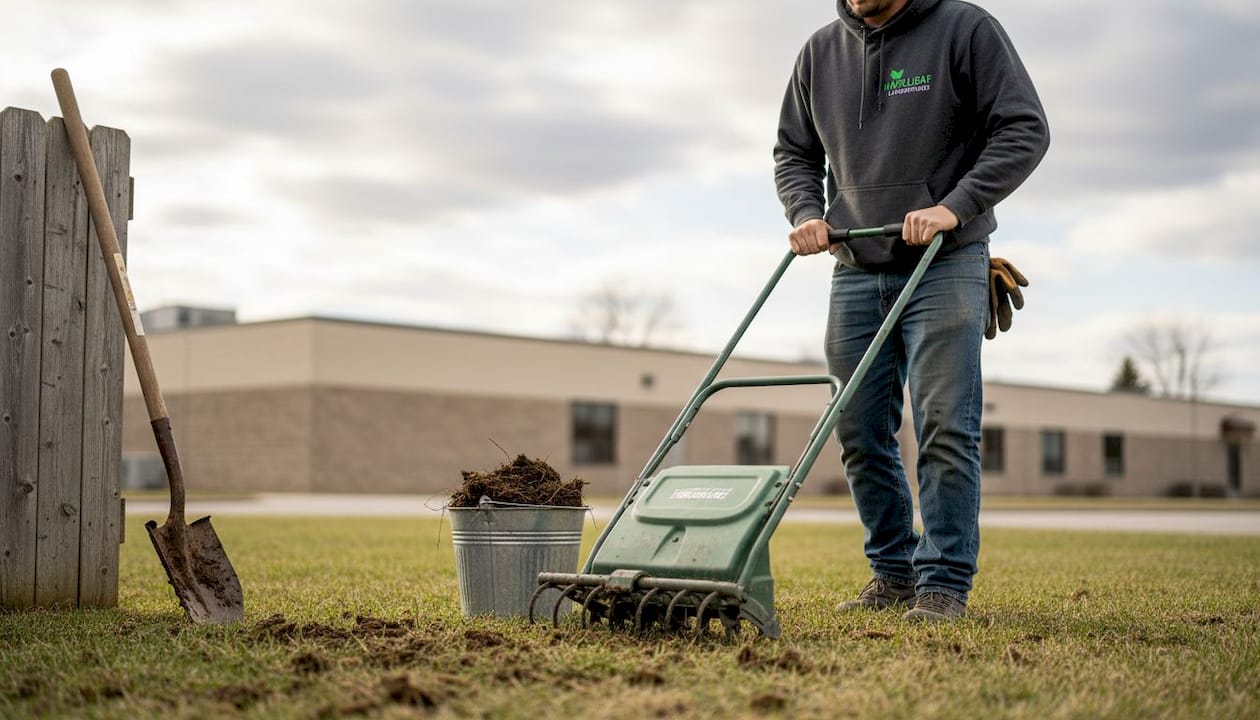
Dethatching in early fall removes the layer of dead organic material that builds up between the grass blades and the soil. More than half an inch of thatch starts to block water and fertiliser from reaching the roots. Power raking before you aerate and overseed gives everything that follows a much better chance of success.
Here’s a comparison of the three core soil health tasks:
| Task | Primary benefit | Best timing | Risk if skipped |
|---|---|---|---|
| Aeration | Relieves compaction, improves drainage | Mid-Sept to mid-Oct | Thin, weak spring growth |
| Dethatching | Removes thatch barrier | Early fall | Poor fertiliser uptake |
| Overseeding | Fills bare patches, thickens turf | Mid-Sept to mid-Oct | Thin, patchy lawn in spring |
For more on Calgary soil needs and how to address them, the City of Calgary’s own lawn care resources are worth reviewing. You can also explore overseeding Calgary lawns and Calgary yard aeration tips for local-specific guidance.
Preventing common fall and winter lawn problems
Even with a solid fall routine in place, a few specific threats can undo your work if you’re not watching for them. Snow mold is the most common and damaging issue Calgary business lawns face after a long winter.
Snow mold is a fungal disease that develops under snow cover, particularly where leaves, long grass, or thick thatch have been left behind. It shows up in spring as circular grey or pink patches of matted, dead grass. Preventing snow mold comes down to avoiding thick leaf mats, mowing at the correct height, and ensuring good air circulation across the lawn surface before snow arrives.
Here’s how to spot the difference between snow mold and other common issues:
| Problem | Appearance | Cause | Season |
|---|---|---|---|
| Snow mold | Circular grey/pink patches | Fungal growth under snow | Early spring |
| Drought stress | Brown, dry, uniform areas | Lack of moisture | Late summer/fall |
| Compaction damage | Thin, sparse growth | Heavy foot traffic | Year-round |
| Pest damage | Irregular dead patches | Grubs or insects | Late summer |
To reduce the risk of disease and pest outbreaks:
- Remove all leaf accumulations before the first snowfall
- Mow to the correct height for your final cut of the season
- Avoid walking on frost-covered grass, which damages cell structure
- Keep irrigation off once temperatures consistently drop below 5°C
- Clear debris from lawn edges and beds to prevent moisture traps
Pro Tip: Scheduling a thorough Calgary yard clean up in late October gives your lawn the best possible starting conditions when snow melts in spring.
Maximising spring success with smart fall preparation
Everything you do in fall is really an investment in spring. Grass roots don’t go dormant the moment temperatures drop. They continue storing energy and carbohydrates well into late fall, building reserves that fuel the first burst of green growth when temperatures rise again.
Fall prep consistently outperforms spring-only care for root strength and reduces the need for chemical inputs the following season. Business owners who invest in fall aeration, overseeding, and cleanup routinely report fewer bare patches, less moss, and a noticeably greener lawn by mid-May.
Here’s what a well-executed fall programme delivers by next spring:
- Thicker turf density from overseeding filling in bare and thin areas
- Faster green-up because roots stored more energy through winter
- Reduced weed pressure since dense turf leaves less room for weeds to establish
- Lower fertiliser costs because healthy soil needs less chemical correction
- Better drainage from aeration reducing compaction and runoff
- Fewer disease issues because snow mold and fungal risks were addressed proactively
The return on a few hours of fall lawn work is significant. For business properties where curb appeal directly affects how clients and customers perceive your brand, a patchy, struggling lawn in May is a real cost. Connecting with expert fall prep services early in the season ensures nothing gets missed in that critical six-week window.
Our perspective: Why fall lawn care is non-negotiable in Calgary
After years of working on Calgary properties, we’ve seen a consistent pattern. Business owners who focus only on spring lawn care spend more money, deal with more problems, and get worse results than those who prioritise fall. It’s not even close.
The most common myth we encounter is that spring is when lawns need the most attention. In reality, spring is when you see the results of what you did in fall. By the time bare patches and snow mold appear in April, the damage was done six months earlier.
High-traffic business lawns are especially vulnerable. Foot traffic compacts soil faster than residential properties, and without annual aeration and overseeding, the turf thins out progressively each year. We’ve seen commercial properties go from lush to patchy in just two seasons of skipped fall care.
The full annual lawn checklist we recommend treats fall as the foundation of the entire year. Spring is maintenance. Fall is investment. That shift in thinking changes everything about how you manage your outdoor spaces.
Upgrade your fall lawn care: Professional support for Calgary businesses
Fall lawn care done right takes time, the right equipment, and local knowledge of Calgary’s soil and climate. For business owners already managing a full schedule, that combination is hard to pull together on your own.

Working with a local professional means your aeration, overseeding, mowing, and cleanup all happen at exactly the right time, with no guesswork. YearLong Property Maintenance has been serving Calgary businesses since 2017, handling everything from Calgary lawn care services to full Calgary fall clean up programmes. We know what Calgary lawns need because we work on them every season. Reach out today to build a fall plan that protects your property and sets you up for a strong spring.
Frequently asked questions
When should I schedule fall lawn aeration in Calgary?
Plan aeration for mid-September to mid-October, when soil is moist and workable before the first frost arrives.
How can I prevent snow mold on my business lawn?
Regularly mow at 2 to 2.5 inches, remove thick leaf mats, and ensure good air circulation. Preventing snow mold before the first snowfall is far easier than treating it in spring.
Is mulching leaves good for Calgary business lawns?
Finely mulched leaves add nutrients back into the soil, but thick unshredded layers trap moisture and promote disease, so always shred finely and avoid heavy accumulations.
Why does fall prep matter more than spring for lawn health?
Fall prep builds root strength and reduces disease and chemical needs the following season, delivering results that spring-only care simply cannot match.