

Your Calgary lawn deserves better than patchy, yellowing grass after fertilisation attempts. Many homeowners struggle with timing, product selection, and application methods, leading to disappointing results and wasted effort. This comprehensive guide delivers a clear, seasonally adapted fertilisation process tailored to Calgary’s unique climate, transforming your lawn into the vibrant green space you envision.
Table of Contents
- Prerequisites: Soil Testing And Preparation
- Step 1: Timing Of Fertilisation For Calgary Lawns
- Step 2: Fertiliser Selection
- Step 3: Application Rates And Method
- Step 4: Post-Application Care
- Common Mistakes And Troubleshooting
- Alternative Approaches And Tradeoffs: Organic Vs Synthetic Fertilisers
- Expected Outcomes And Maintenance Schedule
- Discover Expert Lawn Care Services Tailored For Calgary
- Frequently Asked Questions
Key takeaways
| Point | Details |
|---|---|
| Soil testing first | Test pH and nutrients before fertilising to target actual deficiencies and avoid waste. |
| Perfect timing | Start in early May during evening hours to align with grass growth cycles and reduce evaporation. |
| Right fertiliser ratio | Use 20-5-10 N-P-K formulations designed for Calgary’s cool-season grasses. |
| Precise application | Apply evenly at recommended rates to prevent lawn burn and environmental harm. |
| Post-care essentials | Water within 24 hours to boost nutrient absorption and limit foot traffic immediately after. |
Prerequisites: soil testing and preparation
Before spreading any fertiliser, you need to understand what your lawn actually requires. Soil pH and nutrient testing ensures you address real deficiencies rather than guessing, saving money and protecting your grass from unnecessary chemical exposure.
Local Calgary labs and DIY soil test kits both deliver reliable results. Test for pH levels and key nutrients like nitrogen, phosphorus, and potassium in early spring. This timing gives you several weeks to make amendments, such as adding lime to correct overly acidic soil, before the May fertilisation window opens.
Measure your lawn area accurately using a measuring tape or smartphone app. Multiply length by width for rectangular sections, and break irregular shapes into smaller zones. Accurate measurements prevent over-application that burns grass or under-application that wastes your effort.
Pro Tip: Store soil test results from year to year to track how amendments and fertilisation programmes change your lawn’s nutrient profile over time.
- Confirm pH falls between 6.0 and 7.0 for optimal nutrient uptake
- Adjust acidic soil with lime applications at least four weeks before fertilising
- Correct nutrient deficiencies identified in test results with targeted amendments
- Calculate total lawn square footage to determine fertiliser quantities needed
Professional lawn care services can handle testing and preparation if you prefer expert analysis and soil conditioning before fertilisation begins.
Step 1: timing of fertilisation for Calgary lawns
Timing determines whether your fertiliser investment pays off or evaporates into thin air. Early May marks the optimal start for Calgary fertilisation, coinciding with active grass growth as soil temperatures rise above 10°C consistently.
Evening application between 6 PM and 8 PM reduces nutrient loss through evaporation and runoff. Cooler temperatures and reduced wind allow fertiliser granules to settle properly, and overnight dew helps activate nutrients before morning sun intensity peaks.
Avoid fertilising during extreme heat waves or drought periods when grass enters survival mode. Stressed lawns cannot absorb nutrients effectively, leading to waste and potential chemical damage. Similarly, skip late-autumn applications after mid-September when cool-season grasses prepare for dormancy.
Quarterly fertilisation maintains consistent lawn density and colour throughout Calgary’s growing season. Plan applications for early May, late June, mid-August, and early September to support continuous growth without overwhelming grass during temperature extremes.
- Monitor long-range weather forecasts to avoid fertilising before heavy rainfall
- Wait until grass actively grows in spring before first application
- Never fertilise frozen or snow-covered ground
- Space applications 8 to 10 weeks apart for balanced nutrition
Combine fertilisation with seasonal tasks covered in our Calgary lawn spring clean up tips for comprehensive early-season lawn preparation.
Step 2: fertiliser selection
Calgary’s cool-season grasses, primarily Kentucky bluegrass and fescue blends, thrive with balanced nutrition favouring nitrogen for blade growth. A 20-5-10 N-P-K ratio provides the nitrogen boost these grasses need whilst supporting root development and disease resistance.
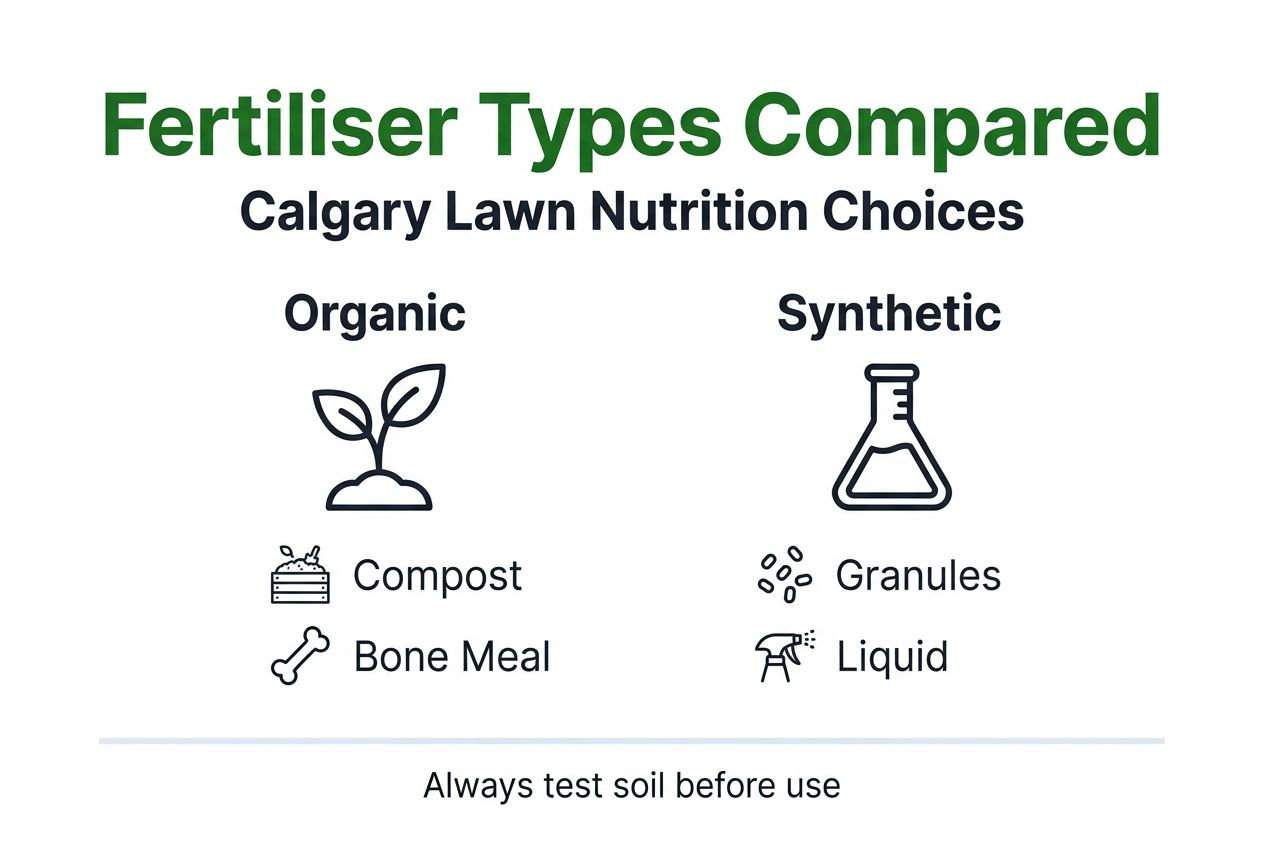
Synthetic fertilisers deliver rapid greening within two weeks but carry higher environmental risks. Water-soluble formulations can leach into storm drains during heavy rainfall, contributing to waterway pollution. Slow-release synthetic options reduce this risk whilst maintaining quick visible results.
Organic alternatives like composted manure or bone meal release nutrients gradually over months, improving soil structure and microbial activity. Results appear slower, often taking four to six weeks, but environmental impact remains minimal and soil health improves long-term.
Local garden centres in Calgary stock fertilisers formulated for prairie climate conditions. These products account for alkaline soil tendencies common in the region and temperature fluctuations during the growing season.
Pro Tip: Check fertiliser labels for slow-release nitrogen content, ideally 30% or higher, to extend nutrient availability and reduce application frequency.
| Fertiliser Type | Pros | Cons |
|---|---|---|
| Synthetic | Fast results, precise nutrient ratios | Higher runoff risk, soil microbiome impact |
| Organic | Environmentally friendly, improves soil health | Slower visible results, variable nutrient content |
| Slow-release synthetic | Balanced speed and longevity | Moderate cost, still some environmental concern |
Explore comprehensive nutrient management in our essential Calgary lawn maintenance tips for year-round lawn health strategies.
Step 3: application rates and method
Precise application protects your lawn from chemical burn whilst maximising nutrient uptake efficiency. The standard safe rate is 1 lb nitrogen per 1000 sq ft, which translates to roughly 5 lbs of 20-5-10 fertiliser per 1000 square feet.
Broadcast spreaders distribute granules evenly across large areas, whilst drop spreaders offer precision for smaller lawns or tight spaces near flower beds. Calibrate your spreader according to manufacturer instructions, running a test pass over pavement to verify spread pattern before touching grass.
Apply fertiliser in overlapping passes following a consistent pattern. Walk at steady pace to maintain even distribution, and avoid double-passing areas which concentrates nutrients dangerously. Mark your path with flags or natural landmarks to prevent missed strips or overlap confusion.
Choose dry grass and calm weather conditions for application. Wet blades cause granules to stick and burn foliage, whilst wind scatters product into flower beds, driveways, and neighbouring properties.
Pro Tip: Sweep any fertiliser that lands on pavement back onto the lawn immediately to prevent storm drain contamination and wasted product.
- Calculate exact fertiliser quantity needed using lawn square footage and product label rates
- Fill spreader on pavement or tarp to contain spills for easy cleanup
- Set spreader to half the recommended rate for first pass
- Apply second pass perpendicular to first at remaining half rate for even coverage
- Clean spreader thoroughly after use to prevent corrosion and product contamination
Integrate fertilisation with garden care practices outlined in our bed maintenance guide to create cohesive outdoor nutrition strategies.
Step 4: post-application care
Fertiliser activation requires moisture to dissolve granules and carry nutrients into the root zone. Watering within 24 hours boosts absorption by up to 40%, preventing nutrient loss and maximising your investment.
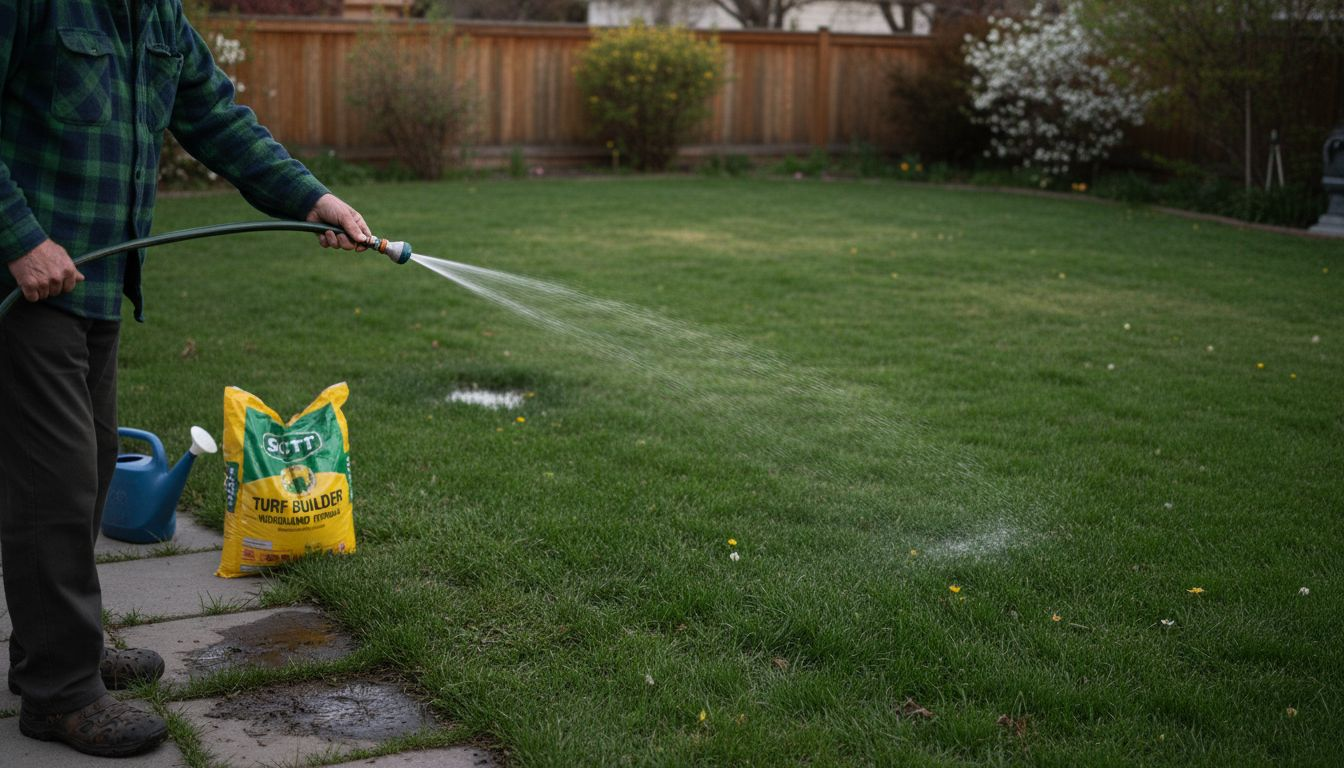
Apply half an inch of water through sprinklers or natural rainfall to activate fertiliser without causing runoff. Deep watering encourages roots to grow downward, creating drought-resistant turf that withstands Calgary’s dry summer periods.
Limit foot traffic for 24 to 48 hours after fertilisation. Walking on freshly treated grass can dislodge granules before they dissolve and compact soil, reducing water penetration and nutrient movement.
Monitor your lawn for over-fertilisation signs including rapid yellowing, brown patch development, or excessive blade growth. If symptoms appear, flood the area with water immediately to dilute concentrated nutrients and prevent permanent damage.
Watering stands as the single most critical post-fertilisation step. Without adequate moisture, granules remain inactive on soil surface, vulnerable to wind dispersal and foot traffic displacement.
- Check weather forecasts and delay fertilising if heavy rain exceeds half an inch within 24 hours
- Water early morning after evening fertilisation to reduce evaporation loss
- Observe grass colour changes weekly to gauge fertiliser effectiveness
- Document application dates and results to refine future fertilisation schedules
Professional services detailed in our expert lawn care services handle all post-application monitoring and adjustments for optimal results.
Common mistakes and troubleshooting
Homeowners frequently skip the crucial soil testing step, leading to nutrient imbalances that reduce lawn health rather than improving it. Skipping soil testing often causes deficiencies to persist whilst adding unnecessary nutrients that wash into waterways.
Fertilising too early in spring, before soil temperatures stabilise above 10°C, wastes product as dormant grass cannot absorb nutrients. Late-season applications after mid-September similarly fail as cool-season grasses enter dormancy preparation.
Over-application remains the most damaging error. Exceeding recommended rates creates salt accumulation that draws moisture from grass roots, causing brown patches and thinning. Always measure lawn area accurately and follow product label instructions precisely.
Neglecting post-application watering leaves granules sitting on soil surface where they provide no benefit. Wind, foot traffic, and mowing scatter inactive fertiliser, creating uneven nutrition and potential environmental contamination.
- Test soil every two years minimum to track changing nutrient needs
- Mark fertilisation dates on calendars to maintain consistent quarterly schedules
- Store unused fertiliser in sealed containers away from moisture to prevent clumping
- Adjust future application rates based on grass response and soil test results
- Address yellow patches immediately with deep watering before permanent damage occurs
Review our Calgary lawn spring clean up tips to coordinate fertilisation with seasonal maintenance tasks for best results.
Alternative approaches and tradeoffs: organic vs synthetic fertilisers
Environmental priorities and result timelines drive fertiliser selection decisions. Organic options minimise runoff into Calgary’s storm systems whilst building long-term soil health through microbial activity and organic matter addition. However, visible greening takes four to six weeks compared to synthetic formulations showing results within 10 to 14 days.
Synthetic fertilisers deliver precise nutrient ratios and predictable performance, making them ideal for correcting specific deficiencies identified through soil testing. The trade-off involves higher environmental impact risk and potential soil microbiome disruption with repeated use.
Many homeowners blend approaches, using synthetic products for quick spring green-up and organic options for summer and autumn maintenance. This balanced strategy provides immediate aesthetic results whilst building soil quality over multiple seasons.
Cost considerations also influence choice. Synthetic fertilisers typically cost less per application but require more frequent use. Organic alternatives carry higher upfront costs but improve soil structure, reducing long-term fertiliser dependency.
| Consideration | Organic Fertilisers | Synthetic Fertilisers |
|---|---|---|
| Result speed | 4 to 6 weeks | 10 to 14 days |
| Environmental impact | Minimal runoff, builds soil health | Higher runoff risk, microbiome concerns |
| Cost per application | Higher upfront | Lower upfront |
| Nutrient precision | Variable, depends on source | Exact ratios |
| Long-term soil benefit | Significant improvement | Minimal to none |
- Evaluate personal priorities regarding speed, cost, and environmental stewardship
- Consider starting synthetic and transitioning to organic as soil health improves
- Match fertiliser type to lawn condition and immediate needs
- Track results from both approaches to determine best fit for your property
Comprehensive lawn nutrition strategies appear in our essential Calgary lawn maintenance tips covering all aspects of turf health.
Expected outcomes and maintenance schedule
Visible lawn transformation typically appears four to six weeks after proper fertilisation. Grass blades darken to rich green, density increases as new shoots emerge, and overall vigour improves noticeably. Quarterly fertilisation can increase density and greenness by up to 25% by late summer compared to unfertilised lawns.
Consistent quarterly scheduling maintains these improvements throughout Calgary’s growing season. Plan applications around key growth periods whilst avoiding stress periods during extreme heat or preparation for dormancy.
| Season | Timing | Purpose |
|---|---|---|
| Spring | Early May | Stimulate growth after dormancy, green-up |
| Early Summer | Late June | Maintain colour and density during peak growth |
| Late Summer | Mid-August | Support recovery from heat stress, prepare for autumn |
| Early Autumn | Early September | Strengthen roots before winter dormancy |
Monitor grass colour, density, and growth rate between applications. Adjust fertiliser amounts or timing based on observed results and changing weather patterns. Drought conditions may require skipping a planned application, whilst cool, wet summers might benefit from slight rate increases.
Combine fertilisation with proper mowing height and frequency for synergistic results. Taller grass shades soil, reducing water evaporation and supporting deeper root growth that maximises fertiliser uptake.
Pro Tip: Take photos of your lawn before first fertilisation and monthly thereafter to document improvements and identify problem areas requiring special attention.
- Record each application date, product used, and weather conditions
- Note visible results timing to refine future fertilisation schedules
- Adjust autumn fertilisation based on first frost date predictions
- Coordinate fertilisation with aeration for enhanced nutrient penetration
Integrate fertilisation timing with cutting schedules covered in our seasonal lawn mowing in Calgary guide for complete turf management.
Discover expert lawn care services tailored for Calgary
Whilst this guide equips you with complete fertilisation knowledge, professional execution saves time and eliminates uncertainty. Yearlong offers comprehensive lawn fertilisation services adapted specifically to Calgary’s climate challenges and soil conditions.

Our team handles soil testing, custom fertiliser selection, precise application, and post-care monitoring throughout the growing season. We combine fertilisation with coordinated lawn care programmes including mowing, aeration, and weed control for complete turf health management.
Professional-grade equipment ensures even distribution at calibrated rates, whilst our seasonal schedules align applications with optimal grass growth windows. Whether you need full-service programmes or supplemental support for DIY efforts, our flexible packages adapt to your preferences and budget.
Experience the difference professional care makes. Our bed maintenance and seasonal clean up services integrate seamlessly with lawn fertilisation for cohesive outdoor property enhancement.
Frequently asked questions
What is the best time of day to fertilise my Calgary lawn?
Early evening between 6 PM and 8 PM provides optimal conditions. Cooler temperatures reduce evaporation whilst overnight dew helps activate granules before morning sun intensity peaks.
How often should I fertilise my lawn in Calgary?
Quarterly applications in early May, late June, mid-August, and early September support sustained greening and density. This schedule aligns with active growth periods whilst avoiding stress from temperature extremes.
Can I use organic fertiliser instead of synthetic?
Organic fertilisers work excellently for environmentally conscious homeowners willing to wait four to six weeks for results. They reduce runoff concerns and improve soil health, though they lack the rapid greening synthetic options provide.
What are signs of over-fertilisation and how do I fix them?
Yellowing blades, brown patches, and excessive growth indicate over-application. Immediately flood affected areas with water to dilute concentrated nutrients, and avoid further fertilisation until grass recovers completely over two to three weeks.
Why is soil testing crucial before fertilising?
Testing identifies your lawn’s specific nutrient deficiencies and pH imbalances unique to your property. This enables targeted fertiliser selection that addresses actual needs rather than applying generic products that may worsen existing imbalances or waste resources.
2 Responses