

A well-maintained xeriscape in Calgary runs on three priorities: watering new plants through their establishment window, keeping mulch at the right depth, and grouping plants by water needs from day one. Get those three right and the workload drops sharply after year two or three. The City of Calgary’s YardSmart programme is clear that perennials typically need extra watering for the first few years, and shrubs for several years, before rainfall carries most of the load. After that, a xeriscape genuinely earns its low-maintenance reputation.
Three things to do this week:
- Sketch your yard and mark which areas stay wet, which stay dry, and where sun hits longest.
- Check mulch depth across all beds and top up any spots where mulch is thinner than recommended depth.
- Confirm whether your irrigation system is connected to the City water supply and review the Calgary watering schedule so your timer settings are already compliant.
Pro Tip: The single most common early mistake is skipping weed sweeps in May and June. Weeds that root into fresh mulch compete directly with establishing plants for moisture, which forces you to water more, not less. Catch them before they set seed.
Key takeaways
A well-designed Calgary xeriscape, maintained through the establishment window with correct mulch depth and hydrozoned irrigation, becomes genuinely low-maintenance by year three.
| Point | Details |
|---|---|
| Establishment window | Perennials need extra watering for 1–2 years; shrubs for 2–3 years before rainfall suffices. |
| Mulch depth | Apply 5–10 cm of wood chip or bark mulch; keep it clear of stems and crowns. |
| Hydrozoning | Group plants by water needs and assign separate irrigation zones to simplify restriction-stage adjustments. |
| City compliance | Calgary’s watering schedule applies to all City-connected systems; four restriction stages can override it at any time. |
| Yearlong | Yearlong offers Calgary bed maintenance packages that taper with the establishment cycle, from intensive first-year care to seasonal visits. |
Table of Contents
- What does xeriscaping maintenance in Calgary look like season by season?
- How do you water new xeriscape plantings in Calgary?
- What soil and mulch does a Calgary xeriscape need?
- How do you remove lawn and build xeriscape beds?
- How do you comply with Calgary’s irrigation rules?
- How do you prune, divide, and manage pests in xeriscape beds?
- How do you winterise a Calgary xeriscape?
- When should you hire a professional for xeriscape care?
- A local perspective on what actually works
- Yearlong handles the establishment work so you don’t have to
- Sources
What does xeriscaping maintenance in Calgary look like season by season?
Calgary’s growing season runs roughly April through October, with hard frosts possible into late May and returning by late September. Each season has a short window of high-value tasks.
Spring (April to June)
Spring is the busiest maintenance window, especially during the first three years of establishment.
- Rake out any winter debris and remove dead foliage you left for insulation (see the winterising section for why you left it).
- Do a full weed sweep before weeds set root, ideally when soil is just moist enough to pull cleanly.
- Check mulch depth and top up where winter has thinned it.
- Inspect irrigation lines for frost damage before turning the system on.
- For a spring yard cleanup that sets beds up well for the season, timing matters: aim for the last two weeks of April once overnight temperatures stay above freezing.
For a typical garden bed, a thorough spring cleanup typically takes under an hour: 15 minutes for debris and foliage removal, 20 minutes for weeding, and 10–15 minutes for mulch top-up.
Summer (July to August)
Once plants are established, summer tasks are light. During the establishment window, watering is the main job.
- Water new perennials to about 2.5 cm per week; check soil moisture 2–5 cm down at the base of roots.
- Spot-weed every two to three weeks, focusing on the mulch edges where seeds blow in.
- Watch for signs of heat stress: leaf curl, wilting in the morning (not just midday), or yellowing at the base.
- Confirm your irrigation timer is set to comply with the City’s watering schedule and check for any restriction stage announcements.
Fall (September to October)
Fall is about protecting what you built, not adding to it.
- Water shrubs deeply before the ground freezes, particularly any planted in the last two to three years.
- Pull invasive weeds before they drop seed for spring.
- Refresh mulch in thin spots but do not pile fresh mulch against plant crowns or stems.
- Leave perennial foliage standing. It catches snow for insulation and provides wildlife habitat through winter.
A comprehensive fall cleanup for a xeriscape bed takes about 30–40 minutes per bed: less than a traditional lawn-heavy yard because you are not raking turf or aerating.
Winter (November to March)
Winter maintenance is almost entirely passive.
- Avoid piling ploughed snow or road salt onto planting beds.
- Leave mulch and foliage undisturbed.
- Check beds after major freeze-thaw cycles in late February or March for frost heaving on shallow-rooted plants.
How do you water new xeriscape plantings in Calgary?
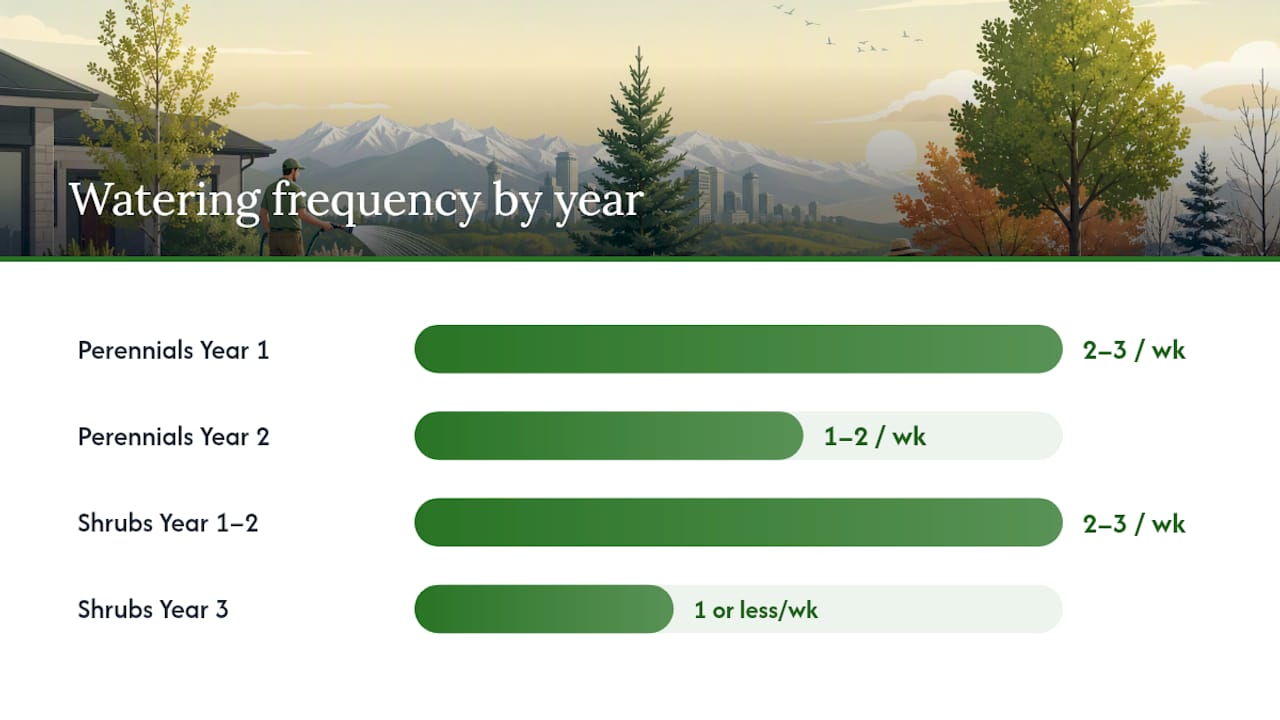
The establishment window is where most homeowners underestimate the work. A xeriscape is not zero-water from day one. YardSmart guidance sets the expectation plainly: perennials need supplemental watering for the first few years; shrubs need it for several years. After that, most seasons, rainfall handles the rest.
Target a moderate amount of water per week during establishment. Check soil moisture 2–5 cm down at the root base. If it is still moist, skip the session.
Establishment timeline
| Year | Plant type | Watering frequency | Notes |
|---|---|---|---|
| Year 1 | Perennials | 2–3 times/week | Soil should stay consistently moist |
| Year 2 | Perennials | 1–2 times/week | Taper as roots deepen |
| Year 1–2 | Shrubs | 2–3 times/week | Deep, slow watering preferred |
| Year 3 | Shrubs | 1 time/week or less | Monitor for stress signals |
| Year 3+ | Both | Rainfall + occasional deep water | Drought-tolerant once established |
Drip and soaker vs. sprinkler
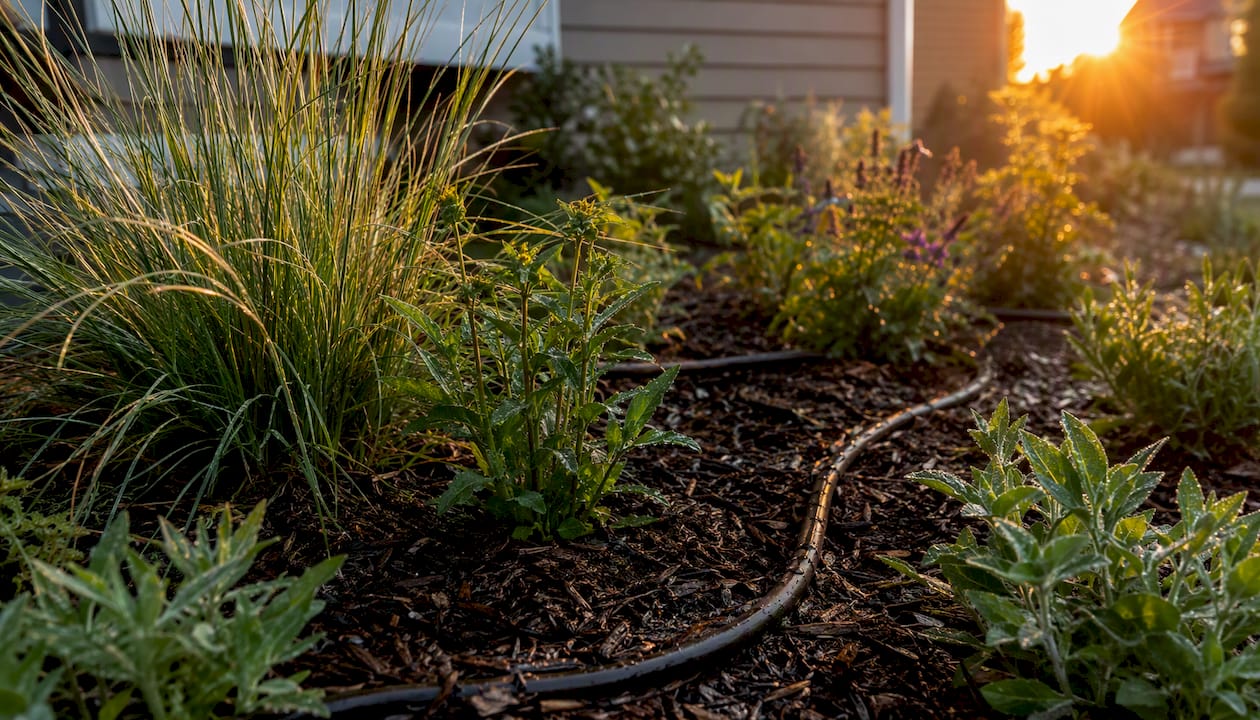
Drip lines and soaker hoses deliver water directly to root zones, which cuts evaporation and keeps foliage dry. For a 4.5 m × 4.5 m bed, a soaker hose running 30–45 minutes delivers roughly the equivalent of 2.5 cm of rainfall, though actual output depends on your water pressure. Sprinklers work for large areas but lose more water to evaporation and can promote fungal issues on drought-tolerant plants not suited to wet foliage.
Hydrozoning: grouping plants by water needs
The YardSmart design approach recommends mapping your yard for wet and dry zones before planting, then grouping plants with similar water needs together. This is called hydrozoning. A low-water zone (native grasses, sedums, yarrow) gets one irrigation circuit; a moderate-water zone (ornamental shrubs, some perennials) gets a separate one. When a City restriction stage is declared, you can shut off the low-water zone entirely and keep the moderate zone on a reduced schedule without stressing either group.
Calgary’s outdoor water restriction stages are mandatory and city-wide. There are four stages, each progressively limiting outdoor water use, and they can override your normal schedule at any time. If your system is tied to City water, you need a programmable timer you can adjust by zone within 24 hours of a stage declaration.
What soil and mulch does a Calgary xeriscape need?
Good soil and the right mulch depth do more long-term maintenance work than any tool you own.
YardSmart’s gardening basics guidance recommends adding compost and achieving a sufficiently deep layer of quality planting soil. Calgary soils tend toward clay-heavy or sandy extremes depending on the neighbourhood. Composted material is typically recommended to improve drainage or water retention depending on soil type.
For mulch, apply a moderate depth of wood chip or shredded bark mulch across all beds. Keep mulch 5–10 cm away from plant crowns and stems to prevent rot. Mulch at the recommended depth suppresses weed germination, retains soil moisture, and moderates soil temperature through Calgary’s freeze-thaw cycles.
Pro Tip: Leave perennial foliage standing through winter rather than cutting it back in fall. The stems catch snow, which acts as natural insulation for crowns, and the dried foliage reduces erosion on bare soil. Rake it off in April rather than cutting in October.
Soil improvement is largely a one-time investment at bed installation, with compost top-dressing every two to three years after that. Property managers can schedule compost top-ups as a spring visit task, keeping it off the weekly rotation.
How do you remove lawn and build xeriscape beds?
Three methods work reliably in Calgary, each with different trade-offs.
Smothering (cardboard or newspaper overlay)
Lay corrugated cardboard or six layers of newspaper directly over existing turf, wet it thoroughly, and cover with 15–20 cm of compost and topsoil. Grass dies underneath over one growing season. Best for: large areas, low budget, minimal labour. Drawback: slow (takes a full season before planting) and weed seeds in the topsoil layer can still germinate.
Sod removal (lift and flip)
Cut sod into manageable strips with a flat spade or rented sod cutter, roll it up, and remove or flip it grass-side down as a base layer. Best for: smaller areas where you want to plant the same season. Drawback: physically demanding; compacted clay subsoil may still need amendment.
Soil overlay (sheet-mulching)
Apply a thick layer of compost and soil directly over existing lawn without removing it, then plant through the new layer. Fastest method for getting plants in the ground. Drawback: higher material cost and some risk of grass re-emerging if the overlay is too shallow.
First planting day checklist
- Amend soil with compost to a depth of 15–20 cm before planting.
- Space plants according to their mature spread, not their current size.
- Water each plant in deeply at planting, even if rain is forecast.
- Apply mulch immediately after planting, keeping it clear of stems.
- Mark each plant with a label noting its water-need group (low, moderate).
A typical front yard bed conversion of roughly 20–25 m² takes a two-person team about four to six hours for sod removal and soil prep, plus another hour for planting and mulching. For Calgary’s hardiness zones (Zone 2–3), plant selection matters as much as method. Place any plants with slightly higher water needs near natural low spots or downspouts where runoff collects, following YardSmart’s guidance on mapping wet and dry zones.
Hire a team for areas larger than 40 m², steep slopes, or yards with heavily compacted clay that needs mechanical tilling. The time and equipment cost of doing it by hand on those sites rarely makes sense.
How do you comply with Calgary’s irrigation rules?
Use drip lines or soaker hoses for all planting beds. Reserve sprinklers for turf areas only, and only where turf is genuinely needed. Beds designed with hydrozoning in mind can be irrigated with a single soaker loop per zone, which is far easier to shut down or adjust when a restriction stage is declared.
Calgary’s Lawn and landscape watering schedule has been in effect as of April 29, 2026, setting specific watering days and times for properties connected to the City water supply. Watering in cooler hours (early morning) reduces evaporation and aligns with the schedule’s intent.
When a restriction stage is declared under the Water Utility Bylaw, it applies city-wide and overrides your normal schedule immediately. Stage 1 typically limits watering days; Stage 4 can restrict outdoor water use almost entirely.
Property manager compliance checklist:
- Confirm which irrigation systems on each property are connected to City water.
- Label each irrigation zone by water-need group (low, moderate) so adjustments are fast.
- Set all timers to programmable-by-zone mode and document the current settings.
- Keep a simple log of restriction stage dates and any adjustments made.
- Know the location of the manual shut-off for each system.
Common irrigation problems and quick fixes: a zone that runs too long and puddles likely has a blocked emitter elsewhere in the line; a zone that dries out fast usually has a spacing gap in the soaker layout. Walk each zone while it runs at least once per season.
How do you prune, divide, and manage pests in xeriscape beds?
Light, well-timed maintenance keeps beds from becoming crowded and weedy, which is what drives up watering needs over time.
Routine schedule:
- Weed sweep: early May and again in late June, before weeds set seed. A third pass in August catches late-season germinators.
- Pruning: late spring (late May to early June) after new growth confirms which stems survived winter. Remove dead wood cleanly at the base.
- Division: fast-spreading perennials like yarrow, coneflower, and ornamental grasses benefit from division every three to five years. Divide in early spring or early fall in Calgary to avoid transplant shock during summer heat.
- Mulch check: combine with each weed sweep to top up thin spots.
Pro Tip: When dividing perennials in Calgary, do it on a cloudy day or in the evening and water the divided clumps in immediately. The combination of cool temperatures and immediate moisture cuts transplant shock significantly compared to dividing on a hot afternoon.
For pests, the approach that works best for drought-tolerant beds is monitor first, treat only when necessary. Aphids on ornamental shrubs, spider mites during dry spells, and slugs near mulch edges are the most common issues. Remove aphid colonies by hand or with a strong water spray before reaching for any product. Persistent dieback, root rot, or a sudden collapse of multiple plants in one zone usually signals a watering or drainage problem, not a pest, and warrants a professional assessment.
Red flags that need a pro:
- Sudden dieback across more than one plant species in the same zone.
- Persistent standing water in a bed that was previously draining well.
- Irrigation failure affecting an entire zone with no obvious mechanical cause.
- Weed pressure that returns within two weeks of a full sweep (suggests a weed-seed layer under the mulch).
How do you winterise a Calgary xeriscape?
Winterising a xeriscape is genuinely light work, but the timing matters.
Fall checklist (September to October):
- Water all shrubs deeply at least once after the first frost warning but before the ground freezes hard.
- Pull any invasive weeds (thistle, bindweed) before they drop seed.
- Refresh mulch in spots thinner than 5 cm, but do not mound fresh mulch against crowns.
- Stake young trees or shrubs planted in the last two years if they are in exposed, wind-prone spots.
Do not do these things:
- Do not cut perennial foliage back to the ground in fall. The stems and seed heads catch snow, insulate crowns, and feed birds through winter.
- Do not apply a thick fresh mulch layer after the ground has already frozen; it traps moisture against crowns instead of insulating them.
Keep ploughed snow and road salt away from beds. Salt spray from adjacent sidewalks or driveways damages drought-tolerant plants faster than most pests. A simple physical barrier of burlap or a snow fence redirects plough piles away from beds in tight urban yards.
During late freeze-thaw cycles in February and March, check shallow-rooted plants for frost heaving. If a crown has been pushed up out of the soil, press it back gently and add a thin layer of compost around the base.
Calgary’s watering schedule applies through the season; confirm your irrigation system is fully shut off and drained before the first hard freeze to avoid line damage.
When should you hire a professional for xeriscape care?
Hire a pro for the initial bed conversion, any irrigation work involving new zones or system connections, and the first two to three years of establishment care. After that, most homeowners can handle routine maintenance themselves with one or two professional visits per season for weed sweeps and mulch top-ups.
Questions to ask any provider:
- Have you worked with xeriscaped or drought-tolerant beds in Calgary specifically?
- Are you familiar with the City of Calgary’s YardSmart guidelines and watering schedule?
- Do you offer a maintenance package that tapers after the establishment window (years one to three)?
- Can you programme irrigation zones by water-need group and adjust for restriction stages?
- Do you carry liability insurance and can you provide a written service agreement?
- What is your process for identifying plant stress versus pest or disease issues?
Yearlong offers bed maintenance services across Calgary, including establishment-period care packages, seasonal weed sweeps, mulch top-ups, and annual pruning visits. Their team works with Calgary’s climate and YardSmart principles, which means service packages are structured to be front-loaded during the establishment window and scaled back as plants mature. For property managers overseeing multiple sites, Yearlong’s recurring packages include irrigation checks and compliance documentation for City watering stages.
To book a site visit or get a quote, contact Yearlong directly through Yearlong.
A local perspective on what actually works
Calgary xeriscapes succeed or fail at the design stage, not the maintenance stage. After eight years of working in Calgary yards, the pattern is consistent: beds that were mapped for sun, shade, wet, and dry zones before a single plant went in require a fraction of the intervention of beds that were planted first and adjusted later. The YardSmart framework gets this right. Homeowners who follow it, even loosely, end up with beds that genuinely run themselves after year three.
The other thing worth saying plainly: the establishment window is not optional. Two to three years of attentive watering is the price of a low-maintenance yard for the following decade. Skipping it, or underwatering in year one, sets plants back in ways that compound. A stressed plant in year one is a dead plant by year three, and replanting costs more than the water you saved.
Yearlong’s approach is to match service intensity to where a property actually is in its establishment cycle, which keeps costs reasonable and plants healthy without over-servicing mature beds.
Yearlong handles the establishment work so you don’t have to
The hardest part of a Calgary xeriscape is the first two to three years: consistent watering, timely weed sweeps, mulch top-ups, and irrigation adjustments every time the City changes restriction stages. That is exactly where most homeowners fall behind, and where a professional service pays for itself.

Yearlong has been maintaining Calgary properties since 2017, with bed maintenance packages built specifically for the establishment-to-steady-state arc that xeriscapes follow. You get more visits in year one, fewer in year three, and a team that already knows Calgary’s watering schedule and YardSmart guidelines. No guessing about restriction stages, no missed mulch windows, no replanting costs from under-watered first-year plants.
Ready to hand off the establishment work? Book a site visit with Yearlong and get a maintenance package matched to where your beds are right now.
Sources
- YardSmart — plant and garden bed guidance for partial sun (City of Calgary)