

TL;DR:
- Flexible outdoor services adapt to changing seasonal needs and lifestyle preferences, optimizing property care throughout the year. They reduce costs, prevent costly repairs, and help maintain or increase property value by matching service frequency to actual conditions. Implementing these plans involves assessing seasonal needs, setting budgets, and coordinating regular reviews with providers to ensure responsive, cost-efficient maintenance.
Flexible outdoor services are maintenance plans designed to adapt to changing seasonal demands and lifestyle preferences, delivering the right care at the right time throughout the year. For homeowners and property managers in Calgary, where winters are long and summers are short, a one-size-fits-all approach to outdoor care leaves money on the table and property value at risk. Professional landscaping maintenance can increase a property’s total value by 10% to 15%, making the case for adaptable, year-round care impossible to ignore. Yearlong has built its entire service model around this principle, offering Calgary homeowners and property managers the flexibility to match their outdoor maintenance to the season, the budget, and the way they actually use their property.
Why flexible outdoor services outperform rigid maintenance plans
Rigid maintenance plans fail because properties do not stay the same. A lawn that needs weekly mowing in june requires a completely different level of attention in october. Flexible outdoor services, the industry term for customisable property maintenance agreements, solve this by letting you scale service frequency and scope up or down as conditions change.
The core advantage is adaptability. A homeowner who entertains frequently in summer needs regular lawn mowing, bed maintenance, and cleanup before gatherings. That same homeowner may only need monthly visits in early spring and a thorough seasonal cleanup before winter sets in. A property manager overseeing multiple units faces a different challenge: consistent, predictable care across all properties without paying for services that are not needed at a given time of year.

Flexible landscape service design includes intentional, long-term planning for natural evolution with use and climate shifts, avoiding costly rigid designs. This means the best providers do not just react to what is in front of them. They plan ahead, adjusting your service schedule before problems appear rather than after.
Seasonal service tasks and their timing
Outdoor maintenance follows a clear seasonal rhythm in Calgary:
- Spring (april to may): Power raking, aeration, first mowing, bed edging, and debris removal after snowmelt
- Summer (june to august): Regular lawn mowing, bed weeding, fertilising, and irrigation checks
- Fall (september to october): Leaf removal, final mowing, bed cleanup, and winterisation prep
- Winter (november to march): Snow removal, salting, and pathway clearing
Pro Tip: Align your service frequency to your property’s actual growth rate, not the calendar. A shaded lawn in a dry summer may need mowing every 10 days rather than every 7. Ask your provider to adjust visit frequency based on conditions rather than a fixed schedule.
What are the financial and environmental benefits of flexible services?
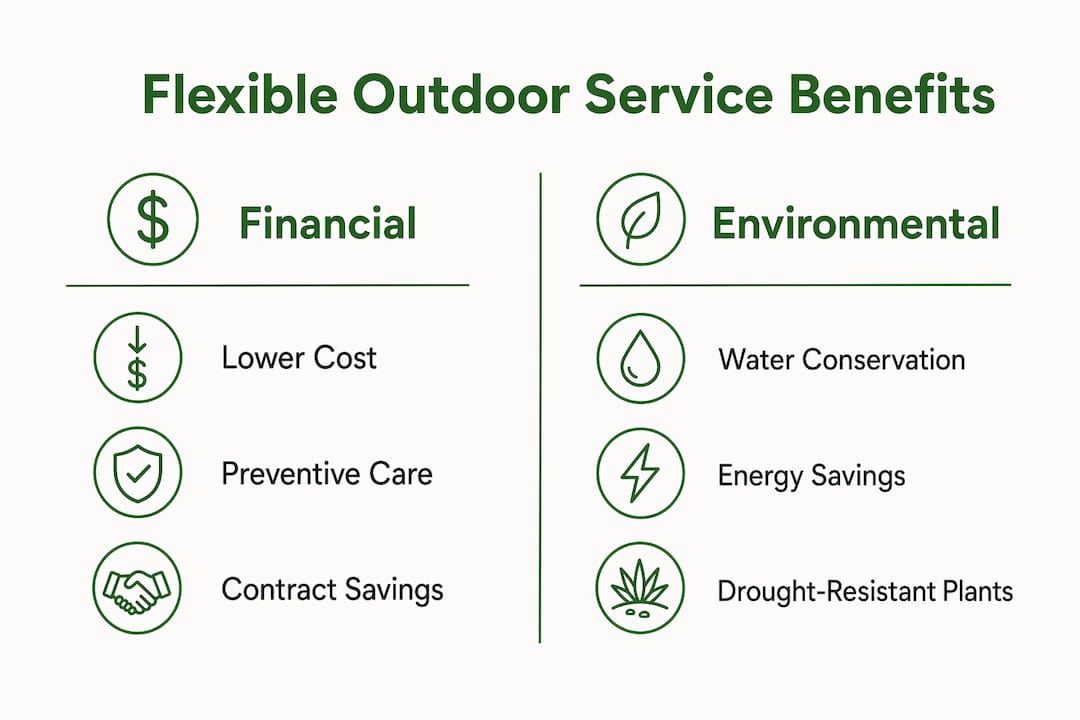
Flexible outdoor care saves money in two ways: it reduces what you spend per visit, and it prevents the expensive repairs that come from neglected properties.
Recurring service contracts reduce the cost per visit by about 10% to 20% compared to ad hoc scheduling for homeowners needing more than six services annually. That saving compounds quickly over a full season. Ad hoc or per-visit services carry higher cost per visit and lower priority during peak seasons compared to fixed recurring contracts. In practical terms, if you call for a one-off mow in july, you are likely to wait longer and pay more than a client on a recurring plan.
Preventive maintenance with early intervention is significantly less expensive than emergency repairs after damage or degradation. Catching a drainage issue in spring costs far less than repairing a flooded garden bed in august. Consistent, scheduled care is the most cost-effective approach to protecting your property value over time.
The environmental benefits are equally concrete. Strategic placement of trees and shrubs can lower home cooling costs by up to 25% during hot months through natural shading. A flexible service provider can plan and maintain this kind of planting as part of a long-term property strategy, not just as a one-off project.
| Benefit | What it means for you |
|---|---|
| 10–20% lower cost per visit | Recurring contracts save money versus calling for one-off services |
| Up to 25% cooling cost reduction | Strategic tree and shrub placement cuts summer energy bills |
| 10–15% property value increase | Consistent professional landscaping raises market value |
| Fewer emergency repairs | Preventive care catches problems before they become expensive |
Pro Tip: Ask your provider about drought-resistant plant options for Calgary’s dry summers. Native and adapted species require less watering and less maintenance, cutting both your water bill and your service frequency without sacrificing kerb appeal.
What service contract models should you know about?
Understanding the three main contract types helps you choose the right fit for your property and budget.
Service contracts vary from fixed-price to time-and-materials, and each suits a different type of work. Fixed-price contracts work best for routine, well-defined tasks like weekly mowing or monthly bed maintenance. You know exactly what you will pay, and the provider knows exactly what to deliver. Time-and-materials contracts suit unpredictable renovation or restoration projects where the scope is hard to define upfront.
A third option, the per-visit model, gives maximum flexibility but comes with the highest cost per visit and the lowest scheduling priority during busy periods. For homeowners who need more than six visits a year, a recurring contract almost always makes more financial sense.
When evaluating providers, ask these questions directly:
- Can you adjust my service frequency mid-season without a penalty?
- What is your response time for urgent requests, such as snow removal after a heavy fall?
- Do you have the equipment to handle both summer and winter services?
- How do you communicate schedule changes or weather delays?
Professional outdoor maintenance relies on expert knowledge of plant biology and climate to proactively care for landscapes. A provider who understands Calgary’s climate will anticipate what your property needs before you have to ask. That proactive approach is what separates a genuinely flexible service from one that simply shows up on a fixed schedule regardless of conditions.
Pro Tip: Review your annual landscape planning with your provider each spring. A 30-minute conversation at the start of the season can prevent miscommunication, align expectations, and save you from paying for services you do not need.
How to implement flexible outdoor maintenance on your property
Switching to a flexible maintenance model is straightforward when you follow a clear process.
Assess your property’s seasonal needs. Walk your property in each season and note what requires attention. A Calgary property typically needs snow removal from november through march, active lawn care from may through september, and cleanup services in april and october. Write down the tasks and their rough frequency.
Set a realistic annual budget. Divide your outdoor maintenance spending into seasonal buckets. Knowing you spend more in summer and less in winter helps you choose a contract that reflects actual usage rather than an averaged flat fee.
Communicate your lifestyle priorities. Tell your provider how you use your outdoor space. If you host gatherings, you need the lawn in top condition before weekends. If you prioritise low maintenance, drought-resistant plantings and mulched beds reduce visit frequency significantly.
Build in a review point. Schedule a mid-season check-in with your provider. Conditions change, and a good provider will adjust your plan based on what is actually happening on your property rather than sticking rigidly to the original schedule.
Track what you spend versus what you planned. Keep a simple record of services delivered and costs. This makes it easy to renegotiate your contract at renewal and identify where you are getting the most value.
Hiring outdoor living contractors saves time and reduces stress by managing logistics, permits, and schedules effectively. For property managers overseeing multiple sites, this coordination benefit alone justifies the cost of a professional recurring contract. Trying to manage seasonal outdoor care across several properties without professional support is one of the most common property maintenance errors that leads to budget overruns and deferred work.
Key takeaways
Flexible outdoor services deliver better value than rigid plans because they match care to actual seasonal conditions, reduce cost per visit through recurring contracts, and prevent expensive reactive repairs.
| Point | Details |
|---|---|
| Adaptability drives value | Matching service frequency to seasonal conditions prevents overspending and neglect. |
| Recurring contracts save money | Contracts reduce cost per visit by 10–20% versus ad hoc scheduling. |
| Preventive care is cheaper | Early intervention avoids costly emergency repairs after damage or degradation. |
| Strategic planting cuts costs | Trees and shrubs placed for shade can reduce cooling costs by up to 25%. |
| Provider selection matters | Ask about mid-season adjustments, response times, and year-round equipment capacity. |
Flexibility is not a luxury, it is the only approach that works
I have seen the same pattern repeat itself with homeowners who lock into rigid annual contracts. They pay for weekly mowing in september when the grass has stopped growing, and they scramble to find emergency snow removal in november because their summer-only provider has moved on. The frustration is real, and it is entirely avoidable.
What I have learned from years of working with Calgary properties is that the climate does not follow a tidy schedule. A warm october can push the last mow into november. An early snowfall in late september can catch a property completely unprepared. Rigid plans simply cannot account for this. Flexible service agreements, built around what the property actually needs rather than what a calendar says, are the only approach that holds up year after year.
The other thing homeowners underestimate is how much their own usage patterns change. A family that adds a new deck suddenly needs more frequent lawn care around that space. A property manager who takes on additional units needs to scale services without renegotiating from scratch. Flexibility is not about paying less for less. It is about paying for exactly what you need, when you need it, and having a provider who can respond when conditions change.
The properties I see hold their value and look their best consistently are the ones with providers who treat the relationship as ongoing rather than transactional. That is the standard worth holding out for.
— Lewie
Yearlong’s flexible outdoor care for Calgary properties
Yearlong has served Calgary homeowners and property managers since 2017, building service plans around what each property actually needs across every season.

Whether you need regular lawn care and yard cleanup through the growing season, bed maintenance to keep your property looking sharp, or reliable snow removal through Calgary’s long winters, Yearlong builds a plan around your schedule and budget. Every package is adjustable mid-season, so you are never locked into services that no longer fit your needs. Reach out to Yearlong to discuss a flexible maintenance plan tailored to your property.
FAQ
What are flexible outdoor services?
Flexible outdoor services are customisable property maintenance agreements that adjust in scope and frequency based on seasonal conditions and homeowner needs. They differ from rigid annual contracts by allowing mid-season changes without penalty.
How much can I save with a recurring outdoor service contract?
Recurring contracts reduce the cost per visit by about 10% to 20% compared to ad hoc scheduling. Homeowners needing more than six services annually benefit most from this model.
Why choose flexible landscaping over a fixed annual plan?
Fixed plans charge the same rate regardless of what your property needs each month. Flexible plans match service intensity to actual conditions, preventing both overspending in slow seasons and under-servicing during peak periods.
Can flexible outdoor services improve my property value?
Professional landscaping maintenance can increase a property’s total value by 10% to 15%. Consistent, adaptable care keeps the property in top condition year-round, which directly supports that value increase.
How do I start with a flexible outdoor maintenance plan?
Assess your property’s seasonal needs, set a seasonal budget, and communicate your lifestyle priorities to your provider. Schedule a mid-season review to adjust services based on actual conditions rather than the original plan.