

TL;DR:
- Consistent outdoor maintenance plans help property owners protect asset value by preventing deterioration and reducing emergency repair costs. Regular upkeep improves safety, tenant satisfaction, and market appeal, especially in climate-specific conditions like Calgary’s freeze-thaw cycles. Failing to follow these plans leads to higher expenses, unpredictable budgets, and loss of property value over time.
Consistent maintenance plans are the single most reliable method for preserving and growing outdoor property value over time. Property owners who commit to scheduled, documented upkeep spend less on repairs, face fewer safety liabilities, and retain tenants longer than those who react to problems as they arise. Platforms like SafetyCulture define a maintenance plan as a structured, written programme of recurring tasks designed to prevent deterioration before it starts. The Reserve Study framework used by property associations reinforces the same principle: proactive scheduling converts unpredictable emergency costs into manageable, budgeted line items. This article explains why consistent maintenance plans work, what they cost when ignored, and how to build one that holds up in the real world.
Why consistent maintenance plans matter for property owners
A consistent maintenance plan is a scheduled, documented approach to recurring property care tasks. It differs fundamentally from reactive maintenance, where work only happens after something breaks or deteriorates visibly. The distinction matters because planned maintenance reduces emergency repair premiums and deferred-maintenance risk by keeping systems and surfaces in reliable condition.
Reactive maintenance feels cheaper in the short term. You only pay when something goes wrong. The problem is that “going wrong” in outdoor property care often means a cracked driveway becomes a liability, an overgrown bed becomes a pest habitat, or a neglected lawn becomes an expensive re-sodding project. Each delay compounds the eventual cost.
A well-built plan covers these core elements:
- Scheduled task frequency: Mowing, bed maintenance, seasonal cleanups, and snow removal all assigned to specific dates or triggers
- Written documentation: Task descriptions clear enough for any crew member to follow without relying on memory
- Record keeping: Completed work logs that track what was done, when, and by whom
- Review cycles: Planned checkpoints to update task frequency based on actual property conditions
Pro Tip: Start your maintenance plan with a property walkthrough in early spring. Photograph every area and note what deteriorated over winter. That baseline becomes your first review data point.
The scheduling importance for property managers goes beyond aesthetics. A written plan creates accountability, supports insurance documentation, and gives you a defensible record if a safety incident occurs on your property.
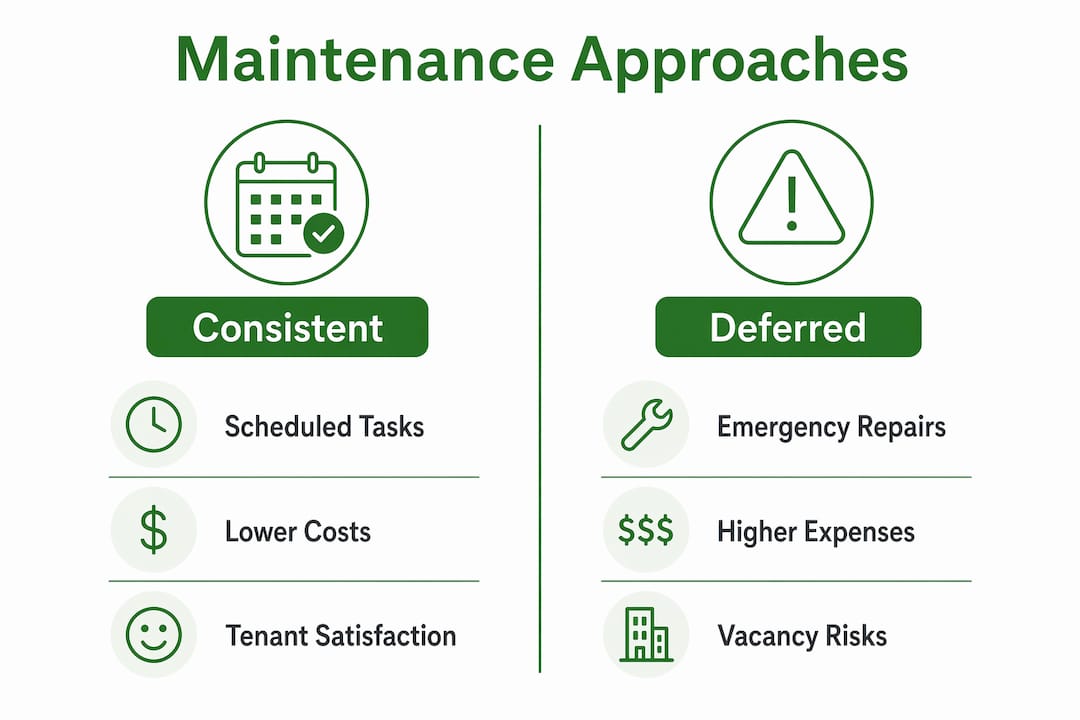
How does consistent maintenance improve property value and safety?
Regular upkeep preserves asset condition in ways that compound over years. A lawn that receives consistent fertilisation, aeration, and seasonal cleanup stays dense and healthy. A lawn that gets attention only when it looks bad develops thatch, bare patches, and weed pressure that costs significantly more to reverse than to prevent.
The benefits of regular maintenance operate across four dimensions:
- Asset condition: Routine care preserves property condition and prevents small defects from becoming costly repairs. A cracked concrete pad sealed annually stays functional for decades. Left unsealed, freeze-thaw cycles in Calgary’s climate accelerate deterioration rapidly.
- Safety compliance: Maintained walkways, clear beds, and debris-free surfaces reduce slip-and-fall risk. This directly affects your liability exposure and insurance premiums.
- Tenant and occupant satisfaction: Scheduled maintenance improves operational performance and tenant satisfaction by reducing disruptions and outages. Tenants who experience fewer maintenance emergencies stay longer.
- Kerb appeal and market value: Properties with documented, consistent upkeep histories command stronger sale prices and attract higher-quality tenants. First impressions are formed at the property line, not the front door.
Calgary’s climate adds a layer of urgency to this. The city experiences significant temperature swings, heavy snowfall, and spring freeze-thaw cycles that accelerate outdoor surface wear. A property without a year-round maintenance schedule accumulates damage faster than one in a milder climate.
The financial case is direct. Lower tenant turnover means lower vacancy costs. Fewer emergency repairs mean lower labour premiums. Preserved surfaces mean deferred capital replacement. The long-term maintenance benefits of consistent outdoor care are not theoretical. They show up on your balance sheet.

What does deferred maintenance actually cost you?
Deferred maintenance is the practice of postponing scheduled work until a later date, usually to save money in the short term. Waiting to address maintenance creates higher risk of failure and budget unpredictability. That is the core finding from Association Reserves, which manages Reserve Study planning for property associations across North America.
The cost escalation follows a predictable pattern. A minor issue ignored becomes a moderate repair. A moderate repair ignored becomes a major project. At each stage, the cost multiplies, and the disruption to tenants or occupants grows.
| Maintenance Approach | Cost Pattern | Risk Level | Budget Predictability |
|---|---|---|---|
| Consistent scheduled care | Lower, stable costs | Low | High |
| Occasional reactive repairs | Moderate, variable costs | Medium | Low |
| Deferred maintenance | High, unpredictable costs | High | Very low |
Emergency repairs carry a premium that scheduled work does not. Emergency repair costs and disruption are larger and harder to manage than planned maintenance. Contractors charge more for urgent callouts. Materials sourced quickly cost more than those ordered in advance. And the disruption to tenants or daily operations adds an indirect cost that never appears on an invoice.
Pro Tip: Track every reactive repair you make in a calendar year. At year end, total the cost and compare it to what a scheduled programme would have covered. Most property owners are surprised by the gap.
Deferred outdoor maintenance also affects property perception. Overgrown beds, cracked concrete, and patchy lawns signal neglect to prospective tenants and buyers. That perception affects both rental rates and sale prices in ways that are difficult to recover from quickly.
How to build and maintain a consistent outdoor maintenance plan
Effective maintenance planning starts with documentation, not scheduling. Written procedures and daily record-keeping prevent work reliance on tribal knowledge and support adaptation over time. If your plan only exists in the head of one crew member or property manager, it will not survive staff changes.
A practical outdoor maintenance plan for Calgary properties covers these categories:
- Lawn care: Mowing frequency by season, fertilisation schedule, aeration timing, and overseeding triggers
- Bed maintenance: Weeding intervals, mulch refresh schedule, edging frequency, and plant health checks
- Seasonal cleanup: Spring debris removal, fall leaf and thatch clearing, and pre-winter preparation
- Hardscape care: Concrete cleaning and sealing cycles, driveway inspection dates, and walkway safety checks
- Snow removal: Trigger conditions (snowfall depth), response time standards, and de-icing protocols
Once the task list is built, the schedule must reflect real-world conditions. Consistency across multiple properties often fails due to schedule collapse when real-world conditions are not accounted for. Build in realistic travel times between properties, access windows for gated areas, and buffer time for weather delays. A plan that looks clean on paper but collapses every second week is not a plan. It is a wish list.
The annual maintenance guide from Yearlong breaks down typical task categories by season, which gives property owners a useful starting framework before customising for their specific site.
Optimising over time is not optional. Programmes without review cycles experience eroding reliability as conditions change. Set a formal review at the end of each season. Ask: which tasks were completed on schedule, which were skipped, and why? Adjust frequency and scope based on actual data, not assumptions.
Treat your maintenance plan as a dynamic feedback loop rather than a static document. Add tasks when new issues emerge. Retire tasks that no longer apply. Adjust frequency when a surface or area shows more or less wear than expected. This approach is what separates plans that work for years from plans that get abandoned after one season.
Key takeaways
Consistent maintenance plans protect property value by converting unpredictable emergency costs into scheduled, budgeted work that preserves assets, satisfies tenants, and reduces long-term expenditure.
| Point | Details |
|---|---|
| Proactive beats reactive | Scheduled maintenance costs less and causes fewer disruptions than emergency repairs. |
| Documentation is non-negotiable | Written plans with clear task descriptions survive staff changes and support accountability. |
| Deferred maintenance compounds costs | Postponing work increases repair scope, labour premiums, and budget unpredictability. |
| Review cycles sustain effectiveness | Plans without seasonal reviews erode in reliability as property conditions change. |
| Calgary climate demands year-round care | Freeze-thaw cycles and heavy snowfall accelerate outdoor surface wear without consistent upkeep. |
What i’ve learned after years of watching properties drift
The most common mistake I see property owners make is treating their maintenance plan as a document they create once and file away. They build a reasonable schedule in spring, feel good about it, and then watch it quietly fall apart by july because nobody reviewed it, adjusted it, or held anyone accountable to it.
The second mistake is confusing activity with consistency. A property that gets intensive attention twice a year and nothing in between is not on a consistent plan. It is on a crisis management cycle with extra steps. Real consistency means the lawn gets mowed on schedule even when it looks fine, the beds get weeded before the weeds set seed, and the concrete gets inspected before the first hard frost. That rhythm is what prevents the expensive surprises.
I have also seen plans fail because they were written for an audit rather than for the person doing the work. A ten-page maintenance manual that a crew member cannot read in the field is not a maintenance plan. It is a liability document. The best plans I have encountered are one-page schedules with clear task descriptions, a completion checkbox, and a notes column. Simple enough to follow, detailed enough to be useful.
The properties that hold their value over a decade are almost always the ones where someone treated maintenance as an ongoing data collection exercise. They tracked what worked, adjusted what did not, and never let the plan go stale. That discipline is not glamorous. It is just effective.
— Lewie
How Yearlong keeps calgary properties on track year-round
Yearlong has been delivering consistent outdoor property care across Calgary since 2017, and the pattern is always the same: properties on a scheduled plan look better, cost less to maintain, and retain tenants more reliably than those managed reactively.

Yearlong builds customised maintenance programmes that cover every season, from spring lawn and bed care through to winter snow removal. Each plan is documented, scheduled, and reviewed with the property owner to stay aligned with actual site conditions. If you want the financial predictability and kerb appeal that come from genuine consistency, Yearlong’s Calgary lawn care services are the practical starting point. Reach out to discuss a plan built around your property’s specific needs.
FAQ
What is a consistent maintenance plan for outdoor property?
A consistent maintenance plan is a scheduled, written programme of recurring outdoor care tasks designed to prevent deterioration before it occurs. It covers lawn care, bed maintenance, seasonal cleanup, hardscape care, and snow removal on defined timelines.
How do maintenance plans save money over time?
Scheduled maintenance converts unpredictable emergency repair costs into budgeted, planned work. Emergency repairs carry higher labour premiums and material costs than work ordered in advance, so consistency directly reduces total annual expenditure.
How often should an outdoor maintenance plan be reviewed?
Review your plan at the end of each season, at minimum. Programmes without regular review cycles experience eroding reliability as property conditions and use patterns change over time.
Does consistent outdoor maintenance affect tenant retention?
Scheduled maintenance improves tenant satisfaction by reducing disruptions and unplanned outages. Tenants who experience fewer maintenance emergencies are more likely to renew leases, which lowers vacancy costs for property owners.
What happens if outdoor maintenance is deferred in calgary’s climate?
Calgary’s freeze-thaw cycles and heavy snowfall accelerate surface deterioration significantly. Deferred maintenance allows small defects to compound into major repairs, increasing both project scope and cost with each season of delay.