

Most hedges want their routine trim in late August or September, once summer growth has slowed but before the plant goes dormant. Save hard renovation cuts for late winter or early spring, February to March, while the plant is still dormant. The one exception overrides both windows: check for active nests before you cut anything between March and August, and hold off if you find one.
TL;DR:
- Hedge trimming should generally occur in late summer or early autumn for routine shaping, with hard renovation cuts in late winter or early spring.
- Species and hedge style affect timing, with deciduous hedges best pruned in winter, flowering ones after blooms fade, and conifers requiring cautious, light trims.
- Avoid trimming during frost, heatwaves, or active bird nesting seasons, and always check for nests before March through August cuts.
- Use precise tools like secateurs, loppers, or powered trimmers, and never remove more than one-third of a shrub’s live growth in a single season.
- In Calgary, hedge maintenance is integrated into regular property care, with staged renovations recommended for overgrown or neglected hedges.
Table of Contents
- When to trim hedges: a month-by-month planning calendar
- Does the right time to prune change by hedge type?
- What tools and techniques keep a hedge healthy?
- When should you hard-prune an overgrown hedge?
- How do nesting birds and weather affect trimming safety?
- How does YearLong approach hedge trimming season in Calgary?
- What actually matters more than the calendar date
- Book seasonal hedge care with Yearlong in Calgary
- Sources
When to trim hedges: a month-by-month planning calendar
The logic behind hedge timing comes down to growth cycles, not habit. Trim in late summer or early autumn and you’re cutting into slowed growth, so the shape holds through winter instead of pushing out a fresh flush that frost can damage. Prune hard in late winter, and the plant is dormant, sap is low, and wounds seal before the growing season demands energy elsewhere.
Weather matters as much as the calendar. Avoid cutting during a hard frost or a heat wave. New cuts expose tender tissue, and a sudden cold snap or blazing afternoon sun can scorch it before it has a chance to callus over. An overcast, mild, frost-free day is the sweet spot, whatever month you’re in.
How often you need to be out there with shears depends on the hedge’s job:
- Once-yearly plan: a single trim in late August or September for most informal or mixed hedges.
- Twice-yearly plan: a spring shape-up around late May, followed by the late-summer trim, for hedges that grow fast or need a crisper line.
- Thrice-yearly plan: formal hedges like boxwood or privet often need trims in late spring, midsummer, and early autumn to keep sharp edges.
Seasonal property checklists help homeowners track these windows alongside lawn and bed care, since hedge timing rarely happens in isolation from the rest of the yard’s schedule.
Does the right time to prune change by hedge type?
Yes, and this is where a lot of homeowners get tripped up treating every hedge the same. Species and hedge style both shift the calendar.
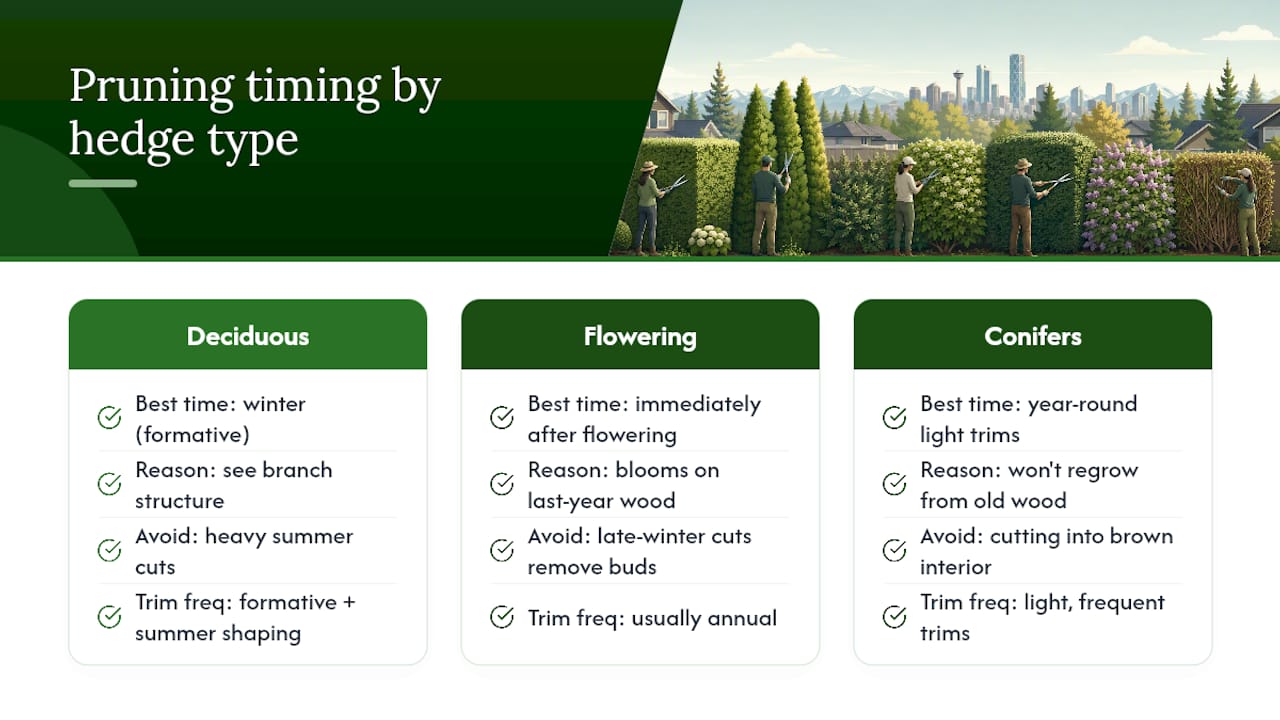
Deciduous hedges (beech, hornbeam, hawthorn) take formative cuts in winter while bare, which makes it easy to see the branch structure, and lighter maintenance shaping in summer.
Flowering hedges need a different rule entirely: if the shrub blooms on last year’s wood, like forsythia or lilac, prune right after the flowers fade. Cut it in late winter instead and you’ll remove the buds before they ever open.
Conifers are the riskiest category. Many, including Leyland cypress and most junipers, will not regrow from old wood. Cut back into bare brown interior and that patch stays bare, often permanently, so trims should stay light and frequent rather than heavy and occasional.
Formal versus informal is the other big split. Formal hedges typically need two to three trims per growing season to keep a tight outline, while informal hedges get by on one trim a year once established. That single distinction explains why two neighbours with similar hedges can be on completely different mowing, sorry, trimming, schedules.
What tools and techniques keep a hedge healthy?
Two cutting approaches cover almost every situation. Heading cuts shorten a branch partway, which is what keeps a formal hedge’s outline crisp. Thinning cuts remove whole stems back to a junction, opening up airflow and light on denser, overgrown growth. Most trims mix both.
Tool choice depends on stem size and finish:
- Secateurs (hand pruners) for precision work and large-leaved evergreens like laurel, where powered shearing shreds leaves and leaves brown, ragged edges.
- Loppers for stems roughly half an inch to two inches thick that secateurs can’t handle cleanly.
- Pole pruners or powered hedge trimmers for reach, bulk shaping, and long, straight runs on formal hedges.
Pro Tip: Never remove more than one-third of a shrub’s live growth in a single season. If a hedge needs more than that, stage the reduction across two or three years instead of shocking it all at once.
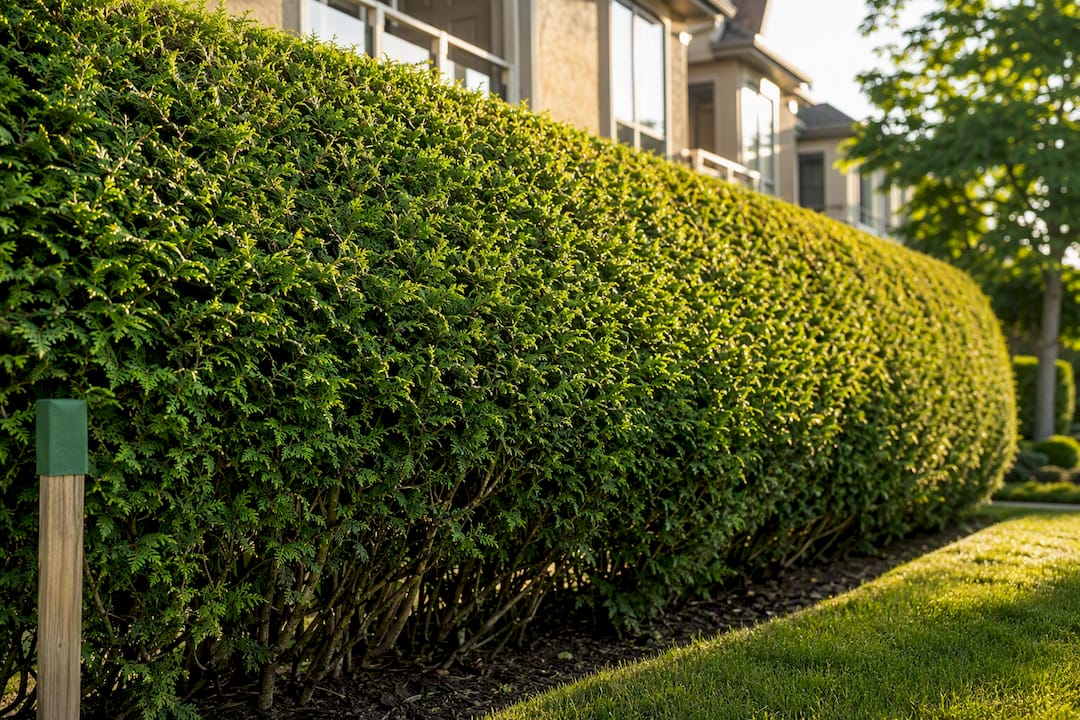
Shape it with the top slightly narrower than the base. That taper lets sunlight reach the lower branches, which keeps the hedge dense down to the ground instead of thinning out and going leggy at the bottom, a problem that’s nearly impossible to reverse once it sets in.
When should you hard-prune an overgrown hedge?
Late winter to early spring, while the plant is dormant, gives it the best shot at recovering before the growing season kicks in. That’s the window for real renovation work, not routine shaping.
Not every species tolerates it. Yew and several deciduous species handle hard pruning well and will push new growth from old wood. Most conifers won’t. If a hedge is badly overgrown and it’s a conifer, weigh replacement against renovation before you commit to a heavy cut you can’t undo.
- Stage the reduction over three years: one side or one-third of the height per season.
- Recheck growth each spring before deciding how much more to remove.
- If a conifer hedge shows bare brown patches after a cut, it’s likely not coming back in that spot, and replacement may be the more practical fix.
How do nesting birds and weather affect trimming safety?
Nesting season is the one factor that overrides the calendar. Check thoroughly for active nests before trimming anything between March and August, and if you find one, wait until the young have left before you touch that section.
Weather matters for the plant’s sake, not just your comfort. Cutting during a hard frost or an extreme heat spell exposes fresh wounds to stress they can’t handle yet. Overcast, mild days are safest for both new growth and the person holding the trimmer.
- Wear eye protection, gloves, and sturdy footwear before starting powered equipment.
- Set ladders on level ground and never overreach; a second person spotting is worth it on tall hedges.
- Keep blades sharp and clean between jobs. A dull or dirty blade tears stems instead of cutting cleanly, and torn tissue is more prone to disease.
How does YearLong approach hedge trimming season in Calgary?
Calgary’s short growing season and early frosts compress the usual windows, so YearLong builds hedge work into the same seasonal rounds as lawn and bed maintenance rather than treating it as a separate call. Maintenance trims get scheduled in late summer before the first frost risk climbs, and any renovation work gets staged across dormant late-winter visits so a client’s hedge isn’t shocked by a single aggressive cut.
Before booking a trim, homeowners can run through a short checklist:
- Confirm no active nests are present if working between March and August.
- Note which sections have grown past one-third over their target size, since that flags renovation rather than routine trimming.
- Check the forecast for frost or heat extremes and reschedule if either is likely within 48 hours.
What actually matters more than the calendar date
Homeowners spend a lot of energy pinning down the exact week to trim, and the calendar genuinely matters. But the bigger mistake I see isn’t timing by a week or two. It’s ignoring the one-third rule and trying to fix five years of neglect in a single afternoon. That’s how a hedge ends up with bare patches that never fill back in, especially on conifers.
The conventional advice tells you when to cut. It rarely tells you when to stop cutting for the season, which is arguably the more useful skill. A hedge that’s slightly shaggy in July and gets tidied properly in September will outlast one that’s sheared into submission every few weeks regardless of growth stage.
If you take one thing from this: check for nests first, respect the one-third limit second, and treat the calendar as a guide rather than a rulebook. Species, weather, and how overgrown the hedge already is will always matter more than the specific date on a chart.
— Lewie
Book seasonal hedge care with Yearlong in Calgary
Getting the timing right is only half the job. The other half is actually being out there on the right week, with sharp tools, while juggling a lawn, beds, and everything else on a Calgary property. Yearlong handles hedge maintenance as part of its regular bed maintenance visits, so trims happen on schedule instead of getting pushed back until the hedge is overgrown enough to need a full renovation.

If your hedge has gotten away from you, a staged renovation across a couple of seasons is usually safer and cheaper than letting it go another year. Professional crews know which Calgary-hardy species tolerate a hard cut and which ones need a lighter touch, and they carry the loppers, pole pruners, and sharpened blades that a once-a-year homeowner job usually doesn’t justify buying. Book a visit through the bed maintenance page and a crew will assess your hedge’s growth stage before recommending a maintenance trim or a staged reduction plan.
Sources
- Stihl — Hedge maintenance and trimming
- RHS — Pruning hedges
- This Old House — Shrub pruning dos and don’ts
- Purdue Extension — Pruning principles and hedge shaping