

Aerate in Calgary during late spring (May to June) or the brief fall window (late August through mid-September), and only when the soil is moist but not soaked through. Those two stretches line up with when cool-season grass is actively growing and can recover fast. Not every lawn needs it every year, though. Check for compaction first, water two days ahead if the ground is dry, then book the work before the fall window closes.
TL;DR:
- Aerate only in late spring or fall when soil is moist but not soaked, to optimize recovery for cool-season grasses like bluegrass and fescue.
- Use screwdriver tests in multiple yard spots to accurately assess soil compaction, especially on patchy or clay-heavy soil, before scheduling aeration.
- Avoid aeration during drought, extreme heat, or if the lawn is newly seeded or sodded within the past year to prevent root damage.
- Book early for fall aeration, ideally in the first half of the window, since the short season often closes by mid-September due to early frosts.
- Pair aeration with overseeding and light fertilizing immediately afterward, and remember to water lightly for several weeks to ensure successful turf thickening.
Table of Contents
- Do I need to aerate? Quick tests and visible signs for Calgary lawns
- Best timing windows for Calgary: exact months and why they work
- How to prepare and aerate your lawn the right way
- Overseeding, fertilizing, and post-aeration care in Calgary
- When not to aerate: timing mistakes and special-case warnings
- Practitioner tips from Yearlong: Calgary-specific nuances
- Calgary lawns don’t follow the textbook, and the advice shouldn’t either
- How Yearlong handles aeration timing so you don’t have to
- Sources
- FAQ
Do I need to aerate? Quick tests and visible signs for Calgary lawns
Grab a screwdriver before you grab a rental machine. Push it into the soil in a few spots around the yard. If it slides in easily to about 6 inches, your lawn is loose enough that aeration probably isn’t urgent this year. If you’re fighting to get it past an inch or two, compaction is holding your roots back.
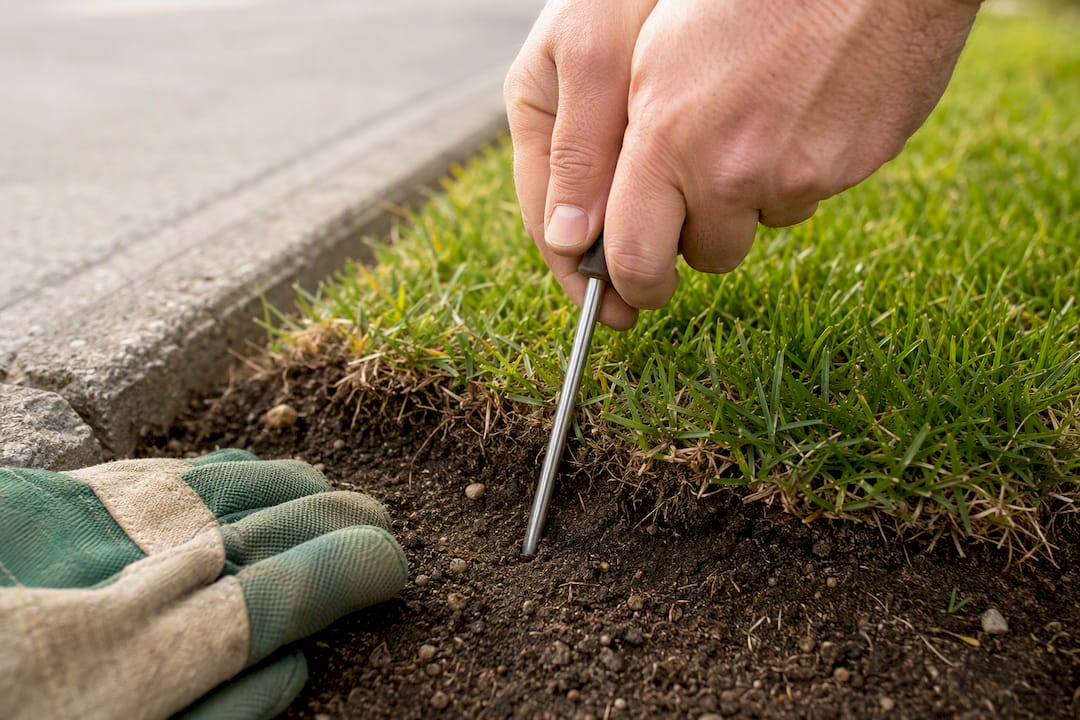
A proper core-sample or screwdriver test to that 6 inch depth is the diagnostic the City of Calgary itself points homeowners toward, and it beats guessing based on how the lawn looks from the porch.
Beyond the screwdriver test, watch for these signs:
- Water pooling on the surface after rain instead of soaking in
- Soil that feels hard as pavement underfoot, even a day after watering
- Thin, worn strips where kids, pets, or foot traffic cross the yard
- Thatch buildup thicker than half an inch at the base of the grass blades
Skip aeration on lawns you seeded or sodded this year. New root systems are too fragile for tines to pass through safely. The same goes for yards with a lot of buried rock, exposed roots, or irrigation lines close to the surface. Get a professional opinion first rather than risk shredding something you can’t see.
Pro Tip: Do the screwdriver test in three or four spots, not just one. Calgary yards often have patchy compaction from old construction fill, and one soft corner near a garden bed can hide a rock-hard zone by the driveway.
Best timing windows for Calgary: exact months and why they work
Two windows work for Calgary lawns, and they’re tied to how cool-season grass grows, not to the calendar in general. The City of Calgary points homeowners toward May and June, then again around mid-September, and there’s solid reasoning behind both.
- Late spring (May–June): the ground has thawed, snowmelt has usually passed, and Kentucky bluegrass and fescue (the dominant lawn grasses here) are pushing new growth. Aerating now lets the lawn heal while it’s already in an active growth phase.
- Fall (late August to mid-September): this is the window most Canadian turf guides call the better of the two for cool-season grass, because aerating in fall means the lawn recovers with less weed competition and builds stronger roots as it heads into winter.
Here’s the part that trips people up locally: Calgary’s fall window is short. Grass growth slows fast once nighttime temperatures drop, and an early hard frost can shut down recovery altogether. If you’re aiming for the fall slot, book it in the first half of that window rather than waiting until the last week of September and hoping the weather cooperates.
Cool-season grasses put most of their root growth into spring and fall, going semi-dormant through the heat of July and August. Aerating during that dormant stretch stresses turf that’s already working hard just to survive, which is one reason mid-summer aeration rarely delivers the recovery you’re after.
How to prepare and aerate your lawn the right way
Getting the timing right only helps if the soil and equipment cooperate. A few days of prep make the difference between clean plugs and a machine that just bounces across the surface.
- Water two days ahead. The soil should be moist but not saturated when the tines go in — dry ground resists penetration, while soggy ground turns into mud and smears rather than pulling clean cores. A deep watering roughly 48 hours before aeration usually gets you there.
- Choose hollow-tine core aerators, not spike aerators. Hollow tines pull actual plugs of soil to the surface, while spike models just punch holes and can make compaction worse over time by pressing soil sideways instead of removing it.
- Aerate in two directions. Run one pass north to south, then a second pass east to west. This crosshatch pattern gives more consistent coverage than a single pass and matters more than most homeowners assume.
- Add extra passes on clay or heavily compacted patches. A single run rarely cracks Calgary’s denser clay soils. Go over problem zones two or three times rather than accepting a light pass everywhere.
- Stay off steep slopes and tight bed edges. Aerators can chew up turf on an incline or scalp the edge of a flower bed. Hand tools or a smaller pass make more sense in those spots.
If you’re renting a machine, book early. Fall weekends disappear fast at rental counters once the season’s short window opens.
Hiring a contractor instead? Ask specifically what tine type they run, how many passes are included, whether overseeding comes with the visit, and whether the quote changes for clay soil or sloped yards. A vague answer to any of those is a red flag.
Pro Tip: If your yard has a mix of clay pockets and lighter soil, walk the property with whoever’s doing the work before they start. Pointing out the hard spots in person gets you better coverage than hoping they notice on their own.
Overseeding, fertilizing, and post-aeration care in Calgary
Aeration by itself thins out compaction. Pairing it with overseeding is what actually thickens the lawn. The holes left by hollow tines give grass seed far better seed-to-soil contact than scattering it over intact turf, which is why most Calgary lawn crews overseed on the same visit rather than scheduling it separately.
- Spread seed right after aerating, while the cores and holes are still open on the surface.
- Use a slow-release nitrogen fertilizer at a light starter rate. Heavy feeding right at seeding tends to push leaf growth at the expense of roots.
- Water lightly but frequently for the first two to three weeks, enough to keep the top inch of soil damp without pooling, until you see germination.
- Once new grass is established, taper back to deeper, less frequent watering that trains roots to grow downward instead of staying near the surface.
- Hold off on mowing until new grass reaches about 7 to 8 centimetres, then resume your normal cutting height rather than scalping it.
A light topdressing of compost after aeration helps fill in low spots and gives seedlings a better starting medium, though it’s optional if your soil is already reasonably healthy. Homeowners running an aeration and overseeding program on the same visit tend to see thicker turf by the following spring than those who treat the two jobs as separate projects months apart.
When not to aerate: timing mistakes and special-case warnings
Aeration isn’t risk-free when the timing or conditions are wrong. A handful of mistakes show up again and again in Calgary yards.
- Don’t aerate saturated soil right after heavy rain or a snowmelt surge. Wet clay smears instead of coring cleanly and can compact worse than before you started.
- Don’t aerate cool-season lawns during a summer drought or heat stretch. Grass under moisture stress has little energy left for recovery.
- Skip aeration entirely on lawns sodded or seeded within the past year. Young root systems can’t handle the disruption yet.
- Be cautious with heavy clay and sloped yards. Clay-heavy soils resist standard tines and often need multiple passes or specialized equipment, and slopes risk erosion once the surface is perforated.
Expect a short cosmetic dip after aeration, too. Pulled cores sit on the lawn for a week or two (mow over them or leave them to break down naturally), and the lawn can look temporarily thinner right after the tines pass through. That’s normal. The real risk is skipping overseeding afterward: bare aeration holes without new seed are an open invitation for weeds to move in before your existing grass fills back in.
Practitioner tips from Yearlong: Calgary-specific nuances
Working across Calgary properties for years turns up patterns that generic lawn advice misses. Soil here isn’t uniform, and neither is the right approach to aerating it.
- Clay dictates the job more than the calendar does. Many Calgary yards sit on heavy clay that resists a single standard pass. Deep core aeration or multiple passes often does more for these lawns than a quick once-over with a rental machine, and it changes both the timeline and the cost of the visit.
- A proper site assessment checks more than the calendar. Before recommending standard or deep core aeration, we look at slope, clay content, drainage, and where traffic wears the grass thinnest.
- Microclimates shift the fall window by about a week. Elevation and neighbourhood exposure affect frost timing, so a yard in a low-lying or shaded spot may need to move a week earlier than a property on higher, more exposed ground.
- A reputable quote spells out specifics. Tine type, number of passes, whether overseeding is bundled in, and how the price shifts for clay or slopes should all be stated up front, not discovered halfway through the job.
Pro Tip: If a contractor quotes your job at the same flat rate regardless of soil type or slope, ask why. Clay and slopes take real extra time, and a price that doesn’t reflect that is either underbuilt for the work or overpriced for an easy yard.
Calgary lawns don’t follow the textbook, and the advice shouldn’t either
Most lawn care guidance written for a general Canadian audience treats aeration timing like a fixed rule: spring or fall, done. That’s not wrong, but it’s incomplete for Calgary. The bigger variable here isn’t the calendar month, it’s what’s under the grass. A yard sitting on heavy clay in a low pocket of the city behaves nothing like one on sandy loam a few kilometres away, even if both are aerated on the same September weekend.
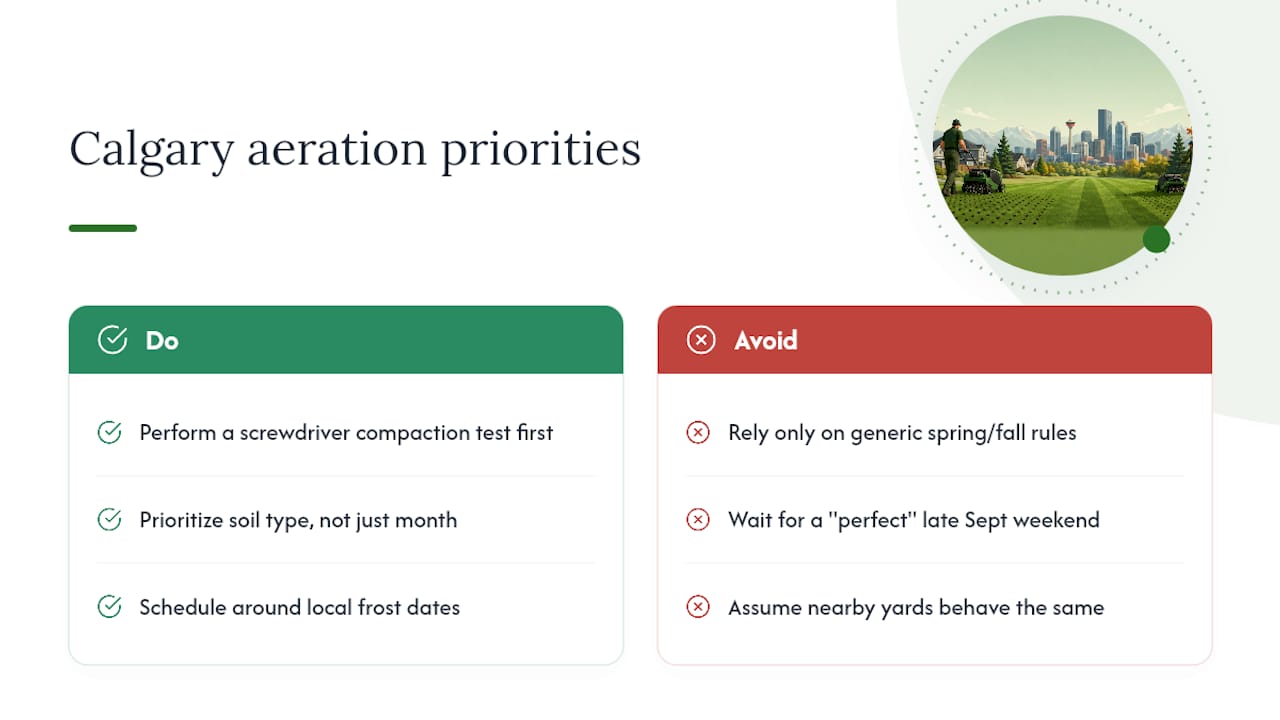
The conventional advice also undersells how short the fall window really runs here. Guides written for milder climates assume weeks of buffer before frost. Calgary sometimes gives you ten days. Waiting for the “perfect” weekend late in September is how people miss the window entirely and end up aerating too late for the grass to recover before winter.
If there’s one thing to prioritize, it’s the screwdriver test before anything else. Skip the guesswork about whether your lawn even needs the work, confirm the compaction is real, then build the calendar around Calgary’s specific frost patterns rather than a generic seasonal chart.
— Lewie
How Yearlong handles aeration timing so you don’t have to
Some companies offer services to help you navigate Calgary’s short aeration windows. Instead of renting a machine, guessing at soil moisture, and hoping you hit the fall window before frost, a professional crew can assess your specific yard, clay content and all, and book the work when your lawn is actually ready for it.

Booking starts with a site visit where we check compaction, slope, and traffic wear, then walk you through whether standard or deep core aeration fits your property. From there you get a clear quote with no vague pricing for clay-heavy or sloped yards, plus the option to bundle overseeding and ongoing lawn care so the lawn keeps improving after the initial visit. Spring and fall clean-up services pair naturally with the same seasonal window if your beds and yard need attention beyond just the grass.
Every visit comes with a satisfaction guarantee. If you’d rather have someone with local Calgary experience handle the timing and the tines, book a lawn care assessment and get a quote before the next window closes.
Sources
- City of Calgary — lawn care / aeration guidance
- City of Calgary — Aeration
- Growers Guide — When to aerate lawn in Canada
- BestLawn — Alberta aeration and overseeding timing
FAQ
Is October too late to aerate your lawn in Calgary?
Yes, in most years. Calgary’s fall window closes by mid-September because cool-season grass needs time to recover before a hard frost sets in, and October usually doesn’t leave enough growing time left.
What are the downsides to aerating a lawn?
The main downside is a short cosmetic dip: pulled cores sit on the surface for a week or two, and the lawn can look temporarily thin. If you aerate saturated or drought-stressed soil, or skip overseeding afterward, you also risk weeds moving into the open holes before grass fills back in.
Do you need to overseed immediately after aeration?
Overseeding right after aeration isn’t mandatory, but it’s strongly recommended. The holes left by hollow tines give seed much better seed-to-soil contact than seeding into intact turf, so most Calgary lawn crews do both in the same visit.
When shouldn’t you aerate your lawn?
Skip aeration when soil is saturated after heavy rain, when cool-season grass is stressed by summer heat or drought, or on lawns sodded or seeded within the past year. Heavy clay and steep slopes also call for extra caution and often need multiple passes or specialized equipment rather than a standard single-pass job.
How often should a Calgary lawn be aerated?
Lawns with heavy foot traffic or more than half an inch of thatch usually benefit from aeration every year, while lower-traffic yards can often go every one to three years depending on soil type and compaction.