

TL;DR:
- HOA property maintenance includes managing shared community spaces and private homeowner boundaries. Responsibilities are defined by legal documents, with common areas maintained by the HOA and interior upkeep by homeowners. Proper funding and clear communication prevent disputes and ensure community stability.
HOA property maintenance is the coordinated upkeep, repair, and replacement of shared community spaces managed by a homeowners association on behalf of all residents. The industry term for this work is “common area maintenance,” and it covers everything from clubhouse roofs to private roads and shared landscaping. The Utah Community Association Act 2026 sets a clear legal standard: HOAs are responsible for common areas, while homeowners maintain their personal property from the “studs-in” or “drywall-in” boundary. Getting this distinction right prevents costly disputes, protects property values, and keeps community finances on track. Whether you are a homeowner trying to understand your dues or a property manager overseeing a complex, knowing who maintains what is the foundation of a well-run community.
What is HOA property maintenance and who is responsible?

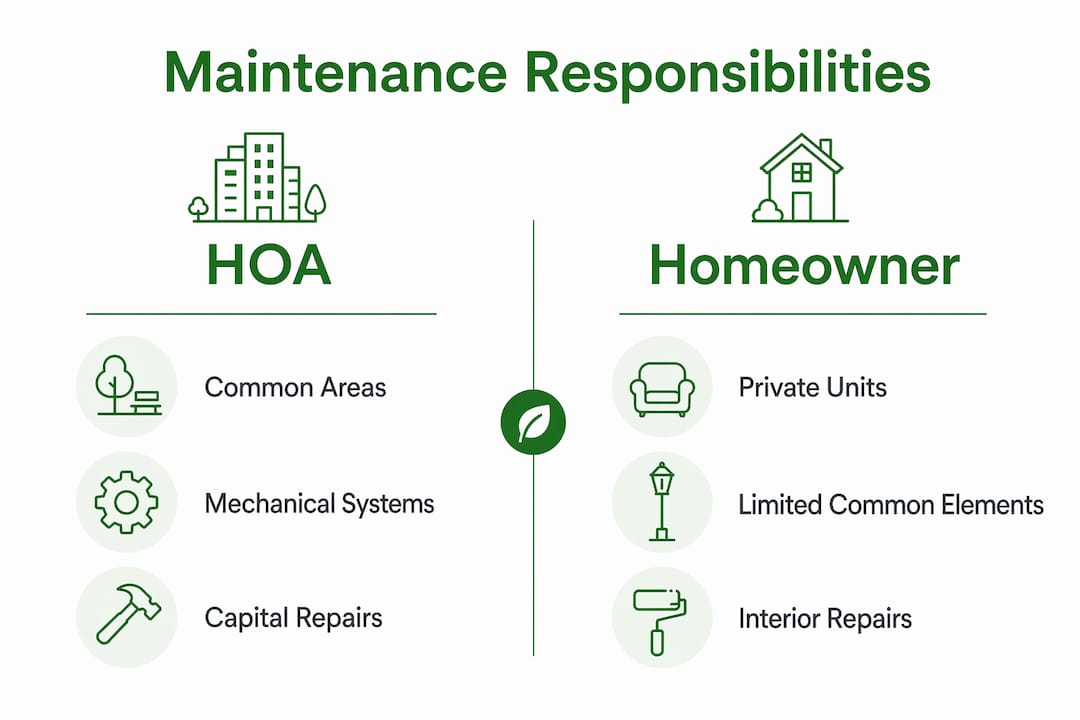
HOA property maintenance covers three distinct categories: common areas, limited common elements, and private homeowner property. Each category carries different legal and financial obligations, and confusing them is the single most common source of HOA disputes.
Common areas are spaces the entire community shares and the HOA maintains exclusively. These include:
- Clubhouses, fitness centres, and pools
- Private roads and parking lots
- Shared landscaping, parks, and green spaces
- Exterior building structures in condominium communities
Limited common elements are spaces assigned to one homeowner’s exclusive use but owned by the association. Balconies, patios, and assigned parking stalls fall into this category. The maintenance responsibility here is often split: the HOA typically handles structural repairs, while the homeowner handles cosmetic upkeep. This ambiguity makes limited common elements the most contentious maintenance issue in HOA communities.
Private homeowner property starts at the unit boundary, usually defined as “studs-in” or “drywall-in” depending on the governing documents. The boundary definition varies by community and governs who maintains interior components like flooring, fixtures, and interior walls. Homeowners bear full responsibility for everything inside that line.
Shared mechanical systems add another layer of complexity. A building’s main sewer lateral, for example, may run through private property but serve multiple units. Maintenance matrices clarify these split responsibilities for components like sewer laterals, structural repairs, and insurance coverages. Reading your community’s matrix before a problem arises saves significant money and conflict.
Pro Tip: Ask your HOA board for a copy of the maintenance responsibility matrix before you buy or rent in a community. This single document tells you exactly what you own, what the association owns, and who pays for repairs.
How do HOAs fund property maintenance?
HOA property care runs on two funding streams: operating accounts and reserve funds. Understanding both helps homeowners see where their dues go and why assessments sometimes increase.
The operating fund covers day-to-day maintenance costs. Lawn mowing, snow removal, pool cleaning, and minor repairs all draw from this account. Dues collected monthly from homeowners replenish it on a rolling basis.
The reserve fund is a long-term savings account for major capital replacements. Roofs, roads, elevators, and parking lot resurfacing are all reserve fund expenses. Reserve studies predict the timing and cost of these replacements, forming the backbone of a sustainable HOA maintenance budget. A properly funded reserve study reduces surprise costs and keeps dues predictable year over year.
When reserves fall short, the board levies a special assessment, a one-time charge to all homeowners to cover an unexpected or deferred expense. About 10–30% of older communities have underfunded reserves, which directly impacts maintenance quality and triggers more frequent special assessments. That statistic means a significant portion of established communities are already behind on their financial obligations.
Homeowners who do not pay their dues face serious consequences. HOAs can record liens as a security interest for unpaid dues and restrict amenity access upon reasonable notice. Non-payment is not just a personal financial issue. It undermines the association’s ability to maintain the community for everyone.
The practical takeaway for property managers is straightforward: budget conservatively, fund reserves fully, and treat the reserve study as a living document updated every three to five years.
Why do HOA maintenance disputes happen and how do you prevent them?
Most HOA maintenance disputes trace back to three root causes: unclear governing documents, insurance misunderstandings, and poor board communication.
Governing documents are the legal foundation of every HOA. The CC&Rs (Covenants, Conditions, and Restrictions) define maintenance boundaries, outline homeowner obligations, and grant the board authority to enforce rules and manage vendor service contracts. Many homeowners never read these documents until a dispute arises, which is far too late.
Insurance confusion is a particularly expensive source of conflict. The HOA’s master policy covers common elements and the building structure. Homeowners need their own HO-6 policy for interior and personal property. Coverage does not equal maintenance responsibility. A homeowner whose balcony floods may assume the HOA’s insurance covers interior damage, but the master policy typically stops at the unit boundary. Misunderstanding this distinction leads to denied claims and bitter disputes.
Maintenance responsibility matrices are the most practical tool for preventing conflict. These documents consolidate legal obligations into a single reference, showing who handles every repair and upkeep task for every part of the property. Matrices prevent costly disputes by removing ambiguity before a problem occurs. Boards that publish and regularly update their matrix see fewer formal complaints and faster resolution when issues do arise.
The board’s role extends beyond enforcement. Boards that communicate proactively, share maintenance schedules, and explain budget decisions build the trust that keeps communities functioning. For multi-family properties, cleaning and maintaining shared spaces consistently is one of the most visible ways a board demonstrates competent stewardship.
Pro Tip: If your HOA does not have a maintenance responsibility matrix, request that the board create one at the next annual meeting. Frame it as a cost-saving tool, not a complaint. Boards respond better to solutions than grievances.
Practical steps for homeowners and property managers
Navigating HOA maintenance effectively requires active participation, not passive dues payment. These steps apply whether you are a homeowner in a condominium or a property manager overseeing a townhouse complex.
Read your governing documents in full. The CC&Rs, bylaws, and rules and regulations define your rights and obligations. Pay particular attention to the maintenance responsibility sections and any definitions of “limited common elements.” If the language is unclear, ask the board for a written interpretation.
Report maintenance issues in writing. Verbal reports get lost. Submit maintenance requests by email or through the HOA’s official portal so there is a dated record. This protects you if the issue escalates and gives the board a clear paper trail for vendor follow-up.
Attend budget planning meetings. The annual budget meeting is where reserve fund contributions and operating expenses are set. Reviewing documents and participating in meetings improves clarity and cooperation between owners and boards. Homeowners who attend these meetings understand their dues and are less likely to resist increases.
Request a reserve study summary. Ask the board when the last reserve study was completed and what the current funding level is. A well-funded reserve means fewer special assessments. An underfunded reserve is a financial risk you should know about before it becomes a crisis.
Communicate directly with the board or management company. If you have a maintenance concern that is not being addressed, escalate through proper channels before assuming bad faith. Most boards are volunteers managing complex responsibilities with limited time.
Seek mediation for unresolved disputes. If direct communication fails, many provinces and states offer community association mediation services. Mediation is faster and less expensive than litigation and preserves community relationships. For outdoor maintenance questions specific to Calgary, Yearlong offers consultations that help property managers understand what professional seasonal outdoor care looks like in practice.
Key takeaways
HOA property maintenance divides responsibility between the association and individual homeowners based on governing documents, and underfunded reserves remain the leading cause of community financial strain.
| Point | Details |
|---|---|
| Responsibility boundaries are legal | CC&Rs and maintenance matrices define who maintains what; read them before disputes arise. |
| Reserve funds prevent financial crises | A fully funded reserve study reduces special assessments and keeps maintenance on schedule. |
| Limited common elements cause most disputes | Structural repairs belong to the HOA; cosmetic upkeep typically belongs to the homeowner. |
| Insurance coverage is not maintenance duty | Master HOA policies cover structures; homeowners need HO-6 coverage for interior property. |
| Active participation protects your investment | Attending budget meetings and submitting written reports keeps maintenance accountable. |
HOA maintenance: what I’ve learned from working with communities
After years of working alongside HOA boards and property managers in Calgary, the pattern I see most often is not negligence. It is confusion. Homeowners assume the HOA covers more than it does. Boards assume homeowners have read the governing documents. Neither assumption holds.
The communities that run well share one trait: they treat maintenance education as an ongoing responsibility, not a one-time orientation. The best boards I have worked with publish their maintenance matrix annually, explain reserve fund contributions in plain language, and respond to maintenance requests within a defined window. That transparency builds the trust that makes every other part of community management easier.
The financial side is where I see the most avoidable damage. Underfunded reserves feel like a savings until a roof fails or a road needs resurfacing. Then a community that deferred proper funding faces a special assessment that strains homeowner budgets and damages board credibility. Funding reserves properly from the start is always cheaper than catching up later.
My honest advice to any homeowner or property manager: treat your HOA’s maintenance plan the same way you treat your own home’s maintenance schedule. Deferred work always costs more. Clear documentation always prevents more conflict than it creates. And a professional outdoor care partner, especially for seasonal work like lawn bed maintenance and snow removal, removes one of the most visible and time-sensitive burdens from the board’s plate.
— Lewie
Yearlong’s outdoor care services for HOA communities
HOA boards and property managers in Calgary face real pressure to keep shared outdoor spaces looking their best year-round. Yearlong has supported communities across Calgary since 2017 with lawn bed maintenance and seasonal yard cleanup that take the guesswork out of outdoor property care.

Yearlong’s services cover the full outdoor maintenance cycle: spring and fall cleanups, lawn care, bed maintenance, snow removal, and concrete cleaning. For HOA boards managing vendor contracts, Yearlong offers flexible service packages with a satisfaction guarantee, so your community’s curb appeal stays consistent without adding to the board’s workload. Contact Yearlong to discuss a tailored outdoor maintenance plan for your community.
FAQ
What does HOA property maintenance include?
HOA property maintenance includes the upkeep, repair, and replacement of common areas such as roads, landscaping, clubhouses, and shared structures. Homeowners are responsible for maintaining their private property from the unit boundary inward.
Who pays for HOA maintenance costs?
Homeowners pay monthly dues that fund the HOA’s operating account for routine maintenance and a reserve fund for major capital repairs. Special assessments cover unexpected costs when reserves are insufficient.
What are limited common elements in an HOA?
Limited common elements are areas assigned to one homeowner’s exclusive use but owned by the association, such as balconies and patios. The HOA typically handles structural repairs while the homeowner handles cosmetic upkeep.
How do I find out what my HOA maintains?
Request a copy of your community’s maintenance responsibility matrix and review the CC&Rs. These documents define every maintenance obligation for both the association and individual homeowners.
What happens if I don’t pay HOA assessments?
Non-payment of HOA dues can result in a lien recorded against your property and suspension of amenity access. HOAs are legally authorised to take these actions upon reasonable notice under most community association statutes.