

TL;DR:
- Winter debris management involves the organized removal and disposal of storm-related residues after snow clearance to ensure property safety and compliance. It focuses on residual vegetative, salt, and hidden hazards left behind post-melt, which differ from snow removal operations. Proper site inspection, debris separation, municipal rule adherence, and thorough documentation are essential for effective cleanup and cost recovery.
Debris management in winter is the organised clearance, sorting, and disposal of storm-related and snow operation residues to keep properties safe, functional, and compliant. It is a distinct practice from snow removal. FEMA defines debris removal as the clearance and disposal of disaster debris, explicitly excluding snow itself, which is handled as a separate operation. What remains after the snow melts, including broken branches, salt residue, plow scarring, and hidden hazards buried in snow stacks, falls squarely under debris management. For property owners and managers in Calgary and across cold-climate Canada, understanding this distinction is the foundation of a safe, well-maintained site from February through May.
What is debris management in winter and why does it matter?
Winter debris management covers every material left behind by cold-weather storms and snow operations, once the snow itself has been cleared. The industry body SIMA notes that hazards from debris emerge once snow melts, meaning relying only on plowing misses critical safety and drainage issues that require formal cleanup. That gap between “the snow is gone” and “the property is safe” is exactly where debris management lives.

The debris categories you will encounter fall into three broad groups. Vegetative debris includes fallen branches, uprooted shrubs, and dead plant material brought down by ice loading or wind. Residue debris covers the salt, sand, and abrasive grit spread during winter maintenance, along with the scarring and cracking that snowplow blades leave on asphalt and concrete. Hidden hazards are the most dangerous category. Snow stacking areas act as collection points for broken asphalt chunks, damaged signage, discarded trash, and ice masses that are invisible until the thaw.
Each category creates a different problem. Vegetative debris blocks drainage channels and creates slip hazards on walkways. Salt and abrasive residue accelerates concrete deterioration and contaminates soil near garden beds. Hidden hazards in former snow stacks are the leading cause of post-winter trip and fall incidents on commercial and residential properties alike. Addressing all three categories is what separates a thorough winter debris removal programme from a basic spring sweep.
Pro Tip: Walk your property immediately after the first significant melt, not after full snowmelt. Early inspection reveals hazards while they are still isolated and easier to remove safely.
What types of debris appear after a winter storm?
The full catalogue of winter storm debris is wider than most property owners expect. A single Calgary storm can deposit all of the following across one property.
- Vegetative debris: Fallen limbs, snapped tree tops, uprooted hedges, and dead perennial material flattened by snow load
- Construction and hardscape debris: Cracked concrete sections, broken curb edges, displaced paving stones, and asphalt fragments from plow contact
- Salt and abrasive residue: Granular deposits on driveways, walkways, and garden borders that persist long after snow has gone
- Plow scarring: Gouges and surface damage on asphalt and concrete that collect water and accelerate freeze-thaw cracking
- Miscellaneous waste: Litter, lost signage, broken bollards, and other objects buried in snow stacks during the winter season
FEMA advises that salt and plow residue should be treated as post-storm maintenance distinct from formal debris removal operations. This matters practically because it affects how you schedule crews, what equipment you need, and whether certain costs qualify for reimbursement or insurance claims.
The impact on drainage is significant and often underestimated. Catch basins clogged with grit and leaf matter from winter storms back up during spring rain events, causing surface flooding and potential basement water ingress. Clearing these basins is a debris management task, not a plumbing one, and it belongs on every post-winter property checklist.
How do local regulations affect winter debris removal planning?
Municipal rules govern where debris can be placed for collection, what can be mixed together, and what is excluded entirely. Getting this wrong delays pickup and can result in debris sitting on your property for weeks longer than necessary.
The table below summarises the most common regulatory requirements property managers encounter.
| Requirement | What it means for your property |
|---|---|
| Debris separation | Vegetative, construction, and hazardous waste must be sorted into separate piles before collection |
| Exclusion zones | Debris piles must not block fire hydrants, storm drains, or sight lines at intersections |
| Set-out timing | Many municipalities specify collection windows; debris placed too early or too late misses the schedule |
| Non-vegetative exclusions | Items like appliances, electronics, and construction rubble are excluded from standard storm debris collection |
| Communication to residents | Property managers must relay site-specific instructions to tenants to prevent non-compliant placement |
Nashville’s NDOT provides a clear real-world example. Nashville’s residential collection programme mandates that vegetation debris be placed in set-out zones that avoid hydrants and drains, with no size restrictions on vegetative material but a strict exclusion of non-vegetative debris. The result is faster county-wide collection because crews are not stopping to sort or skip non-compliant piles.
Calgary’s municipal collection rules follow similar logic. Debris placed incorrectly, whether blocking a drain or mixed with excluded materials, will be passed over during scheduled collection runs. The EPA recommends that property owners separate disaster debris into categories and follow local curb set-out rules precisely, noting that correct categorisation facilitates quicker municipal pickups and smoother waste handling logistics.
Pro Tip: Convert municipal exclusion zone rules into a simple site map for your property. Mark where debris piles can and cannot go before any storm hits, so tenants and contractors follow the rules without needing to read the bylaw themselves.
What are best practices for post-winter site cleanup?
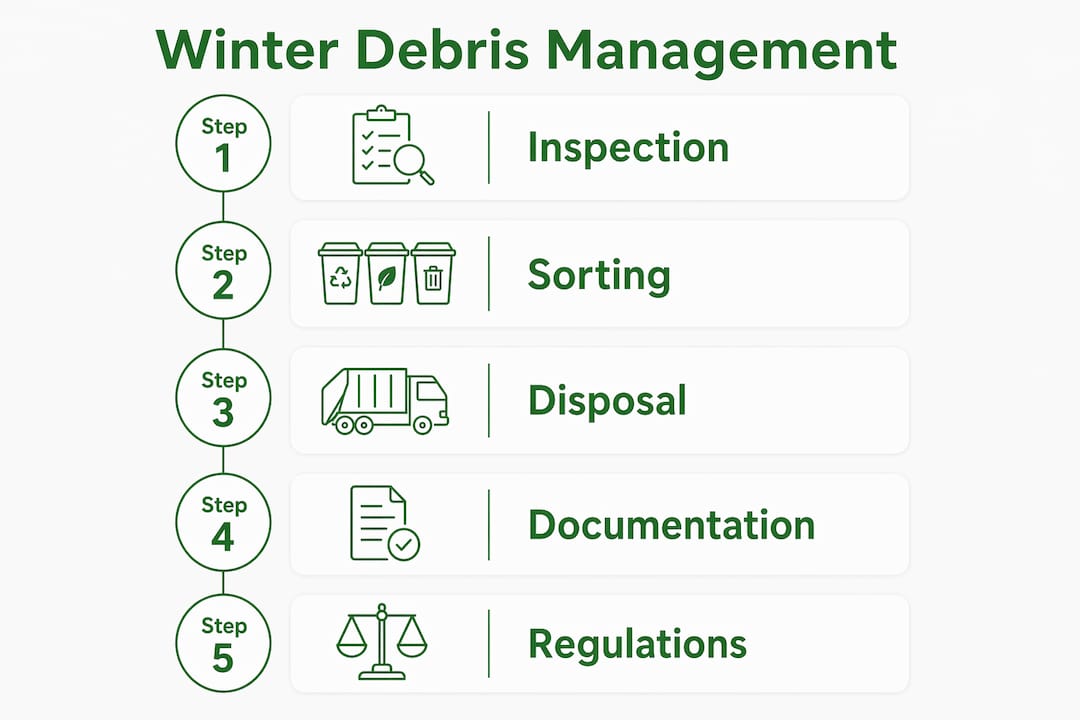
A systematic approach to post-winter cleanup prevents the two most common failures: missing hidden hazards and leaving drainage infrastructure blocked. The following workflow applies to residential and small commercial properties across cold-climate Canada.
Conduct a baseline comparison walkthrough. SIMA recommends comparing post-winter conditions against preseason documentation. Photograph every area of the property before winter begins, then walk the same route after snowmelt with those photos in hand. Differences reveal damage, debris accumulation, and hazards that would otherwise be overlooked.
Sweep all paved surfaces. Power sweeping removes salt, grit, and fine debris from driveways, parking areas, and walkways. This step protects the surface from further freeze-thaw damage and removes the abrasive material that accelerates wear on footwear and tyres.
Clear all catch basins and drainage channels. Remove accumulated grit, leaf matter, and debris from every drain on the property. A blocked catch basin during a spring rain event causes flooding that costs far more to remediate than the clearing itself.
Inspect and clear former snow stacking areas. These zones are the highest-risk areas on any property. Snow stacking areas accumulate broken asphalt, damaged signage, trash, and ice chunks that require thorough inspection and removal before the area is returned to normal use.
Document all findings and completed work. Record what debris was found, where it was located, what was removed, and by whom. This documentation supports insurance claims, municipal reimbursement applications, and future preseason planning.
Use appropriate personal protective equipment. Heavy gloves, steel-toed boots, and high-visibility vests are standard for debris removal work. Broken asphalt and hidden metal debris in former snow stacks create cut and puncture risks that are not present during routine lawn maintenance.
For a detailed local perspective on managing this process in Calgary’s specific climate, the Calgary winter debris removal guide covers the timing and sequencing of cleanup tasks through the spring thaw cycle.
How does winter debris management connect to disaster frameworks and insurance?
Winter storms that cause significant property damage can trigger disaster debris protocols managed by agencies like FEMA and provincial emergency management offices. Understanding where your cleanup costs might qualify for reimbursement or insurance coverage is worth knowing before you hire contractors.
FEMA’s framework is clear on eligibility. Vegetative debris and construction rubble from storm events are eligible debris types under public assistance programmes. Snow removal costs are not. This means the fallen tree limbs, damaged fencing, and broken hardscape from a winter storm may qualify for reimbursement, while the cost of plowing the same storm’s snowfall does not.
North Carolina Emergency Management’s debris guidance illustrates the practical side of this. Homeowners are advised to separate debris into construction and vegetative piles, with the state’s DOT handling road-side pickup in severely impacted areas. The same guidance notes that monitoring and procurement violations are the leading cause of denied FEMA reimbursement claims, meaning documentation and compliant contracting matter as much as the physical cleanup work itself.
For property managers, the key points are these:
- Separate vegetative debris from construction debris from the moment collection begins. Mixed piles are harder to classify and may be excluded from reimbursement.
- Use pre-positioned contracts with debris removal contractors where possible. Emergency procurement after a storm is both more expensive and more likely to produce compliance issues.
- Photograph debris volumes before removal begins. Cubic metre estimates supported by photographs are the standard evidence format for insurance and government reimbursement claims.
- Check your property insurance policy for debris removal coverage. Many commercial property policies include a debris removal clause that covers a percentage of the loss amount, but the coverage is often subject to timely notification and proper documentation.
Strong operational controls in debris monitoring and contracting directly influence the success of government and insurance reimbursement applications. This is not a bureaucratic detail. It is the difference between recovering cleanup costs and absorbing them entirely.
Key takeaways
Effective winter debris management requires separating debris types, following municipal set-out rules, and documenting all work to protect both safety and cost recovery.
| Point | Details |
|---|---|
| Debris vs. snow removal | FEMA excludes snow from debris operations; post-melt residue and hazards require separate management. |
| Debris categories matter | Vegetative, construction, and residue debris each require different handling, equipment, and disposal routes. |
| Municipal rules drive timing | Correct pile placement and debris separation determine whether municipal collection picks up your property on schedule. |
| Systematic inspection is non-negotiable | Comparing post-winter conditions to preseason baselines is the only reliable way to find hidden hazards. |
| Documentation protects your costs | Photographs and records of debris volumes support insurance claims and potential government reimbursement. |
Why property owners underestimate winter debris every single year
I have seen the same pattern repeat across Calgary properties since Yearlong started operating in 2017. The snow gets cleared, the driveway looks passable, and the property owner considers winter done. Then April arrives and the site looks like a construction zone. Broken branches across the lawn, grit ground into the concrete, a catch basin so packed with sand it cannot drain, and a former snow stack that is now a pile of broken asphalt and miscellaneous debris.
The mistake is treating snow removal and debris management as the same task. They are not. Snow removal is reactive and seasonal. Debris management is methodical and requires a different mindset entirely. You need a checklist, a baseline to compare against, and a clear plan for where debris goes once it is collected.
The hidden hazard problem in snow stacking areas is the one I find most consistently underestimated. Property owners see a clean-looking melt zone and assume it is fine. What they cannot see is what the plows deposited there over four months of winter. I have pulled cracked concrete sections, bent metal stakes, and shattered bollard caps from stacking zones that looked completely clear from ten metres away.
My honest recommendation is to treat the post-winter walkthrough as a formal inspection, not a casual look around. Bring a camera, bring your preseason photos, and bring someone who knows what damaged drainage infrastructure looks like. The cost of a thorough inspection is a fraction of the cost of a flooded basement or a slip-and-fall claim.
For properties that need professional backyard cleanup support after winter, the difference between a rushed sweep and a systematic cleanup is visible for the entire growing season.
— Lewie
Let Yearlong handle your post-winter property restoration
Calgary winters are hard on properties, and the cleanup that follows requires more than a rake and a bag of salt. Yearlong provides professional post-winter debris removal, power sweeping, catch basin clearing, and vegetation removal across the entire Calgary area. Whether you manage a single residential property or a portfolio of commercial sites, the team at Yearlong brings the equipment, local knowledge, and systematic approach that post-winter cleanup demands.

From seasonal cleanup services that cover debris hauling and site restoration, to full lawn care and yard cleanup that restores your property’s appearance after months of snow and salt, Yearlong offers flexible packages built around Calgary’s specific climate and municipal requirements. Contact Yearlong today to schedule your post-winter site inspection and get your property back to a safe, clean condition before the growing season begins.
FAQ
What is the difference between snow removal and debris management in winter?
Snow removal is the physical clearing of snow from driveways, walkways, and parking areas during winter. Debris management covers the clearance and disposal of materials left behind after snowmelt, including branches, salt residue, plow scarring, and hidden hazards, which FEMA treats as a separate category from snow operations.
What types of debris are most common after a winter storm?
The most common types are vegetative debris such as fallen branches and uprooted shrubs, construction debris including cracked asphalt and broken hardscape, and residue debris from salt and abrasive grit. Former snow stacking areas also accumulate miscellaneous waste and hidden hazards that only become visible after the thaw.
How do I know where to place debris for municipal collection?
Municipal set-out rules vary by city, but most require debris to be separated by type and placed away from fire hydrants, storm drains, and intersections. Nashville’s NDOT, for example, mandates vegetation-only piles in clear set-out zones with no size restrictions. Check your local municipality’s guidelines and create a site-specific placement map before debris collection begins.
Does insurance cover winter debris cleanup costs?
Many commercial property insurance policies include a debris removal clause that covers a percentage of storm-related cleanup costs. Coverage typically applies to vegetative and construction debris from storm events, not to routine snow removal. Timely notification to your insurer and photographic documentation of debris volumes before removal are required to support a successful claim.
Why is post-winter inspection important for drainage?
Catch basins and drainage channels accumulate grit, leaf matter, and debris throughout winter. If left blocked, they cause surface flooding during spring rain events. SIMA recommends scheduled post-winter walkthroughs specifically to identify and clear drainage infrastructure before the spring melt season creates runoff that has nowhere to go.