

What makes a property service truly reliable?
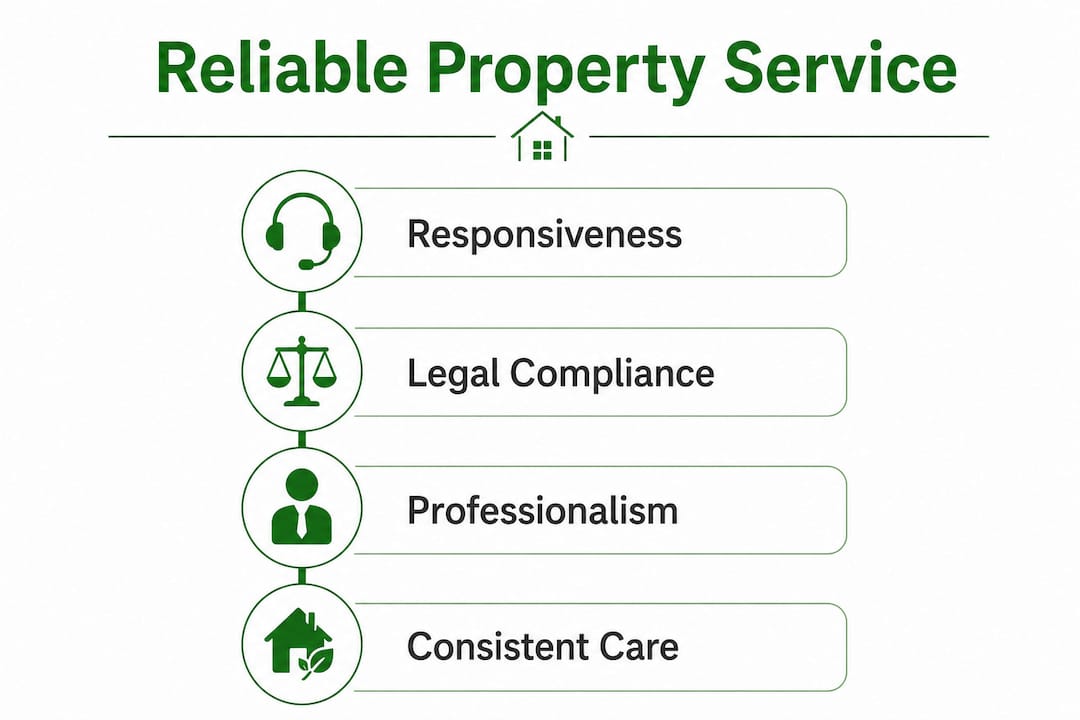
Reliable property service comes down to four things: responsiveness, legal compliance, professionalism, and consistent communication. A provider who delivers on all four protects your asset, keeps tenants satisfied, and keeps you out of legal trouble. Miss even one, and you are left chasing problems instead of preventing them.
The scope of dependable property management runs wider than most owners expect. Beyond routine maintenance, it covers legal and financial management duties: tenant relations, regulatory compliance, and trust accounts for security deposits and rents. A provider who handles only the physical upkeep while ignoring the legal side is only doing half the job.
Key trust signals to look for before signing anything:
- Certificates of General Liability and Worker’s Compensation insurance, provided without hesitation
- Active, verifiable industry licences
- Formal response time SLAs for maintenance emergencies, written into the contract
- Client references from comparable properties
- Transparent financial record keeping with monthly reporting
If a provider stalls on any of these, treat it as a red flag, not a minor inconvenience.

What does a complete property maintenance service actually cover?
Dependable property maintenance is not just fixing things when they break. The best providers split their work between proactive care and reactive response, and the ratio matters. A prevention-first approach catches problems early, before a small issue becomes a costly repair.
Core service areas in a complete maintenance offering include:
- HVAC: Scheduled filter changes, seasonal tune-ups, and system inspections to prevent mid-winter failures
- Electrical and plumbing: Safety checks, leak detection, and code compliance reviews
- Exterior and lawn care: Grass cutting, bed maintenance, seasonal cleanup, and debris removal
- Snow removal: Timely clearing of driveways, walkways, and parking areas to meet safety standards
- Concrete cleaning and sealing: Pressure washing and sealing to protect hardscape surfaces from freeze-thaw damage
- Restoration and emergency repairs: Rapid response to water damage, storm damage, or structural issues
- Security and inspections: Routine walkthroughs, lock checks, and condition documentation
The distinction between proactive and reactive service is where providers separate themselves. Scheduled inspections and preventive maintenance logs catch issues early. Providers who only show up when something fails cost you more over time, in both repair bills and tenant turnover.
How do you evaluate a property service provider’s reliability?
The interview process is where you find out whether a provider is genuinely dependable or just good at selling themselves. Interview at least three candidates and ask each one for specific metrics: current vacancy rates, average days to place a tenant, and their formal emergency response time SLA. Vague answers to these questions are useful evidence of how they actually operate.
Practical criteria to assess during vetting:
- Responsiveness: Does the provider have a written SLA for emergencies? How quickly do they acknowledge non-urgent requests?
- Licence and insurance transparency: A legitimate provider hands over certificates of General Liability and Worker’s Compensation insurance without being asked twice. Hesitation on this signals real risk for your liability exposure.
- System-driven processes: Providers who rely on transparent documentation and repeatable systems deliver more consistent results than those who depend on individual effort. Ask how they track inspections, repairs, and owner communications.
- Local expertise: A provider who knows your specific market, climate, and local bylaws will anticipate problems that an out-of-area operator misses entirely.
- References: Ask for three current client contacts from comparable properties. Trusted referrals from real estate agents or fellow investors confirm track records far better than online listings alone.
Watch for these red flags: no online owner portal, reluctance to share references, inability to state their current vacancy rate, or a long-term contract with no performance-based exit clause.
Pro Tip: Ask every candidate for sample reporting outputs before you commit. Reliable providers share clear, repeatable inspection and maintenance reports without hesitation. Also confirm the maintenance spending limit written into the contract: the standard practice is to have a spending limit for repairs where owner approval is required above a certain amount. Anything higher without your sign-off is a budget control problem waiting to happen.

When vetting contractors specifically, the advantages of hiring licensed and insured professionals extend beyond compliance. Licenced contractors carry accountability that unlicensed operators simply do not.
Why does regular property maintenance protect your investment?
Proactive, ongoing maintenance does more than keep a property looking presentable. It directly affects market value, tenant retention, and your long-term liability exposure. Owners who treat maintenance as an expense to minimise tend to pay far more when deferred problems compound.
The concrete benefits of a regular maintenance programme:
- Preserves and builds market value: Consistent property care prevents the gradual deterioration that erodes resale and rental value over time.
- Reduces emergency repair costs: Catching a failing HVAC component during a scheduled inspection costs a fraction of an emergency replacement in January.
- Improves tenant satisfaction and occupancy: Tenants stay longer in well-maintained properties. High turnover is expensive, and it usually traces back to deferred maintenance and slow response times.
- Supports regulatory compliance: Regular inspections keep electrical, plumbing, and safety systems up to code, reducing liability risk for owners.
- Extends asset lifespan: Routine care of roofing, concrete, landscaping, and mechanical systems adds years to their functional life. Investing in property upkeep consistently outperforms the cost of reactive replacement.
The financial logic is straightforward. A property that looks maintained attracts better tenants, commands stronger rents, and sells at a premium. One that shows deferred care does the opposite.
How Yearlong demonstrates reliable property service in Calgary
Yearlong has operated in Calgary since 2017, providing year-round outdoor property maintenance to homeowners, property managers, and HOAs across the city. What sets Yearlong apart from generic service providers is the combination of local climate knowledge and a genuinely customer-focused approach, not just a list of services.
Calgary’s weather demands a provider who understands the local conditions. Freeze-thaw cycles damage concrete and hardscape surfaces in ways that providers from milder climates simply do not anticipate. Yearlong’s lawn care and seasonal cleanup services are timed to Calgary’s specific growing season and weather patterns, not a generic national schedule.
| Service area | What Yearlong delivers |
|---|---|
| Lawn care and mowing | Regular cuts, edging, and seasonal health treatments |
| Bed maintenance | Weeding, mulching, and planting bed upkeep |
| Seasonal cleanup | Spring and fall debris removal and property preparation |
| Snow removal | Driveway, walkway, and parking area clearing |
| Concrete cleaning and sealing | Pressure washing and protective sealing for hardscape |
Yearlong’s service model includes flexible packages and a satisfaction guarantee, which removes the risk that makes many property owners hesitant to commit to a provider. Pricing is transparent, communication is direct, and the team covers the entire Calgary area. For property owners who want a provider they can actually rely on through both a July heat wave and a february blizzard, that local consistency is the point.

Ready to work with a Calgary property service provider you can count on year-round? Get in touch with Yearlong to discuss a maintenance plan that fits your property.
Key takeaways
Reliable property service in Canada requires verified insurance and licences, written response SLAs, system-driven documentation, and a prevention-first maintenance approach to protect property value and reduce owner liability.
| Point | Details |
|---|---|
| Insurance and licences first | Always request General Liability and Worker’s Compensation certificates before signing any agreement. |
| Written emergency SLAs | Formal response time commitments in the contract separate dependable providers from those who improvise. |
| System-driven documentation | Providers with repeatable reporting and inspection processes deliver more consistent results than those relying on individual effort. |
| Spending authorisation limits | A written spending limit for repairs without owner approval protects your budget and prevents surprises. |
| Prevention over reaction | Scheduled inspections and proactive maintenance reduce costly emergency repairs and support long-term asset value. |