

TL;DR:
- Effective maintenance scheduling transforms a property management plan into consistent upkeep by assigning specific tasks, dates, and resources. Proper scheduling reduces emergency repairs, extends asset life, and improves cost predictability, all while optimizing labor productivity and safety. It is essential for both property managers and homeowners to proactively plan seasonal and routine tasks, build buffer time for unforeseen work, and use digital tools to ensure timely, quality maintenance.
Maintenance scheduling is the process of placing planned maintenance tasks on a calendar with assigned resources, timing, and priorities to deliver consistent, cost-effective property upkeep. For property managers and homeowners in Calgary, the role of maintenance scheduling goes well beyond writing tasks on a to-do list. It coordinates who does what, when, with which tools, and under what conditions. Without this coordination layer, even the most thorough maintenance plan fails at execution. The result is reactive repairs, inflated costs, and property assets that deteriorate faster than they should.
What are the key benefits of maintenance scheduling?
Proactive maintenance scheduling reduces unplanned downtime and creates predictable budgeting by fixing minor issues before they become failures. For a property manager overseeing multiple Calgary properties, that predictability is the difference between a controlled annual budget and a string of emergency invoices.
The core benefits break down clearly:
- Reduced emergency repairs. Scheduled upkeep catches small problems, such as a cracked concrete slab or a clogged drainage channel, before they require expensive intervention.
- Extended asset lifespan. Lawn equipment, irrigation systems, and hardscaping all last longer when serviced on time rather than run until failure.
- Predictable cost management. When you know a seasonal cleanup, a bed maintenance visit, and a snow removal contract are all calendared, you can budget accurately months in advance.
- Improved safety. Outdoor walkways, driveways, and turf areas that receive scheduled attention are less likely to create slip hazards or liability issues.
- Better use of labour. Effective planning and scheduling improves technician wrench time from around 35% to 55%, a 57% productivity gain. That means more work gets completed with the same crew, reducing the reactive maintenance that drains budgets.
Pro Tip: Schedule a brief property walkthrough at the start of each season before finalising your maintenance calendar. Catching new issues in March costs far less than discovering them in July when contractors are fully booked.
How does maintenance scheduling differ from maintenance planning?

Maintenance planning and scheduling are two distinct functions that work together. Confusing them is one of the most common reasons outdoor property programmes underperform.
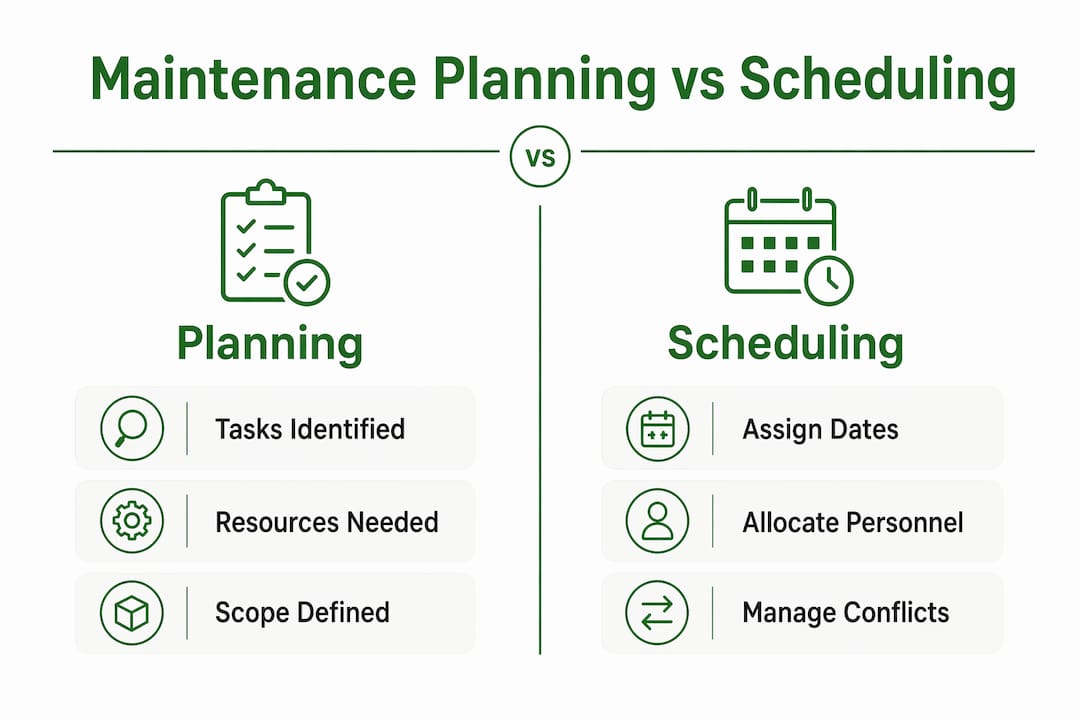
| Function | Definition | Key question answered |
|---|---|---|
| Maintenance planning | Identifying what tasks need to be done and what resources are required | What needs to happen? |
| Maintenance scheduling | Assigning when tasks will happen, who will do them, and in what sequence | When, by whom, and in what order? |
Planning defines the scope. Scheduling aligns resources, permits, parts, and downtime windows to reduce conflicts and prevent work from stalling. A plan that says “service the irrigation system before spring planting” is useful. A schedule that books the technician for April 15th, confirms the replacement parts are on hand, and blocks off two hours on the property calendar is what actually gets the job done.
The consequences of skipping proper scheduling are concrete. A property manager might have a detailed maintenance plan for a Calgary property covering lawn care, snow removal, and seasonal cleanups. Without scheduling, tasks pile up, technicians arrive unprepared, and good maintenance plans fail when real-world constraints like skill sets, cost, and downtime windows are ignored. The plan becomes a wish list rather than a working system.
Pro Tip: Treat your maintenance schedule like a production calendar. Assign each task a specific date, a named person or service provider, and a list of required materials. Vague schedules produce vague results.
What maintenance scheduling strategies actually work?
Building a schedule that holds up through a Calgary winter and a full growing season requires more than good intentions. These strategies produce results in practice.
Audit technician availability and skill sets first. Scheduling must respect constraints like technician availability and skills to avoid conflicts. Assigning a task to someone unavailable or unqualified creates a gap that often goes unnoticed until the work is already late.
Build seasonal windows into the calendar early. Outdoor property maintenance follows predictable patterns. Bi-weekly mowing during the growing season and seasonal irrigation turn-on and turn-off are standard recurring frequencies that should be locked into the calendar before the season begins, not scheduled reactively.
Prepare job packets in advance. Prepared job packets containing tools, parts, and instructions allow scheduled work to proceed without pre-job delays. Searching for parts on the day of a job is one of the most common reasons schedules slip.
Use a CMMS or digital calendar for conflict management. Computerised Maintenance Management System (CMMS) platforms like Limble, eMaint, or even a well-structured Google Calendar help property managers visualise overlapping tasks and resolve conflicts before they cause disruption. For homeowners, a shared digital calendar with service providers works just as well.
Coordinate maintenance windows to minimise disruption. Scheduling lawn care, bed maintenance, and concrete cleaning on the same visit reduces the number of service days and lowers the total labour cost per property.
Review and adjust the schedule quarterly. A schedule set in January will need revision by April. Build in a quarterly review to account for weather delays, new priorities, and completed tasks that open up calendar space.
A useful reference point is the property maintenance checklist for homeowners, which maps recurring outdoor tasks by season and provides a practical starting point for building your own schedule.
What challenges come up in outdoor maintenance scheduling?
Even well-built schedules encounter friction. Knowing the common failure points helps you design around them.
- Parts shortages and supplier delays. Ordering replacement parts for irrigation components or concrete sealant well ahead of the scheduled task date prevents last-minute cancellations. Build a two-week lead time into any task that requires specialised materials.
- Overlapping work orders. When multiple properties or multiple tasks share the same technician or time window, conflicts arise. A digital scheduling tool surfaces these conflicts before they become missed appointments.
- Unplanned work disrupting the schedule. A burst pipe or a storm-damaged fence cannot wait for the next scheduled visit. The solution is to build buffer time into each week’s schedule, typically 15 to 20 percent of total capacity, reserved for urgent work without derailing planned tasks.
- Assuming compliance equals quality. Schedule compliance alone does not guarantee quality. A task marked complete on a work order may have been done incorrectly or incompletely. Incorporating checklist-based standard operating procedures and requiring photo evidence of completed work closes this gap.
- Seasonal demand spikes. In Calgary, spring cleanup and fall cleanup periods create high demand for outdoor maintenance services. Booking service providers early, ideally in February for spring and August for fall, secures appointment availability before the rush.
The outdoor property upkeep workflow guide covers how to structure recurring schedules to handle these pressures without letting urgent work crowd out planned maintenance.
How does seasonal scheduling protect your property and your budget?
Seasonal timing is where the importance of maintenance planning becomes most visible. Miss the right window and the cost multiplies.
HVAC maintenance scheduled twice yearly, in spring and fall, aligns with manufacturer recommendations and prevents peak-season emergency calls. The same logic applies to every outdoor system on a Calgary property. Irrigation startup before spring planting prevents dry turf and root stress. Drainage checks in October prevent ice damming and water infiltration through freeze-thaw cycles. Snow removal contracts signed before November secure priority service before the first major snowfall.
| Seasonal task | Recommended timing | Risk of missing the window |
|---|---|---|
| Irrigation startup | Late April to early May | Dry turf, root damage, replanting costs |
| Lawn bed cleanup and mulching | May, before peak growth | Weed overgrowth, soil moisture loss |
| Concrete sealing | June to August, dry weather | Surface cracking, freeze-thaw damage |
| HVAC servicing | April and September | Emergency repair costs, peak-season unavailability |
| Snow removal contract | October, before first snowfall | No priority service, ice hazard liability |
| Fall drainage and irrigation shutdown | October | Pipe damage, flooding risk |
Scheduling seasonal tasks ahead of peak demand periods is the single most cost-effective habit a property manager or homeowner can develop. The cost of a scheduled spring cleanup is a fraction of the cost of repairing turf damage or replacing a cracked irrigation line that froze over winter.
Pro Tip: Set calendar reminders six weeks before each seasonal window opens. This gives you enough lead time to book contractors, order materials, and confirm access to the property before the optimal service date arrives.
Key takeaways
Effective maintenance scheduling is the execution layer that turns a maintenance plan into consistent, measurable property upkeep and cost control.
| Point | Details |
|---|---|
| Scheduling vs. planning | Planning identifies tasks; scheduling assigns timing, people, and resources to execute them. |
| Productivity gains | Proper scheduling lifts technician wrench time from 35% to 55%, completing more work with the same crew. |
| Seasonal timing matters | Booking seasonal tasks like irrigation startup and snow removal before peak demand prevents costly emergency repairs. |
| Quality control is required | Schedule compliance does not equal quality; checklists and evidence capture are needed to confirm work is done correctly. |
| Buffer capacity prevents failure | Reserving 15 to 20 percent of weekly capacity for unplanned work keeps the core schedule intact. |
Why scheduling is the part most property managers underestimate
I have seen this pattern repeat itself more times than I can count. A property manager puts together a thorough maintenance plan, lists every task that needs doing across the year, and then wonders why the property still looks neglected by mid-summer. The plan was fine. The scheduling was not.
Scheduling is treated as an administrative afterthought when it is actually the mechanism that makes everything else work. The moment you assign a specific date, a specific person, and a specific set of materials to a task, the probability of that task being completed on time jumps significantly. Without that specificity, tasks drift. They get bumped by urgent work, forgotten in busy periods, or handed off to whoever is available rather than whoever is qualified.
The other misconception I see regularly is that scheduling is only relevant for large commercial properties with full maintenance teams. Homeowners in Calgary face the same coordination problem on a smaller scale. Booking your lawn care, bed maintenance, and seasonal cleanup with a reliable provider like Yearlong and locking those dates into your calendar is exactly the same principle. You are removing the decision-making friction that causes tasks to slip.
The properties that look the best and cost the least to maintain over time are not the ones with the biggest budgets. They are the ones with the most consistent schedules.
— Lewie
Keep your Calgary property on schedule with Yearlong
Yearlong has been managing outdoor property maintenance across Calgary since 2017, and the foundation of every service is a schedule that actually holds.

Whether you need recurring lawn care, professional bed maintenance and mowing, or reliable snow removal before the first Calgary snowfall, Yearlong builds your service calendar around your property’s specific needs and seasonal windows. You get consistent upkeep without the coordination burden, and a team that shows up when scheduled. Explore Yearlong’s seasonal clean-up services or contact the team to build a maintenance schedule tailored to your property.
FAQ
What is the role of maintenance scheduling in property management?
Maintenance scheduling coordinates the timing, resources, and assignment of planned tasks to prevent conflicts and reduce downtime. It is the execution layer that turns a maintenance plan into completed work on a consistent, predictable basis.
How often should outdoor property maintenance be scheduled?
Recurring tasks like lawn mowing are typically scheduled bi-weekly during the growing season, while seasonal tasks such as irrigation startup, fall cleanup, and snow removal contracts follow annual windows tied to Calgary’s climate calendar.
What is the difference between maintenance planning and scheduling?
Planning identifies what tasks need to be done and what resources are required. Scheduling assigns specific dates, personnel, and materials to each task, resolving conflicts and aligning work with available capacity.
How can homeowners build an effective maintenance schedule?
Start with a seasonal property checklist, assign each task a specific date and service provider, and book contractors before peak demand periods. Using a shared digital calendar with your service providers keeps everyone aligned and reduces missed appointments.
Does schedule compliance guarantee that maintenance work is done correctly?
No. Compliance only confirms a task was marked complete. Incorporating checklists and requiring photo evidence of completed work are the only reliable ways to confirm that scheduled maintenance was executed to the required standard.