

For most cool-season lawns, aerating in early-to-mid fall gives the best long-term results. Fall wins because roots recover faster, overseeding takes hold better, and you sidestep the annual weeds that spring aeration can wake up. Spring still has its place, but only as a fallback when fall gets missed or compaction is already severe.
TL;DR:
- Aerating in early to mid-fall is preferred for cool-season lawns because roots stay active longer, aiding recovery and overseeding success.
- Timing should be based on soil temperature of 50°F to 65°F, roughly 6 to 8 weeks before the first hard frost, with moist but not saturated soil.
- Fall aeration minimizes weed germination by closing roots in warm soil and aligns with overseeding, while spring risks stimulating weeds and faces quicker weed competition.
- Spring aeration makes sense after severe winter damage or if fall window is missed, but it requires careful management to prevent weed seedling promotion.
- A professional service helps coordinate aeration, overseeding, and fertilization based on soil and climate conditions, improving lawn health and reducing guesswork.
Table of Contents
- Spring vs fall aeration: quick comparison
- Why fall is usually the better call
- When spring aeration actually makes sense
- How to pick the exact date for aeration
- What to do after aeration for the best results
- Tools, frequency, and when to hire a pro
- What we’ve learned scheduling hundreds of fall aerations
- Book your fall aeration window before it closes
- Sources
Spring vs fall aeration: quick comparison
If you’re deciding between spring vs fall aeration right now, here’s the short version.
Fall advantages:
- Roots stay active in warm soil, so holes close and recover within 6 to 8 weeks instead of dragging into summer stress.
- Overseeding pairs naturally with fall aeration, since cooler nights and warmer soil favour germination.
- Annual weeds like crabgrass are dormant or dying, so you’re not opening up bare soil for them to colonize.
Fall watch-outs:
- The window is real. Wait too long and cold soil stalls root growth before winter.
Spring advantages:
- Useful when fall aeration got skipped entirely.
- Helps relieve severe compaction from winter equipment, foot traffic, or construction before the growing season kicks in.
Spring watch-outs:
- Aerating in spring can stimulate crabgrass and other annual weeds right when they’re most eager to germinate.
- Recovery competes with spring’s naturally faster weed pressure, so the lawn has less breathing room to bounce back before summer heat arrives.
Why fall is usually the better call
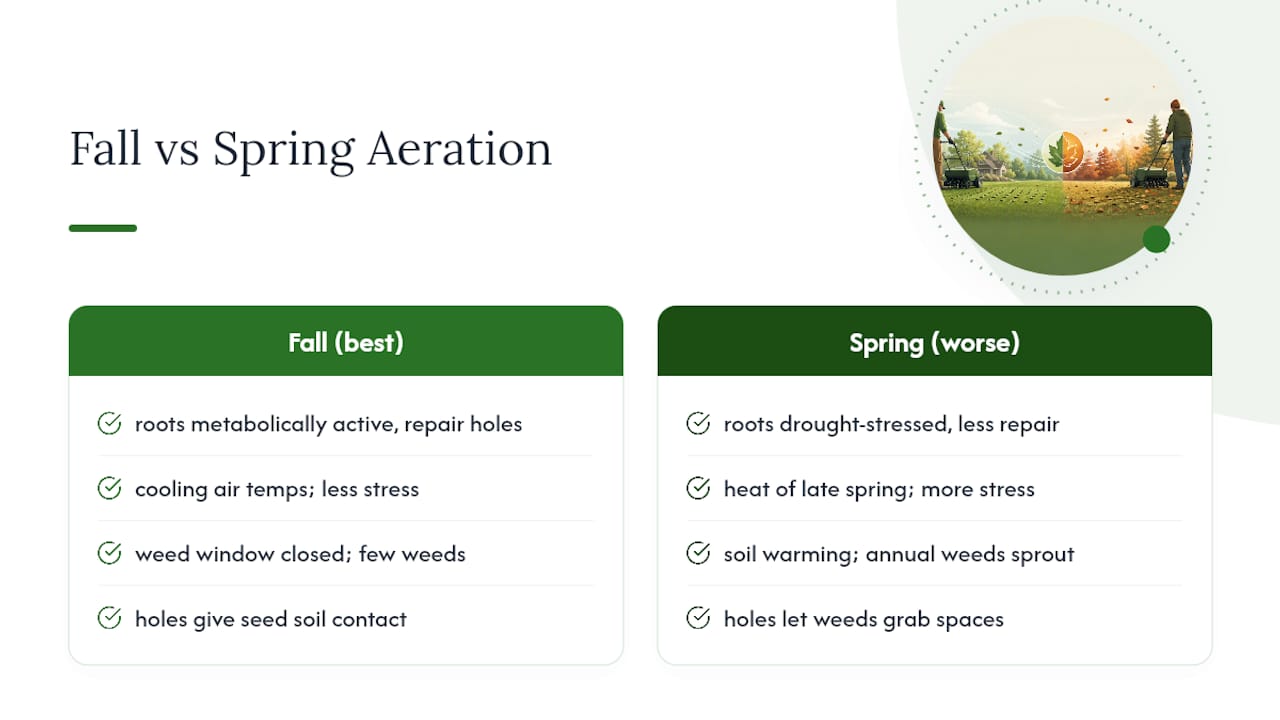
The biology behind this isn’t complicated once you see it. Soil holds onto summer heat well into fall, even after air temperatures drop. That residual warmth keeps grass roots metabolically active, which means they push new growth into the aeration holes and close them up quickly instead of sitting exposed.
Compare that to a lawn aerated in the heat of late spring or early summer, where roots are already fighting drought stress and have less energy left over for repair work.
Fall is the single best season to aerate a cool-season lawn for most regions because it lines up three things at once: active roots, cooling air temperatures that stress the grass less, and a natural lull in weed germination. Crabgrass and other annual weeds need warm soil to sprout, and by fall, that window has closed. Aerate in spring instead, and you’re punching holes into soil that’s warming up right as weed seeds are looking for an opening.
This is also why fall aeration and overseeding go together so well. New grass seed needs direct contact with soil to germinate, and aeration holes give it exactly that, without competing against a flush of weeds trying to grab the same real estate.
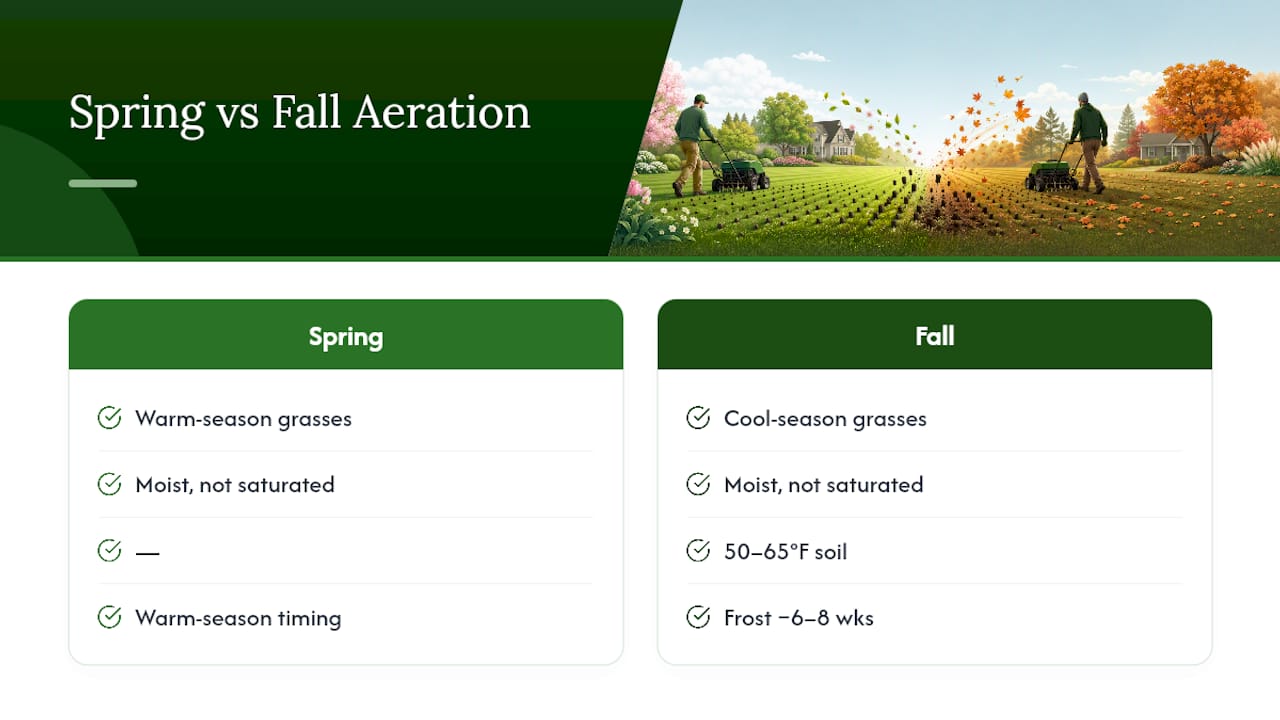
The practical rule: aim for 6 to 8 weeks before your area’s average first hard frost, with soil sitting between 50°F and 65°F. That gives new grass enough time to establish before winter dormancy sets in.
When spring aeration actually makes sense
Spring aeration isn’t wrong, it’s just situational. If your lawn took a beating over winter from a driveway extension, a construction crew, or months of foot traffic packing down clay soil, waiting until fall means months of a struggling, compacted lawn. In that case, spring aeration is the right call, done early.
The same goes if you flat-out missed the fall window last year. Schedule it as soon as the soil is workable, ideally before soil temperatures consistently climb past 55°F, to limit how much you’re helping crabgrass along.
The trade-off to plan around: spring aeration plus overseeding leaves bare soil that weeds want too, but spring aeration plus a pre-emergent herbicide blocks seed germination entirely, including any grass seed you put down. Pick one or the other. If compaction is your real problem, aerate and skip the seed until fall, then apply your pre-emergent on schedule.
How to pick the exact date for aeration
Forget the calendar. The lawn tells you when it’s ready, if you know what to check.
Push a soil thermometer 2 to 4 inches into the ground. For fall aeration, you’re looking for a range of 50°F to 65°F. That’s warm enough for roots to still be active, cool enough that weed germination has mostly shut down.
Next, count backwards. Find your region’s average first hard frost date and subtract 6 to 8 weeks. That’s your target aeration window, and it’s usually a tighter band than people expect, often just two or three weeks wide.
Moisture matters as much as temperature. Aerate when soil is moist but not saturated; soil that’s bone dry resists the tines and gives you shallow, useless plugs, while waterlogged soil pulls up in clods and can make compaction worse. The day or two after a moderate rain is close to ideal.
One more variable: grass type. Cool-season lawns (fescue, Kentucky bluegrass, ryegrass) follow the fall-first rule above. Warm-season grasses like Bermuda or zoysia actually aerate best in late spring to early summer, once they’re fully out of dormancy and actively growing.
What to do after aeration for the best results
Aeration alone doesn’t fix a lawn. What you do in the two weeks after matters just as much.
- Aerate first, pulling plugs across the whole lawn, not just problem patches.
- Overseed immediately after, while holes are open and seed can settle into direct soil contact. Follow the seed bag’s rate for your grass type; skimping here is the single most common overseeding mistake.
- Top-dress lightly with compost or fine soil if you want to speed germination, though this step is optional for most lawns.
- Apply fall fertilizer formulated for root development rather than leaf growth.
- Water consistently, aiming for light, frequent watering (once or twice daily) for the first two weeks to keep the top inch of soil moist, then tapering to deeper, less frequent watering as seedlings establish.
Avoid heavy foot traffic on the lawn for at least two to three weeks, and don’t mow short (scalp) right after seeding, since new grass needs leaf surface to photosynthesize and grow roots.
Pro Tip: If you’re overseeding a larger area, a light pass with a lawn roller or even a few walks across the lawn with normal shoes can press seed into firmer contact with the soil, which noticeably improves germination rates without any extra cost.
For a full walkthrough of prep and timing, Yearlong’s step-by-step aeration guide covers the process in more detail, and their overseeding guide breaks down seed selection by lawn type.
Tools, frequency, and when to hire a pro
Core aerators, the ones that physically remove small plugs of soil, do more than spike aerators, which just poke holes and leave the compaction largely intact. If your soil is at all compacted, a core machine is worth the extra rental cost.
Most lawns only need aeration once a year, ideally in fall. Clay-heavy soil or lawns with heavy foot traffic (kids, dogs, a busy patio area) can benefit from a second pass in spring.
Call in a professional when compaction runs deep, your lawn is large enough that a rental machine becomes a full weekend project, or you want aeration and overseeding coordinated in one visit instead of guessing at timing yourself.
What we’ve learned scheduling hundreds of fall aerations
Homeowners tend to treat aeration as a one-and-done task they can schedule around a free Saturday. It doesn’t work that way. Yearlong’s fall aeration and overseeding scheduling runs on soil temperature checks, not a fixed date on the calendar, because the window shifts year to year depending on how the season plays out.
A typical booking involves confirming the client’s frost timeline, checking soil temperature that week, then following up with watering guidance through germination. The lawns that struggle most are almost always the ones aerated on a convenient weekend instead of the right week.
— Lewie
Book your fall aeration window before it closes
Guessing at soil temperature and frost dates is where most DIY aeration attempts go sideways, either too early for good root response or too late for seed to establish before winter. Yearlong’s fall program bundles the parts that actually need to happen together instead of separately:
- Core aeration timed to your lawn’s soil temperature and grass type
- Overseeding immediately after, while holes are open
- Fall fertilizer application suited to root development
- A follow-up check to catch watering or germination issues early
Working with a crew that tracks these variables across every property in Calgary means you skip the trial-and-error most homeowners go through on their own. Yearlong’s lawn care packages include aeration and overseeding as a coordinated fall service rather than separate bookings, and current availability for the Calgary area is listed on the aeration and overseeding page. Get your fall slot booked while soil temperatures are still in range.
Sources
- When to Aerate Cool Season Grass: Fall vs. Spring Timing Explained – GreenTurf Lab
- How to aerate your lawn – Martha Stewart
- 11 Simple Steps for Spring Lawn Care – The Spruce
- Best time to aerate lawn | TruGreen