

A solid snow removal contract needs eight things: clear parties and property details, defined scope of service, a measurable snow event trigger, a pricing model, response time standards, de-icing terms, insurance and indemnity requirements, service logs tied to invoicing, plus a term and cancellation clause. Skip the insurance certificate or the service log requirement, and you have no real defence if someone slips and sues.
TL;DR:
- Insurance certificates must be provided before the first snowfall, including snow removal endorsements, to ensure proper liability coverage.
- Service logs documenting arrival times, services performed, and photos should be mandatory for invoicing and retained for at least two to three years for dispute resolution.
- Trigger clauses should specify exact snow depth, measurement authority, response window, and re-clear rules to prevent disagreements about service activation.
- Pricing models vary from per-push, tiered per-inch, seasonal flat rates, to hourly; each shifts risk differently and influences overall cost predictability.
- Clear termination and force majeure clauses are essential, with specific causes for early exit and defined events outside control, like extreme weather or government-ordered closures.
Table of Contents
- What are the essential clauses in a snow removal contract?
- Which pricing model fits your property?
- How do you define a snow event that avoids disputes?
- What performance standards should the contract guarantee?
- What insurance and indemnity terms should owners require?
- Why do service logs matter more than most owners realize?
- How should term, payment, and cancellation work?
- Copy-ready clauses and a quick review checklist
- What happens when a dispute can’t be settled informally?
- When can either party end the agreement early?
- How do force majeure clauses handle extreme weather?
- What equipment and staffing standards should a contract require?
- What safety and compliance standards belong in the contract?
- Negotiation priorities and where contractors push back
- Get contract-ready snow removal terms without drafting from scratch
- Where to check contract templates and insurance rules
- Sources
- FAQ
What are the essential clauses in a snow removal contract?
Every enforceable snow removal contract rests on a handful of clauses that name exactly who does what, where, and under what conditions. Vague language is where most disputes start, usually months after the ink dries and a driveway hasn’t been touched in three days.
Start with parties and property. Name both parties by their full legal names, not just “the contractor” or “the client,” and include current contact information for emergencies. Attach a service map or photos showing the exact property boundaries, entry points, and any features (fire hydrants, fences, garden beds) that plows need to avoid. This single addition resolves more disputes than any clause about pricing ever will.
Scope of service comes next, and it needs to be exhaustive rather than general:
- Driveways, parking stalls, and lot lanes to be plowed
- Sidewalks, entrances, and walkways requiring hand shovelling or blowing
- Roof snow load removal, if included
- Snow hauling and where excess piles get relocated
- Explicit exclusions (decks, hot tubs covers, gated side yards)
Snow pile rules matter more than most homeowners realize. Specify where snow gets stacked on the property and at what point piles get hauled off site, especially for smaller lots where accumulated snow eats into usable parking or sightlines by January. Add hidden-obstacle language too. Contractors should not be liable for damage to items not visible under snow cover (garden edging, low retaining walls) unless the owner disclosed them in writing beforehand.
Which pricing model fits your property?
Snow removal pricing agreements generally fall into four structures, and each shifts risk differently between the property owner and the contractor.
- Per-push: A flat rate charged every time the crew visits, regardless of how much snow fell. Simple to understand, but costs climb fast in a heavy winter.
- Per-inch (tiered): Rate increases at set depth thresholds (say, one rate for 2 to 4 inches, a higher one past 8 inches). Fairer for light winters, harder to predict for budgeting.
- Seasonal flat rate: One price covers the whole season regardless of snowfall totals. Predictable for the owner, riskier for the contractor in a brutal winter.
- Time-and-materials: Billed hourly plus materials, common for large commercial lots or one-off jobs rather than ongoing service.
Seasonal contracts commonly include record-winter clauses and event caps that let a contractor request a surcharge after a defined number of pushes, protecting them from an unusually severe season while keeping the season rate viable for the owner. Residential per-push pricing and seasonal pricing ranges vary widely by region and lot size, so treat any published range as illustrative rather than a quote.
How do you define a snow event that avoids disputes?
The trigger clause is the single most argued-over part of a winter service contract, and it’s entirely avoidable with three details written into the agreement.
- Set a trigger depth. Most residential contracts use a low trigger depth, and commercial lots typically use a slightly higher threshold, since a lower trigger means more visits and higher seasonal costs.
- Name who measures, and where. Designate either an on-site measuring stake or a named weather-data provider or station as the authoritative source, so nobody argues over whose ruler is correct.
- Define the response window and re-clear counting. State how many hours after the trigger is hit the contractor must arrive, and how continuous storms are billed. A complete trigger clause spells out depth, measurement authority, response window, and re-clear counting together, since leaving any one piece vague reopens the whole argument at invoice time.
What performance standards should the contract guarantee?
Response time is where good contracts separate from vague ones. Residential contracts commonly promise service beginning within a few hours of the trigger being met; commercial contracts serving businesses that open early often require lots cleared before a set opening time, since a blocked entrance at opening is a liability problem, not just an inconvenience.
- Missed service should trigger a defined remedy: partial invoice credit, a cure period to fix it, or the owner’s right to hire another provider and bill the difference back to the original contractor.
- Damage caused by equipment (torn sod, cracked curbs, damaged sprinkler heads) needs a repair timeline written into the contract, not left to goodwill.
- Quality standards for hand-cleared walkways and de-icing coverage should be spelled out, not assumed.
Pro Tip: Put a dollar figure or percentage on the missed-service credit before the season starts. “Reasonable adjustment” sounds fair on paper but turns into a fight the first time it actually gets used.
What insurance and indemnity terms should owners require?
Insurance is where homeowners get burned the most, usually because they never asked to see a certificate before the first snowfall. Require the contractor to carry commercial general liability insurance, commonly with limits around $1,000,000 per occurrence, and confirm the certificate lists a snow-specific endorsement, since some standard policies exclude snow removal operations entirely.
- Request a certificate of insurance (COI) before the season starts, not after the first visit.
- Have the property owner named as an additional insured on the policy.
- Confirm the endorsement section explicitly covers snow and ice control operations.
- Use hold-harmless language tied to the contractor’s negligence, not a blanket indemnity that shifts unrelated risk onto the owner.
Roughly a handful of slip-and-fall claims against snow contractors turn on whether the certificate actually named the right endorsements at the time of the incident, which is why verifying the paperwork matters more than trusting a verbal assurance that “we’re insured.”
Why do service logs matter more than most owners realize?
A service log is the single cheapest piece of protection in the entire contract, and it costs the contractor nothing but a few minutes per visit. Standardized visit logs recording arrival time, services performed, and materials used, backed by photos, serve as the primary evidence in a slip-and-fall dispute, since a signed contract alone proves nothing about what actually happened on a given day.
- Date, arrival and departure time
- Measured snow depth at arrival
- Areas serviced and de-icing materials applied
- Operator name and photos of before/after conditions
Make log submission a condition of invoicing, not a courtesy. Require logs retained for at least two to three years, and give the owner audit rights to request them within a reasonable window, since commercial contracts commonly build signed snow-and-ice control logs into the payment terms for exactly this reason.
How should term, payment, and cancellation work?
Most seasonal winter service contracts run November through March or April, and many auto-renew unless one party gives notice, typically 30 to 45 days before the season starts. Missing that window can lock an owner into another year with a contractor they didn’t intend to rehire.
- Payment terms usually offer monthly installments across the season or a lump sum up front, with per-push billing invoiced weekly or monthly depending on the provider.
- Late-fee language should specify a grace period and a flat or percentage penalty after that.
- Cancellation rights need clear language for termination for cause (missed service, unsafe conditions) versus termination for convenience, which often carries a notice period or early-termination fee.
- Mid-season pricing adjustments, if allowed at all, should require written agreement, not a unilateral rate change.
Copy-ready clauses and a quick review checklist
A few short clause snippets, adapted to your property, cover most of what’s above:
- Trigger: “Service will begin within 6 hours of accumulation reaching 2 inches, as measured by [named weather station].”
- Scope: “Contractor will clear the driveway, front walkway, and entrance stairs; deck and side yard are excluded.”
- Insurance: “Contractor shall provide a certificate of insurance naming Owner as additional insured, with snow removal endorsement, before December 1.”
- Logging: “Invoices will not be processed without a completed service log, including timestamps and photos, for each visit.”
- Response time: “Contractor guarantees lot clearance before 7 a.m. on business days.”
Before signing, run any proposal through this short list:
- Are both parties’ legal names and the property address correct?
- Is the trigger depth and measurement source named?
- Is the response window specific (hours, not “promptly”)?
- Does the scope list exact surfaces and named exclusions?
- Is the pricing model and rate clearly stated?
- Is a COI required before the season starts?
- Are snow endorsements confirmed on the certificate?
- Are service logs mandatory and tied to invoicing?
- Is the cancellation and renewal notice window stated?
- Is there a remedy listed for missed service?
What happens when a dispute can’t be settled informally?
Every snow removal service contract needs a clause naming how disagreements get resolved, because “we’ll work it out” rarely survives an actual dispute over a missed visit or a slip-and-fall claim.
Most residential and small commercial agreements name mediation as the first step: a neutral third party helps both sides reach a voluntary agreement without the cost of formal proceedings. If mediation fails, many contracts escalate to binding arbitration rather than court, since arbitration is generally faster and less expensive than litigation, and the process stays private rather than becoming a public court record. The contract should name which arbitration rules apply (a provincial arbitration act, for instance) and who pays the arbitrator’s fees if the parties can’t agree.
Jurisdiction matters just as much as the resolution method. State which province’s laws govern the contract and which court or arbitration venue has authority if a dispute needs to be filed formally. This detail sounds like boilerplate until a contractor is based in a different province than the property, and suddenly nobody agrees on where a claim should even be heard.
For high-value commercial properties, a tiered approach works well: mandatory mediation first, arbitration second, and litigation reserved only for claims above a certain dollar threshold or disputes involving fraud. Smaller residential contracts rarely need anything beyond a simple mediation clause with a named local jurisdiction, since the cost of formal arbitration can exceed the value of the dispute itself.
When can either party end the agreement early?
Termination clauses protect both sides, and a one-sided version (favouring only the contractor or only the owner) is a warning sign worth pushing back on during negotiation.
Termination for cause covers real failures: missed service beyond an agreed number of incidents, unsafe work, failure to carry required insurance, or non-payment. This type of termination usually takes effect immediately or after a short cure period, giving the offending party a chance to fix the problem before the contract ends. Spell out exactly what counts as cause. “Poor performance” is too vague to enforce; “three missed service windows in a 30-day period” is not.
Termination for convenience lets either party exit without alleging fault, typically with 30 days’ written notice. Seasonal contracts often attach an early-termination fee here, since a contractor who staffs and equips for a full season loses real revenue if an owner cancels in January.
Penalties for non-performance should scale to the severity of the miss. A single late visit might trigger a partial credit on the next invoice. Repeated failures, or failures that lead to a documented injury, might justify contract termination plus the owner’s right to hire a replacement contractor and bill the difference back to the original provider. Some commercial agreements also include liquidated damages, a pre-agreed dollar amount owed per missed service window, which avoids arguing over actual damages after the fact.
One overlooked detail: what happens to equipment, salt stockpiles, or prepaid balances at termination. A contract silent on this leaves both sides guessing whether a prepaid seasonal balance gets refunded pro-rata or forfeited entirely.
How do force majeure clauses handle extreme weather?
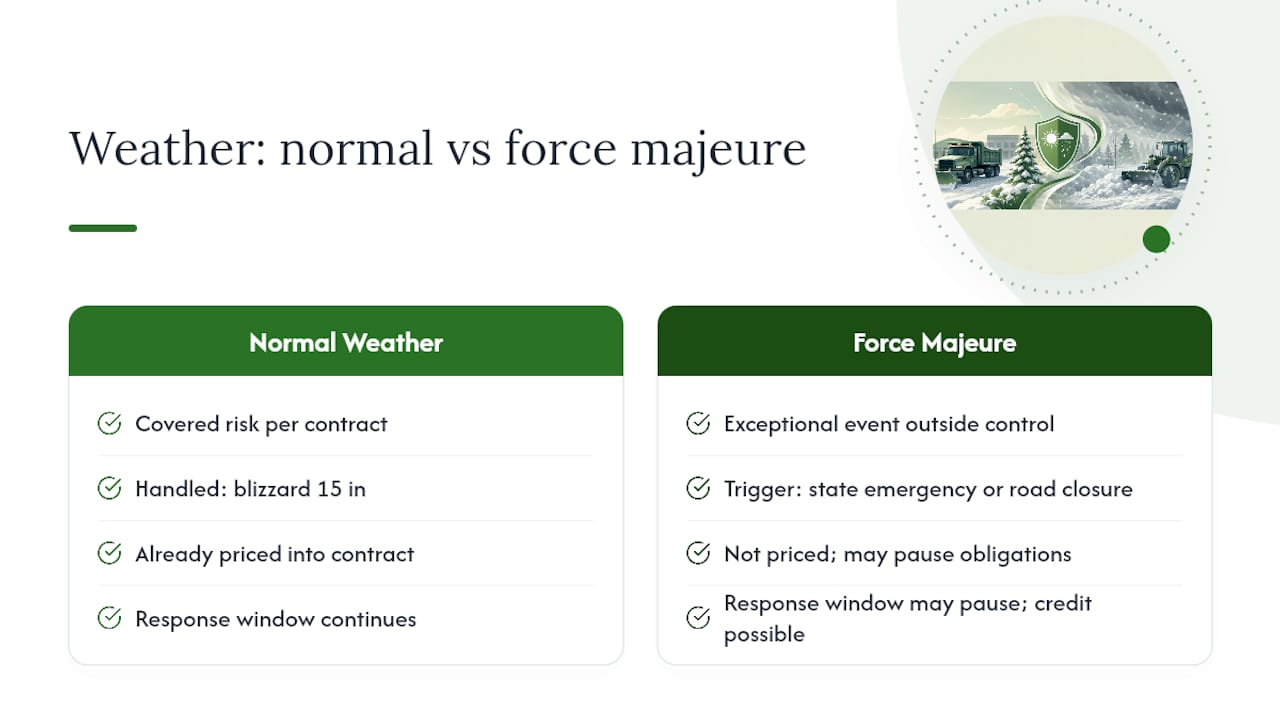
Force majeure clauses exist to protect both parties from events truly outside anyone’s control, but in a snow removal contract, weather itself can’t be the excuse since weather is the entire reason the contract exists.
A properly drafted clause distinguishes between normal winter weather (which the contract already prices for) and genuinely extraordinary events: a state of emergency declaration, a highway closure preventing equipment access, extreme cold warnings that make safe operation impossible, or equipment failure caused by conditions beyond reasonable maintenance. A blizzard dumping 15 inches overnight is not force majeure; it is exactly what the trigger clause and response window were built to handle.
List specific triggering events rather than a vague “acts of God” phrase. Named events might include declared states of emergency, government-ordered road closures, or extreme cold warnings issued by a named weather authority. This precision protects the owner from a contractor claiming force majeure every time a storm gets inconvenient, while still protecting the contractor when conditions genuinely make service impossible or unsafe.
The clause should also state what happens during a force majeure event: does the response window pause, does the owner get a credit for missed service days, and how quickly must the contractor resume once conditions clear? Silence on this point tends to favour whoever has more leverage after the fact, usually the contractor, so owners should push to have resumption timelines written in rather than left open ended.
What equipment and staffing standards should a contract require?
A contract that never mentions equipment or crew qualifications leaves owners with no recourse if a contractor shows up with a pickup truck and a shovel for a property that needs a skid steer and a dedicated sidewalk crew.
Specify the equipment class required for the property: plow trucks for lot clearing, walk-behind or ride-on sidewalk machines for pedestrian areas, and backup equipment in case of mechanical failure during an active storm. Larger commercial properties should require the contractor to name backup equipment and a backup operator, since a single point of failure during a major storm leaves the whole lot uncleared.
Personnel standards matter too, particularly for de-icing and salt application, which require some judgment about material type and application rate. Contracts should state whether operators need specific training or certification for de-icing chemical handling, and whether the contractor supervises subcontracted crews directly or through a third party. Subcontracting is common in the industry, but owners should know whether their contract allows it and whether the same insurance and log requirements flow down to subcontractors.
Fuel, maintenance, and equipment condition responsibilities belong to the contractor by default, but a contract silent on this can create arguments if a breakdown mid-storm delays service. A simple line stating the contractor is responsible for maintaining all equipment in safe operating condition throughout the season closes that gap.
What safety and compliance standards belong in the contract?
Safety language protects the owner from liability exposure just as much as it protects workers, and it’s one of the more commonly skipped sections in residential agreements.
The contract should require the contractor to comply with applicable provincial occupational health and safety regulations, including proper training for equipment operators and safe salt or de-icing chemical handling. For commercial properties, this often extends to specific signage requirements (wet floor or ice warning signs at entrances) and marked pedestrian pathways during active clearing operations.
De-icing material selection matters for both safety and property protection. Some de-icers damage concrete, landscaping, or pet paws, so the contract should specify which materials the contractor will use and give the owner the right to request an alternative (calcium chloride instead of rock salt, for instance) if there are specific concerns about pets or new concrete.

Finally, include a clause addressing what happens if a safety hazard is discovered that falls outside the contracted scope, like a cracked step or a loose handrail. The contract should state whether the contractor is obligated to report it, and clarify that identifying a hazard doesn’t create an obligation to repair it unless separately agreed. This keeps the lines of responsibility clean if something goes wrong later and both parties start pointing fingers.
Negotiation priorities and where contractors push back
If you can only fight for three things in a snow removal contract, make them insurance verification, mandatory service logs, and precise trigger language. Price matters less than most owners think once winter actually starts.
Contractors will push back on rigid response windows, especially during major storms when every client wants to be first. A reasonable compromise is a tiered response window that extends slightly during named storm events, rather than a fixed hour count that becomes unenforceable in a blizzard. They’ll also resist broad liability for hidden obstacles. Fair compromise: the owner discloses known hazards in writing, and the contractor accepts liability only for obstacles that were disclosed or reasonably visible.
Never let the first plow happen before the certificate of insurance is in hand.
— Lewie
Get contract-ready snow removal terms without drafting from scratch
Most of the clauses above take hours to negotiate line by line with an unfamiliar contractor, and Calgary winters don’t wait for paperwork to catch up. Yearlong offers seasonal snow removal plans starting from $130 per month as well as one-off service, and can provide a sample contract addendum and a current certificate of insurance before your first snowfall, so the insurance and logging clauses covered here aren’t something you have to chase down after the fact.

Local Calgary crews track trigger conditions directly, aim to respond within 6 hours of snowfall rather than the 24-hour standard common elsewhere, and log every visit so you have documentation on hand if a dispute ever comes up. If you manage a residential property, small commercial lot, or HOA and want pre-season terms locked in before the first storm hits, request a pre-season snow removal proposal and get your contract details settled while there’s still driveway to see.
Where to check contract templates and insurance rules
Start with Zensurance’s guide to writing a snow removal contract for a general clause checklist, and myBoardwalk’s insurance guidance for certificate and endorsement details specific to snow operations. Yearlong’s own Calgary snow removal standards guide covers local expectations in more depth. Have any commercial contract above a modest dollar value reviewed by a lawyer before signing.
Sources
- Snow removal contractor insurance guidance
- Snow plowing contract template — triggers, pricing and liability
- How to write a snow removal contract
FAQ
How do snow removal companies pay their employees?
Most snow removal companies pay crews hourly during active storm events, sometimes with a per-push or per-property bonus structure layered on top for efficiency. Seasonal staff are commonly paid hourly regardless of snowfall volume, while owner-operators typically earn based on the contract’s per-push or seasonal revenue after expenses.
What are the laws regarding snow removal contracts?
Snow removal laws vary by province and municipality, particularly around sidewalk clearing deadlines and liability for slip-and-fall incidents on adjacent public walkways. Contracts should name the governing province’s law and confirm the contractor carries the liability coverage and endorsements required to operate legally in that jurisdiction.
What is the typical price for snow removal?
Pricing depends heavily on the model. Per-push residential rates and seasonal flat rates both vary by lot size, region, and snowfall severity, so any published figure should be treated as illustrative rather than a quote; Yearlong’s snow removal service starts from $130 per month for seasonal plans, with one-off service also available.
Is snow plowing a good side hustle?
Snow plowing can generate solid seasonal income for someone with a truck and plow attachment, but profitability depends on route density, equipment costs, and insurance. Anyone plowing for pay, even occasionally, should carry commercial general liability coverage, since a slip-and-fall claim without insurance can wipe out a season’s earnings.
What’s the difference between per-push and seasonal snow removal pricing?
Per-push pricing charges a set rate every time the crew visits, while seasonal pricing charges one flat rate for the entire winter regardless of snowfall totals. Per-push suits light-snowfall years; seasonal pricing offers predictable budgeting but usually includes a record-winter clause protecting the contractor from an unusually heavy season.