

Properly maintained gutters are the single most effective thing you can do to protect your lawn from concentrated runoff, soil erosion, and root disease. When gutters work as intended, roof water moves through downspouts and disperses safely away from turf and beds. When they fail, that same water hammers the same patch of soil every rainfall until the grass dies, the topsoil washes away, and the problem spreads to your foundation. The role of gutter health for your lawn is not a minor footnote in home maintenance — it is the upstream cause of some of the most persistent lawn problems Calgary homeowners face.
Three things to do right now:
- Check gutters during the next rain. Stand outside during a moderate rainfall and watch for water spilling over the gutter edge or running down the fascia. That overflow is actively eroding your lawn.
- Clear debris or book a cleaning. If you see overflow, the gutter needs cleaning before the next storm. Twice-yearly cleaning — late fall and early spring — is the baseline for most Calgary homes.
- Verify downspout discharge distance. Walk each downspout and confirm water exits several metres from the foundation. If it does not, an extender or splash block is a quick, inexpensive fix.
Table of Contents
- How clogged or failing gutters actually damage your lawn and soil
- Signs your gutters are harming the lawn right now
- How to schedule gutter maintenance to protect your lawn in Canada
- Where your downspouts discharge matters as much as clean gutters
- Gutter guards: do they actually help your lawn, and are they worth it in Calgary?
- Winter and melt-season risks: ice dams and freeze-thaw damage to your lawn
- What to do when you find gutter-related lawn damage
- Key takeaways
- The part most homeowners get wrong
- Yearlong keeps your gutters and lawn working together in Calgary
- Helpful sources and further reading
How clogged or failing gutters actually damage your lawn and soil
Gutters are part of your home’s exterior drainage ecosystem, not just a roof accessory. When they clog, roof runoff concentrates into a narrow stream and drops from the gutter edge with enough force to carve channels in soil, strip mulch from beds, and compact the ground below.
The physical damage follows a predictable sequence. First, topsoil erodes from the discharge zone, taking with it the nutrients and organic matter that grass roots depend on. Bare patches appear, weeds move in, and the lawn becomes uneven. Second, the saturated soil beneath those patches loses its oxygen capacity. Grass roots sitting in waterlogged, anaerobic soil develop rot and fungal disease, which shows up as thinning or browning turf that no amount of fertiliser will fix.
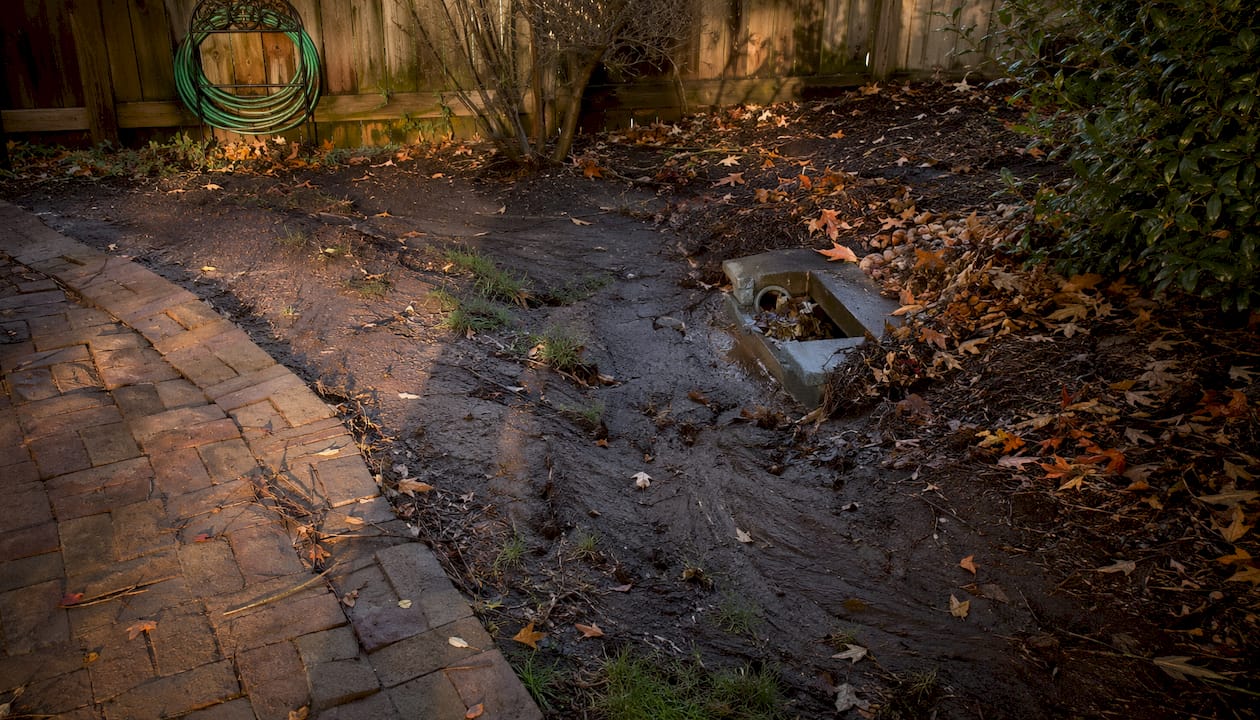
The longer-term cascade is worse. Washed mulch scatters across walkways and needs constant raking. Soil grading near the house shifts as topsoil migrates away. If the discharge point is close to the foundation, repeated saturation can create moisture concerns in crawl spaces or basements. Addressing the gutter is almost always cheaper than addressing what comes after.
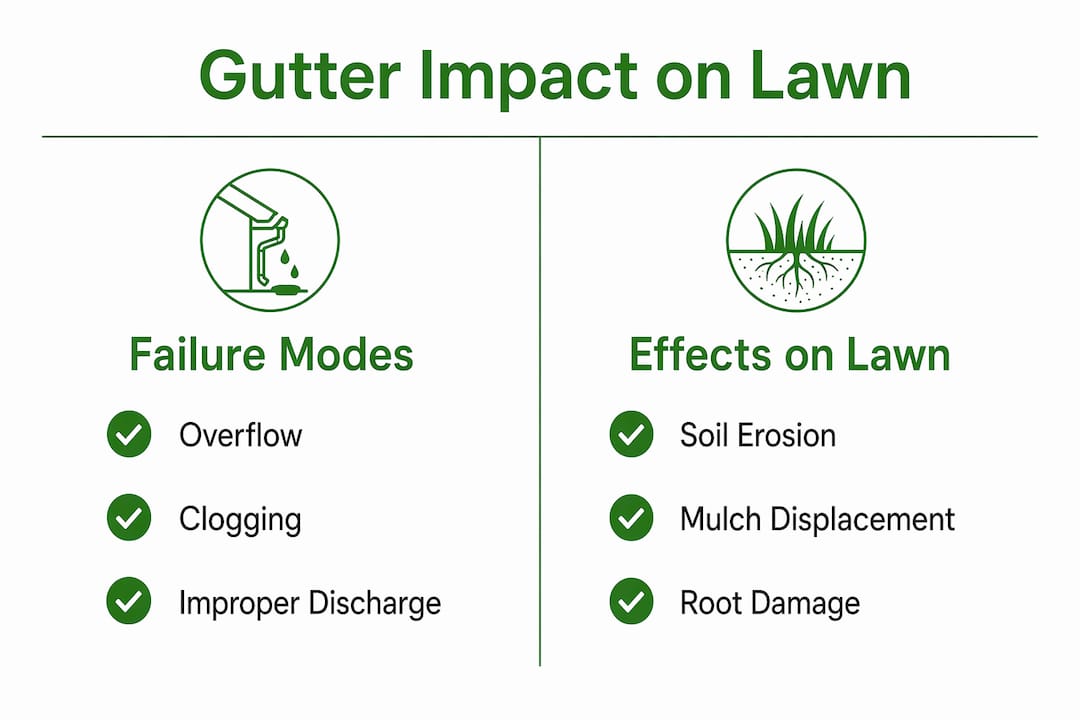
| Failure Mode | Immediate Lawn Effect | Long-Term Risk |
|---|---|---|
| Gutter overflow over edge | Topsoil erosion, mulch washout | Bare patches, weed invasion |
| Downspout discharge too close | Concentrated soil saturation | Root rot, fungal disease |
| Standing water in gutter | Fascia rot, ice dam formation | Foundation moisture, landscape damage |
| Sagging gutter, poor slope | Pooling at low points, overflow | Repeated erosion in same zone |
Signs your gutters are harming the lawn right now
The fastest diagnostic is also the simplest: watch your gutters during a rainstorm. You do not need a ladder or any tools. Stand back and observe.
Watch for these specific signs:
- Water spilling over the front or sides of the gutter rather than exiting through downspouts
- Soggy or permanently wet patches of lawn that take days to dry after rain
- Narrow channels or rills cut into soil, especially near downspout bases or directly below the roofline
- Mulch that has migrated away from beds or piled unevenly after storms
- Grass that is thin, discoloured, or dying in a pattern that follows the roofline above it
- Mud splatter on siding or foundation walls after moderate rain
Timing matters. Inspect during a moderate rainfall and again within 24 hours after a heavy storm. Overflow is easiest to spot in the moment; pooling and soggy patches are easiest to assess the morning after.
Pro Tip: Draw a rough sketch of your roofline and mark where each downspout exits. Then walk the lawn and mark every problem patch. If the patches align with downspout locations or with the roofline directly above, the gutter is almost certainly the cause — not soil quality, not shade, not irrigation.
How to schedule gutter maintenance to protect your lawn in Canada
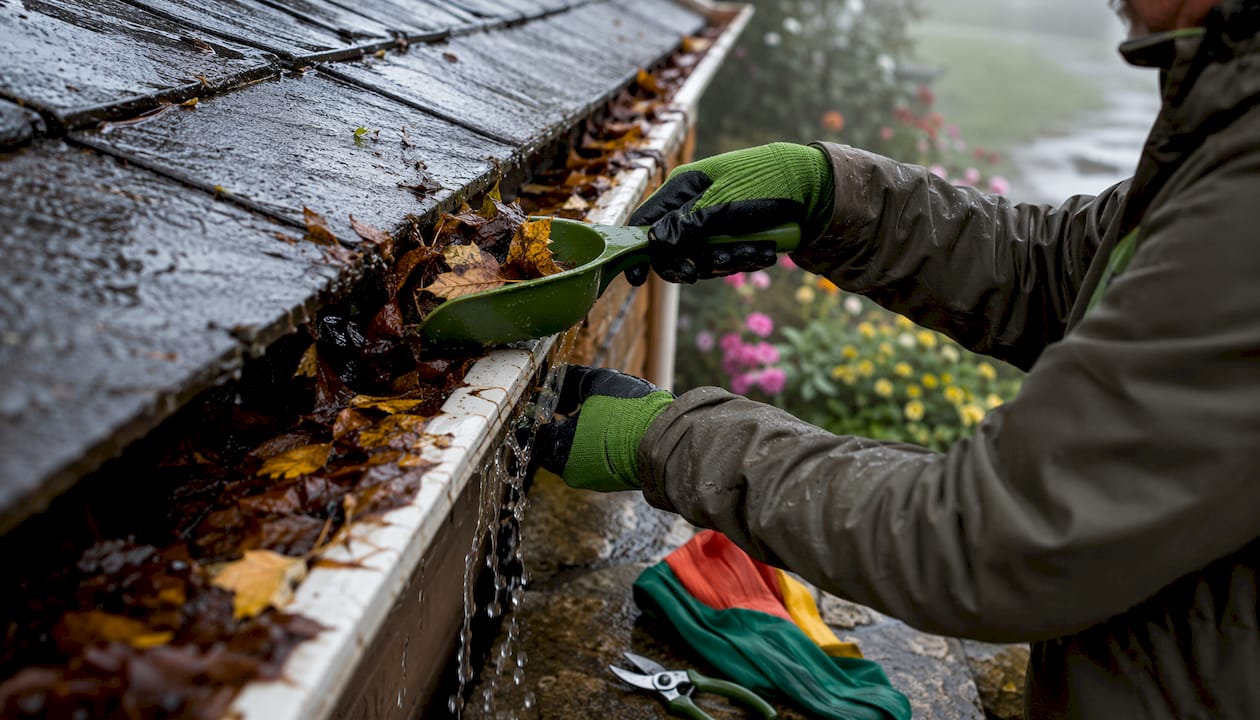
Calgary’s climate makes timing non-negotiable. The freeze-thaw cycle means a gutter full of leaves entering winter is not just a drainage problem — it is an ice-dam waiting to happen.
- Late fall cleaning (October to early November). Complete this after the majority of leaves have fallen but before the first hard freeze. This is the highest-stakes cleaning of the year. Leaf-filled gutters entering winter are the most common path to ice dams, which back water under shingles and release it slowly into soil and beds during spring melt.
- Early spring cleaning (April to May). Once seeds, pollen, and spring debris have finished accumulating, flush the gutters and downspouts. This clears anything that built up over winter and prepares the system for the heavy spring rainfall Calgary typically receives.
- Additional cleanings for tree-heavy properties. Homes with overhanging branches may need three or four cleanings per year. Do not wait for a scheduled date if you notice overflow symptoms — condition-based checks are more reliable than calendar-only scheduling.
For each cleaning, the task list is consistent: remove all debris from gutters and downspout openings, flush downspouts with a hose to confirm clear flow, inspect for sagging sections or loose hangers, check for leaks at seams and corners, and confirm downspout discharge distance from the foundation. Add splash blocks or extenders during this visit if discharge is landing too close.
Micro-mesh gutter guards can reduce cleaning frequency, but they do not eliminate it. Installed costs typically run a moderate amount per linear foot, which for a standard home with a typical range of gutter length means a significant investment. That investment can reduce two annual cleanings to one in many cases, but the guard surface itself needs periodic inspection.
When to hire a professional: any time the roof pitch is steep, the gutters are above a single storey, you notice structural sagging or visible rust, or you have had repeated overflow after a recent cleaning. Safety and visible damage are the two clearest signals that DIY is not the right call.
Where your downspouts discharge matters as much as clean gutters
A clean gutter that empties six inches from your foundation is still a lawn and foundation problem. Downspout placement and extensions are what complete the drainage system.
- Measure discharge distance. Walk each downspout and measure where water exits. Aim for a safe distance from the foundation wall to prevent water pooling; more distance is better on flat lots.
- Add extenders or splash blocks where needed. Plastic extenders are inexpensive and snap onto most standard downspouts. Splash blocks redirect flow and reduce soil impact at the discharge point. Both are DIY-friendly.
- Consider underground leaders for problem zones. Where surface extenders are not enough, a buried pipe can carry discharge to a lawn area, a rain garden, or a municipal drain. This is the most durable solution for chronic erosion spots.
- Check grading along the foundation. The ground should slope away from the house over the first one to two metres. If it slopes toward the house, water will pool regardless of how clean the gutters are. Regrading is a one-time fix that pays for itself quickly.
Pro Tip: After installing an extender or completing a regrade, simulate a heavy flow with a garden hose at the downspout inlet. Watch where the water goes and whether it disperses across the lawn or pools in a new spot. Adjust before the next real storm, not after.
Gutter guards: do they actually help your lawn, and are they worth it in Calgary?
Guards reduce large-debris entry and can lower how often you clean. For Calgary properties with heavy tree cover, that is a real benefit. The tradeoff is that guards introduce their own failure modes, and some perform poorly under snow loads.
| Guard Type | Lawn Benefit | Downside | Winter Performance |
|---|---|---|---|
| Micro-mesh | Fewer clogs, more consistent flow | Pollen and needles accumulate on mesh surface | Generally good; inspect after heavy snowfall |
| Reverse-curve | Keeps large debris out | Can fail with fine debris; water may overshoot in heavy rain | Mixed; ice can form along curve |
| Foam insert | Low cost, easy install | Degrades over time; moss and algae grow inside | Poor; traps ice and moisture |
| Basic screen | Inexpensive | Needles and seeds pass through or mat on top | Moderate; can buckle under snow weight |
The core limitation of any guard is that fine-mesh screens accumulate pollen and needles on the surface, eventually forming a hardened mat that blocks flow just as effectively as a debris-filled open gutter. Guards change the maintenance cadence; they do not end it. Schedule at least one inspection per year even with guards installed, and check downspout outlets after every major storm.
Winter and melt-season risks: ice dams and freeze-thaw damage to your lawn
Ice dams form when heat escaping through the roof melts snow, which then refreezes at the cold gutter edge. A gutter already full of leaves accelerates this process by holding water in place as temperatures drop. The IBHS documents how ice dams from retained water can lead to significant repair costs, and the landscape damage is part of that bill.
Key cold-season risks for Calgary lawns:
- Ice dams force meltwater under shingles and into wall cavities; when it releases in spring, it saturates soil in concentrated zones adjacent to the house
- Freeze-thaw cycles in waterlogged soil heave turf and damage shallow root systems, leaving bare patches that need reseeding in spring
- Prolonged wet soil from slow spring melt delays root recovery and creates ideal conditions for snow mould and other fungal diseases
- Gutters that hold ice all winter can pull away from fascia under the weight, creating new overflow points that did not exist the previous fall
The fall cleaning is the intervention that prevents most of this. Clear gutters before the first hard freeze and you break the chain before it starts. For winter repairs on icy roofs, do not attempt DIY access. A professional with the right equipment is the only safe option, and visible ice-dam damage to gutters or fascia warrants a professional assessment before the next melt season.
What to do when you find gutter-related lawn damage
Stopping the water source comes first. Everything else is secondary until the overflow is resolved.
- Clear the gutter or divert the downspout immediately. If you cannot clean the gutter today, use a temporary downspout diverter to redirect flow away from the damaged area. This stops active erosion while you arrange a proper cleaning.
- Protect bare soil. Cover any exposed soil with a layer of mulch or temporary burlap to prevent further washout from rain. This buys time for a proper repair.
- Aerate compacted patches. Soil that has been repeatedly saturated and dried becomes compacted and hydrophobic. Core aeration opens it up and allows water and nutrients back in.
- Topdress and reseed. Where topsoil has washed away, add a thin layer of quality topsoil or compost before reseeding. For larger bare patches, restoring patchy lawn properly means addressing the soil structure, not just throwing seed down.
- Rebuild bed edges and mulch. Redefine bed edges and replace washed mulch to protect plant roots and prevent further erosion from future rain events.
- Call a professional when the problem repeats. If overflow returns after a cleaning, if you see structural sagging or visible rust, or if there is dampness on foundation walls, the issue is beyond routine maintenance. That is when Yearlong or a qualified contractor needs to assess the system.
Key takeaways
Healthy gutters are the upstream fix for the most common persistent lawn problems — erosion, root disease, and patchy turf — and the seasonal maintenance schedule is what keeps them working.
| Point | Details |
|---|---|
| Clean twice yearly at minimum | Clean gutters late fall after leaves drop and early spring after pollen and debris; homes with substantial tree cover should plan for three or even four cleanings per year. |
| Map lawn problems to roof drainage | Persistent bare or soggy patches that align with downspouts or roofline sections almost always have a gutter cause. |
| Extend downspout discharge | Direct water at least two metres from the foundation to prevent concentrated erosion and root saturation. |
| Guards reduce but do not end maintenance | Micro-mesh guards can lower cleaning frequency, but the guard surface needs annual inspection to prevent hidden clogs. |
| Yearlong handles the full cycle | Yearlong offers seasonal gutter cleaning, downspout work, and lawn remediation for Calgary homeowners who want the problem solved, not just managed. |
The part most homeowners get wrong
Calgary properties with mature trees are the ones I see most often at Yearlong. The pattern is almost always the same: a homeowner spends money on fertiliser, aeration, and overseeding, sees modest improvement, and then the following spring the same bare patches are back. The gutter was never checked.
The fall cleaning is the appointment that matters most. A gutter full of leaves entering a Calgary winter is not just a drainage problem — it is the start of an ice dam, a saturated spring soil, and another season of patchy grass. Get the gutters cleared before the first hard freeze, log where each downspout discharges, and you have done more for your lawn than most soil treatments will ever accomplish.
One habit worth building: after the fall cleaning, walk each downspout with a hose and confirm the discharge point. Mark it on your phone. Next spring, check whether that spot shows any erosion or soggy patches. Two minutes of observation twice a year is the whole system.
Yearlong keeps your gutters and lawn working together in Calgary
Gutter problems and lawn damage are two sides of the same maintenance gap, and Yearlong handles both. Since 2017, Yearlong has been the go-to property maintenance provider across Calgary for homeowners who want seasonal gutter cleaning, downspout extensions, and lawn remediation handled by one reliable team rather than coordinated across multiple contractors.

Time-poor homeowners, properties with heavy tree cover, and anyone who has already dealt with repeat overflow or foundation dampness are exactly who Yearlong’s bundled seasonal packages are built for. Spring and fall seasonal clean-up services include gutter clearing, downspout checks, and lawn assessment in a single visit. If the lawn has already taken damage, Yearlong’s Calgary lawn care services cover aeration, topdressing, and reseeding to get turf back on track. Book a seasonal maintenance visit at yearlong.ca before the first fall freeze and skip the spring repair bill.
Helpful sources and further reading
- How Often Should You Really Clean Your Gutters? — The Spruce: Seasonal cleaning schedule guidance from maintenance professionals, including frequency adjustments for tree-heavy properties.
- How Gutters Protect Your Home’s Landscaping — Weather Guard Gutters: Explains the gutter-as-drainage-ecosystem framing and the mechanisms behind erosion and plant damage.
- Gutter Blockages and Their Impact on Lawns — Auburn Landscaper: Practical diagnostic advice, including the rainstorm observation method.
- The Role of Gutters in Lawn and Garden Health — Muskoka Gutters: Downspout placement and grading guidance from a Canadian gutter company.
- How Often Should I Clean My Gutters? — Kempt: Guard costs, cleaning frequency data, and the limitations of micro-mesh guards.
- Why Your Gutters Might Be Causing Your Lawn Problems — JAExterior: Homeowner-facing overview of visible lawn symptoms tied to gutter failure.
- Yearlong Gutter Cleaning — Why It Matters: Yearlong’s own overview of how gutter upkeep protects Calgary lawns and foundations.
- Yearlong Seasonal Clean-Up Services: Spring and fall clean-up packages that include gutter and lawn maintenance for Calgary properties.
- Yearlong Lawn Care Calgary: Primary service page for lawn remediation, mowing, and seasonal care across Calgary.