

Rinse the stained area with water, scrub with a 1:1 white vinegar and water solution (add a splash of dish soap), then extract the rinse water with a wet/dry vacuum before it dries. That sequence handles most salt stains on concrete driveways, garage floors, and patios without any special equipment.
Immediate steps you can take right now:
- Sweep loose grit and debris off the surface first
- Test your vinegar mix on a small, hidden patch and wait 5 minutes before treating the full area
- Mix white vinegar and water in a ratio suitable for the stain severity; add a few drops of dish soap
- Apply the solution, let it dwell for 10–15 minutes, then scrub with a stiff-bristle brush
- Extract the dirty water with a wet/dry vacuum or mop it up; do not let it air-dry on the slab
According to Citadel Floors, this vinegar-and-water approach with thorough extraction removes most household salt stains, and you can repeat the process for stubborn deposits.
Pro Tip: Call a professional when you see white powder returning within days of cleaning (ongoing efflorescence), when the surface is flaking or spalling, when the stained area covers a large driveway, or when you have stamped or coloured concrete that could be damaged by the wrong chemistry.
Key takeaways
Removing salt stains from concrete requires rinsing, scrubbing with a vinegar or commercial cleaner, and extracting the rinse water before it dries — skipping extraction is why stains reappear.
| Point | Details |
|---|---|
| Extract rinse water | Use a wet/dry vacuum after scrubbing; letting it air-dry redeposits dissolved salt on the slab. |
| Vinegar ratios | Use 1:3 (vinegar to water) for light stains and 1:1 for stubborn deposits, with a splash of dish soap. |
| Seal after cleaning | Apply a breathable silane/siloxane sealer to clean, dry concrete; reapply every 2–5 years. |
| Avoid high pressure on damaged slabs | Pressure washing over scaling or spalling drives brine deeper; repair first, then clean. |
| Yearlong for Calgary | Yearlong provides professional concrete cleaning, extraction, and sealing with a satisfaction guarantee across Calgary. |
Table of Contents
- Why do salt stains form on concrete?
- How to remove salt stains from concrete: step-by-step
- When should you use a pressure washer or acid cleaner?
- How can you prevent salt stains from coming back?
- When should you hire a professional?
- What most homeowners get wrong about salt stains
- Yearlong handles concrete cleaning and sealing in Calgary
- Sources
Why do salt stains form on concrete?
Salt stains on concrete fall into two categories, and knowing which one you are dealing with changes how you treat it.
Surface salt residue is the white, powdery film left behind when a de-icer or road salt solution dries on the slab. Water carries the dissolved salt to the surface, evaporates, and leaves the mineral behind. A single vinegar pass usually lifts this type cleanly.
Efflorescence is a deeper problem. It happens when water moves through the concrete itself, dissolving naturally occurring salts inside the slab, and then deposits them on the surface as it evaporates. The result is the same chalky white crust, but it keeps coming back because the source is inside the concrete, not on top of it.
The freeze-thaw cycle makes both worse. Here is what happens:
- Water carrying dissolved salt enters the pores of the concrete
- When temperatures drop below freezing, that water expands by roughly 9%, cracking the paste around the pores
- When it thaws, more salt-laden water enters the now-larger cracks
- Chloride ions from sodium chloride de-icers penetrate deep enough to reach reinforcing steel, accelerating corrosion
Calgary’s climate, with its rapid temperature swings and heavy de-icer use from November through March, puts concrete through this cycle repeatedly. Surface stains are a cosmetic signal; scaling and spalling are the structural warning that the cycle has gone too far.
How to remove salt stains from concrete: step-by-step
This method works for driveways, garage floors, and patios. Follow it in order.
Clear the surface. Sweep off all loose grit, sand, and debris. Any abrasive particles left under your brush will scratch the concrete during scrubbing.
Pre-rinse with water. Flood the stained area generously. This dissolves loose salt crystals sitting on the surface and prevents them from being ground in during scrubbing. ShunTool’s guidance emphasises this step specifically to reduce re-deposition as the slab dries.
Test patch first. Mix your solution and apply it to a small, inconspicuous spot. Wait 5 minutes. If the surface colour or texture changes unexpectedly, dilute the mix further before proceeding.
Mix your cleaning solution. For light staining, use 1 part white vinegar to 3 parts water. For stubborn or embedded marks, go 1:1. Add a few drops of dish soap to help the solution penetrate. Citadel Floors confirms these ratios are the standard DIY recommendation across professional how-to guides.
Apply and dwell. Pour or spray the solution onto the stained area. Let it sit for 10–15 minutes. You may see light fizzing where the acid reacts with the mineral deposit; that is normal.
Scrub with a stiff-bristle brush. Work in overlapping circles or a back-and-forth pattern. Use a nylon or natural-bristle brush. Avoid wire brushes on decorative, stamped, or coloured concrete — they scratch the surface and can lift colour.
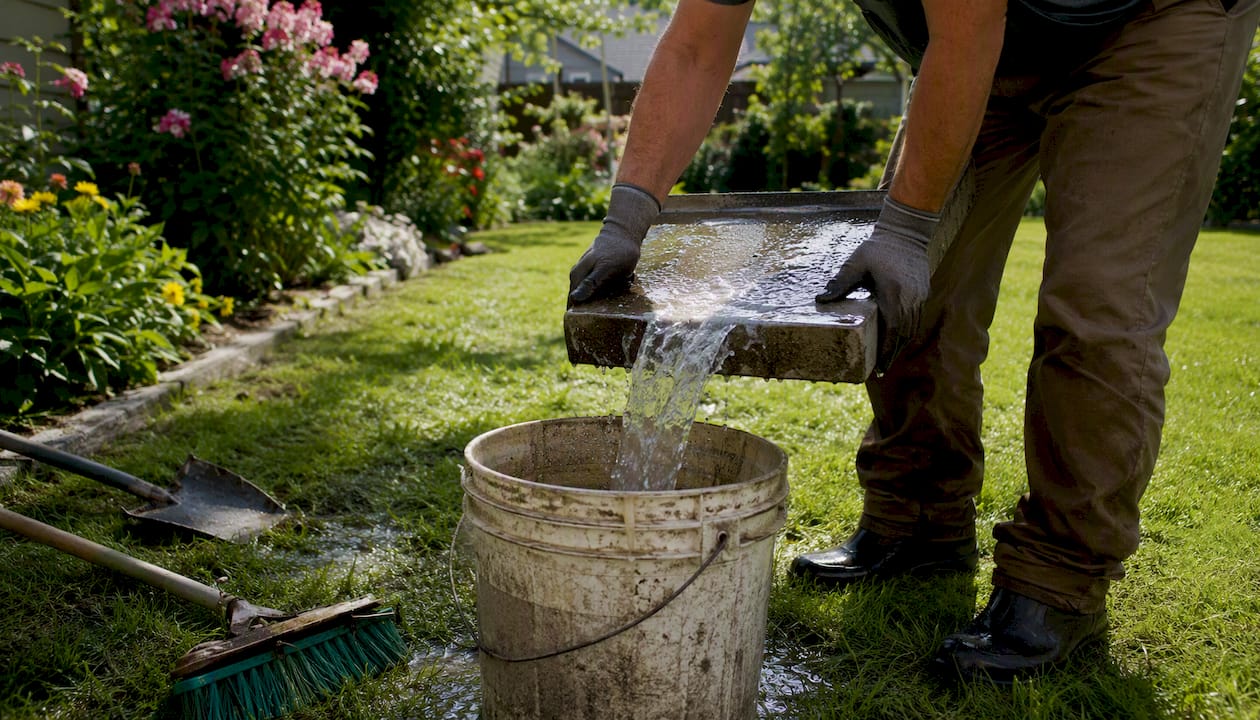
Extract the dirty water immediately. This is the step most homeowners skip, and it is the reason stains come back. Use a wet/dry vacuum to pull up the dissolved salt solution before it dries. If you do not have a vacuum, mop it up and wring the mop into a bucket rather than pushing the water to the edges of the slab.
Final rinse and dry. Rinse with clean water and extract again. Let the surface dry fully before inspecting.
Post-clean inspection. Once dry, look for any remaining white haze (repeat the treatment), surface pitting or flaking (a sign of scaling that may need repair before sealing), or cracks that were hidden under the stain.
Pro Tip: For a garage floor, crack a window or door before you start. Vinegar fumes in an enclosed space are unpleasant and can irritate your eyes and throat. Wear gloves and safety glasses regardless of which cleaner you use.
Safety and environmental note: Do not let your rinse water run directly into a storm drain or onto garden beds. Salt-laden runoff harms vegetation and contributes to the infrastructure corrosion that municipal salt-management guidance specifically flags as a concern. Contain it in a bucket and dispose of it down a household drain connected to the sanitary sewer.
When should you use a pressure washer or acid cleaner?
Vinegar handles most residential salt stains. When it does not, you have two stronger options: pressure washing and commercial efflorescence removers or mild acid etches. Both carry real risks if misused.
Pressure washing
A standard residential pressure washer set to a moderate low pressure with a 25-degree fan nozzle held at a safe distance from the surface is appropriate for most sound concrete slabs. Keep the nozzle moving; holding it in one spot etches the paste. Always pre-wet the surface and extract or squeegee the runoff rather than letting it dry.
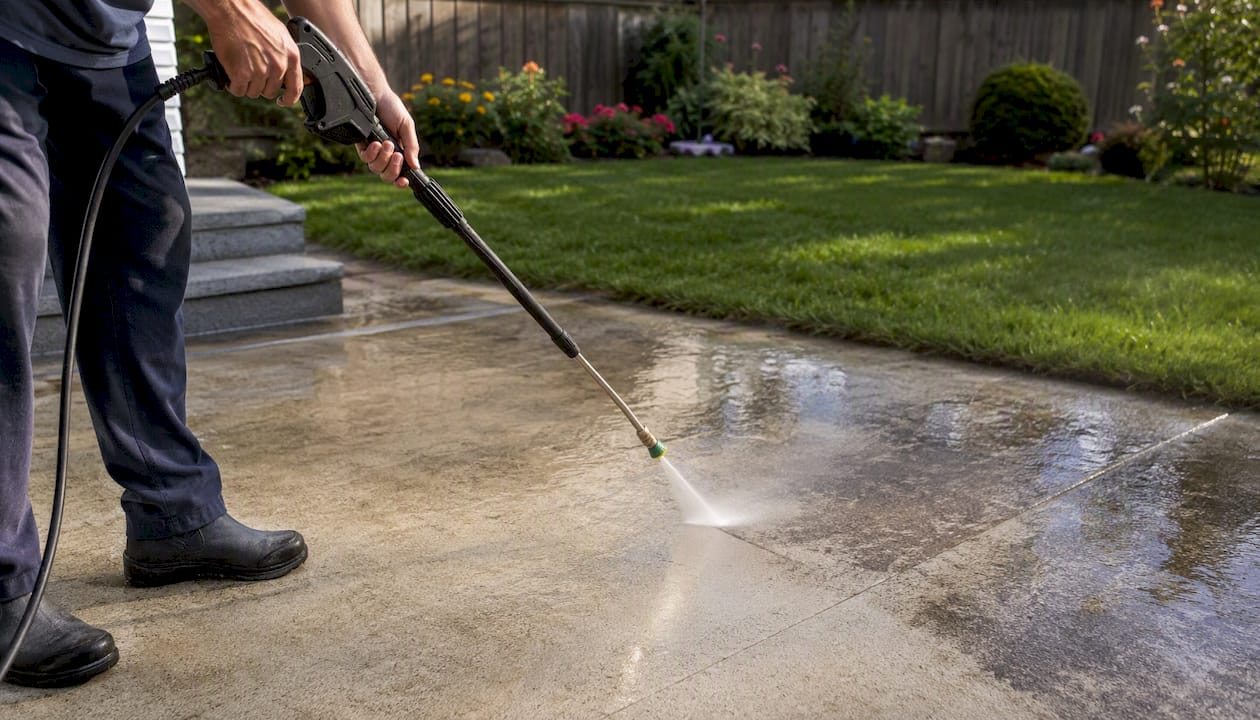
The bigger risk is using too much pressure. Von Stroke Painting’s comparison of soft wash vs. high-pressure methods makes the point plainly: high PSI can force brine deeper into the pores and etch the surface if applied incorrectly. For stamped, coloured, or older concrete, industry best practice is soft washing under 500 PSI with the right chemistry. If your slab shows any scaling or spalling, do repairs before you pressure wash.
Commercial efflorescence removers and mild acid etches
When vinegar and pressure washing leave a persistent white haze, a commercial efflorescence remover or a diluted muriatic acid solution is the next step. These products work by dissolving the mineral deposits that water-based cleaners cannot fully break down.
Key safety steps:
- Always dilute per the manufacturer’s instructions and test a small patch first
- Wear chemical-resistant gloves, eye protection, and work in a ventilated area
- After the dwell time (typically 5–10 minutes), neutralise the acid with a baking soda and water solution before rinsing
- Extract all rinse water; acid runoff is harmful to drains, soil, and nearby vegetation
LYNX Concrete Coatings notes that professionals use these products with careful testing and neutralisation, and they recommend sealing the concrete afterwards to prevent recurrence.
As Concrete Captain points out, oil-based products like WD-40 have no effect on salt stains. Salt is a mineral deposit; it responds to water-based and acidic cleaners, not solvents.
When the risk is too high for DIY: If the slab is older than 20 years, shows significant spalling, or if you cannot safely contain the acid runoff, stop and call a professional.
How can you prevent salt stains from coming back?
The most cost-effective move after cleaning is sealing. Breathable silane/siloxane sealers penetrate the concrete and repel water and chloride ions without trapping moisture inside the slab. D and G Flooring identifies post-clean sealing as the most reliable long-term prevention strategy. Apply sealer only after the concrete has dried fully and any repairs have cured.
Prevention checklist for Calgary homeowners:
- Seal after cleaning. Apply a silane/siloxane sealer to clean, dry concrete. Reapply every 2–5 years depending on traffic and weather exposure.
- Sweep after every storm. Once snow melts or is cleared, sweep the remaining salt slurry off the slab before it dries. A five-minute sweep prevents a 30-minute scrubbing session.
- Rinse in early spring. A thorough rinse in March or April, before the salt residue from the whole winter bakes into the surface, makes a measurable difference.
- Time your snow removal. Clearing snow promptly with a professional snow removal service reduces the amount of de-icer you need to apply in the first place.
For a broader seasonal maintenance plan, the hardscape maintenance checklist for Canadian properties covers concrete care alongside other outdoor surfaces through winter and spring.
When should you hire a professional?
Some situations genuinely call for a pro. Here is a clear list of when to make that call:
- Repeated efflorescence. If white deposits return within a week of cleaning, the salt source is inside the slab. A professional can assess whether the issue is a drainage problem, a failed vapour barrier, or deep chloride penetration.
- Scaling or spalling. Flaking concrete needs repair before any cleaning or sealing. Applying a sealer over damaged concrete traps moisture and accelerates the damage.
- Large surface areas. A full driveway or commercial parking area is physically exhausting to hand-scrub and requires equipment to extract rinse water at scale.
- Stamped, coloured, or exposed aggregate concrete. The wrong chemistry or PSI can permanently damage the finish. A professional matches the treatment to the surface.
- Inability to contain runoff safely. If your property drains directly to a storm sewer or a sensitive area, a professional has the equipment to capture and dispose of runoff properly.
Questions to ask any concrete cleaning contractor:
- What PSI do you use, and do you offer soft washing for sensitive surfaces?
- How do you neutralise acid cleaners and handle runoff?
- Do you extract rinse water, or do you let it drain?
- Do you inspect for repairs before sealing?
- Are you insured, and do you offer a satisfaction guarantee?
Pro Tip: Get at least two quotes for any job involving acid etching or sealing. Ask each contractor to walk you through their extraction and neutralisation process specifically — that question separates experienced operators from those who just spray and rinse.
For a residential driveway in Calgary, a professional clean and seal typically takes 2–4 hours for the cleaning phase, plus a drying period of 24–48 hours before sealing. Cost factors include surface area, stain severity, whether repairs are needed, and whether sealing is included. Yearlong’s concrete cleaning service covers the full scope: assessment, cleaning, extraction, and sealing, with a satisfaction guarantee.
What most homeowners get wrong about salt stains
The single biggest mistake is letting the rinse water dry on the slab. You scrub, the stain lifts, you rinse with a hose, and then you walk away. The dissolved salt travels with that water to the edges of the slab, evaporates, and leaves a new ring of white residue. Extraction is not optional; it is the whole point.
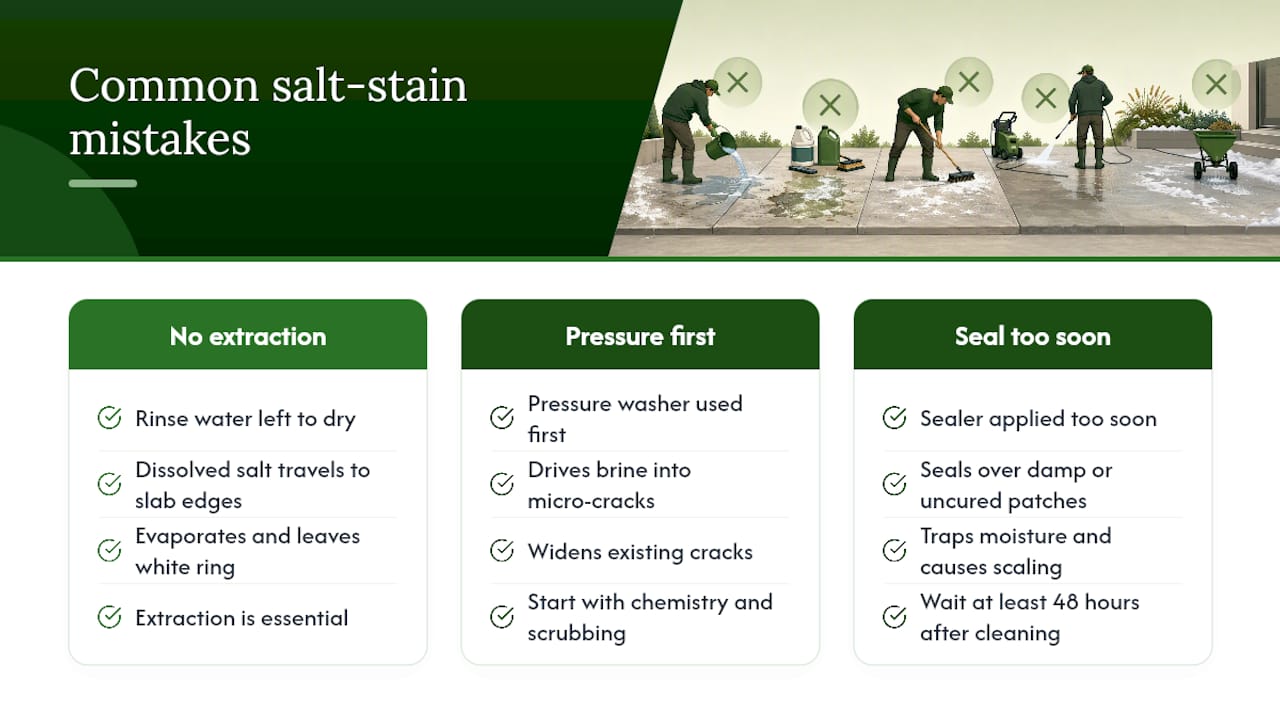
The second mistake is reaching for the pressure washer first. High pressure feels decisive, but on a slab that already has micro-cracks from freeze-thaw cycling, it drives brine deeper and can widen those cracks. Start with chemistry and mechanical scrubbing. Bring in the pressure washer only if the surface is sound and the staining is widespread.
There is also a tendency to seal too soon. Concrete needs to be completely dry, and any repairs need to cure fully, before a sealer goes down. A sealer applied over damp concrete or uncured patches traps moisture and causes the very scaling it was meant to prevent. In Calgary’s climate, that means waiting for a dry stretch of at least 48 hours after cleaning, ideally in late spring or early fall when temperatures are stable.
The prevention side is underrated. A $30 bag of sand and a $15 bottle of potassium chloride, used consistently through winter, reduces the cleaning burden in spring far more than any single cleaning session. Pair that with a silane/siloxane sealer applied every few years, and most of the white-stain problem simply does not develop.
Yearlong handles concrete cleaning and sealing in Calgary
Scrubbing a driveway yourself is satisfying when it works. When the stains keep coming back, the surface is flaking, or the area is simply too large to treat safely by hand, Yearlong’s concrete cleaning and sealing service is the practical next step for Calgary homeowners and property managers.

Yearlong assesses the surface before touching it, matches the cleaning chemistry to the concrete type, extracts all rinse water on-site, and applies a breathable silane/siloxane sealer once the surface is ready. The satisfaction guarantee means the job is done right or Yearlong comes back. To request a quote, have your surface area, a few photos of the staining, and a rough description of severity ready. Reach out through Yearlong and expect a response within one business day.
Sources
- How to Remove Salt Stains from Concrete – Citadel Floors
- Effective Methods To Remove Sodium Chloride Stains From Concrete Surfaces | ShunTool
- Remove Winter Salt Stains: Pressure Wash vs. Soft Wash for Concrete
- Salt Stains: A Complete Guide for Homeowners – Concrete Captain