

TL;DR:
- Timing lawn revival to soil temperature prevents weed issues and promotes healthy growth. Proper sequence of debris removal, aeration, and targeted treatments yields better results. Avoid rushing with chemicals or mowing too short early in the season for optimal lawn recovery.
A successful spring lawn revival begins the moment your soil thermometer reads 13°C (55°F) for three consecutive days, not when the calendar flips to april. That single temperature reading tells you when crabgrass starts germinating and when your grass roots wake up from dormancy. Miss that window and you spend the rest of the season playing catch-up. This lawn revival tutorial for spring cuts through the guesswork and gives you a soil-temperature-triggered checklist that works for Calgary’s unpredictable climate. Follow the steps in order and your lawn will green up faster, resist weeds better, and need fewer chemical inputs by midsummer.
What tools do you need for a spring lawn revival?
The right tools make the difference between a smooth restoration and a frustrating restart. Gather these before the ground fully thaws.
- Soil thermometer. Track the 4-inch depth reading daily. You need three consecutive days at 13°C before applying pre-emergent herbicide.
- Stiff rake or dethatching rake. Use for light debris removal and thatch assessment. A power rake is only necessary if the thatch layer exceeds 1.25 cm (0.5 inch).
- Core aerator. A manual or rental unit works for most residential lots. Aeration breaks up compacted soil and lets oxygen reach the root zone.
- Broadcast spreader. Gives even coverage for granular fertiliser and grass seed. Hand-casting leads to patchy results.
- Lawn mower with a sharp blade. A dull blade tears grass rather than cutting it, leaving ragged tips that brown quickly and invite disease.
- Soil testing kit. A basic pH and nutrient test tells you whether lime or sulphur is needed before you spend money on fertiliser.
| Tool | Purpose | When to use |
|---|---|---|
| Soil thermometer | Trigger timing for herbicide and fertiliser | Daily from early spring |
| Core aerator | Improve root oxygenation and water penetration | After debris cleanup |
| Broadcast spreader | Apply seed, fertiliser, and herbicide evenly | As each product is needed |
| Soil testing kit | Assess pH and nutrient gaps | Before first fertiliser application |
| Dethatching rake | Remove excess thatch only | If thatch exceeds 1.25 cm |
Start with a thorough debris cleanup. Dead leaves, matted grass, and winter salt residue block sunlight and trap moisture against the soil surface. Clearing that layer is the foundation of any solid spring lawn care routine.
How do you perform spring lawn revival steps in the right order?
Sequence matters as much as the individual steps. Doing things out of order, such as fertilising before aerating, reduces the benefit of both.
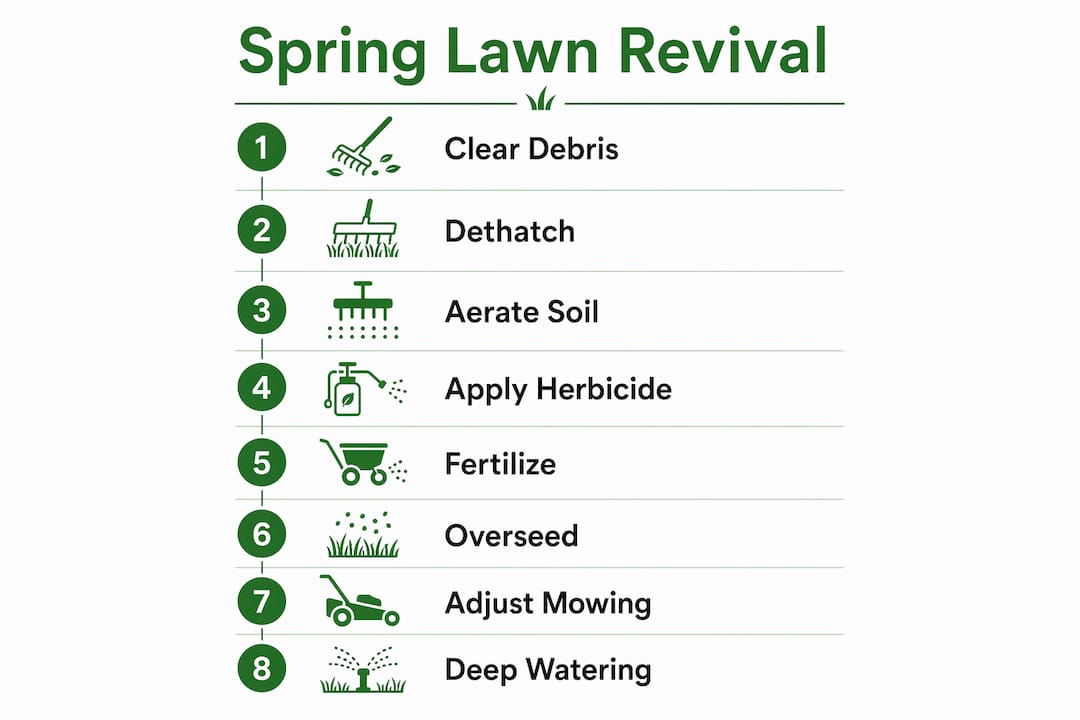
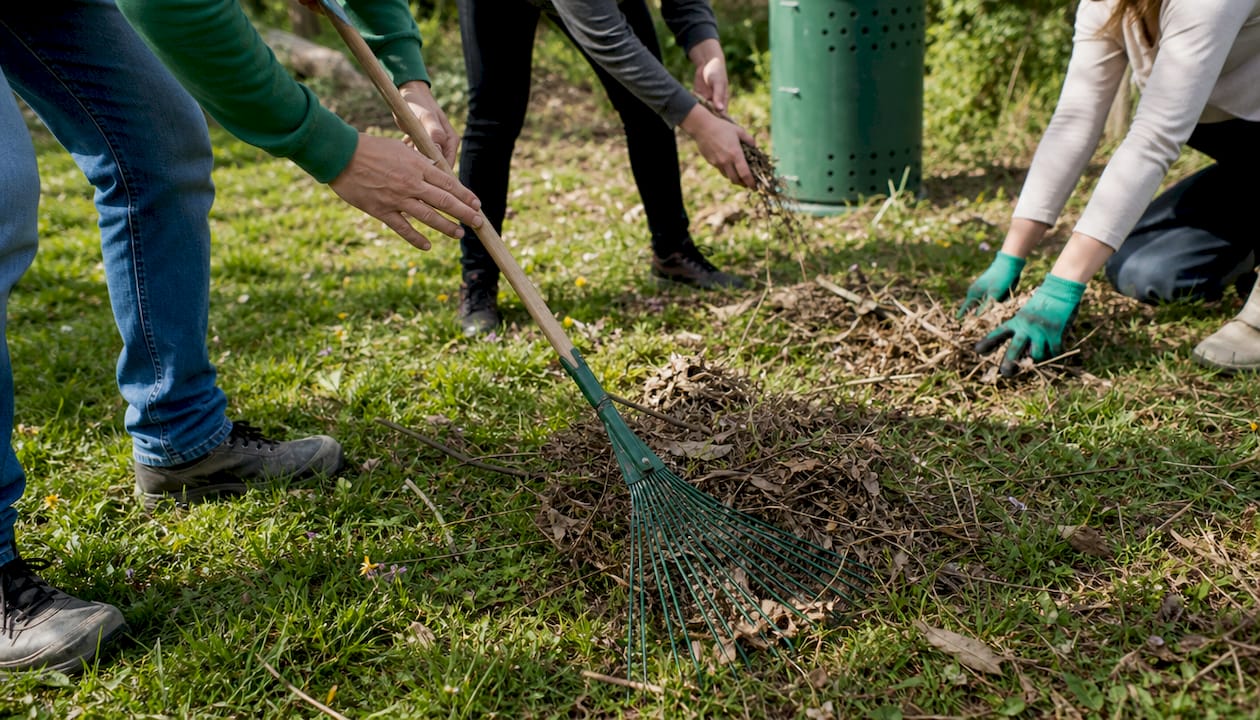
Step 1: Clear winter debris
Rake out dead leaves, broken branches, and any matted grass that smothered the turf over winter. Pay attention to low spots where water pooled and ice sat longest. Those areas are most likely to show bare patches or fungal damage.
Step 2: Assess and dethatch only if needed
Push a finger into the lawn surface. If the spongy layer between the grass blades and the soil exceeds 1.25 cm, dethatching is necessary. Unnecessary dethatching tears healthy roots and sets recovery back by weeks. A light raking is enough for most Calgary lawns after a typical winter.
Step 3: Aerate compacted soil
Core aeration pulls small plugs of soil from the ground, opening channels for water, air, and nutrients to reach the root zone. Rent a core aerator for the day and make two passes in perpendicular directions for best coverage. Leave the soil plugs on the surface. They break down within two weeks and return organic matter to the lawn.
Step 4: Apply pre-emergent herbicide at the right temperature
Pre-emergent herbicide timing is the most critical step in this entire guide. Apply when soil temperature at the 4-inch depth holds at 13°C for three consecutive days. That is the point when crabgrass seeds begin to germinate. Apply too early and the product breaks down before it works. Apply too late and crabgrass is already established.
Pro Tip: Set a daily phone reminder to check your soil thermometer reading in the morning. Three days in a row at 13°C is your green light, not the date on the calendar.
Step 5: Fertilise once grass is actively growing
Fertilising too early pushes weak top growth at the expense of root development and feeds weeds more than grass. Wait until 50–70% of your lawn is visibly green and growing. Use a slow-release granular fertiliser that feeds the lawn gradually over 6–8 weeks at roughly 0.5 lb of nitrogen per 1,000 square feet. That rate avoids turf burn and prevents nitrogen from leaching into groundwater.
Step 6: Overseed bare patches
Match your seed to your existing grass type and the light conditions of each bare spot. Shaded areas need a shade-tolerant blend. Sunny areas do well with a standard fescue or bluegrass mix suited to Calgary’s climate. Rake the seed lightly into the soil surface and keep those patches moist until germination. For detailed guidance on this step, Yearlong’s lawn overseeding guide covers Calgary-specific seed selection.
Step 7: Adjust mowing height for the first cuts
Raise your mower deck by 1.25 cm (0.5 inch) above your summer setting for the first 2–3 mows. Taller grass shades the soil, retains moisture, and reduces stress on roots that are still recovering. After those initial cuts, lower the deck gradually. Never remove more than one-third of the blade length in a single mow. Cutting too short in spring is one of the fastest ways to invite weeds and thin out your turf.
Step 8: Set a deep watering schedule
Water deeply at 2.5–3.75 cm (1–1.5 inches) per session every couple of weeks rather than shallow daily watering. Deep, infrequent watering trains roots to grow downward in search of moisture. That makes the lawn far more drought-resistant by midsummer. A shallow daily sprinkle keeps roots near the surface where they dry out quickly.
| Step | Trigger | Key detail |
|---|---|---|
| Pre-emergent herbicide | 13°C soil temp for 3 days | Prevents crabgrass germination |
| Fertiliser application | 50–70% lawn actively green | Slow-release, 0.5 lb N per 1,000 sq ft |
| First mow | Grass visibly growing | Deck 1.25 cm higher than summer setting |
| Deep watering | After aeration and seeding | 2.5–3.75 cm per session, every 2 weeks |
What mistakes should you avoid during spring lawn restoration?
Most spring lawn problems come from doing the right things at the wrong time or doing too much too soon. These are the errors that set Calgary homeowners back the most.
- Fertilising before the lawn is ready. Early nitrogen feeds weeds and produces soft, disease-prone top growth. Wait for visible green-up across most of the lawn before applying anything.
- Dethatching when it is not needed. Unnecessary dethatching tears healthy root systems and delays recovery. Test the thatch depth first.
- Mowing too short too early. Scalping the lawn in spring removes the leaf area the grass needs to photosynthesise and recover. Follow the one-third rule without exception.
- Using calendar dates instead of soil temperature. Calgary’s spring weather varies significantly from year to year. A warm march can push soil temperatures up early, while a cold april can delay them. Your thermometer is more reliable than any fixed date.
- Applying combination “weed and feed” products. Combined weed-and-feed products compromise results because pre-emergent herbicide and fertiliser have different optimal application windows. Apply them separately for full effectiveness.
- Treating clover as a problem. Clover fixes nitrogen biologically from the air, reducing your lawn’s need for supplemental fertiliser. A small amount of clover in a lawn is a sign of healthy ecology, not failure.
Pro Tip: Patience is the most underrated spring lawn care tool. Rushing multiple treatments in the same week reduces the effectiveness of each one. Space applications by at least one week.
How do you maintain your lawn through spring and into summer?
Reviving a lawn is one task. Keeping it healthy through the season is another. These practices carry your lawn from spring green-up through to summer heat.
- Mow based on growth rate, not a fixed schedule. Some weeks in spring your lawn grows fast and needs cutting twice. Other weeks it barely moves. Let the grass tell you when it needs cutting, not the calendar.
- Keep mower blades sharp all season. A sharp blade produces a clean cut that heals quickly. A dull blade leaves torn tips that turn brown and create entry points for disease. Sharpen blades at least twice per season.
- Continue deep, infrequent watering. As temperatures rise, increase the volume per session slightly rather than watering more often. Deep roots survive heat stress far better than shallow ones.
- Spot-treat weeds rather than blanket-spraying. A dense, healthy lawn crowds out most weeds on its own. Working with natural growth cycles and avoiding excessive chemical inputs produces the most resilient turf over time.
- Monitor for grubs and surface insects. Check for irregular brown patches that lift easily from the soil. Early detection means targeted treatment rather than a full lawn rescue later in summer.
- Avoid over-fertilising through the season. One well-timed slow-release application in spring feeds the lawn for 6–8 weeks. A second application in late summer or early fall is usually sufficient for most Calgary lawns.
For a full year-round plan, Yearlong’s annual lawn rejuvenation guide covers each season’s priorities in detail.
Key takeaways
A spring lawn revival succeeds when you follow soil temperature, not the calendar, and apply each treatment in the correct sequence.
| Point | Details |
|---|---|
| Soil temperature is the trigger | Apply pre-emergent herbicide only after 13°C holds for three consecutive days at 4-inch depth. |
| Fertilise after green-up | Wait until 50–70% of the lawn is actively growing before applying slow-release nitrogen. |
| Mow high in spring | Raise the deck 1.25 cm above your summer setting for the first 2–3 mows and follow the one-third rule. |
| Water deeply and infrequently | Apply 2.5–3.75 cm per session every two weeks to build deep, drought-resistant roots. |
| Avoid over-treatment | Separate herbicide and fertiliser applications, and only dethatch if the thatch layer exceeds 1.25 cm. |
What I have learned from Calgary springs after years on the ground
Calgary’s spring is genuinely unpredictable. I have seen lawns that looked completely dead in late march come back thick and green by mid-may with nothing more than proper timing and one good fertiliser application. I have also seen homeowners spend hundreds of dollars on products applied too early, only to end up with patchy, weed-filled turf by june.
The single biggest shift in my thinking over the years has been moving away from calendar-based care entirely. Soil temperature is the only honest signal your lawn gives you. When I started tracking it daily with a basic thermometer, my timing improved and my results got noticeably better with less effort.
The other thing I advocate strongly is restraint with chemicals. A dense, well-fed lawn crowds out weeds on its own. When homeowners ask me about persistent weeds, my first question is always about mowing height and watering depth, not which herbicide to buy. Most of the time, fixing those two things solves the problem without any spray at all.
Calgary’s chinooks and late cold snaps mean you cannot rely on what worked last year to work this year. Observe your own lawn. Check the soil. Let the grass tell you what it needs rather than following a rigid programme. That approach produces the most consistent results I have seen across years of working with Calgary properties.
— Lewie
Yearlong’s spring lawn care services for Calgary homeowners
Spring is the busiest season for lawn care, and the timing pressure is real. If your schedule does not allow for daily soil temperature checks, sequential applications, and careful mowing adjustments, professional help makes a practical difference.

Yearlong has served Calgary homeowners since 2017 with professional lawn care that matches local climate conditions. The team handles spring cleanup, power raking, fertilising, and mowing on a schedule timed to actual soil conditions, not a generic calendar. Yearlong also offers lawn bed maintenance to keep your entire yard looking sharp through the season. Reach out to book a spring assessment and get your lawn on the right track from the first warm week.
FAQ
When should I apply pre-emergent herbicide in spring?
Apply pre-emergent herbicide when soil temperature at the 4-inch depth reaches 13°C for three consecutive days. That is the point when crabgrass seeds begin to germinate.
How often should I water my lawn in spring?
Water deeply at 2.5–3.75 cm per session every couple of weeks rather than daily. Infrequent deep watering builds stronger, drought-resistant roots.
Is it bad to fertilise my lawn too early in spring?
Fertilising before the lawn is actively growing pushes weak top growth and feeds weeds. Wait until 50–70% of your lawn is visibly green before applying any nitrogen fertiliser.
Do I need to dethatch my lawn every spring?
Dethatching is only necessary if the thatch layer exceeds 1.25 cm. Dethatching a lawn that does not need it damages healthy roots and slows recovery.
What mowing height should I use in early spring?
Set your mower deck 1.25 cm higher than your normal summer height for the first 2–3 mows. Never remove more than one-third of the blade length in a single cut.