

TL;DR:
- Calgary homeowners should focus on timing, soil amendments, and seasonal routines to ensure thriving flower beds. Proper tools, strategic mulching, and tailored watering, weeding, and pruning practices help beds withstand Calgary’s harsh climate. Consistent, small weekly efforts, combined with expert support when needed, lead to low-maintenance, flourishing gardens year-round.
Many Calgary homeowners put genuine effort into their flower beds every spring, only to watch them thin out, turn weedy, or fade completely by July. The problem usually isn’t effort. It’s timing, soil conditions, and a routine that doesn’t account for Calgary’s chinooks, dry spells, and sharp freeze-thaw cycles. This guide lays out a structured, year-round approach to flower bed maintenance built specifically for Calgary conditions. Whether you’re starting fresh or trying to rescue a bed that never quite delivered, you’ll find a clear path from preparation through to winter protection.
Table of Contents
- What you need before you start
- Seasonal flower bed maintenance calendar
- Step-by-step: Calgary’s method for watering, weeding, and mulching
- Deadheading and pruning: why, when, and which plants
- Common mistakes and troubleshooting year-round
- The Calgary flower bed mindset: low maintenance doesn’t mean low effort
- Get year-round help for lush Calgary flower beds
- Frequently asked questions
Key Takeaways
| Point | Details |
|---|---|
| Right tools matter | Having good-quality hand tools and mulch is essential for effective flower bed care in Calgary. |
| Timing is everything | Following a seasonal maintenance calendar ensures your flower beds stay healthy all year. |
| Smart watering saves effort | Water only as needed using mulch to keep moisture in and weeds out. |
| Pruning with purpose | Deadhead and prune thoughtfully—some plants benefit while others should be left alone. |
| Low-maintenance relies on design | Matching plant choices and mulch to your site’s sunlight and wind is the real path to less work. |
What you need before you start
To prepare your flower beds for thriving, start with gathering the right materials and understanding what sets Calgary apart.

Calgary sits in a semi-arid climate with high wind exposure, intense UV during summer, and unpredictable late frosts in spring. Your tools and materials need to match those realities, not just what looks good at the garden centre.
Essential tools you’ll want on hand:
- Hand trowel for planting and weeding
- Bypass pruners (clean cuts, less plant stress)
- Garden gloves with grip
- Garden rake and hand cultivator
- Kneeling pad (your knees will thank you after hour two)
- Watering wand or drip hose
These aren’t luxuries. Trying to maintain beds without sharp, proper tools leads to torn roots, plant damage, and frankly, more frustration than the job is worth.
Soil and amendments matter more than most people realise. Calgary’s native soil is often alkaline and clay-heavy, which drains poorly and compacts easily. Before planting or reviving a bed, work in compost or a balanced triple-mix to improve drainage and nutrient availability. A bag of peat moss can help loosen heavy clay. If you’re unsure what your soil pH looks like, simple test kits are available at most local garden shops.
When it comes to mulch, mulch helps retain soil moisture and stabilise soil conditions, which is critical given Calgary’s tendency toward dry stretches and temperature swings. Shredded bark, wood chips, or composted leaves are all solid choices. Avoid dyed or rubber mulch, which can interfere with soil biology over time.
| Material | Best use | Depth to apply |
|---|---|---|
| Shredded bark mulch | General beds, moisture retention | 5-8 cm |
| Composted leaves | Soil conditioning, top dressing | 5-8 cm |
| Triple mix soil | Amending clay-heavy Calgary beds | Mix in 10-15 cm deep |
| Peat moss | Loosening soil structure | Mix in as needed |
| Coarse compost | Nutrient building and aeration | 5-10 cm |
For site selection, consider how much direct sun, shade, and wind a spot receives across the day. A bed that gets baked on a south-facing wall will need far more watering than one tucked beside a fence. Wind is particularly underestimated in Calgary; it accelerates moisture loss rapidly. Understanding your site is genuinely the foundation of good bed maintenance basics.
Pro Tip: Invest in quality shredded bark mulch from the start. Cheap mulch breaks down too quickly, loses its weed-suppressing ability within weeks, and ends up costing more over the season than one good application would have.
Seasonal flower bed maintenance calendar
Now that you’re equipped, let’s map out the year so you’ll always know what’s next for your beds.
Following a seasonal rhythm is the single biggest difference between beds that thrive and beds that just survive. This calendar is built around Calgary’s actual climate patterns, not a generalised Canadian average.
The fundamentals of year-round bed health combine spring cleanup and pruning, consistent weeding and deep watering during the growth season, and fall and winter moisture and mulch management to avoid winter stress.
| Season | Key tasks | Watch for |
|---|---|---|
| Spring | Remove debris, edge, mulch, prune dead growth | Late frosts (Calgary can see frost into May) |
| Summer | Weed weekly, deadhead, deep water when dry | Drought stress, powdery mildew |
| Fall | Cut back annuals, renew mulch, pull spent plants | Early hard frosts (often in September) |
| Winter | Check mulch hasn’t blown off, monitor for wind damage | Freeze-thaw heaving of roots |
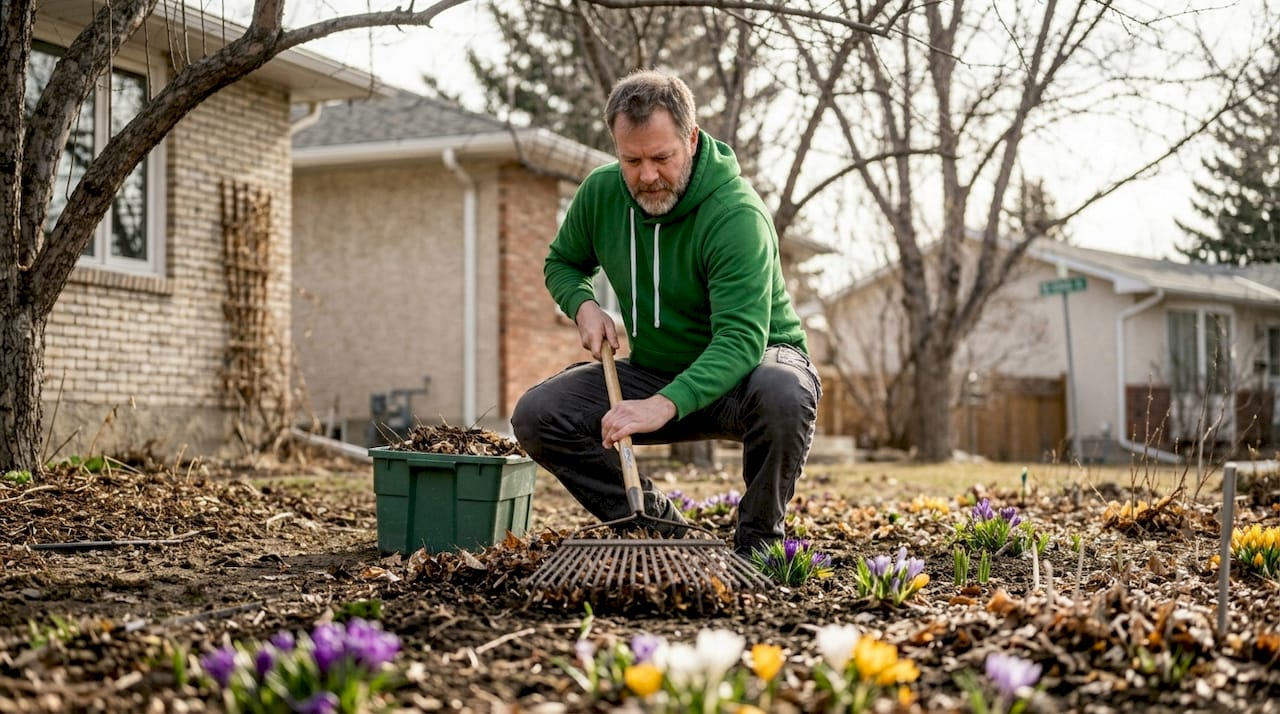
Spring is about resetting and giving plants a clean start. Remove all winter debris, dead leaves, and anything that decayed over winter. Edge the beds to redefine clean lines, then apply fresh mulch before weeds get a head start. Prune dead stems on perennials back to the crown, but wait until you see signs of new growth before assuming something is truly dead. Calgary’s spring clean up essentials go beyond just raking. Timing matters.
Summer is the maintenance season. Weed every week or two so nothing establishes deep roots. Deadhead regularly to extend blooming. Water deeply but infrequently; shallow daily watering trains roots to stay near the surface, which makes plants far more vulnerable during dry spells.
Fall is preparation season. Don’t just let beds go. Pull out spent annuals, cut back perennials that don’t offer winter interest, and add a fresh layer of mulch before the ground freezes. Consider preparing for fall as an investment in next spring’s easier restart.
Winter requires less active work but still some attention. Wind can strip mulch away from root zones in a single afternoon. Check beds after major wind events and top up mulch where needed. Freeze-thaw cycles, which are common in Calgary thanks to chinook conditions, can literally push plant crowns out of the soil. Push them back down gently if you spot heaving.
Pro Tip: Mark your calendar every three months for a bed review. A 20-minute walk-through each season catches problems before they require major intervention.
For broader Calgary seasonal landscaping tips, the principle is consistent: small regular actions beat big reactive ones every time.
Step-by-step: Calgary’s method for watering, weeding, and mulching
With your seasonal checklist in hand, execute these daily and weekly actions to keep your beds thriving.
These three tasks are the engine of healthy flower beds. Get them right, and most other problems take care of themselves.
Watering correctly:
- Check soil moisture before watering. Push a finger 5 cm into the soil; if it feels damp, hold off.
- Water only as needed, accounting for sun exposure, shade, and wind conditions at your specific site.
- Water at the base of plants, not on the foliage. Wet leaves invite disease, especially in Calgary’s cooler nights.
- Water deeply and infrequently. Aim for enough to soak 15-20 cm into the soil.
- Check for hose or drip irrigation leaks. Wasted water doesn’t help plants and drives up costs.
Overwatering is far more common than underwatering. Symptoms of overwatered beds include yellowing leaves, mushy stems at the base, and a soil surface that’s perpetually wet. Underwatered beds show wilting in the afternoon heat that doesn’t recover by morning, and dry, cracked soil.
Weeding efficiently:
Weeds are easier to pull after rain or irrigation when soil is loose. Grab them at the base and pull straight up to get the full root. If you only snap off the top, the root stays and the weed returns within days. Avoid hoeing aggressively between plants. It disturbs soil structure, can slice roots, and brings buried weed seeds up to the light where they’ll germinate. Hand-pulling is slower but far more effective. Seasonal weeding and mulching, combined with deadheading, significantly reduces the seed-setting energy drain on your plants.
Mulching correctly:
Apply mulch 5-8 cm deep around plants, but keep it a few centimetres away from stems and crowns. Mulch piled against stems traps moisture and invites rot. Refresh mulch in spring and fall. By mid-summer, the previous layer has often broken down enough that weeds start pushing through again.
Mulching not only keeps moisture in, it helps protect roots from Calgary’s freeze-thaw cycles. A good mulch layer acts as insulation, moderating the wild temperature swings that cause more plant death in Calgary than actual cold does.
For broader Calgary lawn care solutions, the same principle applies: it’s consistency, not heroic one-time effort, that creates lasting results.
Pro Tip: Water early in the morning, then mulch right after. You lock in moisture at peak freshness and shade the soil before the heat of the day can evaporate your work.
Deadheading and pruning: why, when, and which plants
With weeding, watering, and mulching handled, you can focus on maximising blooms and winter resilience.
Deadheading means removing spent flowers before they set seed. It sounds simple but has a real impact on how long and how enthusiastically plants bloom. Deadheading can make some plants bloom more profusely by preventing energy from going to seed production. However, not every perennial should be deadheaded.
Plants that benefit strongly from deadheading:
- Roses
- Coneflowers (Echinacea) if you want extended bloom
- Salvia
- Marigolds and petunias
- Geraniums
Plants worth leaving intact through winter:
- Ornamental grasses (structural beauty and wildlife shelter)
- Echinacea and rudbeckia (birds eat the seeds through winter)
- Sedum (winter structure, pollinators in late fall)
- Most native wildflowers grown for naturalised beds
| Plant type | Deadhead? | Prune timing | Leave for winter? |
|---|---|---|---|
| Annual flowers | Yes, throughout season | Remove fully in fall | No |
| Repeat-blooming perennials | Yes | Cut back in spring | Depends on structure |
| Single-bloom perennials | Optional | Spring | Often yes |
| Ornamental grasses | No | Early spring only | Yes, for structure |
| Shrub roses | Yes, actively | Light fall, hard spring | Partial |
Pruning timing in Calgary follows one general rule: prune for shape and health in early spring, before new growth breaks. Pruning too late in fall can stimulate tender new growth that gets hammered by frost. For more specific Calgary pruning tips, timing by plant type is the key variable to get right.
Common mistakes and troubleshooting year-round
Even with good systems, mistakes happen. Here’s how to identify and solve them.
Designing for low maintenance is less about doing nothing and more about matching plants to site conditions and using correct moisture management so that maintenance time stays predictable. Many homeowners unknowingly work against this from the start.
The most frequent mistakes in Calgary flower beds:
- Overwatering. More plants die from this than from drought. If you’re watering on a fixed schedule regardless of rain or soil moisture, you’re likely overwatering.
- Using the wrong mulch. Fine-textured mulch compacts into a crust that actually repels water. Use shredded bark or coarse material that stays loose and breathable.
- Planting sun-lovers in wind tunnels. Calgary’s west and southwest wind corridors are brutal. Plants rated for full sun can still suffer if they’re being battered all day. Use fences or shrubs as windbreaks where possible.
- Not adjusting for microclimates. A bed on a south-facing slope near a wall can be 5-8 degrees warmer than a north-facing bed 10 metres away. Treat each bed individually.
- Skipping the fall cleanup. Leaving diseased plant material in the bed over winter lets pathogens and pest eggs overwinter right where you don’t want them.
Quick troubleshooting guide:
- Yellowing leaves with mushy stems: Likely overwatering or poor drainage. Cut back water immediately, check drainage.
- White powdery coating on leaves: Powdery mildew. Improve air circulation by thinning crowded stems, avoid overhead watering.
- Plants flopping or leaning: Often too much shade, or too much fertiliser with too little sun. Stake or relocate.
- Entire plant wilts and doesn’t recover: Check for crown rot or vine weevil damage at the root zone.
For a broader set of residential property care tips, the best homeowners in Calgary share one habit: they pay attention and adjust, rather than following a rigid schedule that ignores what the garden is actually telling them.
Pro Tip: Keep a simple garden notebook. Jot down what you planted, when you watered, and what problems showed up. After two seasons, you’ll have a personalised guide far more accurate than anything generic you’ll find online.
The Calgary flower bed mindset: low maintenance doesn’t mean low effort
Here’s a perspective that doesn’t get said enough: the phrase “low maintenance” has been used to sell plants and designs that still require real, consistent attention. It’s not a promise of doing nothing. It’s a description of a system that, when set up correctly, doesn’t demand dramatic or unpredictable interventions.
Designing for low maintenance in Calgary means matching plants to actual site conditions, not just zone hardiness ratings. A plant listed as “easy” in a Vancouver garden can be a nightmare in a Calgary north-facing bed with heavy clay and wind. The real shortcut isn’t the plant selection alone. It’s the combination of right plant, right soil, right mulch, and regular small check-ins.
We’ve seen this play out repeatedly across Calgary properties. A homeowner invests in a beautiful perennial bed, buys all the “right” plants, and then walks away expecting nature to handle the rest. By August, the weeds have won, the mulch has blown off, and the plants are stressed. Meanwhile, a neighbour with simpler plants but a steady weekly habit has beds that look consistently good from May through September.
The real secret is that small weekly actions take perhaps 15-20 minutes, while neglected beds require hours of recovery work. A consistent small effort is genuinely less labour than occasional heroic rescues.
Calgary’s climate is genuinely demanding. Chinooks, late frosts, and summer drought are not minor inconveniences. They’re the defining conditions your beds must be built around. Accepting that reality, and building a routine to match it, is what separates the homeowners who love their gardens from those who are perpetually frustrated by them.
Get year-round help for lush Calgary flower beds
Sometimes, the best results come with a little expert assistance. Here’s how you can get professional support.
Maintaining beautiful flower beds through a full Calgary year takes time, knowledge, and consistency. Not every homeowner has all three at once, and that’s completely normal.

At YearLong Property Maintenance, we specialise in exactly this kind of ongoing, season-by-season care. Our Calgary bed maintenance services cover everything from spring edging and mulching to fall cleanup and winter prep. If you want beds that look sharp year-round without spending your weekends on them, our lawn care packages include flexible options designed around Calgary’s actual climate and your property’s specific conditions. Reach out for a consultation and let us put together a plan that keeps your beds thriving in every season.
Frequently asked questions
How often should I water flower beds in Calgary?
Apply water only as needed, accounting for sun exposure, shade, and wind at your specific site. Always check soil moisture with your finger before irrigating rather than watering on a fixed daily schedule.
Do I always have to deadhead perennials?
No. Deadheading is not for all perennials; some are intentionally left for seed production, winter structure, or wildlife value. Ornamental grasses, sedum, and native wildflowers are good examples of plants better left through the season.
What is the best type of mulch for Calgary flower beds?
Organic shredded bark or composted leaves work best because mulch helps retain soil moisture and stabilise soil conditions through Calgary’s freeze-thaw cycles and dry summer periods.
When is the best time for major pruning in Calgary?
Early spring is the best time for significant pruning, right before new growth begins. Spring cleanup and pruning before significant new growth reduces the risk of stimulating tender shoots that a late frost will damage.
How do I keep my beds weed-free with less effort?
Apply a 5-8 cm layer of mulch to retain moisture and suppress weed germination, then weed consistently every one to two weeks so nothing establishes deep roots.
One Response