

TL;DR:
- HOA snow removal involves careful planning of policies, contracts, and procedures to ensure safety and cost control during winter. Early vendor contracting, detailed service agreements, and priority-based route management help reduce liability and expenses. Ongoing documentation and resident communication are crucial for maintaining safety and legal protection throughout the season.
HOA snow clearing protocol is the set of policies, contracts, and operational procedures a board uses to keep shared roads, walkways, and amenities safe through winter. A solid guide to snow removal for HOAs covers far more than hiring a plow truck. It addresses contract timing, liability documentation, priority routing, and resident communication. Boards that treat snow management as a year-round planning exercise consistently outperform those that scramble in october. This guide gives HOA board members and property managers the specific tools to build a programme that controls costs, reduces liability, and keeps residents safe.
How to prepare for the snow removal season in an HOA
Preparation is the single biggest predictor of a smooth winter. Boards that wait until the first snowfall to source a contractor pay more and get less.

Lock in your vendor early
Contracts signed between May and August give boards the best combination of vendor availability and competitive pricing. Waiting until september or october means the best local contractors are already committed elsewhere. Early signing also gives both parties time to negotiate terms carefully rather than rushing to get something on paper before the first storm.
The steps to follow before winter arrives:
- Issue a request for proposals by june so you receive bids while vendors still have capacity.
- Review vendor insurance certificates and confirm coverage limits match your community’s risk exposure.
- Conduct a pre-season walk-around with your chosen contractor to flag mailboxes, curbs, fire hydrants, and sensitive turf areas. Pre-season walk-arounds prevent costly turf damage and give the crew a shared map of the property before the first event.
- Confirm equipment suitability. Residential HOA streets and underground utilities require properly sized equipment such as mini front loaders rather than heavy commercial plows.
- Set service level expectations in writing before signing, including response times, trigger depths, and communication protocols.
Pro Tip: Ask every vendor candidate how they document service visits. Contractors who cannot describe their GPS tracking or photo logging process are a liability risk before the season even starts.
What are the key components of an HOA snow removal contract?
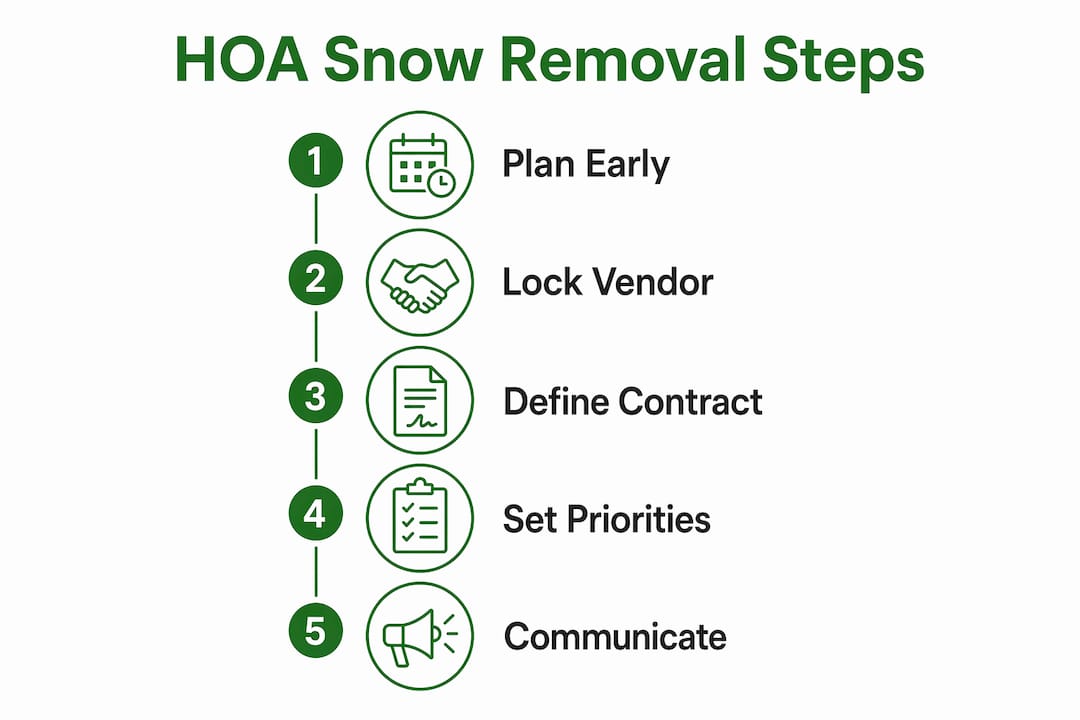
Boards should treat a snow removal contract as a risk management tool, not simply a service agreement. A weak contract leaves the board exposed on liability, cost overruns, and service gaps.
Trigger depths and nuisance snow pricing
Standard plow trigger depths run from 1.5 to 3 inches, with anti-icing and de-icing negotiated as separate line items. That separation matters because de-icing is often the highest-cost element of winter service and must be scoped clearly to avoid invoice disputes. Boards should also negotiate nuisance snow pricing, which allows clearing below the standard trigger depth in safety-sensitive areas without triggering a full contract event. This provision is particularly useful for entrances, accessible ramps, and areas near fire hydrants.
Essential contract clauses
Every HOA snow removal contract should address the following:
- Trigger depth for plowing (typically 1.5–3 inches) and a separate trigger for anti-icing application
- Nuisance snow provisions for light accumulation in high-risk zones
- Documentation requirements: GPS service logs, timestamped photos, and salt usage records. Reputable contractors provide all three as standard practice.
- Hand shovelling scope covering fire hydrant clearance, mailbox access, and accessible pathways
- Equipment specifications to protect streets and underground infrastructure
- Response time guarantees tied to storm severity categories
- Liability and indemnification clauses that clearly define each party’s responsibilities
| Contract element | Why it matters |
|---|---|
| Trigger depth | Defines when service begins and controls event-based billing |
| Nuisance snow pricing | Maintains safety in light snowfall without full event costs |
| GPS and photo documentation | Supports liability defence after slip-and-fall incidents |
| Equipment specifications | Prevents damage to curbs, turf, and underground utilities |
| Hand shovelling scope | Covers areas plows cannot reach, including hydrants and mailboxes |
For more on anti-icing and de-icing provisions, the distinction between pre-treatment and reactive salting is worth understanding before you finalise any contract.
How should HOAs prioritise snow removal routes and manage costs?
Priority-based clearing is the most effective method for controlling snow removal costs without sacrificing safety. Not every area of a community needs the same response time.
Build a priority service map
Priority maps stage clearing from emergency access routes and fire lanes through main internal roads to secondary parking areas and walkways. This approach means the contractor addresses life-safety areas first and works outward, reducing overtime costs on lighter storm events. Boards can also set higher trigger depths for low-priority zones, such as overflow parking lots, so those areas are only plowed when accumulation justifies the cost.
The four steps to effective route prioritisation:
- Map every area by criticality. Emergency vehicle access, main entry roads, and accessible pathways are Tier 1. Secondary roads and visitor parking are Tier 2. Overflow lots and decorative areas are Tier 3.
- Assign different trigger depths per tier. Tier 1 areas may trigger at 1.5 inches while Tier 3 areas trigger at 3 inches.
- Enforce parking restrictions during snow events. Parking enforcement allows contractors to clear lanes in a single pass rather than returning multiple times, which directly reduces per-event costs.
- Review every invoice after each event. Active invoice monitoring catches billing errors and inappropriate charges before they compound across a season.
Pro Tip: Maintain a dedicated snow reserve fund and track spend against it monthly. Boards that monitor their snow budget in real time make better decisions about trigger depth adjustments mid-season.
For a detailed look at priority-based clearing workflows, route sequencing makes a measurable difference in both cost and resident satisfaction.
What are best practices for safety, liability, and resident communication?
HOA boards remain legally liable for slip-and-fall incidents even when a contractor is on site. Demonstrating reasonable care is an ongoing obligation, not a one-time checkbox.
Operational safety measures
The following practices reduce both incident rates and liability exposure:
- Post warning signage on icy walkways and stairwells immediately after a storm, before clearing is complete.
- Maintain lighting in parking areas and along pathways throughout winter. Poor lighting is a contributing factor in a significant share of slip-and-fall claims.
- Clear drainage grates before and after storms to prevent meltwater from refreezing into black ice.
- Log every incident with date, time, location, weather conditions, and any witness information. Incident logs are the primary defence in liability claims.
- Educate residents on their responsibility to clear adjacent sidewalks where local bylaws require it, and on the importance of following parking restrictions during snow events.
“HOAs must continually demonstrate reasonable care through maintenance of lighting, drainage, and other hazard mitigations. A contractor agreement alone does not satisfy the board’s duty of reasonable care to residents and visitors.”
Resident communication during snow season
Clear, timely communication reduces complaints and improves compliance with parking rules. Send a pre-season notice in october that outlines the snow clearing schedule, trigger depths, parking restrictions, and resident responsibilities. During active storm events, a brief update through your community app or email list keeps residents informed and reduces calls to the property manager. After major storms, a follow-up message confirming that clearing is complete and identifying any areas still being treated builds trust and reduces friction.
Boards that invest in HOA outdoor maintenance communication as a year-round habit find that residents are far more cooperative during the demanding winter months.
Key takeaways
Effective HOA snow management requires early vendor contracting, detailed service agreements, priority-based route planning, and continuous liability documentation throughout the winter season.
| Point | Details |
|---|---|
| Contract early | Sign vendor agreements between may and august to secure availability and competitive rates. |
| Build a detailed contract | Include trigger depths, nuisance snow pricing, documentation requirements, and equipment specifications. |
| Prioritise by criticality | Map clearing routes from emergency access areas outward to control costs without compromising safety. |
| Enforce parking rules | Parking restrictions during storms allow faster, more efficient clearing and fewer contractor return visits. |
| Document everything | GPS logs, timestamped photos, and incident records are the board’s primary defence against liability claims. |
What I’ve learned about HOA snow management after years on the ground
The boards that handle winter best are the ones that treat snow removal as a year-round responsibility, not a seasonal scramble. The single most common mistake I see is waiting until september to find a contractor. By then, the best crews are booked and the board is negotiating from a weak position.
The second mistake is treating the contract as a formality. Every clause matters. The nuisance snow provision alone has saved boards significant money on light-accumulation events that would otherwise have triggered a full plow call. The GPS and photo documentation requirements have resolved invoice disputes and supported liability defences in ways that a verbal agreement never could.
Budget pressure is real, and I understand the temptation to cut corners on trigger depths or skip the pre-season walk-around. But the cost of a single slip-and-fall claim, or a season of billing errors that go unchecked, almost always exceeds the savings. The boards that get this right are the ones that plan carefully, communicate clearly with residents, and stay engaged with their contractor throughout the season rather than signing a contract and walking away.
— Lewie
Yearlong’s approach to HOA snow removal in Calgary
HOA boards in Calgary face a demanding winter season, and the margin for error is narrow when safety and liability are on the line.

Yearlong has worked with HOAs and property managers across Calgary since 2017, providing professional snow removal services built around priority-based clearing, detailed service documentation, and contracts tailored to each community’s layout and risk profile. The team conducts pre-season property walk-arounds, provides GPS-tracked service logs after every event, and offers flexible trigger depth arrangements to match your budget and safety requirements. If your board is ready to approach this winter with a plan that actually holds up, Yearlong is worth a conversation. You can also review HOA outdoor maintenance options to see how year-round property care fits together.
FAQ
When should an HOA sign a snow removal contract?
HOAs should finalise contracts between may and august to secure the best vendors and pricing. Waiting until fall significantly limits options and increases costs.
What trigger depth should an HOA specify in a snow removal contract?
Standard plow trigger depths range from 1.5 to 3 inches, depending on the area’s criticality. Emergency access routes typically use a lower trigger depth than secondary parking areas.
Is an HOA still liable for slip-and-fall incidents if it has a snow removal contractor?
Yes. HOAs remain liable and must demonstrate reasonable care through lighting, drainage maintenance, and incident documentation, regardless of contractor coverage.
What is nuisance snow pricing in an HOA contract?
Nuisance snow pricing allows a board to request clearing below the standard trigger depth in high-risk areas without triggering a full contract event. It provides cost control during light snowfall while maintaining safety in critical zones.
How can an HOA reduce snow removal costs without cutting safety?
Priority service maps and parking enforcement are the two most effective cost controls. Clearing emergency routes first and enforcing parking rules reduces contractor return visits and overtime charges.