

The fastest safe approach to efflorescence removal on concrete is a four-step sequence: dry-brush the deposit off first, rinse with water or a low-pressure wash, apply a targeted chemical treatment or poultice if deposits remain, then neutralise and seal. That sequence handles the vast majority of cases. Call a professional when efflorescence keeps coming back after cleaning, when you see hard calcium carbonate crusting over a large area, when there are signs of active water ingress behind the surface, or when you’re working with integrally coloured concrete that could be permanently etched by acid.
Before you start anything:
- Wear chemical-resistant gloves, eye protection, and a respirator if you’re spraying acid or working in a confined space.
- Always do a test patch on an inconspicuous area and let it dry fully before treating the whole surface.
- Identify the likely moisture source — cleaning without fixing drainage or grading is a short-term fix at best.
Key takeaways
Efflorescence removal on concrete works best when you follow the correct sequence, choose the method that fits your surface, and fix the moisture source before sealing.
| Point | Details |
|---|---|
| Follow the four-step sequence | Dry brush, water rinse, targeted chemical or poultice treatment, then neutralise and seal in that order. |
| Match method to surface | Integrally coloured concrete needs 1–2% acid maximum; standard grey concrete tolerates 1:9–1:19 dilutions. |
| Neutralise before sealing | Confirm pH at or above 7 with pH strips before applying any sealer — acid residue causes coating failure. |
| Fix the moisture source | Efflorescence that returns after cleaning signals a drainage or grading problem, not a cleaning problem. |
| Yearlong for Calgary properties | Yearlong provides concrete cleaning, efflorescence removal, and post-cleaning sealing across Calgary with rinse water containment and drainage review included. |
Table of Contents
- How to remove efflorescence from concrete: the full procedure
- Which removal method fits your surface?
- What products are available in Canada for efflorescence removal?
- Safety, test patches, and protecting the environment
- How to prevent efflorescence from coming back
- When should you call a professional?
- What Calgary homeowners should know about efflorescence
- The part most DIY guides skip
- Yearlong handles the full job, not just the surface
- Sources
How to remove efflorescence from concrete: the full procedure
Pre-checks before you touch the surface
Look at what you’re dealing with. Light, powdery white deposits that brush off easily are primary efflorescence — soluble salts that migrated to the surface while the concrete was curing. Hard, crusty white or grey buildup that resists brushing is secondary efflorescence, often calcium carbonate that has already carbonated and become water-insoluble. The method you choose depends entirely on which one you have.
Check the moisture source too. Efflorescence is a symptom. If water is still getting in through a crack, a low-grade slab, or a missing weep hole, the deposits will return no matter how well you clean.
Step 1: dry removal
Start dry. Use a stiff nylon brush, avoiding wire bristles that may stain concrete. to scrub off as much of the deposit as possible. Sweep up the residue and dispose of it rather than letting it wash into the substrate or a drain. Dry removal works well on fresh, powdery deposits and avoids introducing more moisture into a surface that already has a water problem.
Step 2: water rinse or low-pressure wash
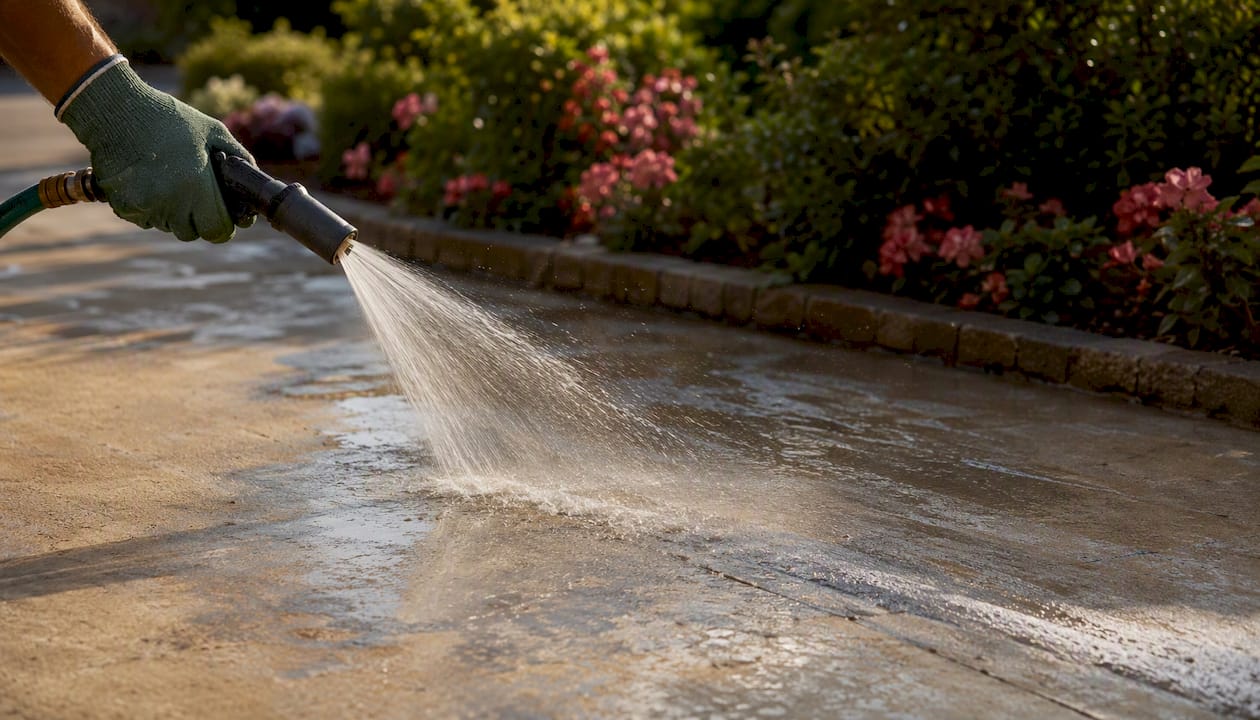
For deposits that survive dry brushing, a controlled water rinse or low-pressure power wash is the next step. Keep pressure in the 500–1,000 PSI range for most concrete and masonry; go lower for older brick or mortar joints. High pressure can erode mortar, open hairline cracks, and drive water deeper into the substrate. W. R. Meadows recommends wetting the surface first, trying dry brushing, and using light waterblasting as needed — then rinsing immediately after any chemical treatment.
Step 3: chemical spot treatment
When water alone isn’t enough, you have three options depending on deposit severity.
White vinegar (acetic acid): Works on light, fresh deposits. Apply a vinegar solution, let it dwell briefly, scrub gently, and rinse thoroughly. Low risk of etching, safe for most surfaces, and easy to source.
Dilute muriatic (hydrochloric) or phosphoric acid: For stubborn or partially insoluble deposits. According to ERDC guidance on efflorescence removal, dilutions in the 1:9 to 1:19 range (acid to water) are standard, with test patches and immediate rinsing required. Always add acid to water, never the reverse. Saturate the surface with clean water before applying acid — this prevents deep absorption and etching. Let the acid dwell for no more than 5 minutes, scrub, then rinse immediately. Treat the entire wall or panel at once; spot-treating with acid creates blotching on the surrounding surface.
Higher concentrations can reveal aggregate and permanently alter the colour.
Step 4: poultice for deep salts
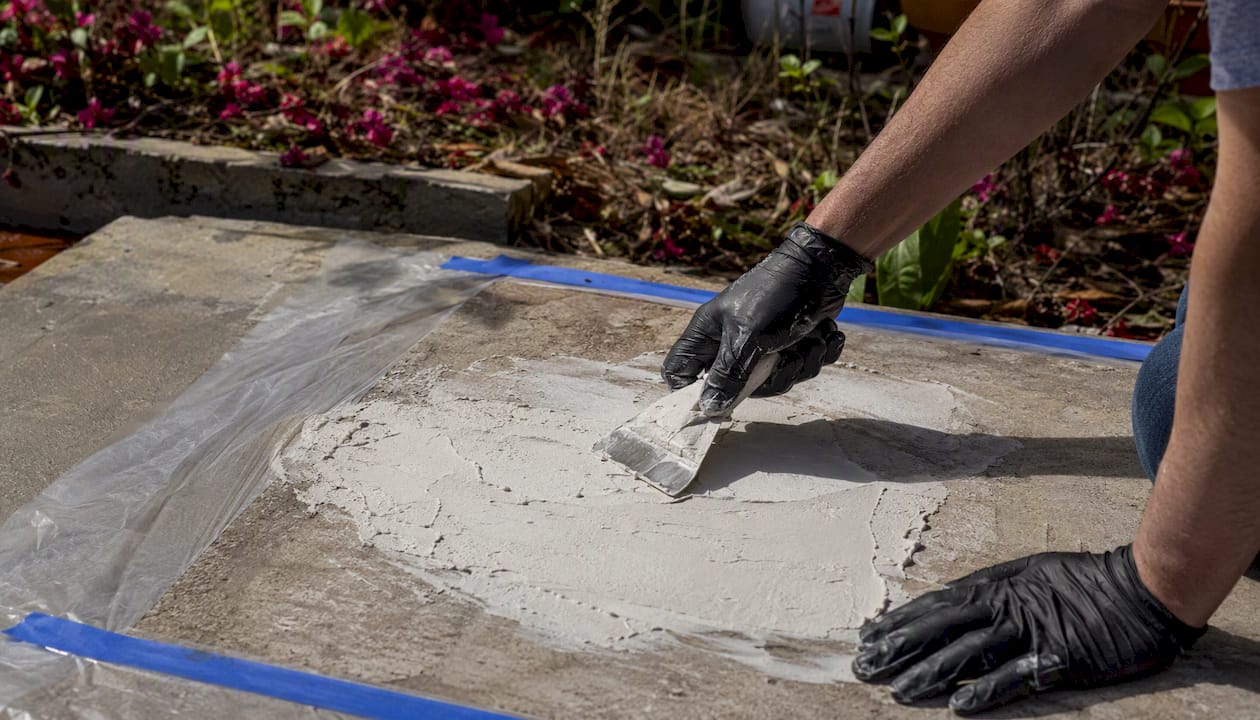
For heavily crusted calcium carbonate where acid or blasting would risk surface damage, a poultice draws salts out without aggressive chemistry. Mix paper pulp or diatomaceous earth with water to a paste, apply it over the deposit, cover with plastic sheeting, and let it dry completely. As it dries, it pulls salts out of the substrate. Remove the dried poultice, dispose of it, and repeat the cycle if needed. ERDC technical notes describe this repeated-cycle approach for surfaces where acids or blasting carry too much risk.
Step 5: neutralise, rinse, and dry
After any acid treatment, neutralise with a baking soda solution (roughly 30 mL of baking soda per litre of water), apply it over the treated area, let it sit for a few minutes, and rinse thoroughly. Use pH strips to confirm the surface is near neutral (pH 7 or above) before you consider sealing. Leftover acid can cause coating failures; allow the surface to dry completely before sealing. — before inspecting and sealing.
Tools you’ll need:
- Stiff nylon brush (not wire)
- Pump sprayer for acid application
- Garden hose or pressure washer (500–1,000 PSI for most surfaces)
- Baking soda and pH strips
- Poultice materials (paper pulp or diatomaceous earth) if needed
- PPE: chemical-resistant gloves, eye protection, respirator
Pro Tip: Never run multiple acid treatments back-to-back without a full rinse between each pass. Acid residue compounds etching risk and makes neutralisation harder. One treatment, full rinse, assess, then repeat only if necessary.
Which removal method fits your surface?
The right method depends on surface type and deposit severity. Using too aggressive an approach on the wrong surface causes permanent damage.
Risk notes by method:
- Dry brushing: No chemical risk, but ineffective on water-insoluble deposits. Use as the first step always.
- Abrasive blasting (sand or brush): Removes heavy deposits but increases surface porosity. NCMA TEK guidance recommends sealing immediately after abrasive cleaning to prevent the roughened surface from re-absorbing salts.
- Dilute acid: Effective on stubborn deposits but risks etching, colour change, and damage to adjacent metal fixtures, plants, and mortar. Protect surrounding materials with plastic sheeting before applying.
- Poultice: Slow (multiple cycles over days) but the safest option for delicate or coloured surfaces.
When a surface is a poor candidate for DIY: large-area hard calcium carbonate crust, visible spalling or delamination, or any surface where a test patch shows immediate colour change or etching. Those are pro jobs.
What products are available in Canada for efflorescence removal?
You don’t need to mix raw acid if you’d rather not. Several ready-to-use or concentrate products are sold at Canadian retailers and building supply stores.
QUIKRETE Efflorescence & Rust Remover: A manufacturer-formulated acid-based cleaner with a recommended dilution and application sequence built in. QUIKRETE’s guidance covers sweeping first, diluting the product (follow label ratios), applying, allowing a short dwell, scrubbing if needed, and rinsing thoroughly. Test on a small area before full application. Available at major building supply retailers across Canada.
Rust-Oleum RockSolid Efflorescence Remover: Available at Canadian Tire in 3.78 L jugs, this is a consumer-accessible option for concrete and masonry. Positioned as a ready-to-use cleaner for residential applications. Check the label for dilution guidance and surface compatibility before using on coloured concrete.
W. R. Meadows cleaners: W. R. Meadows produces trade-grade efflorescence and masonry cleaners used by contractors. Their guidance on efflorescence removal is worth reading even if you use a different product — the pre-soak, test-patch, and immediate-rinse principles apply regardless of brand.
Raw phosphoric or muriatic acid (hardware stores): Available at most hardware and building supply stores in Canada. Lower cost but higher risk. If you go this route, follow the 1:9 to 1:19 dilution guidance from ERDC and never skip the pre-soak or neutralisation steps.
Buying tips:
- Read the SDS (Safety Data Sheet) before purchasing — it tells you VOC content, surface compatibility, and disposal requirements.
- Confirm the product is compatible with your specific surface (coloured concrete, brick, CMU) before buying.
- Prefer water-based proprietary cleaners over raw acid when the deposit is light to moderate — they simplify rinsing and neutralisation.
- Check Canadian Tire, Home Depot Canada, RONA, and local masonry supply houses for stock. Product availability varies by region.
Pro Tip: Trade-friendly cleaners like QUIKRETE’s product reduce the need to handle raw acid and come with manufacturer-tested dilution ratios. For a first-time DIYer, that’s a meaningful safety advantage over mixing muriatic acid yourself.
Safety, test patches, and protecting the environment
PPE checklist
Acid-based cleaners are not forgiving. Before you open a bottle:
- Put on chemical-resistant gloves (nitrile or neoprene, not latex).
- Wear splash-proof eye protection — safety glasses are not enough if you’re spraying.
- Use a respirator rated for acid vapours if you’re working in a confined space (garage, basement stairwell) or spraying rather than brushing.
- Wear closed-toe, chemical-resistant footwear. Acid drips on canvas shoes go straight through.
Test-patch routine
Choose a spot that won’t be visible — behind a step riser, a corner of the slab near a fence. Apply your chosen cleaner at the intended dilution, wait the full dwell time, rinse, and let it dry completely before judging. You’re watching for colour change, surface etching (a rough or pitted texture that wasn’t there before), and any reaction with the substrate. If the test patch shows any of those, dilute further or switch methods.
Neutralising and rinsing
After acid treatment, apply a baking soda solution (roughly 30 mL per litre of water) across the entire treated area. Let it sit for a few minutes, then rinse with clean water. Test with pH strips — you want a reading at or above 7 before the surface is considered safe to seal. Incomplete neutralisation is one of the most common reasons sealers fail within the first season.
Environmental cautions
Acid rinse water carries dissolved salts and residual acid. Letting it run into a storm drain is both an environmental problem and, in many Canadian municipalities, a bylaw violation. Contain wash water where possible using sandbags or absorbent booms, collect it in a bucket, neutralise it with baking soda before disposal, and check your local municipality’s guidelines for liquid waste disposal. Inspectapedia’s GSA-sourced guidance flags containment of rinse water as a key step to prevent dissolved salts from re-entering the substrate or reaching storm drainage.
Note: Calgary’s stormwater bylaws prohibit discharging chemical waste to storm drains. Check the City of Calgary’s guidelines before disposing of any acid rinse water.
How to prevent efflorescence from coming back
Cleaning removes the deposit. Fixing the moisture source stops it from returning. Those are two different jobs, and skipping the second one means you’ll be cleaning again next spring.
Primary prevention — cut off the moisture:
- Regrade soil away from foundations and slabs so water drains away rather than pooling against the concrete.
- Clean gutters and extend downspouts at least 1.5 metres from the foundation.
- Adjust sprinkler heads so they don’t spray directly onto concrete walls or slabs.
- Add or clear foundation drainage vents to reduce moisture accumulation beneath slabs.
Surface treatments — sealers and barriers:
Breathable penetrating sealers (silane or siloxane-based) allow moisture vapour to escape while blocking liquid water entry. They’re the right choice for most exterior concrete and masonry in Canada because they don’t trap salts beneath the surface. Film-forming coatings (acrylics, epoxies) seal the surface completely but can trap salts and cause spalling if moisture is still present — a real risk in Calgary’s freeze-thaw cycles. CMHA guidance notes that some water repellents can trap salts beneath the surface and cause spalling, which is why addressing the moisture source first matters before applying any coating.
Construction and retrofit options:
- Install or repair vapour barriers beneath slabs.
- Check and clear weep holes in brick veneer and retaining walls.
- Re-point deteriorated mortar joints to close water entry paths.
- Inject crack-repair grout into active cracks before sealing.
Seasonal tip for Calgary: Efflorescence is most visible in late winter and early spring, when freeze-thaw cycles push moisture through concrete and slow evaporation lets salt deposits build up on the surface. The best windows for inspection and sealing in Calgary are late May through early June (after the last hard frost, surface dry enough to accept sealer) and late August through September (warm, dry, before freeze-up). Scheduling a seasonal cleanup alongside your efflorescence inspection catches drainage and grading issues at the same time.
Pro Tip: Apply a penetrating sealer only after the surface has been fully cleaned, neutralised, and dried. Sealing over residual salts or acid traps the problem underneath and accelerates surface damage.
When should you call a professional?
Some efflorescence jobs are straightforward DIY. Others aren’t, and misreading the difference costs more in repairs than a pro visit would have.
Call a professional when:
- Efflorescence returns within one season of cleaning — this signals an active moisture source that needs diagnosis, not just another cleaning.
- You see hard, thick calcium carbonate crust over a large area (more than a few square metres) where DIY acid treatment risks widespread etching.
- There are signs of water ingress behind the surface: damp interior walls, staining that extends inward, or visible efflorescence on basement walls.
- The surface is integrally coloured concrete and you’re not confident about acid concentration control.
- Spalling or delamination is already present — cleaning an already-damaged surface can accelerate the damage.
What a competent pro does:
- Diagnoses the moisture source before touching the surface.
- Uses trade-strength cleaners at calibrated concentrations, often with controlled blasting for heavy deposits.
- Applies poulticing at scale for surfaces where acid is too risky.
- Seals or applies membrane treatments appropriate to the substrate and climate.
- Addresses drainage, weep holes, or crack repairs as part of the scope — not as an afterthought.
Questions to ask when hiring:
- Are you insured for concrete and masonry cleaning work?
- What method do you use for integrally coloured concrete?
- Do you contain and dispose of rinse water properly?
- What does your warranty or satisfaction guarantee cover?
- Can you provide references for similar work in this neighbourhood?
Get a written scope of work that includes surface preparation, cleaning method, neutralisation, and sealing — not just “clean and seal.”
What Calgary homeowners should know about efflorescence
Calgary’s climate creates specific efflorescence conditions that don’t apply everywhere. The city averages over 300 freeze-thaw cycles annually in shoulder seasons, and spring thaw pushes significant moisture through concrete driveways, garage floors, retaining walls, and foundation walls all at once. That’s why efflorescence tends to appear suddenly in March and April on surfaces that looked fine in October.
Yearlong has been working in Calgary neighbourhoods since 2017, handling concrete cleaning and sealing across the city. The local work includes:
- Concrete cleaning and efflorescence removal for driveways, patios, retaining walls, and garage aprons.
- Post-cleaning sealing with products suited to Calgary’s freeze-thaw conditions.
- Drainage and grading reviews as part of the service scope, so the moisture source gets addressed alongside the cleaning.
- Rinse water containment to meet Calgary’s stormwater bylaws.
The timing matters here more than in milder climates. Cleaning too early in spring (when the ground is still frozen and moisture is still moving) means deposits return quickly. Cleaning in late May or early June, after the surface has dried and stabilised, gives sealers the best chance to bond and hold through the next winter.
For homeowners in areas like West Springs or Christie Park, where newer construction often means more soluble salts still working their way out of curing concrete, a professional cleaning and sealing in the first two or three years after construction is worth doing before deposits harden into calcium carbonate.
The part most DIY guides skip
Most efflorescence guides focus on the cleaning chemistry and stop there. What they understate is how often the cleaning itself causes the next problem.
Over-pressurising a power washer opens hairline cracks and drives water deeper into the substrate. Skipping the test patch on coloured concrete produces permanent colour change that no amount of re-cleaning fixes. Applying a sealer before the surface is fully dry or fully neutralised traps acid or moisture underneath, and the sealer fails within a season — sometimes taking surface material with it when it peels.
The step that matters most isn’t the acid application. It’s the drying and neutralisation check before sealing. A surface that tests at pH 6 feels fine to the touch but will cause a film-forming sealer to delaminate by the following spring. That’s a $300–$500 repair for a step that costs a few dollars in baking soda and pH strips.
The other thing worth saying plainly: efflorescence that returns after a thorough cleaning is not a cleaning problem. It’s a water problem. Spending more on better cleaners doesn’t fix a grading issue or a cracked weep tile. If you’ve cleaned a surface twice and the deposits are back, the next call should be to someone who can look at the drainage, not someone who can sell you a stronger acid.
Yearlong handles the full job, not just the surface
Efflorescence removal done right means more than scrubbing white deposits off a driveway. It means diagnosing why the moisture is there, cleaning at the right pressure and concentration for your specific surface, neutralising properly, and sealing with a product that holds through Calgary winters.

Yearlong offers concrete cleaning and efflorescence removal across Calgary, including surface preparation, neutralisation, and post-cleaning sealing suited to local freeze-thaw conditions. The service includes rinse water containment (no chemical runoff into storm drains) and a drainage review so the moisture source gets addressed alongside the surface. For homeowners who want the job done once and done correctly, request an estimate or inspection and Yearlong will assess your surface, recommend the right approach, and give you a clear scope of work before anything gets touched.
Sources
Before treating any surface, read the product label and SDS for your chosen cleaner. These sources provide the technical background and procedural guidance behind the steps in this article:
- How do I remove efflorescence? — W. R. Meadows
- Efflorescence & Rust Remover — QUIKRETE
- Rust-Oleum RockSolid efflorescence remover (Canadian Tire listing)
One Response