

TL;DR:
- Eco-friendly property maintenance in Calgary reduces water use by up to 70 percent.
- Native, drought-tolerant groundcovers like microclover and creeping thyme support pollinators.
- Transitioning requires initial effort but offers long-term environmental and financial benefits.
Eco-friendly property maintenance in Calgary saves water
Most Calgary homeowners spend their summer weekends dragging out the hose, not realising their traditional lawn could be consuming up to 950 litres of water every single week. That is a staggering number, especially for a city dealing with increasingly dry summers and water conservation pressures. The good news is that eco-friendly property maintenance is no longer a fringe idea reserved for environmental enthusiasts. It is a practical, money-saving approach that more Calgary homeowners are choosing every season. This guide will walk you through what it means, why it matters, and exactly how to make the switch.
Table of Contents
- Understanding eco-friendly property maintenance
- Comparing traditional and eco-friendly maintenance methods
- Options for eco-friendly lawn and landscape care in Calgary
- Practical steps and tips for transitioning to eco-friendly maintenance
- What most experts don’t discuss: The real challenges and long-term rewards
- Get expert help with eco-friendly property care in Calgary
- Frequently asked questions
Key Takeaways
| Point | Details |
|---|---|
| Lower water usage | Eco-friendly lawns can save up to 950 litres of water per week compared with traditional turf. |
| Sustainable landscape options | Calgary homeowners have climate-suitable choices like microclover, thyme, and fescue that need less fertiliser and mowing. |
| Pollinator-friendly yards | Switching to eco-friendly groundcovers supports local pollinators and biodiversity. |
| Long-term cost savings | Initial setup may require effort, but ongoing maintenance is easier and less expensive than conventional approaches. |
| Expert guidance helps | Calgary property specialists simplify the transition and ongoing care for sustainable lawns. |
Understanding eco-friendly property maintenance
Eco-friendly property maintenance means caring for your outdoor spaces in ways that reduce harm to the environment while still keeping your property looking great. In Calgary, this is especially relevant. Our climate is dry, our soils lean heavily clay-based, and our growing season is shorter than in many other Canadian cities. These conditions make traditional lawn care both expensive and surprisingly damaging.
Conventional lawn care typically relies on frequent watering, synthetic fertilisers, and chemical pesticides or herbicides. While these methods can produce a green, uniform lawn in the short term, they come at a cost. Synthetic fertilisers leach nitrogen and phosphorus into storm drains, contributing to water pollution. Pesticides affect not just the pests you are targeting but also the pollinators your garden depends on. Over time, heavy watering on clay soil can lead to compaction and runoff, washing chemicals into nearby waterways.
Eco-friendly maintenance takes a different approach. It prioritises choices that work with Calgary’s natural conditions rather than fighting against them. This includes selecting plants and groundcovers that thrive in low-water environments, avoiding synthetic chemicals, composting organic yard waste, and reducing mowing frequency. These are not just environmental decisions. They are also financial ones. Lower water bills, fewer fertiliser purchases, and less mowing time all add up.
The City of Calgary promotes lawn alternatives like microclover, fescue grasses, and creeping thyme specifically because they use less water, require less fertiliser and mowing, and actively support pollinators like bees and butterflies. These are not exotic plants. They are well-adapted, resilient options that can handle Calgary winters and dry summers far better than conventional turf grass.
Here is what eco-friendly property maintenance typically includes:
- Replacing or blending traditional turf with low-water groundcovers
- Using compost and organic mulch instead of synthetic fertilisers
- Avoiding pesticides and herbicides in favour of manual weeding or natural deterrents
- Collecting rainwater for irrigation where possible
- Reducing mowing frequency or transitioning to no-mow areas
- Choosing native or drought-tolerant plants for garden beds
As the City of Calgary notes, small changes to your lawn can have a lasting ripple effect on local ecosystems. For more on what this looks like in practice, our eco-friendly lawn care tips cover specific strategies tailored to Calgary’s conditions. You can also explore how sustainable home improvements extend beyond the lawn into every corner of your property.
“Small shifts in how we manage our outdoor spaces can dramatically reduce our environmental footprint while actually making our properties easier to maintain over time.”
Comparing traditional and eco-friendly maintenance methods
Understanding the difference between traditional and eco-friendly maintenance becomes a lot clearer when you look at the actual numbers. The comparison is striking, and for many Calgary homeowners, it is the moment the decision becomes obvious.
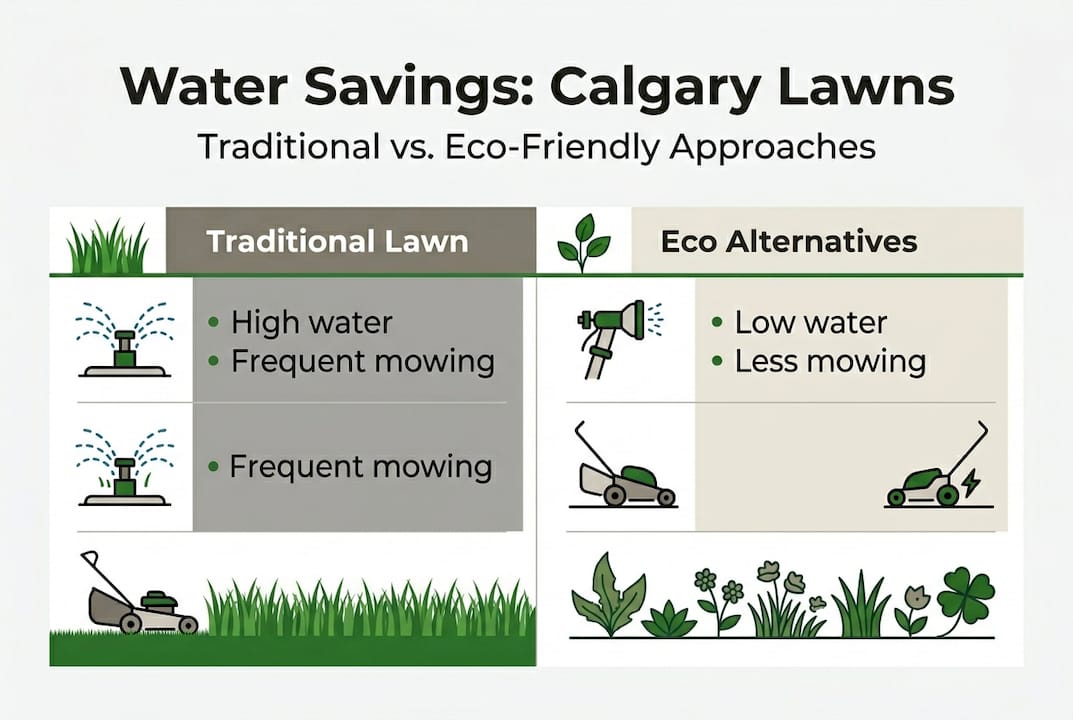
Traditional grass lawns in Calgary consume up to 950 litres per week per hour of watering. Multiply that across an average Calgary summer and you are looking at tens of thousands of litres just to keep a standard lawn green. Alternatives like clover and thyme dramatically reduce that figure, often needing watering only once a week or less once established.
Here is a side-by-side comparison of the two approaches:
| Factor | Traditional grass lawn | Eco-friendly alternatives |
|---|---|---|
| Weekly water usage | Up to 950 litres per hour | Significantly lower, often 50-70% less |
| Fertiliser needs | High, often synthetic | Low or none after establishment |
| Mowing frequency | Weekly or biweekly | Monthly or rarely needed |
| Chemical inputs | Pesticides, herbicides common | Avoided or minimal |
| Pollinator impact | Negative | Positive |
| Long-term cost | Higher ongoing expense | Lower after initial setup |
| Soil health | Degrades with heavy chemicals | Improves over time |
The environmental impact of traditional lawns goes beyond water. Chemical runoff from fertilisers reaches Calgary’s stormwater system, eventually affecting the Bow and Elbow rivers. These waterways are not just scenic features. They are part of Calgary’s drinking water supply chain. Keeping them clean is a shared responsibility.
Transitioning to eco-friendly alternatives is not complicated, but it does help to approach it in an organised way. Here is a simple numbered process to understand the differences in upfront investment:
- Assess your current lawn by noting water usage, mowing hours, and chemical applications per season
- Calculate the annual cost of your current maintenance routine, including water, products, and labour
- Research alternative groundcovers suited to your specific yard conditions, including sun exposure and soil type
- Compare the setup cost of transitioning versus continuing your current approach
- Factor in long-term savings on water, fertiliser, and mowing over a three to five year period
You will likely find that eco-friendly Calgary lawn care pays for itself within two to three seasons. For a full seasonal overview of what your yard needs, our spring yard clean up tips offer a practical starting point for any transition plan.
Options for eco-friendly lawn and landscape care in Calgary
Now that you understand why eco-friendly maintenance makes sense, the next question is: what exactly should you plant? The answer depends on your yard’s specific conditions, but Calgary homeowners have several excellent options that are well-tested for our climate.
The City of Calgary recommends three main alternatives for residential lawns: microclover, fescue grasses, and creeping thyme. Each has distinct characteristics that make it better suited to certain yard conditions.
| Plant type | Best for | Water needs | Mowing needs | Pollinator benefit |
|---|---|---|---|---|
| Microclover | Mixed lawns, general use | Low | Occasional | High |
| Fescue grasses | Shaded areas, clay soil | Low to moderate | Infrequent | Moderate |
| Creeping thyme | Sunny, dry, low-traffic areas | Very low | Rarely | High |
Microclover is perhaps the most versatile choice. It blends naturally with existing grass, fixes nitrogen in the soil (which means it actually feeds itself and the surrounding plants), and stays green through dry periods when traditional grass turns yellow. It grows low and dense, reducing the need for mowing. In Calgary’s unpredictable summers, that resilience is genuinely valuable.
Fescue grasses, particularly fine fescue varieties, are excellent for shaded areas or spots with heavy clay soil. They require far less water than Kentucky bluegrass (the typical Calgary lawn grass) and establish themselves fairly quickly. If you have a north-facing yard or sections of your property that rarely see direct sun, fescue is your best option.
Creeping thyme is the most dramatic transformation available. It produces small purple flowers in summer that pollinators absolutely love, it handles foot traffic reasonably well for a groundcover, and it practically thrives on neglect once established. It works best in sunny, dry sections of your yard and along pathways.
Here are some practical implementation tips for Calgary conditions:
- Aerate clay soil before seeding to improve drainage and root establishment
- Seed in late summer or early autumn for best results in Calgary’s climate
- Avoid planting in areas with consistent heavy foot traffic until fully established
- Mulch garden beds with wood chips to retain moisture and suppress weeds
- Consider blending microclover with your existing lawn rather than a full replacement
Pro Tip: If your lawn has patches of compacted clay, mix in a thin layer of compost before overseeding with fescue or microclover. This gives new roots a much better chance of establishing quickly without expensive soil replacement.
For guidance on introducing new groundcovers, our lawn overseeding in Calgary resource explains the timing and techniques specific to our climate. If you also want to extend eco-friendly practices into your flower beds, Calgary bed maintenance covers organic mulching, plant selection, and soil care. Incorporating eco-friendly home decor choices alongside your outdoor upgrades rounds out a genuinely sustainable property.
Practical steps and tips for transitioning to eco-friendly maintenance
Making the switch to eco-friendly property maintenance is straightforward once you have a clear plan. The biggest mistake most homeowners make is trying to do everything at once. A gradual, zone-by-zone approach works far better for Calgary conditions.
Here is a step-by-step transition process that works well for most Calgary yards:
- Start with one zone rather than your entire lawn. Choose a high-visibility but low-traffic area to trial your first eco-friendly planting.
- Test your soil before planting. Calgary’s clay-heavy soils often need organic matter added to support new groundcovers.
- Remove or suppress existing turf in the chosen area using cardboard mulching or a sod cutter. Avoid herbicides entirely.
- Seed or plant your chosen alternative in late summer, which gives roots time to establish before the first frost.
- Water consistently for the first two seasons. The City of Calgary advises that eco-friendly alternatives still need regular watering while establishing, which typically takes two full growing seasons.
- Expand gradually to other areas of your yard each season as you grow confident with each plant type.
One of the most common errors Calgary homeowners make is assuming eco-friendly means zero work from day one. It does not. The first season often involves more attention than your old lawn, including hand-weeding to prevent existing weeds from outcompeting new groundcovers, reseeding sparse areas, and adjusting irrigation. The payoff comes in season three and beyond, when your groundcover is dense, self-sustaining, and barely needs your attention.
Here are some common mistakes to avoid:
- Skipping irrigation during the first two growing seasons
- Choosing the wrong groundcover for your sun and soil conditions
- Using herbicides to control weeds in areas where you are trying to establish eco-friendly plants
- Expecting full coverage in the first season
- Neglecting to edge or define the borders of groundcover areas, which leads to uncontrolled spreading
Pro Tip: Keep a simple garden journal noting when you seeded, how often you watered, and how the coverage progressed each month. This makes it much easier to troubleshoot and improve in year two.
Trends in Calgary are clearly shifting. More homeowners are blending traditional lawns with eco-friendly groundcovers rather than doing a complete overhaul, which reduces the transition pressure significantly. Our Yearlong lawn services can support your transition at any stage. For those wanting to improve soil health before switching, understanding lawn fertilisation in Calgary using organic inputs gives your new groundcovers the best possible start.
What most experts don’t discuss: The real challenges and long-term rewards
Here is something you will not often read in eco-friendly lawn guides: the first season can be genuinely frustrating. Weeds appear where you least want them. Bare patches take longer to fill in than the brochure suggested. Your neighbour’s perfectly manicured grass makes your transition yard look rough by comparison. We want to be honest about that, because the homeowners who stick with it are the ones who were prepared for it.
The City of Calgary’s own guidance acknowledges that shaded areas suit fescue grasses while high-traffic zones may need clover lawns or even artificial turf. Initial weeding and reseeding are part of the process, not signs of failure. Long-term savings clearly outweigh the early investment.
What surprises most Calgary homeowners is how quickly the rewards compound. By year two or three, water bills are noticeably lower, mowing nearly disappears, and the yard actually looks more interesting than a uniform grass lawn. Pollinators show up in numbers you have not seen before, and soil health improves visibly. Our Calgary lawn sustainability tips and guidance on fertilising Calgary lawns organically can help you stay the course through those early seasons.
Get expert help with eco-friendly property care in Calgary
Making the transition to eco-friendly property maintenance is much smoother when you have experienced local support behind you. At YearLong Property Maintenance, we have been working in Calgary since 2017 and understand exactly how our climate, soil, and growing seasons affect outdoor care decisions.

Whether you need help with bed maintenance Calgary, want to explore our Calgary lawn care services, or are ready to book seasonal cleanups that remove organic waste in an environmentally responsible way, we offer flexible packages that match your goals and your budget. Our team can assess your yard, recommend the right eco-friendly groundcovers for your conditions, and handle the labour-intensive parts of the transition so you can enjoy the results without the stress. Reach out today for a personalised consultation.
Frequently asked questions
What are the easiest eco-friendly lawn alternatives for Calgary’s climate?
Microclover, creeping thyme, and fescue grasses are the most practical starting points, as the City of Calgary recommends all three for their low water needs and suitability for our dry climate and clay soils.
How much water can I save by switching to lawn alternatives?
Switching from traditional grass can reduce water usage dramatically, given that conventional Calgary lawns consume up to 950 litres per week, while established groundcovers like clover and thyme need a fraction of that amount.
Are eco-friendly options less work than regular lawns?
Not immediately. Eco-friendly lawns require consistent watering and weeding during the first two seasons, but once established they become genuinely low-maintenance compared to traditional turf.
Can eco-friendly groundcovers support pollinators?
Absolutely. Groundcovers like microclover and creeping thyme produce flowers that attract bees and butterflies, and the City of Calgary specifically promotes them for their pollinator support and biodiversity benefits.