

TL;DR:
- A customized maintenance plan is a data-driven strategy tailored to specific property assets, optimizing outcomes and reducing costs. It includes asset criticality, SOPs, task intervals, roles, KPIs, and regular reviews, providing a systematic approach beyond reactive fixes. Technology and phased implementation enhance plan accuracy, but fundamental data and priority assessments remain essential for effective outdoor property management.
A customized maintenance plan is a documented, data-driven strategy tailored specifically to your property’s assets and conditions to optimize maintenance outcomes and control costs. Unlike a generic checklist handed out to every client, a personalized plan accounts for what you actually own, how it behaves across seasons, and what failure would cost you. For Calgary property owners and managers, this distinction is not academic. It is the difference between a lawn that recovers well from a harsh winter and one that does not, or between a snow removal schedule that works and one that leaves you scrambling. This article explains customized maintenance plans from the ground up, covering their core components, how they compare to reactive approaches, and the steps you need to build one that works year-round.
What are the essential components of a customized maintenance plan?
A complete maintenance plan requires a minimum of eight core elements to be considered professional-grade. Each element serves a distinct function, and missing even one creates gaps that lead to missed tasks, unclear accountability, or wasted spending.

The eight components work together as a system. Your asset inventory lists every item under your care, from turf areas and garden beds to concrete surfaces and drainage infrastructure. Each asset receives a criticality rating based on how much disruption its failure would cause. A broken irrigation zone in July is far more critical than a cracked garden border in October.
Documented procedures, often called standard operating procedures or SOPs, define exactly how each task gets done. This removes ambiguity and makes it possible to delegate work without losing quality. Maintenance intervals specify whether a task runs on a time trigger (every two weeks), a usage trigger (after a set number of mowing cycles), or a condition trigger (when soil moisture drops below a threshold).
| Component | Purpose |
|---|---|
| Asset inventory with criticality ratings | Identifies what you own and how important each item is to operations |
| Documented SOPs | Standardises task execution to maintain consistent quality |
| Maintenance intervals | Sets time, usage, or condition-based triggers for each task |
| Assigned roles and resources | Clarifies who does what and what parts or labour are needed |
| Safety requirements | Protects workers and property during task execution |
| Performance KPIs | Measures outcomes like task completion rate and asset uptime |
| Budget and cost tracking | Connects maintenance activity to financial performance |
| Review and update schedule | Keeps the plan current as assets age or conditions change |
Performance KPIs are the component most property owners skip, and it is the one that makes everything else measurable. Tracking metrics like preventive maintenance compliance or the ratio of planned to unplanned work tells you whether your plan is actually working. Without that data, you are guessing.
Pro Tip: Start your asset inventory by walking the property with a camera and a notepad. Photograph every asset, note its condition, and assign a rough criticality score of high, medium, or low before you open any spreadsheet or software.
How do customized plans compare to reactive or generic maintenance?
Reactive maintenance costs three to five times more than structured preventive programmes. That figure is not a warning about edge cases. It reflects what happens when the default response to a problem is to fix it after it breaks rather than before. For outdoor property care, reactive work shows up as emergency lawn restoration after a disease outbreak, rushed snow removal after an unexpected storm, or expensive concrete repairs that a sealing programme would have prevented.
Generic checklists create a different problem. Generic maintenance approaches fail because they do not reflect specific operational conditions, leading to either under-maintenance or over-maintenance. A checklist designed for a mild coastal climate does not account for Calgary’s freeze-thaw cycles. A schedule built for a small residential lot does not scale to a commercial property with multiple turf zones, parking areas, and seasonal bed rotations.
| Approach | Cost profile | Risk level | Adaptability |
|---|---|---|---|
| Reactive maintenance | Highest (3 to 5x preventive cost) | High: failures drive decisions | None: responds only to problems |
| Generic preventive | Moderate | Medium: misaligned tasks create gaps | Low: not built for your assets |
| Customized preventive | Lowest long-term | Low: risks are anticipated | High: built around your conditions |
The customized approach prioritises critical assets based on failure risk and operational impact, which means your resources go where they matter most. A property manager overseeing multiple Calgary sites cannot treat every task as equally urgent. The plan tells you what to do first, what can wait, and what to monitor rather than act on immediately.
Pro Tip: The most common pitfall with generic maintenance is over-servicing low-value assets while under-servicing high-value ones. Before adopting any off-the-shelf checklist, map your top five highest-criticality assets and confirm the checklist addresses them specifically.
Steps to create and implement a customized maintenance plan
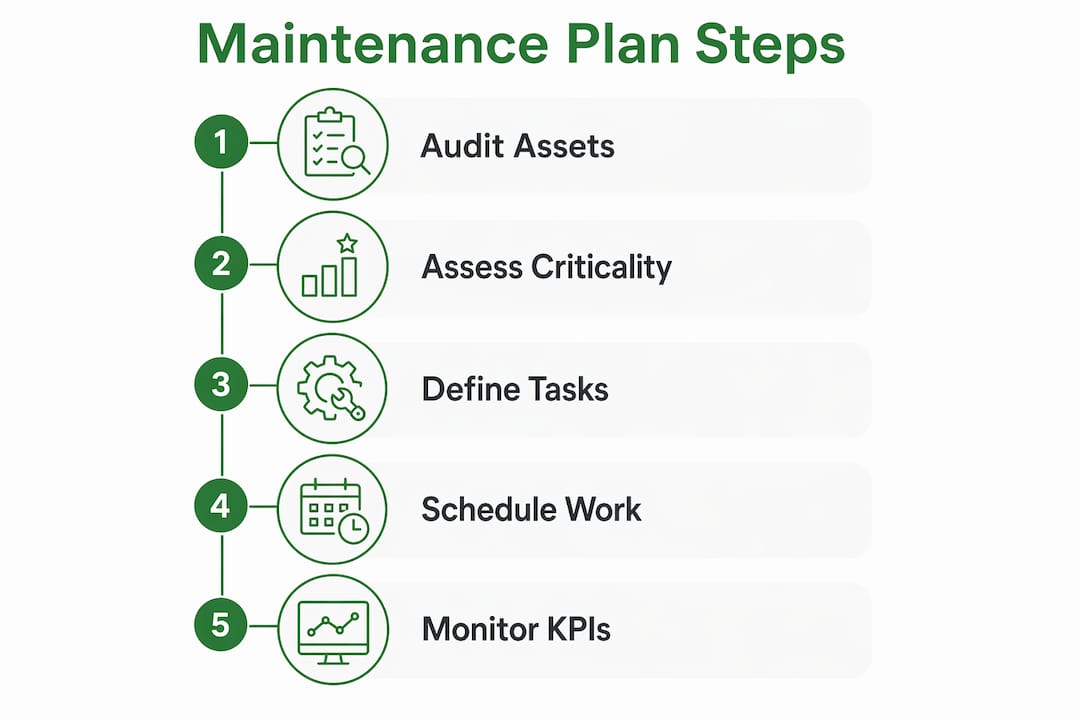
Building a plan from scratch follows a phased, multi-step process that starts with an asset audit and criticality assessment. Skipping the audit phase is the single most common reason plans fail within the first year.
Conduct a full asset audit. Walk every area of your property and document each asset: its type, age, current condition, and estimated replacement cost. For outdoor properties, this includes turf zones, garden beds, trees, hardscaping, drainage, and any seasonal infrastructure like irrigation or lighting.
Assign criticality ratings. Rate each asset on a simple scale. High-criticality assets are those whose failure directly disrupts operations or creates safety hazards. Medium-criticality assets affect aesthetics or convenience. Low-criticality assets can tolerate delayed attention without significant consequence.
Define maintenance tasks per asset. For each asset, list the specific tasks required to keep it functional. A lawn zone needs mowing, fertilising, aeration, and seasonal cleanup. A concrete pathway needs cleaning and sealing on a multi-year cycle. Match the task type to the asset’s failure mode.
Set task frequencies. Use manufacturer guidelines, local climate data, and your own operational history to set intervals. Calgary’s short growing season and long winter compress the outdoor maintenance calendar, which means spring and fall tasks carry more weight than they would in milder climates.
Assign roles and resources. Specify who is responsible for each task and what materials or equipment are required. Ambiguity here creates missed tasks and finger-pointing when something goes wrong.
Select your management tools. A computerised maintenance management system, or CMMS, automates scheduling and tracks completion. For smaller properties, a well-structured spreadsheet combined with a maintenance scheduling approach can work, though it has limits at scale.
Implement in phases. Start with your highest-criticality assets and build outward. Trying to execute a full plan from day one overwhelms teams and produces poor data. A phased rollout lets you refine the process before expanding it.
Pro Tip: Data accuracy at the audit stage determines everything downstream. If your asset list is incomplete or your criticality ratings are guesswork, your schedule will be misaligned from the start. Invest the time upfront.
How does technology support plan execution and optimisation?
Spreadsheets fail at scale because they lack real-time triggers, audit trails, and the ability to flag overdue tasks automatically. This is not a criticism of spreadsheets as a starting point. It is a recognition that as your property portfolio or task volume grows, manual tracking creates gaps that cost money.
CMMS platforms automate the scheduling, work order generation, and compliance reporting that would otherwise require constant manual oversight. Mobile apps extend this capability into the field, allowing technicians to access task checklists, record completion data, and flag issues from the property itself rather than returning to an office to update records.
Condition-based monitoring takes the approach further by triggering maintenance only when sensor data or visual inspection indicates a threshold has been crossed. For outdoor property care, this might mean soil moisture sensors that trigger irrigation adjustments, or visual condition ratings that prompt bed maintenance before a problem becomes visible to clients.
The most valuable output of any digital tool is the data it generates for KPI tracking. Metrics like preventive maintenance compliance rate, the ratio of planned to unplanned work orders, and mean time between failures tell you whether your plan’s frequencies are calibrated correctly. Annual KPI reviews are the mechanism that keeps a plan dynamic rather than static. Without them, even a well-built plan drifts out of alignment with reality as assets age and conditions change.
- Automated scheduling: Removes the need to manually track due dates across multiple assets and locations.
- Mobile task access: Technicians complete and record tasks onsite, reducing data entry errors and delays.
- Condition-based triggers: Maintenance happens when needed, not just when the calendar says so, extending component life.
- KPI dashboards: Real-time visibility into compliance rates and cost trends supports faster, better decisions.
- Audit trails: Documented task history supports warranty claims, insurance requirements, and regulatory compliance.
Pro Tip: Avoid the “set and forget” trap. A maintenance plan is not a document you file and revisit in three years. Schedule a formal KPI review every twelve months and adjust task frequencies based on what the data shows, not what you assumed when you started.
Key takeaways
A customized maintenance plan outperforms reactive and generic approaches by aligning tasks, frequencies, and resources directly to your property’s specific assets and conditions.
| Point | Details |
|---|---|
| Reactive maintenance costs more | Unplanned repairs cost three to five times more than structured preventive programmes. |
| Eight components define a complete plan | Asset inventory, SOPs, intervals, roles, safety, KPIs, budget, and review cycles are all required. |
| Criticality assessment drives prioritisation | Focus resources on high-criticality assets first to generate the highest return on maintenance spending. |
| Technology prevents plan drift | CMMS tools and annual KPI reviews keep frequencies aligned with actual asset performance over time. |
| Phased implementation improves outcomes | Starting with high-criticality assets and expanding gradually produces better data and more manageable rollouts. |
Why I think most property owners are solving the wrong problem
From where I sit, the most common mistake property owners make is treating maintenance as a cost to minimise rather than a system to optimise. They cut the lawn when it looks long, clear snow when it becomes a liability, and deal with the garden beds when a client complains. That is reactive thinking dressed up as management.
What I have seen work, consistently, is starting with criticality. Not every asset on your property deserves equal attention. Your front lawn facing the street carries more reputational weight than the strip of turf behind the utility shed. Your concrete walkways handle foot traffic every day; your back garden border does not. When you rank assets by their actual impact on operations and appearance, the plan writes itself more clearly.
The digital tools question is real but often overcomplicated. You do not need enterprise software to run a good plan for a residential or small commercial property. What you need is accurate data, a clear schedule, and a review habit. I have seen properties managed well with a structured spreadsheet and a quarterly walk-through. I have also seen expensive CMMS platforms produce nothing useful because the asset data feeding them was wrong from the start.
The property maintenance checklist is a useful starting point, but it is not a plan. A plan has ownership, frequencies, and feedback loops. A checklist is just a list. The gap between the two is where most outdoor property care breaks down, and it is entirely fixable with the right structure.
— Lewie
Let Yearlong build the outdoor side of your plan
The outdoor components of a property maintenance plan, lawn care, bed maintenance, seasonal cleanup, and snow removal, are the most weather-dependent and the hardest to self-manage in Calgary’s climate. Yearlong has been handling exactly this work across Calgary since 2017, and the team brings local seasonal knowledge that no generic service schedule can replicate.
If you are building a personalised maintenance strategy and want professional support for the outdoor side, Yearlong’s lawn bed maintenance and lawn care and yard cleanup services are designed to slot directly into a structured plan. You set the standard; Yearlong delivers it consistently, season after season.
FAQ
What does a customized maintenance plan include?
A customized maintenance plan includes an asset inventory with criticality ratings, documented SOPs, task-specific maintenance intervals, assigned roles, safety requirements, and performance KPIs. A complete plan requires a minimum of eight core components to function effectively.
How much does reactive maintenance cost compared to planned maintenance?
Reactive maintenance costs three to five times more than structured preventive programmes. Facilities that rely on reactive repairs often spend 60 to 80 percent of their maintenance budget on avoidable emergency work.
How do I start creating a maintenance plan for my property?
Start with a full asset audit and criticality assessment before defining any tasks or frequencies. A phased implementation that begins with your highest-criticality assets produces better results than trying to build a complete plan all at once.
Do I need software to manage a customized maintenance plan?
Software helps at scale, but accurate asset data matters more than the tool you use. Spreadsheets become unreliable as task volume grows because they lack automated triggers and audit trails. A CMMS is worth adopting once your asset list exceeds what you can reliably track manually.
How often should a maintenance plan be reviewed and updated?
A maintenance plan should be reviewed at least once per year using KPI data to confirm that task frequencies still match actual asset performance. Annual reviews prevent the “set and forget” drift that causes plans to fall out of alignment with real conditions over time.