

For Calgary commercial properties in 2026, the clearest path to staying compliant, reducing liability, and keeping operating costs predictable is a bundled, performance-based lawn care and snow management contract with Yearlong Property Maintenance. Operating since 2017, Yearlong is insured and bonded, covers the entire Calgary area, and backs its work with a satisfaction guarantee.
To get started, have these three items ready before your first call:
- A site map or property address with service areas marked (parking lots, sidewalks, entrances)
- Your preferred SLA triggers and response windows
- Your insurance requirements, including any additional insured language your property demands
Request a site assessment and written quote at Yearlong or through the lawn care page at Yearlong.
Key takeaways
A bundled, performance-based commercial lawn and snow contract with documented SLAs, verified insurance, and clear performance triggers is the most reliable way for Calgary property managers to stay compliant and control costs in 2026.
| Point | Details |
|---|---|
| Bundle lawn and snow services | One contract reduces coordination gaps, stabilises budgets, and closes seasonal accountability gaps. |
| Verify insurance before signing | Require CGL and WCB certificates; delegating work to a contractor does not remove your occupier liability under Alberta law. |
| Normalise quotes by square footage | Convert bids to $/1,000 sq. ft. and add salting, hauling, and surcharge lines to every quote before comparing. |
| Demand documented SLAs | Require GPS logs, timestamped photos, and written event reports; documentation is your primary defence in a slip-and-fall dispute. |
| Yearlong for Calgary properties | Yearlong offers integrated year-round lawn and snow contracts with satisfaction guarantee, insurance, and documented service logs for Calgary commercial sites. |
Table of Contents
- What do commercial lawn and snow services in 2026 actually include?
- Why hire a commercial specialist instead of ad-hoc crews?
- How do vendors price commercial lawn and snow services in 2026?
- Who is responsible under Calgary bylaws and Alberta law?
- How do you evaluate and contract a commercial lawn and snow vendor?
- What service levels and response times should you expect in 2026?
- What does a Yearlong year-round commercial package look like?
- Why integrated packages made sense for Calgary properties
- Get a quote from Yearlong for your commercial property
- Primary sources and references
- Sources
What do commercial lawn and snow services in 2026 actually include?
A bundled commercial contract covers four distinct seasons of work. The table below shows what each phase typically delivers and where add-ons begin.
| Season | Core services | Common add-ons |
|---|---|---|
| Spring | Site cleanup, power raking, edging, bed prep, fertilisation, irrigation startup | Aeration, overseeding, weed control |
| Summer | Weekly mowing, edging, bed maintenance, irrigation checks | Pest control, mulch refresh, concrete cleaning |
| Fall | Leaf removal, final mow, bed cutback, irrigation winterisation | Dethatching, perimeter de-icing prep |
| Winter | Parking lot plowing, sidewalk clearing, salting/sanding, snow stacking | Hauling, roof/awning clearing, pre-storm anti-icing |
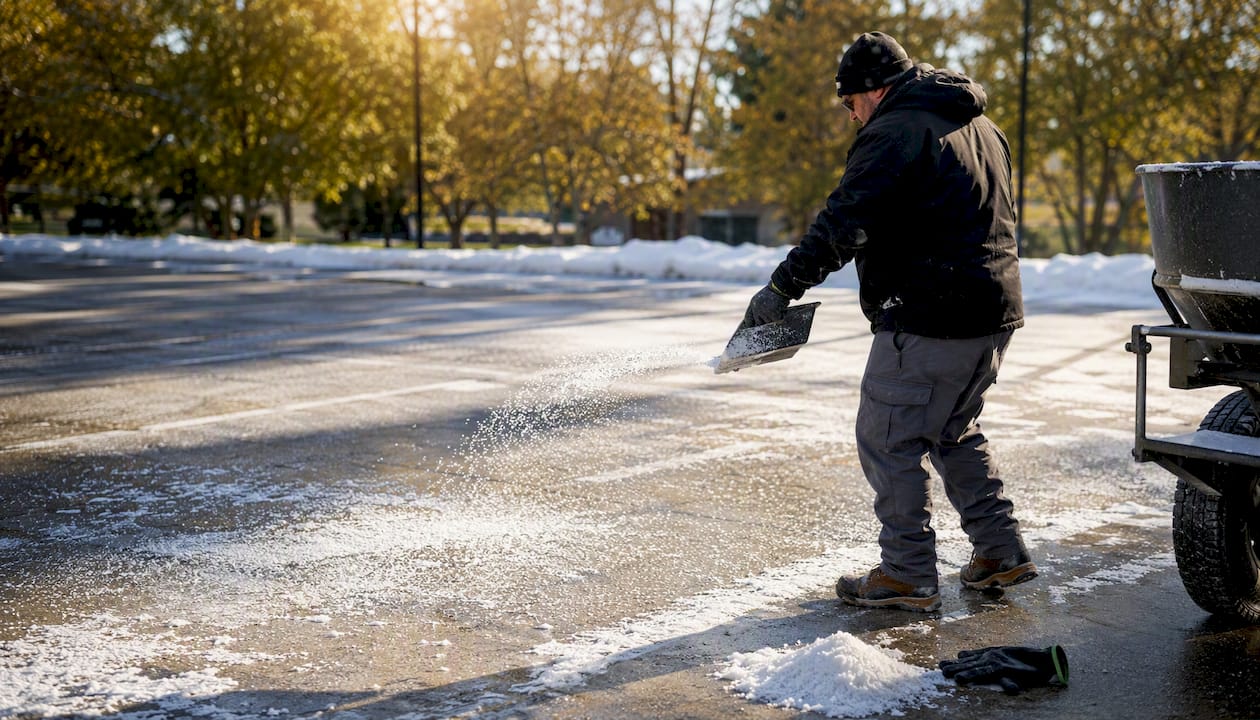
Salting is worth flagging specifically. Most vendors price it as a separate line item rather than bundling it into a flat seasonal fee, because material costs vary with storm frequency and severity. The same applies to snow hauling: once stacking space on-site runs out, hauling becomes a necessity, not an option, and it needs its own budget line.
The 2026 landscaping trends tracked by Buildings show commercial properties shifting away from purely cosmetic lawn programmes toward performance-based design: native plantings, smart irrigation, and permeable surfaces that reduce long-term maintenance costs. Smart irrigation alone can lower outdoor water use by 20–50% depending on property and climate. For property managers, that framing matters: lawn care is infrastructure, not decoration, and it should be scoped and documented accordingly.
Seasonal cleanup packages covering spring and fall transitions are available through Yearlong’s seasonal clean-up page, which can be added to a year-round contract or booked independently.
Why hire a commercial specialist instead of ad-hoc crews?
The short answer: documentation and accountability. A purpose-built commercial provider maintains service logs, carries the right equipment for large lots and narrow sidewalks, and has a storm-response protocol already in place before the first flake falls.
Ad-hoc crews, or single-season contractors stitched together, create coordination gaps. Who owns the sidewalk between the parking lot plow crew and the building’s internal maintenance team? Who documents the 6 AM salting run when a tenant slips at 7 AM? These gaps are where liability claims originate.
A documented service event is your first line of defence in a slip-and-fall dispute. GPS-timestamped photos and event logs showing proactive management and timely response are the single most effective operational defence available to property managers under Alberta law.
Source: MMI — Snow & ice liability for commercial properties
The trust signals worth verifying before signing anything:
- Insured and bonded: request a current certificate of insurance naming your property as an additional insured where required
- Commercial experience: ask specifically about commercial lots, not just residential driveways
- 24/7 storm coverage: confirm the provider patrols during active storms, not just after
- Satisfaction guarantee: get it in writing, with a defined remedy process
Budget predictability is the other argument for a specialist. A seasonal flat-fee contract converts an unpredictable weather variable into a fixed operating cost, which simplifies property budgeting and removes the scramble to find a crew mid-blizzard.
How do vendors price commercial lawn and snow services in 2026?
Three pricing models dominate the Calgary market, and understanding them is the only way to compare bids fairly.
| Model | How it works | Best for |
|---|---|---|
| Per push | Fixed fee each time the crew attends | Low-snowfall seasons; tight budgets |
| Per inch | Rate multiplied by measured snowfall depth | Variable winters; predictable per-event cost |
| Seasonal flat fee | One price for the full season regardless of storm count | High-snowfall winters; budget certainty |
According to CrewNest’s 2026 Calgary pricing benchmarks, residential driveway pushes in Calgary are priced within a moderate range, while commercial pushes can be higher depending on lot size and salting inclusion. The upper end of that commercial range reflects larger lots, tighter access, and salting included. Contractors now routinely use satellite measurement to calculate lot square footage and standardise quotes, which speeds the process and reduces underbidding.
To normalise competing bids, use this three-step method:
- Convert every quote to a $/1,000 sq. ft. equivalent so lot size differences disappear from the comparison.
- Add standardised line items for salting, hauling, and storm surcharges to each bid, even if a vendor did not include them. A quote without hauling is not cheaper; it is incomplete.
- Confirm overtime and after-hours rates in writing. A C$200 push at 2 AM during a major storm may carry a surcharge that doubles the effective cost.
Lawn care pricing follows a simpler structure: most commercial contracts are quoted per visit or as a monthly flat fee covering a defined scope (mow, edge, blow). Bed maintenance and seasonal cleanups are typically scoped and priced separately.
Who is responsible under Calgary bylaws and Alberta law?
Calgary’s street bylaw (section 67) requires property owners to clear adjacent sidewalks to a bare surface within a required timeframe after snowfall ends, maintain a cleared width of sidewalks as required by local bylaws, and prohibits piling snow onto public roads or neighbouring properties. Non-compliance allows the City to clear the sidewalk and invoice the owner a minimum of C$150 plus GST, with unpaid amounts added to the property tax bill and fines escalating for repeat offences. Full details are at the City of Calgary snow and ice bylaws page.
Hiring a contractor does not transfer that obligation away from you.
Under Alberta’s Occupiers’ Liability Act and related case law, delegating snow removal to a contractor does not automatically remove the occupier’s duty of care. Property managers must verify indemnity language, hold insurance certificates, and maintain written performance triggers to reduce their own exposure.
Source: Cuminggillespie — Snow removal and business liability in Alberta
Insurance verification checklist for any commercial snow or lawn contractor:
- Commercial General Liability (CGL) coverage at limits appropriate for your property size
- Workers’ Compensation Board (WCB) coverage for all on-site staff
- Certificate of insurance naming the property owner as additional insured (confirm with your insurer whether this is required)
- Written performance triggers in the contract, not verbal agreements
One more point on licensing: Calgary’s builder and contractor licence guidance confirms that routine lawn care and snow removal typically do not require a contractor licence, but vendors must still comply with municipal bylaws on snow disposal and business licensing. Verify your contractor’s business licence is current regardless.
For a practical guide to avoiding City fines, Yearlong’s article on how snow removal companies help you avoid fines walks through the most common compliance failures.
How do you evaluate and contract a commercial lawn and snow vendor?
Start with the contract, not the price. A low bid with vague service language will cost more in disputes and emergency call-outs than a slightly higher bid with clear SLAs.
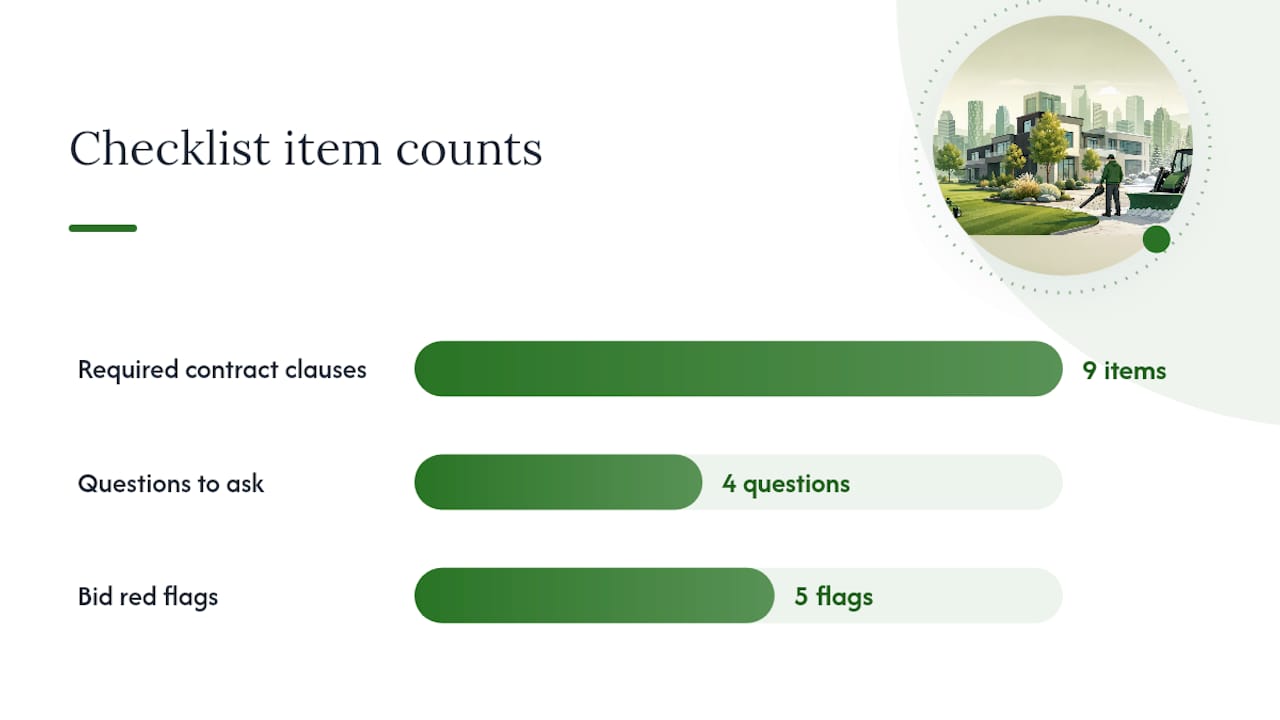
Contract clauses that must be present:
- Defined service areas (specific lots, sidewalks, entrances, not “the property”)
- Performance triggers (e.g., plow when accumulation reaches 2.5 cm; salt after freezing rain)
- Response time windows from trigger to completion
- Photo and GPS documentation requirements for every service event
- Inspection cadence and escalation process for missed events
- Equipment responsibility and damage liability (who pays if a plow clips a curb?)
- Snow disposal and hauling plan, including stacking zones and hauling triggers
- Invoice and billing schedule, deposit requirements, and late-payment terms
- Cancellation and renewal terms, including notice periods
Questions to ask during the proposal review:
- What is your fleet capacity, and do you carry backup equipment?
- How do you staff for simultaneous storm events across multiple sites?
- Can you provide a sample service log and a reference from a comparable commercial property?
- What does your escalation process look like if a trigger is missed?
Red flags in bids:
- Unnamed or unspecified subcontractors handling your site
- No insurance certificate provided upfront
- Triggers described as “as needed” or “at our discretion”
- Blanket indemnity language that attempts to waive all contractor liability
- No documentation process mentioned anywhere in the proposal
Pro Tip: Ask for a sample event report from a previous storm before signing. A contractor who cannot produce one has no documentation process, regardless of what the contract says.
For more on efficient snow removal workflows, Yearlong’s internal process guide covers what a well-run commercial operation looks like from dispatch to sign-off.
What service levels and response times should you expect in 2026?
SLA design for commercial properties in 2026 follows a fairly consistent pattern across Calgary providers, though the specifics vary by site type and risk profile.
Typical trigger points are set at 2.5 cm for high-traffic commercial sites (retail, medical, multi-family) and 5 cm for lower-traffic properties. Response windows after a trigger is reached commonly run 2–4 hours for parking lots and 1–2 hours for primary entrances and sidewalks. Completion windows for full-site clearance are typically 4–6 hours after the storm ends.
Documentation standards that reduce dispute risk:
- GPS-tracked vehicle logs showing arrival and departure times
- Timestamped photos of the site before and after each service event
- Written event reports delivered within 24 hours after any major storm
- A defined escalation workflow when a trigger is reached outside business hours
The difference between proactive and reactive models matters for commercial sites. A proactive model includes scheduled patrols during active storms, pre-storm anti-icing, and a standing crew on call. A reactive model dispatches only after a trigger is confirmed. High-traffic commercial properties, particularly those with public access, generally need the proactive model. A reactive model may be appropriate for low-traffic storage or industrial sites where access windows are more flexible.
Proactive documentation also matters for liability protection: a timestamped record showing the site was patrolled and treated before a slip event is far more defensible than a record showing the crew arrived after a complaint.
What does a Yearlong year-round commercial package look like?
A typical Yearlong commercial contract for a mid-size Calgary property covers the full calendar year in two integrated phases.
| Phase | Services included | Timing |
|---|---|---|
| Spring/Summer/Fall | Spring cleanup, weekly mowing and edging, bed maintenance, irrigation checks, fall cleanup | April through November |
| Winter | Seasonal snow contract: parking lot plowing, sidewalk clearing, salting, snow stacking | November through March |
After signing, the process runs as follows: Yearlong conducts an on-site assessment to map service areas, confirm trigger points, and document existing conditions. A written scope is produced before the first service visit. Performance triggers are agreed in writing, and an onboarding inspection confirms the site is ready for the first season. A first-season review at the end of the initial contract period allows both parties to adjust scope, triggers, or service frequency.
Proof points to request from Yearlong before signing:
- Current certificate of insurance with CGL and WCB coverage
- A sample service log from a comparable commercial property
- Written satisfaction guarantee with a defined remedy process
- References from at least two commercial clients in Calgary
Yearlong’s bed maintenance services can be added to the core lawn package, and the lawn care programme incorporates performance-based practices aligned with 2026 landscaping trends including smart irrigation and native planting options where appropriate.
Why integrated packages made sense for Calgary properties
The operational case for bundled lawn and snow contracts became obvious after watching what happens when they are split. A property manager hires a lawn crew in spring, a separate snow contractor in October, and spends the shoulder months in September and November chasing two vendors about who owns the transition. The lawn crew leaves debris that the snow contractor plows into a drainage channel. The snow contractor’s stacking zone destroys the turf the lawn crew spent the summer building. Neither vendor has a complete picture of the site.
Yearlong built integrated packages specifically to close that gap. Fleet planning for storm peaks, documentation workflows that carry through all four seasons, and a single point of contact for the entire property: these are not marketing claims, they are the operational answer to a coordination problem that costs property managers real money and real liability exposure.
The sustainability side of lawn care has also shifted the conversation. Choosing native species and smart irrigation is not just an environmental preference; it reduces water costs, cuts maintenance hours, and builds turf that handles Calgary’s freeze-thaw cycles better than high-input grass varieties. That is a long-term cost argument, not a green-washing one.
Get a quote from Yearlong for your commercial property
Yearlong gives Calgary property managers a single contract covering commercial lawn care and snow removal with documented SLAs, insurance, and a satisfaction guarantee. No coordinating separate vendors, no gaps between seasons, and no scrambling for a crew when a storm hits overnight.

To request a site assessment and bundled quote, contact Yearlong directly through the website. On first contact, have your property address, a rough map of service areas (parking lots, sidewalks, entrances), your preferred trigger points, and any insurance requirements your property demands. Yearlong will confirm a site visit and return a written proposal with scope, triggers, pricing, and contract terms. Seasonal-only contracts and custom scopes are available if a full year-round package does not fit your situation. Request your year-round property maintenance quote today.
Primary sources and references
The following sources were cited throughout this article. Each covers a distinct aspect of commercial property maintenance compliance, pricing, and liability in Alberta.
- City of Calgary — Snow and ice bylaws: The primary municipal source for sidewalk clearing requirements, minimum widths, prohibited disposal zones, and City invoicing rules. Required reading for any Calgary property manager.
- CrewNest — How to Price Snow Removal in Calgary (2026): Practical 2026 pricing benchmarks for residential and commercial pushes in Calgary, plus explanation of per-push, per-inch, seasonal, and satellite measurement models.
- Buildings — Landscaping trends for 2026: Industry analysis of the shift to performance-based commercial landscaping, smart irrigation, and native planting.
- Classic Landscapes — Commercial Snow and Ice Management: Operational best practices for SLA triggers, patrol models, stacking plans, and documentation standards.
- MMI — Snow and ice liability for commercial properties: Alberta-specific insurance and risk management guidance, including service log requirements and CGL/WCB verification.
- Cuminggillespie — Snow removal and business liability in Alberta: Legal commentary on occupier liability, indemnity language, and performance trigger requirements under Alberta law.
- City of Calgary — Licences for builders and contractors: Clarifies which contractor activities require a licence and confirms that routine lawn and snow work typically falls outside that requirement, while bylaw compliance remains mandatory.
Sources
- Snow and ice bylaws — City of Calgary
- How to Price Snow Removal in Calgary (2026) | CrewNest
- Landscaping trends for 2026: Why performance now matters more than appearance | Buildings
- Snow & ice liability for commercial properties | MMI
- Snow removal and business liability in Alberta — Cuminggillespie (blog)
- Licences for builders and contractors — City of Calgary