

Hire a company that carries general liability and workers’ compensation insurance, hands you a written scope of work before charging you a dime, and can name references from more than one season. Ask about their mowing standards (the one-third rule matters more than most homeowners realize) and get every price in writing. YearLong Property Maintenance in Calgary is one example of a provider built around that exact checklist. What follows is how to verify each piece yourself, in about the time it takes to make two phone calls.
TL;DR:
- Verify the lawn care company’s insurance coverage by seeing proof of both liability and workers’ compensation policies directly from the insurer.
- Expect a written scope of work, clear pricing, and references spanning more than one season before hiring a company.
- Ask about their adherence to the one-third mowing rule and how often blades are sharpened to prevent lawn stress and disease.
- Review quotes line by line to ensure included services like edging and fertilization are explicitly listed, and beware of suspiciously low prices.
- Confirm that the crew is consistent, equipped properly, and responds promptly to inquiries, with onsite visits or short trials recommended before full contracts.
Table of Contents
- How do you check a lawn care company’s legitimacy and reputation?
- Which licences and insurance should you verify?
- What’s actually included in a lawn care quote?
- How reliable is the company’s customer service?
- Why does the one-third mowing rule matter when hiring?
- What should you ask before signing a contract?
- A practical view from YearLong: how a dependable local provider meets these checks
- Ready for lawn care you don’t have to double-check?
- Sources
How do you check a lawn care company’s legitimacy and reputation?
Start where everyone starts: Google reviews. But read them like a skeptic, not a shopper. A company with 40 reviews spread over three years tells you more than one with 200 reviews that all landed in the same month, a pattern that usually means a review push rather than organic satisfaction. Cross-check on the Better Business Bureau, and don’t skip local Facebook groups or Nextdoor threads. Neighbours talk, and they talk more honestly about lawn care than about almost any other home service.
References matter more here than in most industries, because lawn damage doesn’t show up after one visit. It shows up in August, when a scalped lawn goes brown and stays that way. Ask any company for two or three customers they’ve served for at least a full season, ideally two.
When you call a reference, ask specific questions:
- Did the crew show up on the days they promised, without last-minute reschedules?
- Did the lawn look better by mid-summer than it did in May?
- Did bill match what was quoted, with no surprise line items?
- Would they hire the company again next year?
A legitimate operation also has a traceable identity: a real business address (not just a P.O. box), a working phone line answered by an actual person, and staff who can explain their own service process without reading from a script. If a company’s entire web presence is a Facebook page created two months ago, that’s not automatically disqualifying, but it’s a reason to ask more questions before you sign anything.
Which licences and insurance should you verify?
Two kinds of coverage matter, and they protect different things. General liability insurance covers property damage, say, a rock kicked up by a mower that cracks your window. Workers’ compensation protects you if a crew member gets hurt on your property; without it, you can be on the hook for medical costs yourself. Any legitimate company carries both and will show you proof without hesitation.
If a company offers fertilizer or pesticide applications, ask for their applicator licence number and write it down. Extension guidance from UF/IFAS recommends comparing providers based on inspection-based recommendations rather than accepting a blanket treatment plan sight unseen.
- Ask to see the policy declarations page, not just a certificate summary.
- Get the insurer’s name and a contact number, and call if anything seems off.
- Treat hesitation or vague answers as a warning sign, not an oversight.
- Walk away from cash-only operators who won’t produce documentation.
Pro Tip: Ask for the insurance certificate to be emailed to you directly by the insurer, not forwarded by the company. It takes an extra day and tells you everything about how seriously they take the paperwork.
What’s actually included in a lawn care quote?
Pricing models vary more than most homeowners expect. Some companies charge per visit, some sell a seasonal package, and some bundle mowing with bed maintenance, fertilization, and cleanups into one line item. HomeStars puts typical Canadian per-visit mowing costs somewhere between $30 and $150, with routine visits on an average urban lot often landing closer to the lower half of that range. Lawn size, obstacles, and how often the crew comes all move the number.
The real risk isn’t the base price. It’s what’s not in it. Before you sign anything, do this:
- Ask specifically whether edging, blowing clippings off hard surfaces, and the first cut of the season are included or billed separately.
- Ask whether aeration, dethatching, and fertilization are part of the package or add-ons charged per application.
- Get a written estimate that spells out frequency, exactly what’s included, what’s excluded, and how cancellation works.
- Compare quotes against each other line by line, not just as one final number.
If one quote comes in dramatically lower than three others, don’t assume you found a deal. It’s more often a sign of missing insurance, undertrained crews, or corners cut on mowing frequency, which shows up on your lawn a lot faster than in your wallet. Comparing a few lawn care service packages side by side before you commit makes the gaps in a suspiciously cheap quote much easier to spot.
How reliable is the company’s customer service?
Reliability shows up in small operational details long before it shows up as a missed mow. Ask whether the crew sends timestamped photos after each visit, whether you get an assigned crew instead of a rotating cast of strangers, and whether scheduling happens through an online system or a group text that goes unanswered for days.
Industry sources on hiring lawn care companies point to photo proof and online scheduling as practical controls that reduce disputes and keep everyone accountable. Test responsiveness before you sign anything: call or message with a real question and time how long it takes to get an answer. A company that takes three days to respond to a sales inquiry will take longer once you’re already a customer.
- Ask what happens if you’re unhappy with a visit: is there a redo policy, or just an apology?
- Ask how many crews they run and whether that number has grown faster than their staff training.
- Watch for a pattern of missed visits or vague explanations for delays.
Rapid, unexplained growth at a lawn care company is worth a second look. Scaling too fast often shows up first as missed appointments and thinner communication, long before it shows up in a review score.
Why does the one-third mowing rule matter when hiring?
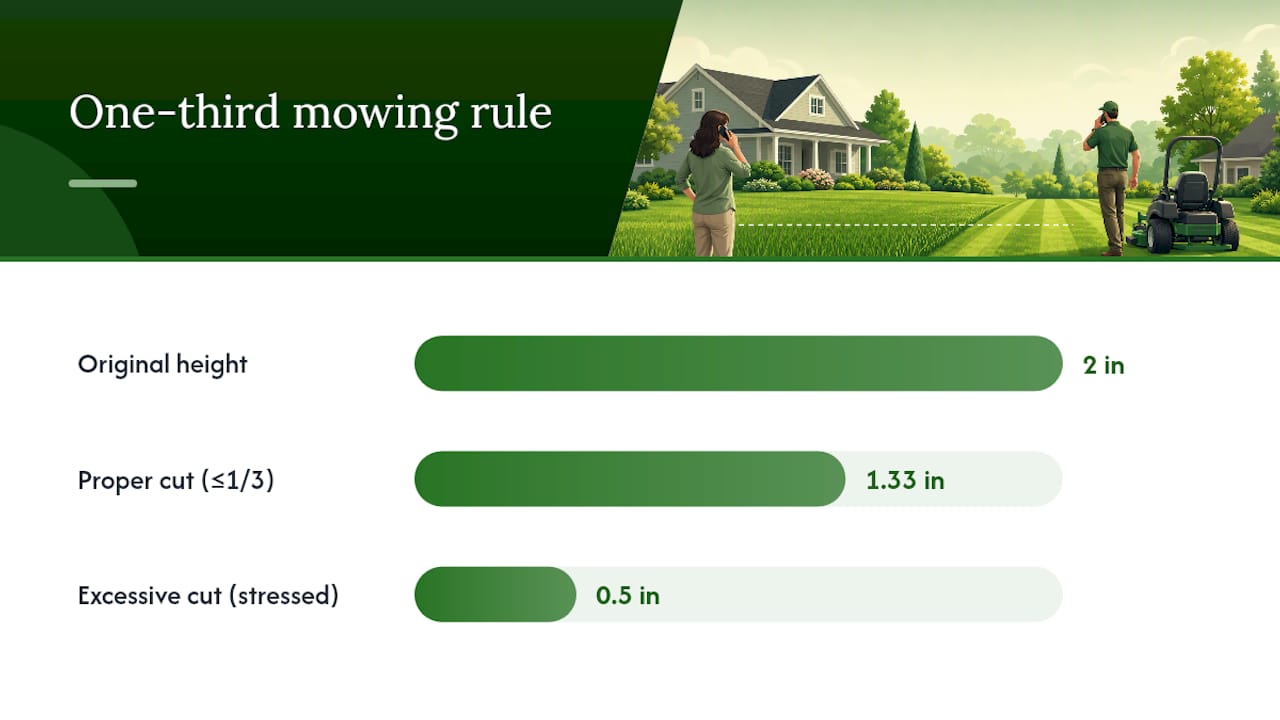
Ask any candidate one specific question: how much do you cut off in a single pass? The correct answer follows the one-third rule: never remove more than one-third of the grass blade’s height in one mow. Cut a lawn kept at two inches down to half an inch, and you’ve shocked the plant, opened it up to disease, and made it far more vulnerable to drought. A company that scalps lawns to stretch time between visits is trading your lawn’s health for their schedule.
Sharp, correctly calibrated equipment isn’t cosmetic. Dull blades tear grass instead of cutting it, leaving frayed tips that brown and invite fungus, an effect the same research on mowing practices ties directly to lawn stress and disease risk. Ask how often blades get sharpened and whether mower height gets reset for different areas of your yard.
If a company offers organic or eco-friendly programs, ask what that actually means in practice. Organic fertilizer often works more slowly than synthetic, so set realistic expectations for how fast you’ll see results, and always ask about safety and wait times for kids and pets after any application, whether it’s organic or not. Our guide to mowing heights breaks down ideal cutting heights by grass type if you want to check what your own lawn should be getting.
What should you ask before signing a contract?
A short call or an on-site visit should answer most of what you need to know before you commit to a season. Ask these directly:
- Who actually does the work: employees or subcontractors, and is it the same crew each visit?
- Can you see proof of insurance and, if chemicals are involved, an applicator licence number?
- What exactly is included in the base price, and what triggers an extra charge?
- What’s the cancellation policy if the service isn’t working out?
- Is there a satisfaction guarantee, and what does it actually cover?
Extension research on lawn care recommends treating it as a partnership: companies handle technical applications while homeowners manage irrigation and everyday upkeep. Clarify that division of labour up front so nobody’s surprised in July.
If you’re still unsure after the calls, book a single visit or a short trial period rather than a full-season contract. It’s a low-risk way to see how a crew actually performs before you’re locked into months of service.
| Green flag | Red flag |
|---|---|
| Provides insurance certificate without hesitation | Refuses or delays showing documentation |
| Written estimate with clear inclusions/exclusions | Verbal quote only, no paper trail |
| References span more than one season | No references offered or only very recent ones |
| Consistent crew, photo proof of visits | Rotating crews, no verification of completed work |
| Explains mowing height and frequency | Vague or dismissive about cutting practices |
A practical view from YearLong: how a dependable local provider meets these checks
YearLong has served Calgary properties since 2017, which is long enough to have handled several full growing seasons across very different weather years, the kind of stretch that exposes shortcuts fast. The company backs its lawn care with a written agreement, proof of insurance on request, and a satisfaction guarantee, the same three things this checklist tells you to demand from anyone.
Local climate knowledge matters more in Calgary than in milder markets, where frost timing and dry spells shift mowing schedules year to year. And the partnership still applies here too: homeowners typically manage irrigation while the crew handles the technical side, so ask any provider, YearLong included, exactly where that line falls before the first visit.
— Lewie
Ready for lawn care you don’t have to double-check?
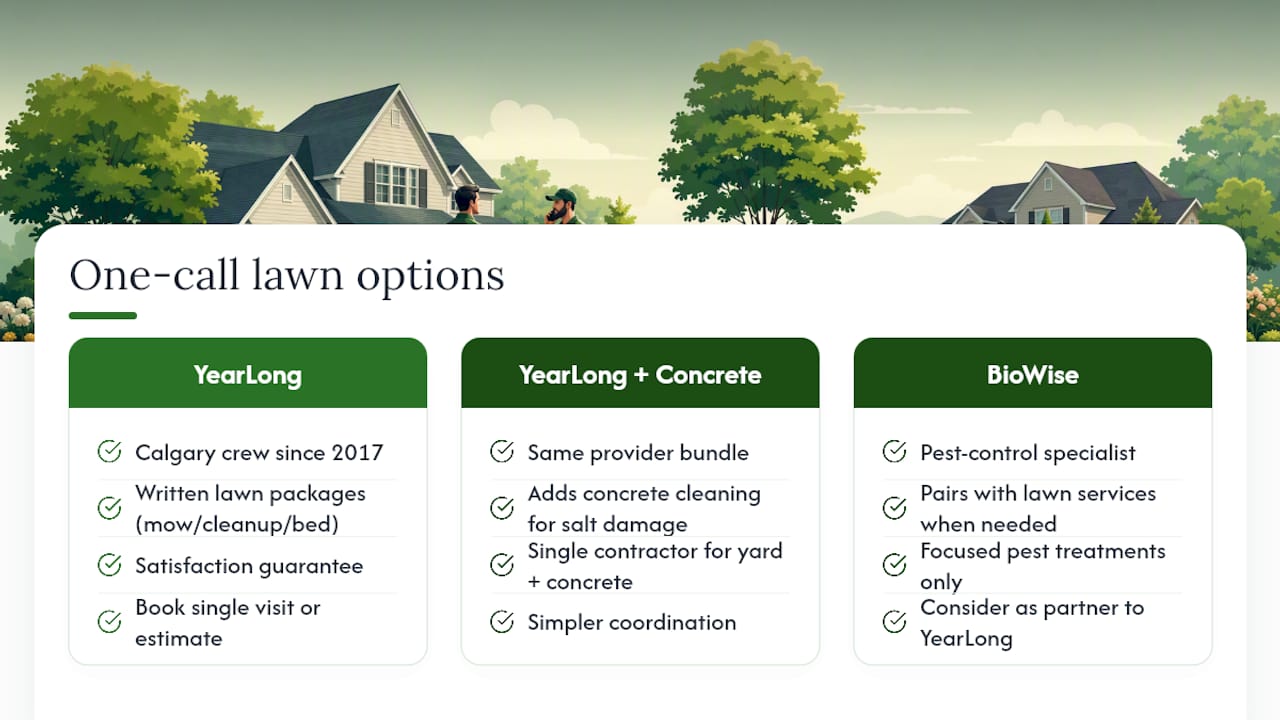
Most of the checklist above exists because homeowners have been burned by vague quotes, no-show crews, or a scalped lawn in July. YearLong was built to remove that guessing entirely: a Calgary-based crew, in business since 2017, offering lawn care packages that spell out mowing frequency, seasonal cleanups, and bed maintenance in writing before you commit to anything.

If you also deal with concrete surfaces that take a beating from winter salt, YearLong’s concrete cleaning services pair naturally with a lawn care package under one provider instead of three. For pest issues that sometimes come with lawn problems, BioWise’s pest control services are worth a look as a specialist partner.
The easiest next step: book a single visit or request a written estimate before locking into a season-long plan. You’ll see exactly how YearLong runs a mow, handles the paperwork, and treats your yard, backed by their satisfaction guarantee, with zero pressure to sign anything beyond that first visit.
Sources
The USGA’s one-third rule explains the mowing standard every provider should follow. University of Illinois Extension covers the homeowner-company partnership model. UF/IFAS Extension details licensing and inspection-based recommendations. HomeStars provides current Canadian mowing cost ranges for comparison shopping.
- The one-third rule (USGA)
- Choosing home lawn care services (University of Illinois Extension)
- Lawn mowing cost guide (HomeStars)
- How to choose the right green industry professional (UF/IFAS Extension)