

Calgary’s average last spring frost lands on May 23, and the average first fall frost hits September 21, giving the city a frost-free growing season of about four months based on Environment and Climate Change Canada’s 1991–2020 climate normals. That’s the average, not a promise. For tender crops like tomatoes and peppers, hold off transplanting until late May or early June in the urban core, and push that another 5 to 10 days if you’re in a suburb, foothill, or exposed prairie edge of the city.
TL;DR:
- Calgary’s frost dates vary locally depending on elevation and proximity to rivers, impacting planting timelines by up to 10 days from the city average.
- Home gardeners should buffer the average last frost date by 5 to 10 days for tender crops and rely on local microclimate clues for more accurate timing.
- Transplanting tender plants outdoors should be delayed until late May or early June, with protection measures like row covers recommended during unpredictable frost periods.
- Relying on nightly weather forecasts and personal thermometers helps prevent frost damage, especially in vulnerable microclimates or during volatile spring weather.
- Gardeners should expect occasional late frosts even in summer and plan protection strategies accordingly, as surface temperatures can drop several degrees below forecast lows.
Table of Contents
- Calgary frost dates at a glance
- How Calgary’s frost dates get calculated (and why the range is so wide)
- Does your neighbourhood run warmer or colder than the average?
- When to seed, harden off, and transplant in Calgary
- Frost protection methods that hold up in a Calgary spring
- Reading forecasts like a Calgary gardener, not a tourist
- Lewie’s local take: treat the May long weekend with suspicion
- Let professionals handle the yard work while you handle the planting
- Sources
- FAQ
Calgary frost dates at a glance
Calgary sits in plant hardiness zone 3b, a designation that reflects how brutal winter minimums can get even though summers run warm and long enough for a decent vegetable garden. The frost-free window is generally generous by Prairie standards, but it’s bracketed by two dates that shift more than most Canadian cities because of Chinook winds blowing warm air off the Rockies mid-winter and, occasionally, mid-spring cold snaps right after.
Here’s the reference table worth bookmarking:
| Metric | Value | Source |
|---|---|---|
| Average last spring frost | May 23 | ECCC 1991–2020 normals |
| Average first fall frost | September 21 | ECCC 1991–2020 normals |
| Frost-free growing season | a moderate length typical of the region | ECCC 1991–2020 normals |
| Plant hardiness zone | 3b | ECCC/AAFC zone data |
| Recommended tender-crop transplant | Late May to early June | GrowersGuide / ACIS |
GrowersGuide’s Calgary frost summary lines up with the ECCC figures and adds neighbourhood detail, which matters more in Calgary than in flatter, less Chinook-affected cities.
How Calgary’s frost dates get calculated (and why the range is so wide)
May 23 and September 21 are the 50th percentile dates. That means frost typically occurs around these times in a typical year, but individual years can vary significantly. It’s a midpoint of a spread, not a hard line, and treating it as one can risk damage to sensitive plants.
The Alberta Climate Information Service (ACIS) handles this with a probabilistic approach instead of a single average. ACIS calculates freezing-date estimates at several thresholds, from 0°C down to minus 5°C, and reports the odds of hitting each one on any given date. That’s a more honest picture than one number, because a 0°C frost and a minus 4°C hard freeze do very different damage to plant tissue.
Home gardeners generally do better with the 50% average plus a buffer, according to Alberta Agriculture’s Agdex freezing-date guidance. In practice that looks like:
- Cautious home gardener: average date (May 23) plus 5 to 10 days
- Risk-tolerant grower: 25% probability date, typically a week or so earlier
- Cold-sensitive seedlings (basil, squash, melons): treat the buffer as a floor, not a suggestion
Does your neighbourhood run warmer or colder than the average?
Calgary’s frost dates aren’t one number citywide. Elevation, wind exposure, and how close you sit to the Bow or Elbow river valleys all nudge your personal frost window earlier or later than the official station reading.
- Inner-city and river-bottom areas (Bow Valley, Elbow Park, parts of the core) often see a few days’ advantage on both ends, thanks to urban heat retention and lower elevation.
- Higher-elevation northwest communities and foothill-facing yards tend to frost 5 to 10 days later in spring and earlier in fall than the city average.
- Satellite towns like Airdrie, Cochrane, Okotoks, and Strathmore sit more exposed to open prairie and typically lag the Calgary core by roughly a week on the last spring frost.
- Microclimate checks: a south-facing wall, a slope that drains cold air away, or proximity to a pond or river all buy you a warmer pocket; a low spot at the bottom of a slope or an open field edge does the opposite.
If you’re not sure which camp your yard falls into, a cheap min/max thermometer left outside for a couple of weeks in April tells you more than any city-wide average ever will.
When to seed, harden off, and transplant in Calgary
Working backward from May 23 gives you a schedule that actually holds up against a Calgary spring, which can swing from snow to 20°C within a week. Here’s the sequence:
- Start seeds indoors 6 to 8 weeks before the last frost for tomatoes, peppers, and eggplant, meaning early to mid April for a May 23 target.
- Start cool-season crops (brassicas, lettuce, spinach) 4 to 6 weeks before last frost, or directly outdoors from mid April since they tolerate light frost.
- Start cucurbits (cucumbers, squash, zucchini) only 3 to 4 weeks before transplant, since they resent root disturbance and grow fast anyway.
- Harden off transplants over 7 to 10 days, moving them outside for a couple of hours at a time and gradually extending exposure to sun, wind, and cooler night temperatures.
- Transplant tender crops outdoors between May 30 and June 1 in the urban core, or June 5 to 10 in suburbs and foothill-facing yards.
- Watch overnight forecasts for the two weeks after transplanting and keep row cover on hand, because that window is exactly when Calgary’s frost volatility bites hardest.
Root crops (carrots, beets, potatoes) and hardy greens can go directly into the ground two to three weeks before the frost date, since a light freeze barely slows them down. Save the indoor-start effort for the crops that actually need it.
Frost protection methods that hold up in a Calgary spring
Cold nights don’t have to end your garden season early. The right cover, deployed at the right time, buys tender plants several degrees of protection, which is often the difference between a bruised leaf and a dead plant.
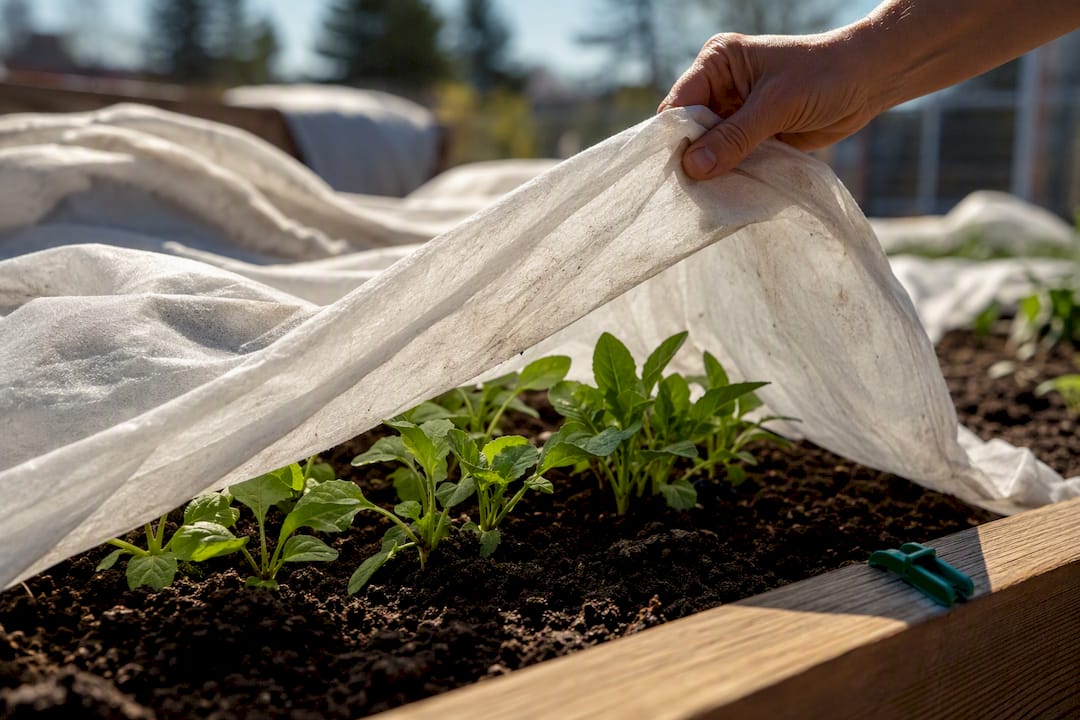
- Floating row covers work for broad beds of low-growing crops and trap several degrees of warmth without weighing down foliage.
- Frost blankets (heavier spun fabric) suit a hard frost warning and can be layered over row cover for extra insurance.
- Cloches or upturned buckets protect individual plants like a single pepper or tomato transplant on a cold, clear night.
- Cold frames extend both ends of the season for greens and brassicas, acting like a mini greenhouse that traps daytime heat.
- Water the soil before a frost night, since moist soil holds more heat than dry soil and releases it slowly overnight.
- Group container plants together near a wall or fence, which adds thermal mass and cuts wind exposure.
Pro Tip: Don’t wait for the forecast to hit 0°C before covering tender crops. Deploy protection any night the forecast low drops to 3 or 4°C, because radiational cooling near the ground can drop surface temperatures several degrees below the official air-temperature reading, quietly frosting leaves that “should” have been safe.
The most common mistake is leaving covers on into a sunny midday. Heat builds up fast under fabric and can cook seedlings just as thoroughly as frost kills them, so pull covers once the sun’s up and temperatures climb.
Reading forecasts like a Calgary gardener, not a tourist
Averages tell you when to plan around; nightly forecasts tell you when to act. Environment Canada’s local forecast gives the overnight low, but the real skill is knowing that a forecast of 4°C doesn’t mean you’re safe.
- ECCC forecasts give the baseline overnight low for the metro area, useful for general planning but not hyper-local.
- ACIS freezing-date tools let you check probability curves for your specific station rather than relying on a single citywide number.
- Your own backyard thermometer beats both if you’re in a known cold pocket, since a clear, calm night lets cold air pool at ground level even when the “official” low sits above freezing.
A simple nightly routine during frost-watch season: check the forecast at dusk, deploy covers before full dark if the low is forecast near 4°C or below, and pull everything back midday once the sun climbs and temperatures rise.
Lewie’s local take: treat the May long weekend with suspicion
Every Calgary gardener eventually learns this the hard way: the May long weekend is not a green light. It’s a Chinook-driven mirage. We’ve watched 22°C afternoons turn into a hard frost warning two nights later, and it happens often enough that treating a cheap row cover as standard equipment, not emergency gear, pays for itself in a single saved tomato plant. Calgary’s swings make short-term protection one of the higher-value moves a home gardener can make, and it costs almost nothing next to the price of restarting seedlings in June. If you’re prepping beds for the season, our fall yard preparation guide covers the flip side of this same volatility.
— Lewie
Let professionals handle the yard work while you handle the planting
Frost dates tell you when to plant. They don’t tell you who’s going to get your beds cleared, edged, and ready before the ground even thaws. That’s where Yearlong comes in: instead of spending your first warm weekend raking last fall’s leaves out of your perennial beds, you can have that done before your seedlings are even hardened off.
Yearlong handles seasonal cleanups, ongoing bed maintenance, and general lawn care across Calgary, on either a one-off or recurring basis depending on how hands-off you want your yard to be. If you’d rather not gamble a weekend on unpredictable spring weather, homeowners preparing for a busy planting season should also look at winterizing other parts of the property, including doors and entryways, using guidance like this weatherproofing checklist. Before you book, have your property size and priority tasks (bed cleanup, edging, debris removal) ready so we can scope the visit accurately. Request an estimate through our lawn care page and get your beds ready before the frost window closes.
Sources
- Environment and Climate Change Canada climate normals
- Growersguide
- Freezing dates for Alberta locations (Agdex guidance)
FAQ
When should I plant my garden in Calgary?
Start hardy seedlings and root crops from mid to late May, but hold tender transplants like tomatoes and peppers until May 30 to June 1 in the urban core, or June 5 to 10 in suburbs and foothill-facing areas.
Has it ever snowed in July in Calgary?
Calgary’s climate is volatile enough that unseasonal cold snaps happen, though a July snowfall is rare rather than typical; the bigger practical risk for gardeners is late-May and early-June frost, well within the historical range around the May 23 average.
Can you get frost at 3 degrees Celsius?
Yes. Radiational cooling near the ground can drop surface temperatures several degrees below the official air-temperature reading, so a forecast low of 3 to 4°C can still frost exposed leaves even though the air technically stays above freezing.
What temperature is considered a killing frost?
There’s no single universal number since it depends on species and duration, but many tender plants suffer damage between 0°C and minus 2°C, while a hard freeze below minus 2°C to minus 4°C typically kills unprotected tender crops outright.