

For most Calgary lawns, apply a slow-release fertilizer at spring green-up, follow up once in late spring, feed again in late summer or early fall, and finish with a potassium-rich winterizer before freeze-up. Use a 23-3-3 slow-release product at an application rate calibrated to provide appropriate nitrogen per 1,000 square feet through a spreader. If soil issues, thatch, or bare patches complicate the picture, a professional visit from an experienced outdoor maintenance crew saves you from guessing.
TL;DR:
- Most Calgary lawns should be fertilized with a 23-3-3 slow-release product at about 0.25 pounds of nitrogen per 1,000 square feet, calibrated through testing.
- Fertilizer applications are best timed for spring green-up, late summer or early fall for root building, and a potassium-rich winterizer before the first freeze, with weather conditions controlling the schedule.
- Heavy rain within 24 hours of fertilizing can cause runoff into storm drains, so applications should be postponed if rain is forecasted.
- Soil testing every two to three years helps determine if adjustments to the fertilizer ratio, especially in phosphorus or potassium, are needed.
- Professional lawn care is recommended for handling soil issues, power raking, overseeding, or precise timing, especially considering Calgary’s unpredictable spring and fall weather.
Table of Contents
- What is the right fertilizer schedule for Calgary lawns?
- How to choose a fertilizer and calculate the right application rate
- Getting the application right: technique and timing
- Do you need a soil test before fertilizing?
- Your month-by-month Calgary fertilizer checklist
- Local field notes from Yearlong
- Why most fertilizer advice online oversimplifies Calgary lawns
- Book a fertilization schedule that fits Calgary, not a generic calendar
- Sources
What is the right fertilizer schedule for Calgary lawns?
Calgary’s growing season is short and its soil temperatures swing hard, so the calendar matters more here than in milder cities. Most local lawns don’t wake up until May, and the City of Calgary points to early summer and fall as the two windows that do the heaviest lifting. Between those, a few smaller applications keep the lawn steady through Calgary’s heat spikes and dry stretches.
Here’s the rhythm that works for most residential lawns in the city:
- Spring green-up (late April to May): Once grass is actively growing and you see consistent colour, apply a slow-release fertilizer with a nitrogen content suitable for spring green-up. Rake up winter debris first and mark your irrigation heads so nobody clips them with a spreader or a mower later.
- Late spring to early summer (June): Only fertilize again if the lawn looks pale or is recovering from stress. Use a reduced nitrogen amount during this period. Heat plus heavy nitrogen is a common way lawns get pushed into fast, weak growth right before a dry spell.
- Late summer to early fall (late August to mid-September): This is prime time for repair seeding and a balanced feed, according to GrowersGuide’s Canadian lawn calendar. Roots are building reserves for winter, so this application should lean toward supporting root mass rather than green top growth.
- Fall winterizer (mid-September to October): Your last feed of the year should shift toward potassium, which improves winter hardiness. The City of Calgary confirms fall feeding is one of the two most valuable windows in the whole season. Time this two to three weeks before the first hard freeze, which in Calgary usually means applying by early October depending on the year.
Weather should guide these windows more than the calendar does. A cold, late spring can push green-up into the third week of May some years, and an early frost can shrink your fall window to a matter of days. Watch soil temperature and grass colour, not just the date on your phone.
How to choose a fertilizer and calculate the right application rate
Every fertilizer bag lists three numbers, the N-P-K ratio, standing for nitrogen, phosphorus, and potassium. Nitrogen drives leaf growth and green colour, phosphorus supports root establishment, and potassium builds stress tolerance and cold hardiness. The City of Calgary recommends a slow-release fertilizer with a 23-3-3 ratio for most residential lawns, applied at approximately 0.25 lb of nitrogen per application.
Working out how much product to spread isn’t complicated once you’ve done it once:
- Check the nitrogen percentage on the bag (a 23-3-3 product is 23% nitrogen).
- Divide your target rate (0.25 lb N per 1,000 sq ft) by that percentage to find how many pounds of product you need per 1,000 sq ft.
- Measure your lawn’s square footage and scale the number accordingly.
- Calibrate your spreader by testing output over a marked section of driveway (a 10-metre by 1 metre strip works well) before you touch actual turf.
Pro Tip: Weigh out your test run on a kitchen scale before you calibrate. Guessing spreader settings is the single fastest way to burn stripes into an otherwise healthy lawn.
Organic fertilizers are a reasonable option for homeowners who want fewer synthetic inputs. Applied two to three times per year, they can replace much of a synthetic schedule, based on the City of Calgary’s lawn care guide, though they release nutrients more slowly and cost more per application. Save winterizer formulas, higher in potassium and lower in nitrogen, specifically for that final fall feed.
Getting the application right: technique and timing
A good product on a bad day still burns your lawn or washes down the storm drain. Technique matters as much as the fertilizer you buy.
- Calibrate the spreader first, then walk overlapping passes (edges touching, not gaps) so you don’t leave dark green stripes where two passes overlapped twice.
- Skip the application entirely if rain is forecast within 24 hours. The City of Calgary specifically flags heavy rain before fertilizing as a risk for runoff into storm drains.
- Early morning on a calm, cool day beats a windy afternoon, both for even coverage and for your own comfort.
- Water lightly after applying to activate slow-release granules, but don’t soak the lawn. Heavy watering right after application is one of the most common ways fertilizer ends up in the gutter instead of the root zone.
Fertilizer that reaches a storm drain doesn’t just waste money. It’s one of the more preventable sources of nutrient runoff into Calgary’s waterway system, which is exactly why the city’s own guidance leads with rain timing before it mentions rates or ratios.
Do you need a soil test before fertilizing?
A basic soil test, checking pH and nutrient levels, tells you whether your lawn actually needs the nitrogen-heavy schedule above or something different. Clay-heavy soil, common across much of Calgary, often holds nutrients differently than sandy soil does, so a test every two to three years is worth the small cost before you commit to a full season of product.
Grasscycling, leaving clippings on the lawn instead of bagging them, works in your favour here too. Decomposing clippings return nitrogen to the soil, and the City of Calgary’s Yardsmart program notes this can meaningfully cut how much supplemental fertilizer a lawn needs. If you run a mulching mower, a solid mulching guide is worth a read for getting the technique right.
- Time aeration or power raking a couple of weeks before a fertilizer application, never the same day, so nutrients reach loosened soil rather than sitting on compacted turf.
- If your soil test comes back low in phosphorus or potassium specifically, adjust your product choice rather than just adding more of a standard 23-3-3 blend.
Your month-by-month Calgary fertilizer checklist
- April: Rake debris, mark irrigation heads, calibrate your spreader.
- May: First fertilizer application (23-3-3 slow-release) once green-up is consistent; repair seeding if needed.
- June: Spot-treat only if colour is uneven; keep nitrogen low.
- August: Prep for the late-summer feed; check soil moisture before applying.
- September: Balanced application, targeting late August through mid-September.
- October: Final winterizer, higher potassium, applied before the first hard freeze.
Contact a professional crew if you’re dealing with power raking, overseeding, or a soil problem that a bag of fertilizer won’t fix on its own.
Local field notes from Yearlong
Two habits separate a good fertilizer season from a rough one: marking irrigation heads before any crew or spreader touches your lawn, and holding off on mowing right after an application so granules stay where they land instead of getting kicked into the grass clippings. Both are small details, but they’re the ones Yearlong’s own fertilization guide flags most often from years of Calgary properties.
The most common mistake we see isn’t the wrong product. It’s timing an application right before a spring downpour, which pushes nitrogen straight past the root zone. A Yearlong fertilization visit starts with a quick assessment of soil and turf condition, moves to a targeted product application matched to that lawn’s actual needs, and includes a follow-up check to confirm uptake and colour response.

Why most fertilizer advice online oversimplifies Calgary lawns
Most fertilizer schedules floating around online are written for growing zones that green up in March and don’t see a hard frost until November. Calgary does neither. That mismatch is why so many homeowners here either fertilize too early and waste product on dormant grass, or skip the fall winterizer entirely because generic advice treats it as optional.
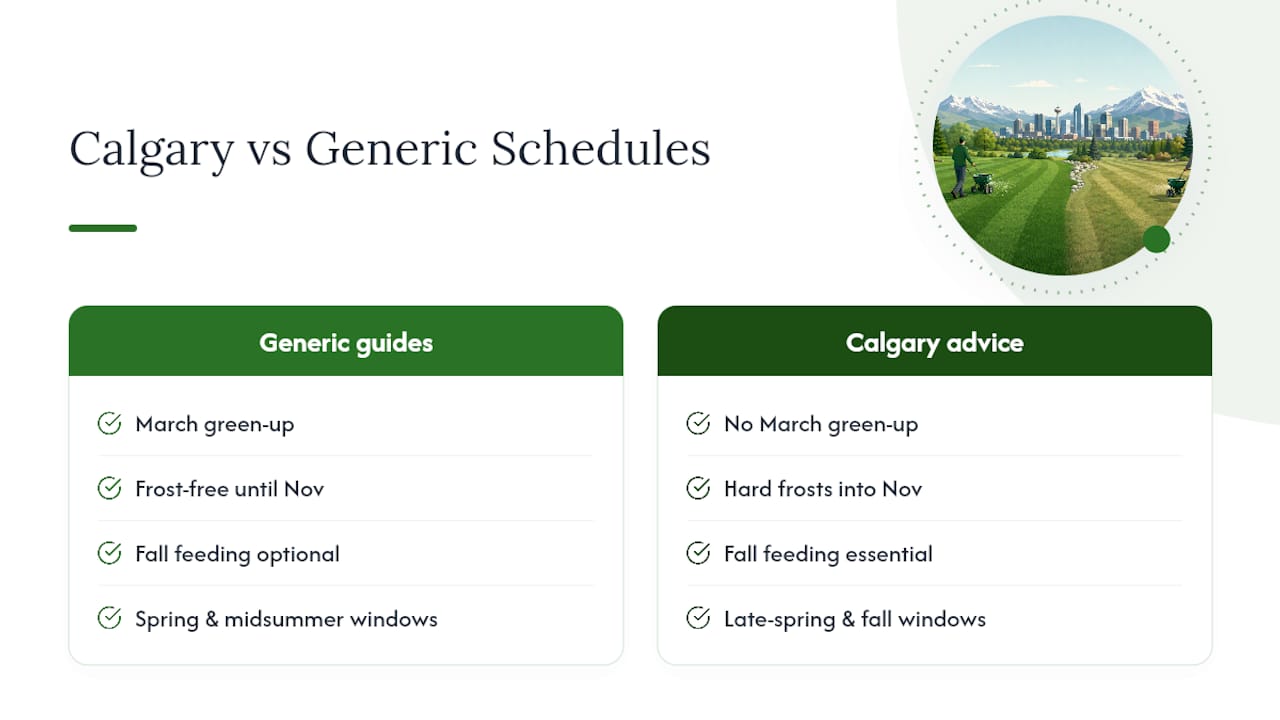
It isn’t optional. The City of Calgary’s own guidance treats fall feeding as one of the two highest-value windows in the whole year, specifically for the potassium boost that gets turf through a Chinook-and-deep-freeze winter. If you only have the energy or budget for two applications a year, make them the late-spring and fall windows, not spring and midsummer.
Where I’d push back on conventional wisdom: most guides treat fertilizer rate as the hard part. It isn’t. Spreader calibration is the actual skill gap for most homeowners, and it’s the one step people skip because it feels like extra work before the “real” job starts.
— Lewie
Book a fertilization schedule that fits Calgary, not a generic calendar
Following a seasonal plan is one thing. Executing four correctly timed visits around Calgary’s unpredictable spring rain and early frosts, with a calibrated spreader and the right product each time, is where most DIY schedules slip. Professional lawn care services can include fertilization as part of full seasonal lawn care packages, so timing, product choice, and follow-up all happen on a calendar built around this city’s growing season instead of a national average.
Typical seasonal lawn care packages cover an initial assessment of your lawn’s condition, scheduled visits timed to local green-up and frost dates, and may include power raking or overseeding if your turf needs a reset. Some providers offer satisfaction guarantees to ensure treatment effectiveness. If your lawn also needs bed cleanup or edging alongside its feeding schedule, that’s worth folding into the same visit rather than booking separately.
Check Yearlong’s lawn care page to see current packages and get a schedule built around your property this season.
Sources
- Fertilizing your lawn — City of Calgary (property owners)
- Lawn care calendar Canada — Month-by-month guide — GrowersGuide