

TL;DR:
- Professional edging creates a clean boundary that prevents grass from invading beds and keeps mulch in place. Yearlong offers scheduled, expert edging across Calgary, backed by a satisfaction guarantee to maintain sharp, consistent borders.
Edge before you mow. That single habit separates a tidy lawn from one that looks like it was mowed but never finished. Professionals set the perimeter first, cutting a clean vertical face with a standard professional drop creating a clear boundary between the turf and the adjacent bed or hardscape. That gap keeps grass from creeping into flower beds, holds mulch in place, and gives the mower a clear line to follow. During peak summer growth in Calgary, edges can need attention as often as once a week. For homeowners and property managers who want crisp results without buying, storing, and maintaining commercial equipment, Yearlong Property Maintenance offers scheduled edging visits across the entire Calgary area, backed by a satisfaction guarantee.
Table of Contents
- How to edge your lawn: the step-by-step sequence
- Which tools give you the best edge?
- What does a good edge actually look like?
- When should you edge in Calgary?
- Safety and PPE for powered edging
- DIY edging vs. hiring a Calgary professional
- What does a professional edging visit include?
- How to choose a Calgary lawn maintenance provider
- What drives the cost of professional edging in Calgary?
- Key takeaways
- The edge most people overlook
- Yearlong keeps Calgary edges sharp, season after season
- Useful sources
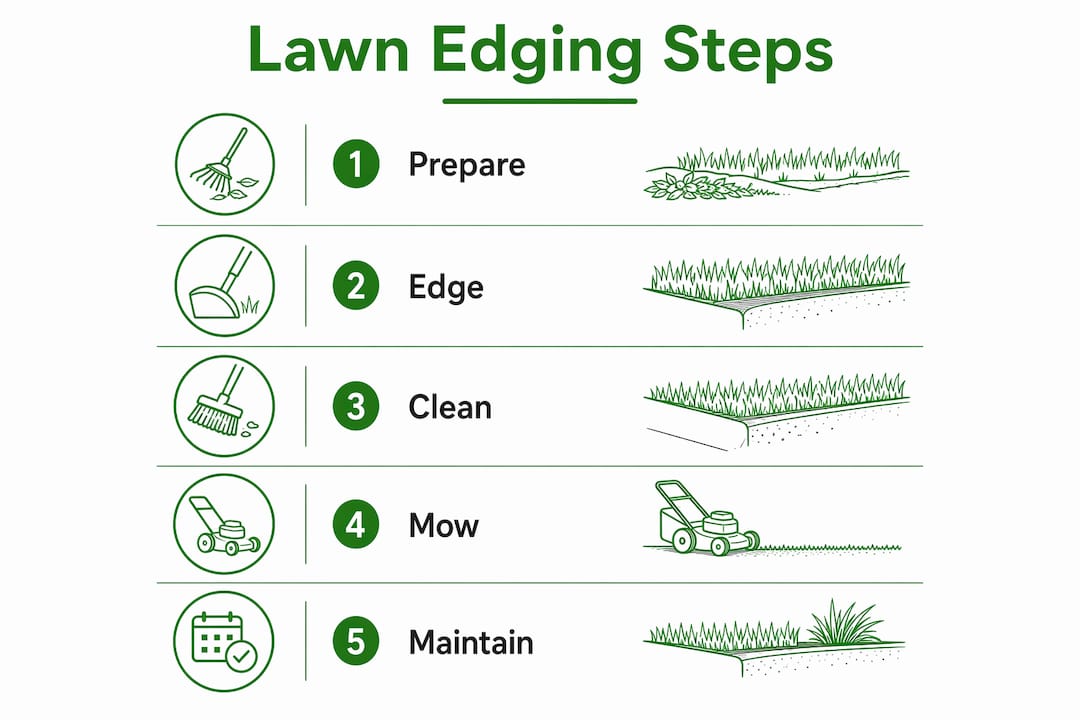
How to edge your lawn: the step-by-step sequence
Professionals edge before mowing so the mower picks up the cut debris in a single pass, leaving a cleaner finish with less raking afterward.
- Clear the edge zone. Remove any rocks, toys, or debris within a metre of the edge line. Check for buried utility lines before cutting into soil.
- Mark your line. Use string and stakes for straight runs, or lay a garden hose on the ground to trace a smooth curve before you commit to a cut.
- Set your edger depth. For a cosmetic trim on a maintained edge, a shallow cut of roughly 1.3 cm (½ in) is enough. Rebuilding an overgrown border calls for a deeper 2-inch sod removal to reset the profile entirely.
- Cut the edge. Work in one consistent direction. Keep the blade vertical to produce a clean wall, not a sloped smear.
- Remove the cut material. Lift and dispose of sod strips in a yard-waste bin. Blow or rake loose clippings back onto the turf, not into the bed.
- Mow. The mower now follows the defined edge, picking up remaining clippings and leaving the perimeter sharp.
Pro Tip: In Calgary’s clay-heavy soils, avoid edging immediately after heavy rain. Wet clay compacts under foot traffic and tool pressure, which can damage turf structure at the edge. If the soil is slightly damp but not saturated, stand on a wooden board to distribute your weight before cutting.
Which tools give you the best edge?
The right tool depends on the shape of your lawn and how much time you have. Here is how the main options compare:
| Tool | Best for | Speed | Precision |
|---|---|---|---|
| Half-moon / manual edger | Curves, small yards, redefining beds | Slow | Very high |
| Wheeled stick edger (powered) | Long straight runs, driveways, sidewalks | Fast | High |
| String trimmer (held vertically) | Tight spots, around obstacles | Moderate | Moderate |
| Rotary / crescent edger | Touch-ups on maintained edges | Moderate | High |
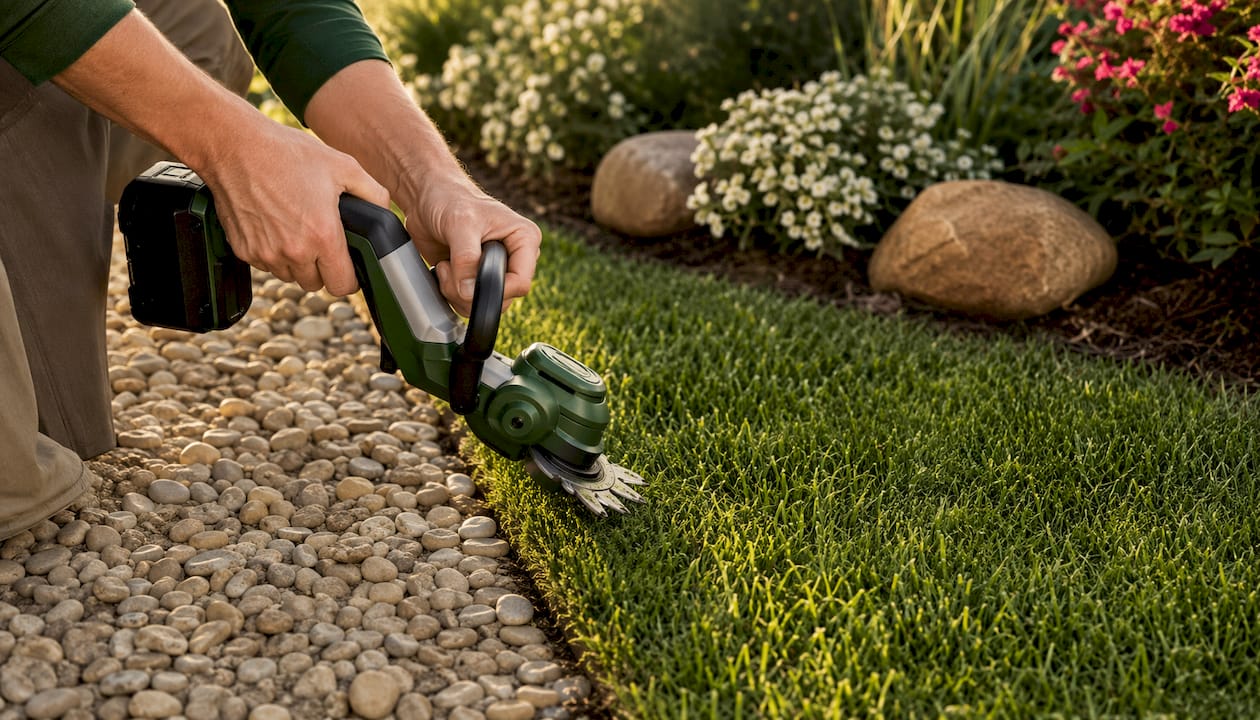
Power tools are faster on long straight runs; manual tools give superior control for flowing curves. For most Calgary residential lots, a powered stick edger handles the driveway and sidewalk runs, while a half-moon or manual edger handles the bed borders where precision matters more than speed.
A dedicated stick or manual edger consistently produces a crisper result than a string trimmer used as a primary edging tool. Reserve the trimmer for spots the edger blade cannot reach, such as around gate posts or curved garden ornaments.
After every use, clean the blade or trimmer head with a stiff brush. Dried grass buildup seizes moving parts faster than most homeowners expect, and a seized edger mid-season is an expensive repair.
Pro Tip: A battery-powered string trimmer with a rotary scissor attachment is the fastest option for cleaning up sidewalk edges without throwing debris across the driveway. It is also quieter than a gas-powered stick edger, which matters in Calgary neighbourhoods with early-morning noise bylaws.
What does a good edge actually look like?
The professional standard drop is the vertical face between turf and bed that is deep enough to stop grass rhizomes from crossing into the bed, yet shallow enough that the lawn does not look excavated.
| Depth setting | Purpose | When to use |
|---|---|---|
| ~1.3 cm (½ in) | Cosmetic trim, surface overgrowth | Maintained edges, weekly touch-ups |
| ~5 cm (2 in) | Full sod removal, edge redefinition | Overgrown borders, annual reset |
| 7.5 cm (3 in) drop | Standard finished profile | All maintained residential edges |
Beyond depth, the shape of the edge affects how much work it creates every season:
- Straight edges suit formal gardens and hardscape borders; they are fast to cut but unforgiving if the line drifts.
- Broad, sweeping curves are easier to maintain long-term and give a natural look that suits most Calgary residential lots.
- Intricate shapes look striking in photos but multiply the time needed on every maintenance visit.
- Installed edging materials (steel, aluminium, stone, or composite) hold the profile between cuts and reduce how often you need to redefine the edge from scratch.
If you are planning a new bed layout, keep the shapes simple. The maintenance savings over a few seasons outweigh any short-term design appeal of complex curves.
When should you edge in Calgary?
Calgary’s growing season runs roughly from late April through October, with peak grass growth in June and July. Edging is performed throughout spring, summer, and autumn; during peak growth it can be as frequent as once per week.
A practical schedule for most Calgary properties:
- Spring (late April to May): Redefine edges after the ground thaws. This is the most labour-intensive session of the year, often requiring a full sod-removal cut to reset the winter profile.
- Summer (June to August): Edge every 1–3 mows during active growth. Irrigated lawns and fescue-heavy mixes grow faster and need the shorter interval.
- Autumn (September to October): Taper to monthly as growth slows. A clean autumn edge reduces the spring workload considerably.
- Winter: Avoid edging on frozen or saturated ground. If a mild spell permits light work, redefining edges in quieter months can reduce the spring catch-up effort.
Grass species, irrigation frequency, and how heavily the property is used all shift the schedule. A Kentucky bluegrass lawn on a drip-irrigated lot will need more frequent attention than a drought-tolerant fescue blend on a low-water property. For seasonal planning tied to Calgary’s specific growth cycles, a recurring professional schedule removes the guesswork entirely.
Safety and PPE for powered edging
Powered edgers and string trimmers can project rocks, sticks, and hardened soil at high velocity. This is not a theoretical risk. Safety glasses and closed-toe footwear are the minimum for anyone operating powered equipment near a lawn edge.
A complete PPE checklist for powered edging:
- Safety glasses or a face shield
- Closed-toe, sturdy footwear (steel-toe boots are preferable)
- Work gloves
- Long trousers
- Hearing protection when using gas-powered equipment for extended periods
Before starting, clear the edge zone of loose stones, wire, or any object the blade could catch. Mark or confirm the location of buried utility lines. A reputable Calgary pro will ask about buried services before the first cut, and their workers’ compensation and liability insurance should be current. Ask to see both before booking.
DIY edging vs. hiring a Calgary professional
DIY edging works well for small, straightforward properties where the homeowner has time, a decent tool, and a consistent schedule. It breaks down when any of those three conditions is missing.
- Time: A full-perimeter edge on a typical Calgary lot takes between three quarters of an hour and an hour and a half, not counting cleanup, with multiple visits required per season.
- Equipment: A quality powered stick edger costs $150–$400 to buy, plus storage space and annual maintenance.
- Consistency: Edges that are skipped for two or three mowing cycles require a full redefinition cut, which takes significantly longer than a routine trim.
Hiring a professional makes the most sense when:
- The property has long bed borders, complex shapes, or multiple hardscape transitions
- The owner or manager cannot commit to a consistent schedule
- Safety around powered equipment is a concern
- The property is managed remotely or as part of a portfolio
Professional services provide commercial-grade equipment, regular schedules, and eliminate the homeowner’s need to buy, store, and maintain tools — a real advantage for property managers handling multiple sites. Yearlong brings commercial equipment, a fixed schedule, and a satisfaction guarantee to every visit, so the edge stays consistent from one mow to the next.
Pro Tip: Before hiring anyone, check the complete lawn maintenance checklist to confirm what a full-service visit should include. It is a useful benchmark when comparing quotes.
What does a professional edging visit include?
A well-run professional visit follows a clear sequence. Here is what to expect and insist on:
- Site inspection: The crew walks the perimeter, notes any buried hazards, and confirms the edge style and depth with the client.
- Edging: Perimeter edges (driveway, sidewalk, street) and bed borders are cut to the agreed depth and profile.
- Debris removal: Cut sod and clippings are collected and removed or blown back onto the turf.
- Blow-down and clean: Hard surfaces are cleared of clippings and soil.
- Client walkthrough: A brief check with the homeowner or property manager before leaving.
Time estimates vary by property. A standard front-yard edge takes 20–30 minutes. A full lot with multiple bed borders runs 60–90 minutes. Bed-heavy properties with intricate shapes can take longer, which is why complex layouts cost more per visit.
Most professional providers, including Yearlong, offer recurring packages where edging is bundled with mowing and bed maintenance, reducing the per-visit cost and keeping the schedule automatic.
How to choose a Calgary lawn maintenance provider
Not every quote is equal. Here is how to vet a provider before signing anything:
- Confirm they carry liability insurance and WCB coverage for their workers.
- Ask for local references, specifically from Calgary properties similar to yours.
- Request a written list of what each visit includes (edging, cleanup, blow-down, debris removal).
- Ask how they handle scheduling changes due to weather or access issues.
- Confirm their satisfaction guarantee: what happens if the result is not up to standard?
Questions worth asking on a quote call:
- What depth do you cut to, and do you adjust for overgrown edges?
- Do you remove cut sod, or leave it on-site?
- What PPE and safety procedures do your crews follow?
- Are there extra charges for first-visit edge redefinition?
- How do you handle buried utility lines?
Red flags: no proof of insurance, vague answers about cleanup, unusually low bids with no written scope, and no mention of safety procedures. A provider who cannot describe their PPE protocol has not thought carefully about the job.
What drives the cost of professional edging in Calgary?
Pricing varies, but the main factors are consistent across providers:
- Edge length and complexity: More linear metres and more bed transitions mean more time.
- First-visit condition: An overgrown edge requires a full redefinition cut, which takes longer than a routine trim.
- Bed material: Removing and replacing mulch around bed edges adds time and cost.
- Access: Gated properties, narrow side yards, or equipment-restricted areas increase labour.
- Visit frequency: Recurring packages cost less per visit than one-off bookings.
Edging is typically quoted as part of a mowing or bed maintenance package, or as a per-visit flat rate. When requesting a quote, have this information ready:
- Property address and approximate lot size
- Number and approximate length of bed borders
- Current edge condition (maintained, overgrown, or never defined)
- Preferred visit frequency
- Any access restrictions or buried service concerns
Key takeaways
Clean, consistent edging starts with the right sequence: edge before mowing, hold the standard 7.5 cm (3 in) drop, and schedule visits through spring, summer, and autumn to keep the profile sharp all season.
| Point | Details |
|---|---|
| Edge before mowing | Edging first sets the perimeter so the mower cleans up cut debris in one pass. |
| Standard drop is 7.5 cm (3 in) | This depth stops grass from creeping into beds and retains mulch effectively. |
| Schedule spring through autumn | Peak growth in Calgary may require more frequent edging during periods of active growth in summer. |
| Hire a pro for complex properties | Large lots, multiple bed borders, or remote management make professional scheduling the practical choice. |
| Yearlong for Calgary edging | Yearlong offers scheduled edging visits across Calgary, with commercial equipment and a satisfaction guarantee. |
The edge most people overlook
Most lawn care advice focuses on mowing height and fertiliser timing. Edging gets treated as a finishing touch, something you do when you feel like it. That framing is backwards.
The edge is the frame. A sharp, consistent edge makes a mediocre lawn look maintained and a well-kept lawn look genuinely cared for. Conversely, a ragged edge undermines everything else. You can mow at the perfect height, water on a precise schedule, and overseed every autumn, but if the border between turf and bed looks like it was cut with a butter knife, the whole property reads as neglected.
What most guides also miss is the compounding effect. An edge maintained weekly during peak growth takes ten minutes. An edge left for three weeks takes forty. Left for a full season, it requires a full redefinition cut with a half-moon edger or a spade, which is a different job entirely. The cost of inconsistency is not linear.
For Calgary properties specifically, the spring redefinition cut is the one that sets the tone for the entire season. Get that one right, keep up with it through summer, and the autumn taper is easy. Skip it, and you are playing catch-up until the first frost.
Yearlong keeps Calgary edges sharp, season after season
Sharp edges on a Calgary property are not a one-time project. They are a recurring commitment, and the gap between a maintained edge and an overgrown one opens up faster than most homeowners expect. Yearlong handles that commitment for you: commercial-grade equipment, a fixed schedule through the growing season, and a satisfaction guarantee on every visit.

Yearlong’s bed and edge maintenance service covers perimeter edging, bed borders, debris removal, and blow-down as part of recurring packages that can be bundled with mowing and spring and fall cleanups. No equipment to buy, no schedule to track, and no catch-up cuts after a missed week.
To request an on-site quote, have your property address, approximate lot size, number of bed borders, and current edge condition ready. Yearlong serves the entire Calgary area and will confirm availability and pricing after a quick site assessment. Get in touch at yearlong.ca to book your quote.
Useful sources
- How to create a lawn edge (Royal Horticultural Society) — edge depth standard (7.5 cm / 3 in drop) and design guidance on sweeping curves vs. intricate shapes
- How to maintain lawn edges (Royal Horticultural Society) — annual redefinition timing and wet-ground compaction advice
- How to edge a lawn in 10 easy steps (The Spruce) — step sequence, tool choice, depth settings, PPE requirements, and frequency guidance
- How to edge a lawn (This Old House) — professional workflow context and the case for commercial equipment
- How to edge a lawn (Lowe’s) — power vs. manual tool tradeoffs
- How to edge a lawn (Scotts Miracle-Gro) — tool maintenance and post-use cleaning guidance
- Yearlong bed and edge maintenance, Calgary — Yearlong’s service page for bed maintenance and edging packages
One Response