

TL;DR:
- Property management companies act as fiduciary agents, handling tenant relations, maintenance, and legal compliance for owners. They provide financial reporting and risk mitigation, enabling portfolio growth and local market knowledge. Fees are typically 8-10% of rent plus additional charges, justified for portfolios of four to five units or more.
Property management companies are defined as fiduciary agents who manage real estate on behalf of owners, handling tenant relations, maintenance coordination, rent collection, and financial reporting. The role of property management companies extends well beyond basic upkeep. These firms carry legal obligations of loyalty and care to property owners, a standard that places them above typical service contractors. The U.S. property management industry is projected to reach $123.502 billion in revenue in 2025, with residential management accounting for 84.6% of that activity. That scale reflects how central professional management has become for homeowners, investors, and businesses seeking reliable, hands-off property operations.
What are the key functions of property management companies?
Property management companies handle every operational layer between a property owner and a functioning rental. Their core functions fall into five distinct areas, each requiring consistent attention and professional judgement.
Tenant screening and placement. A property manager advertises vacancies, reviews applications, runs credit and background checks, and selects qualified tenants. Effective screening is the single most important function a manager performs. Poor tenant selection can lead to eviction costs ranging from $5,000 to $20,000 when lost rent, legal fees, and property damage are combined.
Rent collection and enforcement. Managers set collection schedules, issue notices for late payments, and enforce lease terms consistently. Consistent enforcement protects cash flow and removes the awkward dynamic that often develops when owners manage tenants directly.
Maintenance coordination and vendor management. Property managers receive maintenance requests, triage urgency, dispatch vetted contractors, and follow up on completed work. They typically maintain a network of preferred vendors, which speeds response times and keeps repair costs predictable.
Financial administration. Managers produce monthly income and expense statements, manage security deposits, and prepare year-end summaries for tax purposes. Owners receive a clear financial picture without needing to track individual transactions themselves.
Legal compliance. Residential tenancy legislation, building codes, and fair housing rules change regularly. Property managers track these updates and apply them to lease agreements, notices, and property standards, reducing an owner’s exposure to costly disputes.
Pro Tip: Ask any prospective property manager for a sample monthly report before signing a contract. A well-structured report shows how they track income, expenses, and maintenance, and tells you immediately whether their systems are worth trusting.
How do property management companies benefit homeowners and investors?

Professional property management delivers three categories of benefit: time recovery, risk reduction, and portfolio scalability.
Time recovery is the most immediate gain. Self-managing a property typically takes around five hours per month under normal conditions. That number rises sharply during vacancies, disputes, or major repairs. For investors whose time carries a high hourly value, paying a management fee costs less than the time they would otherwise spend.
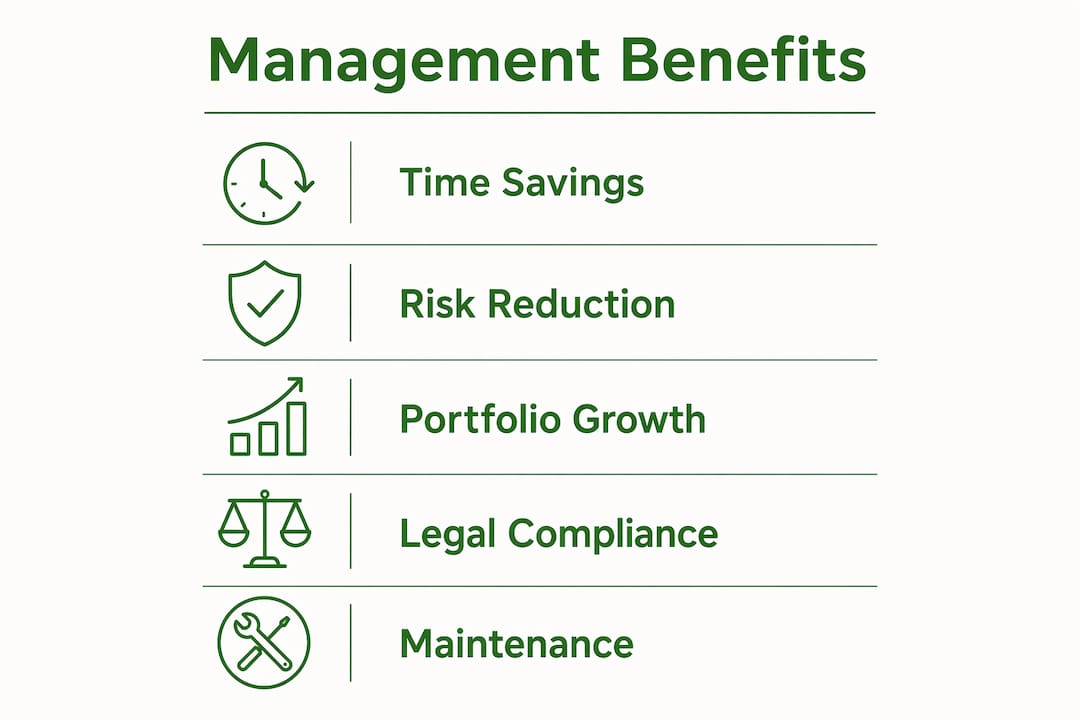
Risk reduction comes primarily through tenant screening and legal compliance. Eviction proceedings are expensive and disruptive. A manager who screens rigorously and enforces leases consistently prevents most eviction scenarios before they start. Owners also avoid personal liability exposure from non-compliant lease terms or missed safety inspections.
Portfolio scalability is the benefit that matters most to serious investors. Professional management creates standardised systems that let owners add properties without adding proportional workload. An investor managing ten units through a professional firm carries roughly the same personal time burden as one managing two units alone.
Key benefits at a glance:
- Reduced vacancy periods through professional marketing and faster tenant placement
- Lower maintenance costs through preventive scheduling and preferred vendor pricing
- Consistent rent collection with documented enforcement procedures
- Legal protection through up-to-date lease agreements and compliance monitoring
- Freedom to invest in out-of-area markets without needing local presence
The importance of preventive maintenance within a managed property cannot be overstated. Catching small issues early prevents the large repair bills that erode returns.
What are typical fee structures for property management services?
Property management fees follow a predictable structure, though the details vary by firm and property type.
The standard monthly management fee runs between 8% and 10% of collected rent. On a $2,000 per month rental, that translates to $160–$200 monthly. This fee covers day-to-day management, rent collection, and routine communication.
Beyond the monthly fee, owners should expect additional charges:
| Fee type | Typical range | What it covers |
|---|---|---|
| Leasing fee | 50–100% of one month’s rent | Advertising, screening, and placing a new tenant |
| Maintenance markup | 10–20% of repair invoice | Coordinating and supervising contractor work |
| Lease renewal fee | $150–$300 | Preparing and executing a renewed lease agreement |
| Eviction coordination | $200–$500 | Managing the legal and logistical eviction process |
These additional fees are standard across the industry. Owners who compare firms on monthly percentage alone often miss the true cost picture. A firm charging 8% with a 100% leasing fee can cost more annually than one charging 10% with a 50% leasing fee, depending on tenant turnover.
The financial break-even point for hiring a property manager typically falls at 4–5 units. Below that threshold, self-management may be more cost-effective for owners with available time. Above it, professional management almost always produces a net financial benefit when opportunity costs are included.
How do property management services differ by property type?
The functions of property management shift meaningfully depending on whether the asset is residential, commercial, or a community association.
Residential properties
Residential management centres on tenant relations and physical upkeep. Managers handle lease renewals, maintenance requests, and tenant communications on a frequent, often weekly, basis. Regulatory compliance focuses on residential tenancy legislation, which varies by province. The tenant relationship is personal and requires consistent, respectful communication to reduce turnover.
Commercial properties
Commercial management adds a layer of financial complexity. Managers handle common area maintenance (CAM) reconciliation, where tenants pay a proportional share of shared operating costs. Lease compliance in commercial settings involves more negotiated terms, longer lease durations, and more significant tenant improvement obligations. Managers must understand both the physical asset and the business operations of their tenants.
HOA and community association management
Association management serves a board of directors rather than a single owner. Managers enforce community rules, coordinate common area maintenance, prepare budgets for board approval, and communicate with residents. This role requires strong governance skills alongside operational ones. HOA maintenance programmes often include pest control, landscaping, and seasonal services as part of a standardised community upkeep plan.
How can property management companies help owners scale their portfolios?
Scaling a property portfolio without professional management creates a ceiling. Owners who self-manage hit a practical limit, usually around three to five units, where the operational load prevents them from evaluating new acquisitions or managing existing assets well.
Professional management removes that ceiling by standardising operations. Managers use property management software to track leases, maintenance histories, and financial performance across multiple units simultaneously. Owners receive consolidated reporting rather than unit-by-unit tracking. That visibility supports better acquisition decisions and clearer performance benchmarking.
Out-of-area investing becomes viable with professional management in place. An investor based in Calgary can own rental properties in Edmonton or Kelowna without needing to travel for inspections, repairs, or tenant issues. The manager acts as the local presence. Understanding how maintenance affects property value is central to this model. A manager who schedules preventive maintenance consistently protects asset value across a geographically spread portfolio.
Hybrid management strategies are also common. Investors sometimes self-manage straightforward local properties while using professional managers for complex, remote, or high-value assets. This approach balances cost control with operational capacity.
Pro Tip: Before hiring a manager to scale your portfolio, ask for references from owners with five or more units. Managing scale requires different systems than managing a single property, and not every firm handles both equally well.
For multi-unit properties, pest prevention is part of responsible maintenance. Multi-unit pest management integrated into a property’s maintenance schedule prevents infestations that can damage structures and trigger tenant complaints across an entire building.
Key takeaways
Property management companies function as fiduciary agents who protect owner investments through tenant screening, legal compliance, financial reporting, and preventive maintenance across residential, commercial, and association properties.
| Point | Details |
|---|---|
| Fiduciary standard | Property managers hold legal obligations of loyalty and care, not just service delivery. |
| Fee structure clarity | Monthly fees of 8–10% are only part of the cost; leasing and maintenance fees add significantly. |
| Break-even at 4–5 units | Professional management becomes financially justified for most investors at this portfolio size. |
| Risk mitigation through screening | Thorough tenant screening avoids eviction costs of $5,000–$20,000 per incident. |
| Scalability through systems | Standardised management software and vendor networks allow portfolio growth without proportional owner workload. |
What I’ve learned from watching owners choose the wrong property manager
The most common mistake I see property owners make is selecting a manager based on the lowest monthly percentage. That number is almost meaningless without understanding the full fee schedule, the manager’s vendor relationships, and how they handle vacancies. A firm charging 8% that marks up every repair invoice by 20% and charges a full month’s rent for each new lease can easily cost more than a firm charging 10% with transparent, flat fees.
The second mistake is undervaluing local knowledge. Property management is deeply local. A manager who knows the rental market in a specific neighbourhood, understands local bylaws, and has relationships with reliable local contractors will outperform a larger firm with generic systems every time. Technology matters, but it does not replace knowing that a particular building inspector is strict about a specific code, or that a certain street has higher tenant turnover than the surrounding area.
The third thing I would tell any investor is to treat the management agreement like a business contract, not a service subscription. Read the termination clauses carefully. Understand what happens to your tenant relationships and maintenance records if you switch firms. A good manager will not hide these details. A poor one will.
Technology is changing the role faster than most owners realise. Real-time owner portals, digital lease signing, and automated maintenance tracking are now standard expectations, not premium features. If a firm cannot show you a live dashboard of your property’s financial performance, that is a red flag worth taking seriously.
— Lewie
Yearlong keeps your property’s outdoor condition working for you

A property manager handles the tenant side of your investment. The outdoor condition of your property is what tenants, buyers, and neighbours see first. Yearlong has served Calgary property owners since 2017, providing year-round outdoor maintenance that protects curb appeal and property value through every season. From lawn and bed maintenance that keeps grounds looking sharp through summer, to professional lawn care and yard cleanup that prepares properties for seasonal transitions, Yearlong’s services complement what any property management arrangement requires. Calgary’s climate demands consistent, knowledgeable outdoor care. Yearlong delivers it with flexible packages, a satisfaction guarantee, and the local expertise that makes a real difference to how your property presents.
FAQ
What is the role of property management companies?
Property management companies act as fiduciary agents for property owners, managing tenant relations, rent collection, maintenance, financial reporting, and legal compliance on the owner’s behalf.
What do property managers typically charge?
Most property managers charge a monthly fee of 8–10% of collected rent, plus a leasing fee for placing new tenants and additional charges for maintenance coordination, lease renewals, and eviction handling.
At what point does hiring a property manager make financial sense?
The break-even point for professional management typically falls at 4–5 rental units. Below that threshold, self-management may cost less; above it, professional management usually delivers a net financial benefit when owner time is factored in.
How does property management differ for commercial versus residential properties?
Residential management focuses on tenant relations and physical upkeep under tenancy legislation. Commercial management adds CAM reconciliation, longer and more complex lease terms, and a closer relationship with tenants’ business operations.
Can property management companies help investors buy in other cities?
Professional management makes out-of-area investing practical by providing local presence, vendor networks, and consolidated reporting. Investors can own properties in distant markets without travelling for routine operations or repairs.