

TL;DR:
- Effective snow management in Calgary involves proactive and comprehensive planning to ensure safety, accessibility, and compliance with legal requirements. Proper procedures include timely clearing, applying de-icers, documenting activities, and prioritizing all pathways, including narrow and less obvious routes. Building a reliable, accessible snow management plan helps prevent fines, liability issues, and community dissatisfaction while maintaining property value and neighborhood reputation.
Most Calgary homeowners think snow management means grabbing a shovel after a storm. In reality, it’s a legal obligation, an accessibility duty, and a practical system that keeps your property safe, functional, and free from costly fines all winter long. Snow and ice removal is framed as a human rights issue, with clear duties for timely clearing of walkways that affect seniors, people with disabilities, and anyone navigating your property on foot. This guide will walk you through what snow management actually covers, why it matters far more than most people realise, and how to get it right every single time.
Table of Contents
- What is snow management? The essentials for Calgary homes
- Why snow management matters: More than just safety
- Key elements of a complete snow management plan
- Best practices: Snow management in action
- Expert perspective: Why snow management must evolve
- Get reliable snow management for your Calgary property
- Frequently asked questions
Key Takeaways
| Point | Details |
|---|---|
| Snow management defined | Snow management means consistently clearing and treating all access routes, not just shovelling a driveway. |
| Accessibility focus | Keeping pathways barrier-free supports everyone, especially people with disabilities, and avoids fines. |
| Plan for reliability | A detailed plan ensures snow is cleared quickly and safely, whether you do it yourself or hire pros. |
| Legal responsibilities | Calgary property owners must clear snow from walkways within 48 hours to stay compliant and reduce risk. |
What is snow management? The essentials for Calgary homes
Snow management is not a single task. It’s a planned, ongoing approach to preventing dangerous ice build-up and keeping every pedestrian and vehicle route on your property safe and accessible throughout winter. Think of it less like a chore and more like a system with scheduled tasks, assigned responsibilities, and legal requirements attached.
Where shovelling is reactive, snow management is proactive. You’re not just clearing what’s there now; you’re monitoring weather forecasts, applying de-icers before ice forms, checking narrow side routes and rear access points, and documenting your work in case a claim or complaint ever arises. It also means ensuring that ramps, transit-access points, and routes used by people with mobility aids stay clear even when those areas seem less obvious.
Key responsibilities for Calgary property owners include:
- Clearing main entrances, walkways, and driveways after every snowfall
- Keeping adjacent public sidewalks clear of snow and ice
- Treating surfaces with sand or non-corrosive de-icers to prevent re-freezing
- Ensuring accessibility ramps and side entrances are never blocked
- Avoiding the deposit of cleared snow onto walkways or public spaces
According to industry snow removal standards, municipalities, businesses, contractors, and homeowners are required to clear pedestrian pathways of snow and ice within 48 hours following significant snowfall. Miss that window and you’re not just negligent in the eyes of your neighbours; you may be liable for injuries and fines from the City of Calgary.
“Snow management is not about what’s convenient for your schedule. It’s about whether your neighbour with a walker can get to the bus stop safely.”
Pro Tip: Don’t overlook small side gates, utility entrances, and the narrow path between your car and your fence. These tight spaces collect ice fast and are frequently missed during routine clearing. A single patch of uncleared ice in a narrow walkway can cause a serious fall.
Why snow management matters: More than just safety
Now that the essentials are clear, let’s tackle why snow management truly matters and what can go wrong if it’s overlooked.
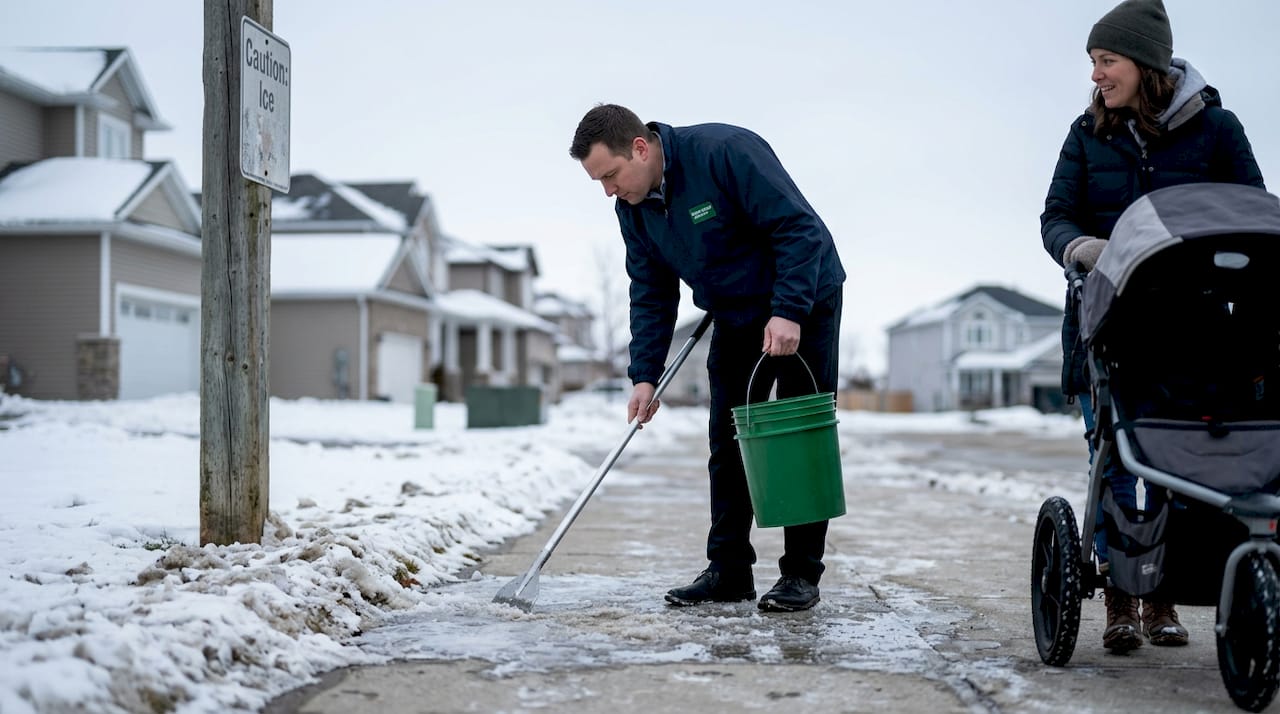
Snow clearing is directly framed as an accessibility and mobility issue, which means when you leave ice on your sidewalk for four days, you’re not just being careless; you may be creating a barrier that prevents someone from leaving their home at all. People who use canes, walkers, wheelchairs, or who are pushing strollers cannot navigate even a modest patch of packed snow. The impact is real and immediate.
Here’s a comparison of what timely versus late snow management actually produces:
| Factor | Timely snow management | Delayed or absent clearing |
|---|---|---|
| Legal standing | Compliant, low fine risk | Potential City of Calgary fines |
| Liability | Protected in case of injury | Exposed to personal injury claims |
| Accessibility | Usable by everyone | Barriers for mobility-impaired people |
| Surface condition | Clear, treated, safe | Packed ice, uneven, dangerous |
| Property value | Enhanced curb appeal | Negative impression, potential damage |
| Neighbour relations | Positive community standing | Complaints, tension |
The legal consequences are not theoretical. Calgary’s municipal bylaws allow for fines when property owners fail to clear sidewalks within the required window. Beyond that, if someone slips and is injured on your uncleared walkway, you could face a personal injury claim that your home insurance may not fully cover.
There are also long-term surface damage concerns that don’t get enough attention. When packed snow and ice go unmanaged, water repeatedly freezes and thaws inside the pores of concrete and asphalt. This process is called freeze-thaw cycling, and it gradually cracks and degrades your driveway and walkway surfaces. Effective why snow hauling matters coverage explains how removing snow bulk rather than just ploughing it to the side also protects your surfaces over time.
The steps to preventing these consequences are straightforward:
- Monitor forecasts and act before heavy accumulation begins
- Clear snow within 24 hours of a storm where possible, and always within the 48-hour legal window
- Apply sand or de-icer to prevent ice re-forming after clearing
- Inspect all pedestrian routes the following morning for overnight freezing
- Document your clearing activities with timestamps and photos
Pro Tip: Timely snow management means fewer emergency calls to your tenants, fewer complaints filed with the city, and fewer awkward conversations with neighbours. Consistency is your best protection. Review these safer winter snow removal strategies to build better habits before the season ramps up.
Key elements of a complete snow management plan
With the rationale established, readers need to know exactly what a snow management plan should cover. A solid plan does not have to be complicated, but it does have to be complete.
Contractually, snow management covers all pedestrian access routes, with special attention to accessibility outcomes. That’s the standard you should hold yourself and any contractor to.
A well-structured snow management plan includes:
- Assigned responsibility: Know who is clearing what, whether that’s you, a hired crew, or a shared arrangement with your strata or HOA
- Monitoring protocol: Set up weather alerts so you’re never caught off guard by overnight snowfall
- Legal deadline awareness: Know your 48-hour window and build in buffer time for heavy or multi-day storms
- Resident or occupant communication: If you manage a rental property, notify tenants about clearing schedules and who to contact if conditions become unsafe
- Equipment accessibility: Keep shovels, de-icers, and traction materials stored somewhere accessible so you’re not digging through a garage in the dark at 6am
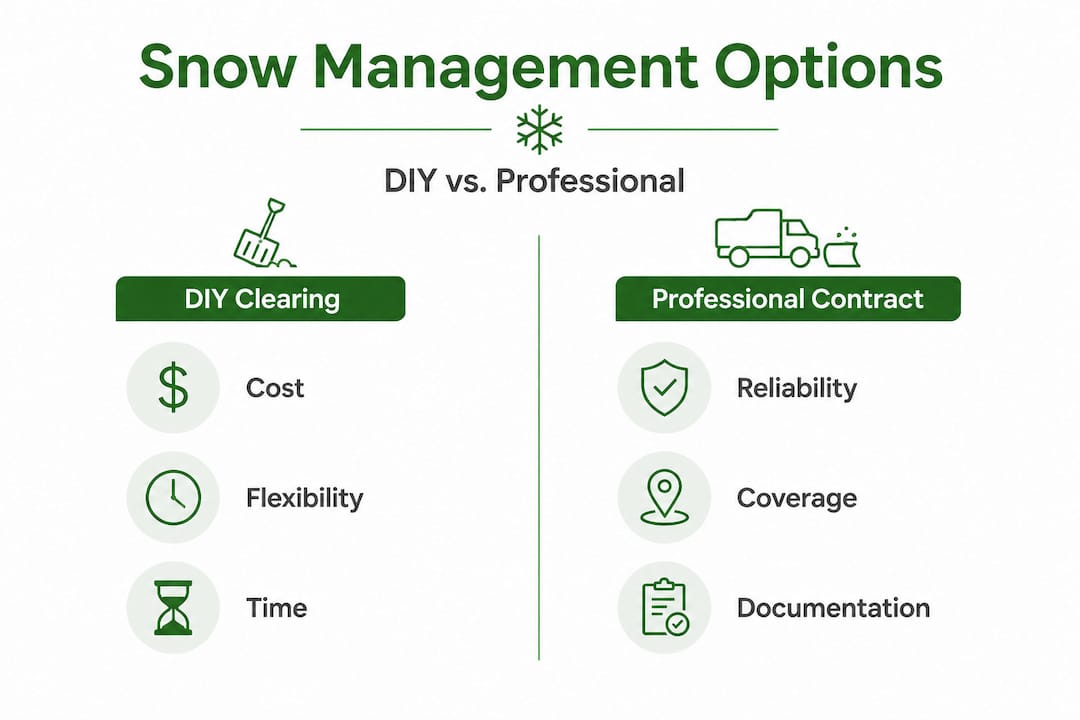
Here’s a practical comparison for homeowners deciding between DIY and professional snow management:
| Feature | DIY clearing | Professional contract |
|---|---|---|
| Cost | Equipment + time investment | Set monthly or per-visit fee |
| Reliability | Depends on your availability | Service guaranteed per contract |
| Coverage | What you have time for | Full property route coverage |
| Documentation | Self-managed | Often provided by service provider |
| Legal compliance | Your responsibility to track | Provider tracks on your behalf |
| Equipment | Limited to what you own | Commercial-grade tools and materials |
For properties with multiple access points, stairways, or shared pathways, a professional contract is frequently the most reliable and cost-effective choice when you factor in your time, physical effort, and liability exposure. Review the snow removal workflow guide for a detailed operational breakdown of how professional teams approach each clearing visit.
Accessibility should also be understood as a community standard, not just a legal checkbox. When seniors, parents with young children, and people with disabilities can safely navigate your property, you’re contributing to a healthier, more inclusive neighbourhood. That reputation has genuine long-term value. Understanding plowing basics for Calgary properties will also help you ask better questions when evaluating service providers.
Pro Tip: Document all snow clearing activities. Take timestamped photos after each clearing, keep receipts for materials and services, and maintain a simple log with dates and conditions. If a claim ever arises, this documentation could save you thousands.
Best practices: Snow management in action
It’s one thing to know what should be done. Now, see how to put it into practice and avoid the missteps that disrupt real Calgary winter management.
Effective snow management follows a repeatable process. Here are the steps that professional crews and diligent homeowners use throughout the season:
- Assess the conditions before you start. Note the snow depth, temperature, and whether ice has formed underneath. This tells you which tools and materials you need.
- Clear the snow from all primary and secondary routes, working from high-traffic areas outward. Remove snow to a designated pile area, not back onto cleared surfaces.
- Apply de-icer or sand immediately after clearing to prevent re-freezing, especially on steps, ramps, and shaded walkways.
- Inspect the area once materials have had time to work. Look for missed patches, re-icing spots, and any drainage issues that might cause new hazards.
- Repeat as needed during multi-day storms. A single clearing on day one is not sufficient if snow continues to fall.
A critical rule that is often violated: do not deposit snow back onto cleared sidewalks or walkways. It sounds obvious, but it happens regularly when snow is ploughed from driveways across adjacent sidewalks. That deposited snow compacts overnight into ice and creates exactly the barrier you were trying to prevent.
Pro Tip: Use non-corrosive de-icers wherever possible, particularly near concrete edges, garden beds, and lawn borders. Standard rock salt is effective but will damage concrete surfaces over time and kill nearby grass and plants. Calcium magnesium acetate or sand-based products protect your property while still providing traction.
Don’t pile snow near accessibility ramps, fire hydrants, or transit stops. These are protected access points and blocking them can result in complaints or fines. If you’re managing a larger property, consider the snow removal equipment options that allow for efficient snow relocation rather than piling.
For heavy snowfalls exceeding 20 cm or during back-to-back storms, don’t hesitate to engage a professional. The physical strain of extended clearing is a real injury risk, and the volume of snow may exceed what standard residential equipment can handle. Check out available outdoor cleaning services and residential care tips to round out your winter property care approach.
Expert perspective: Why snow management must evolve
We’ve been working with Calgary homeowners and property managers since 2017, and one pattern keeps repeating itself. Most people treat snow management as reactive maintenance rather than a proactive responsibility. They wait for complaints, scramble after major storms, and consider the job done once the driveway is clear. That mindset is outdated and, frankly, risky.
From our experience, the property owners and managers who avoid fines, claims, and community friction are the ones who do three specific things differently. They pay attention to small entryways that seem unimportant but create genuine hazards. They schedule routine checks during multi-day cold snaps, not just after snowfall. And they build fast-response protocols so that when conditions deteriorate overnight, someone is clearing by early morning rather than midday.
Most contracts and operational standards still underplay accessibility details, and that has to change. We hear from property managers who proudly say their parking lot is always cleared, yet the narrow path to the mail kiosk or the rear entrance used by suite-level tenants is left for days. That selective approach misses the point entirely.
Snow management that genuinely serves your community protects residential property value and builds the kind of neighbourhood reputation that matters to tenants, buyers, and your own peace of mind. When you’re known as the property that’s always clear and accessible, that means something.
“Accessibility is an outcome, not just a checkbox for compliance. The question isn’t whether you cleared enough to avoid a fine. It’s whether everyone can safely use your property today.”
Get reliable snow management for your Calgary property
If reading this has made you realise your current approach has gaps, you’re already ahead of most property owners in Calgary.

YearLong Property Maintenance has been serving the Calgary area since 2017 with snow removal services built around reliability, accessibility, and real local knowledge. We know Calgary winters because we work through them every season alongside our clients. Whether you need a one-time assessment or a full seasonal contract, we can help you build a plan that keeps your property compliant, accessible, and safe. Review our Calgary snow removal tips and explore our complete range of services including bed maintenance and seasonal care. Reach out today for a free property assessment and take the guesswork out of winter.
Frequently asked questions
What does a snow management contract cover?
A typical Calgary snow management contract covers all pedestrian and vehicle routes, including walkways, entrances, adjacent sidewalks, and compliance with local clearing deadlines to ensure full accessibility.
Who is responsible for clearing snow on public sidewalks in Calgary?
Property owners are responsible for timely removal of snow and ice from sidewalks next to their property, and must clear pedestrian pathways within 48 hours of significant snowfall.
What happens if you re-deposit snow on the sidewalk?
Re-depositing snow on cleared sidewalks creates accessibility barriers and obstruction is not permitted, potentially resulting in complaints and municipal fines.
Is snow management just for businesses or also for homes?
All properties, both homes and businesses, are responsible for snow management in Calgary, as homeowners have a duty to keep pedestrian pathways clear and safe throughout the winter season.