

Hire a single full-service partner that bundles routine mowing, seasonal cleanups, bed maintenance, and winter services, then issue a short RFP with a mandatory site visit. That single decision eliminates the coordination headaches that come from splitting grounds work across two or three vendors. For Calgary-area associations, Yearlong Property Maintenance offers exactly this kind of bundled, year-round package. Request a proposal from them directly, or use the workflow below to run a competitive tender.
Table of Contents
- What lawn care services should your association require?
- How do associations budget for professional lawn maintenance?
- How to run an RFP for association lawn care services
- What should your association’s contract and SLA include?
- How to score and compare association lawn care proposals
- How Yearlong packages lawn care for Calgary associations
- Key takeaways
- What boards often get wrong about association lawn care
- Yearlong is ready to quote your association’s grounds
- Useful resources for Canadian associations
What lawn care services should your association require?
The scope of work is where most association contracts go wrong. Boards either write it too vaguely (“general maintenance”) or forget entire service categories, then spend the next season chasing credits and arguing over what was included.
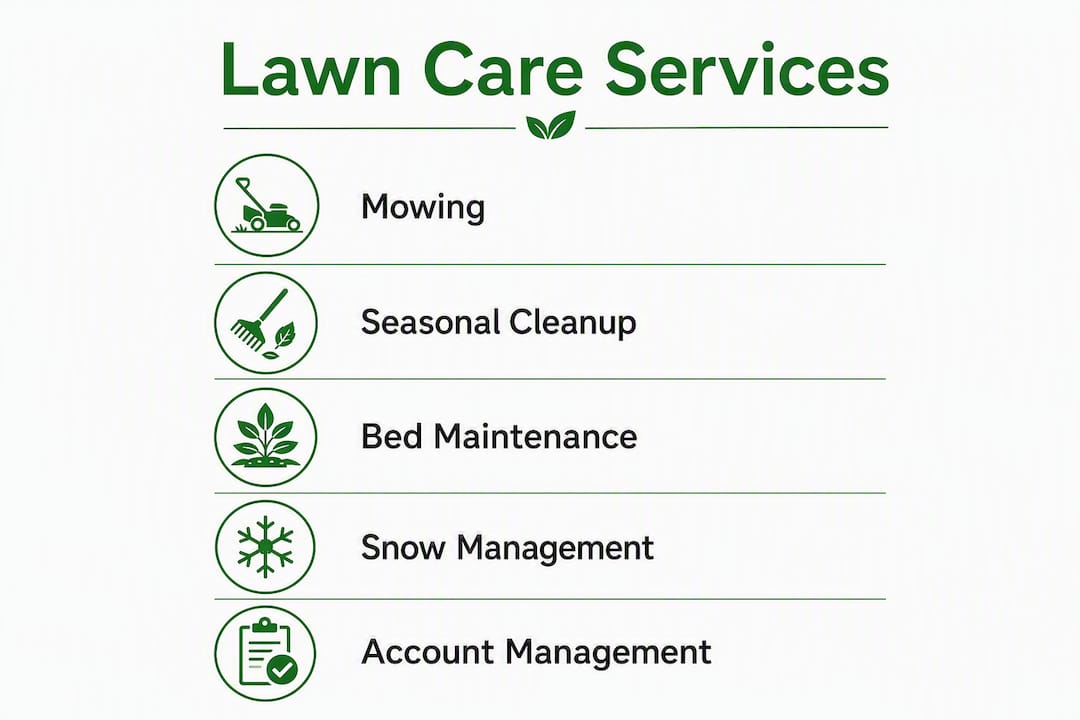
Standard community maintenance programmes cover mowing, edging, weed control, fertilization, irrigation monitoring, and seasonal debris removal. Build your scope around those core items, then layer in the seasonal and optional services your property actually needs.
Core recurring services to specify in your scope:
- Weekly or biweekly mowing, edging, and blowing of all common areas
- Turf fertilization on a scheduled programme (typically several applications per season)
- Weed control in turf and beds
- Bed maintenance: cultivating, edging, and top-dressing
- Spring and fall cleanups: leaf and debris removal, cutback of perennials
- Irrigation start-up and winterization
- Trash and debris removal after each visit
Seasonal and optional add-ons to price separately:
- Shrub and tree pruning, with a separate line for hazardous-branch inspections
- Pest and disease programmes
- Enhancement planting and mulch refresh
- Erosion control on slopes or drainage areas
- Snow and ice management for sidewalks, parking areas, and common roadways
In Canada, proactive snow and ice management is not optional. It is a liability issue. Slip-and-fall claims against associations are real, and a contractor without a site-specific winter plan leaves your board exposed. Require it in the base scope or as a mandatory priced option.
Bundling all of this with one vendor reduces coordination overhead and gives you a single accountable party when something is missed. It also protects property value more consistently than a patchwork of seasonal contractors who never see the full picture.
Pro Tip: Require a dedicated account manager in your contract, not just a general customer-service line. Also require digital service logs with photos after each visit. Digital reports and communication logs are what let you validate invoices and demonstrate completed work to residents at your next AGM.
How do associations budget for professional lawn maintenance?
There is no single published benchmark for Canadian association lawn care costs, because pricing varies significantly by property size, service frequency, and regional labour rates. What you can do is structure your budget request so bids are actually comparable.

The three pricing models you will see most often:
Per-cut billing charges a fixed rate per mowing visit. It is easy to audit but creates unpredictable annual totals when the season runs long or short.
Seasonal flat contracts bundle all recurring services into one annual fee, paid monthly or quarterly. Budgeting is straightforward, and the vendor absorbs the risk of a wet summer that requires extra cuts.
Hybrid pricing combines a seasonal flat rate for recurring maintenance with per-event pricing for enhancements, snow removal, or emergency work. This is the model most boards prefer because it keeps the base budget predictable while giving flexibility on discretionary items.
When building your annual budget estimate, add up: regular maintenance frequency multiplied by the per-cut rate (or the flat seasonal fee), plus line-item estimates for spring and fall cleanups, plus a separate budget line for snow and ice management. Ask bidders for multi-year rate guarantees on the recurring portion. A two-year rate lock on mowing and bed maintenance is a reasonable ask and protects your reserve fund projections.
Red flags in pricing proposals:
- Missing line items for seasonal cleanups or snow and ice (they will be billed as extras later)
- Extremely low per-cut rates that exclude equipment, fuel surcharges, or insurance
- A single lump-sum bid with no itemization, making year-over-year comparisons impossible
Request line-item budgets for recurring work and separate one-line estimates for optional enhancements. That structure makes comparing three or four bids a straightforward spreadsheet exercise rather than a guessing game.
How to run an RFP for association lawn care services
A 6–10 week procurement timeline is realistic for most associations. Rushing it produces non-comparable bids. Dragging it out past ten weeks risks missing the spring season window.
Step-by-step RFP workflow:
- Draft the scope of work (Week 1–2): use the service list above as your starting point. Attach a site map with labelled zones, approximate square footage per zone, and any known problem areas (drainage, shade, slopes).
- Advertise the tender (Week 2–3): post to your association’s website, contact members through industry directories such as the Professional Lawn Care Association of Ontario (PLCAO) and Landscape Ontario, and send direct invitations to two or three known local providers.
- Mandatory site visits (Week 3–4): require all bidders to attend a scheduled walkthrough. Bidders who skip the site visit should be disqualified. A contractor who has not walked the property cannot price it accurately.
- Receive and clarify bids (Week 5–6): set a single point of contact for all bidder questions. Issue written answers to all bidders simultaneously so no one has an information advantage.
- Evaluate proposals (Week 7–8): score against the criteria in the evaluation matrix below.
- Award and execute contract (Week 9–10): notify the winning bidder, negotiate final SLA terms, and execute before the season start date.
What your RFP document must include:
- Site map with zone labels and approximate areas
- Service frequency requirements and accepted working hours
- Required insurance minimums (general liability, minimum $2 million is standard for commercial accounts in Alberta)
- WSIB clearance certificate or equivalent provincial workers’ compensation proof
- Three references from other associations or multi-unit properties
- A sample SLA with response-time windows and missed-service credit terms
- A pricing template with line items matching your scope (so bids land in the same format)
- Contract length options: 1, 2, and 3-year terms
Requiring consistent bid formats is the single biggest time-saver in evaluation. When every bidder fills in the same pricing template, scoring takes an afternoon instead of a week.

What should your association’s contract and SLA include?
A well-drafted contract protects both parties. A vague one protects neither. These are the clauses boards most often wish they had included after the first season.
Essential contract clauses:
- Detailed scope of work (no “general maintenance” language)
- Pricing schedule with payment terms and invoicing frequency
- Accepted working hours and noise restrictions (important for residential communities)
- Equipment and materials responsibility (who supplies fertilizer, ice melt, mulch)
- Confirmed general liability insurance and WSIB clearance, with certificates on file before work begins
- Indemnity clause protecting the association from contractor negligence
- Termination provisions: notice period (30–60 days is typical), cause-based termination, and what happens to pre-paid amounts
- Renewal terms and any rate-escalation caps
SLA elements to require:
- Response time for urgent issues (e.g., a hazardous branch or flooded pathway): 24 hours is a reasonable standard
- Crew arrival windows for scheduled visits
- Site cleanup standards after each visit
- Digital service logs with photos submitted within 24 hours of each visit
- Quarterly performance reviews with the account manager
Common red flags to walk away from:
- No WSIB proof or reluctance to provide it
- Scope described as “general maintenance” with no itemization
- Unlimited subcontracting without disclosure or approval
- No named account manager, only a call-centre number
Pro Tip: Include a missed-service credit clause: if a scheduled visit is skipped without notice, the association receives a credit equal to that visit’s prorated value. It creates the right incentive without requiring you to terminate the contract over a single missed cut.
How to score and compare association lawn care proposals
Use a scoring matrix so the evaluation is defensible to residents and consistent across board members. The table below is a starting point. Adjust weights to reflect your property’s priorities.
| Evaluation dimension | Weight | Score 1 (poor) | Score 3 (meets standard) | Score 5 (exceeds) |
|---|---|---|---|---|
| Scope completeness | — | Missing key services | All required services included | Proactive extras proposed |
| Pricing transparency | — | Lump sum, no itemization | Line-item bid matching template | Multi-year rate lock offered |
| Seasonal coverage (incl. snow & ice) | — | No winter services | Winter services priced separately | Integrated year-round plan |
| Communication & account management | — | No dedicated contact | Named account manager | Board meeting attendance offered |
| Insurance & WSIB compliance | — | Certificates not provided | Certificates on file | Proactive renewal tracking offered |
| Contract flexibility | 5% | 1-year only, no exit clause | 1–3 year options, standard exit | Flexible terms, rate-stability clause |
| References & local association experience | 5% | No references | Two references provided | Three references, similar property type |
Score each bidder on every dimension, multiply by the weight, and sum to a total out of 100. A bidder who scores below 3 on insurance and WSIB compliance should be disqualified regardless of total score.
Before awarding the contract, request from your top two finalists: proof of insurance (certificate naming the association as additional insured), current WSIB clearance, three association references you will actually call, and a short site-specific implementation plan showing how they will transition onto the property.
Providers who act as an extension of the board — proactively flagging irrigation leaks, hazardous branches, and drainage issues before residents complain — consistently score highest on account management and references. Weight that dimension accordingly if your board is tired of fielding resident calls.
How Yearlong packages lawn care for Calgary associations
Yearlong Property Maintenance has been serving the Calgary area since 2017, with a service mix that maps directly onto what association boards typically need in a single-vendor contract.
Yearlong’s core lawn care services include mowing, fertilization, edging, and bed maintenance. Layered on top are spring and fall seasonal cleanups, snow removal for sidewalks and common areas, and concrete cleaning and sealing for shared hardscape. That combination covers the full annual cycle without requiring the board to manage a second contractor for winter.
From a procurement standpoint, Yearlong offers multi-year contract options, which supports the reserve fund planning most boards need. The team is prepared to attend board meetings, which matters when you have a property with active residents who want to hear directly from the service provider. Digital service logs and photos are part of how Yearlong documents completed work, giving the board the paper trail needed to validate invoices and answer resident questions.
A typical association scope Yearlong delivers in Calgary includes: biweekly mowing and edging of common turf areas, four-application fertilization programme, spring and fall debris cleanups, bed maintenance with seasonal top-dressing, and snow clearing of walkways and parking areas after each significant snowfall event.
For boards running a competitive tender, Yearlong’s package is a useful benchmark for what a well-structured local bid should look like. Request a site visit and ask for a sample SLA alongside the multi-year quote.
Key takeaways
Associations that hire a single full-service partner, require WSIB compliance, and use a structured scoring matrix consistently get better value and fewer service gaps than those that split work across multiple vendors.
| Point | Details |
|---|---|
| Bundle your scope | Require mowing, beds, seasonal cleanups, and snow and ice management from one vendor to reduce coordination gaps. |
| Insist on compliance documents | Require WSIB clearance and general liability certificates before the first crew arrives on site. |
| Use a scoring matrix | Score all bids on the same seven dimensions so the evaluation is consistent and defensible to residents. |
| Prefer multi-year contracts | Ask for 1–3 year options with rate-stability clauses to protect reserve fund projections across seasons. |
| Require a dedicated account manager | Avoid vendors that offer only a general call-centre number; a named contact reduces resident complaints and speeds issue resolution. |
| Yearlong as a local benchmark | Yearlong Property Maintenance offers bundled lawn and snow services in Calgary with multi-year options and digital service documentation. |
What boards often get wrong about association lawn care
The conventional wisdom in association procurement is to get three bids and pick the middle one. That approach is understandable, but it misses the point almost every time.
Price is the easiest thing to compare and the least predictive of actual service quality. The board that awards to the lowest bidder and then spends the next eight months chasing missed cuts, arguing over what “general maintenance” means, and fielding resident complaints has not saved money. It has transferred its administrative burden from procurement to complaint management.
The more useful question is not “who is cheapest?” but “who has done this before for a property like ours, and can they prove it?” Three association references from similar-sized properties, a named account manager, and a contract with a missed-service credit clause tell you far more than a per-cut rate.
There is also a tendency to treat snow and ice management as a separate procurement, handled in the fall after the lawn contract is already signed. That split creates a gap in accountability. When a walkway is icy in January, who is responsible? If the answer requires a phone call to two different contractors, the contract structure is the problem. Including winter services in the year-round scope is a risk-management decision, not just a convenience.
One more thing boards underestimate: the value of a vendor who shows up to board meetings. It sounds minor. It is not. A provider who sits in the room, answers resident questions directly, and brings a documented service log to the table changes the dynamic entirely. Residents stop emailing the board and start trusting the process.
Yearlong is ready to quote your association’s grounds
Calgary associations that want a single vendor for lawn care, seasonal cleanups, bed maintenance, and snow removal have a straightforward next step: contact Yearlong for a site visit and a multi-year quote.
Yearlong has been maintaining Calgary properties since 2017, with a satisfaction guarantee and the flexibility to structure contracts across one, two, or three seasons. The team brings local climate knowledge that matters in Calgary, where a late spring snowfall can undo a week of cleanup work and where irrigation winterization timing is not a suggestion.
To get started, request a site visit so Yearlong can walk your common areas and produce a scope-specific proposal. Ask for a sample SLA at the same time. You can review Yearlong’s lawn care and seasonal cleanup services or explore snow removal options for your common walkways and parking areas. A multi-year quote locks in your rate and gives your reserve fund a reliable number to plan around.
Useful resources for Canadian associations
When verifying a contractor’s credentials or sourcing additional bidders, these are the directories and documents that matter most.
Canadian industry directories to check:
- Professional Lawn Care Association of Ontario (PLCAO): a provincial industry group whose membership signals professional standards in lawn and grounds care. Check whether your bidders hold or have held membership.
- Landscape Ontario: the province’s primary horticultural trade association. Membership indicates a commitment to industry education and professional standards. Landscape Ontario also publishes a member directory useful for sourcing additional bidders.
- Canadian Nursery Landscape Association (CNLA): the national body representing the broader landscape and nursery industry. Membership at the national level is a further trust signal for larger or multi-province contractors.
Documents to require from every bidder before evaluation:
- Certificate of general liability insurance (minimum $2 million, naming the association as additional insured)
- Current WSIB clearance certificate or provincial equivalent
- Three references from associations or multi-unit residential properties, with contact names
- Sample digital service log or photo report from a current client
- Sample SLA with response-time commitments and missed-service credit terms
Boards that require digital service logs and photo evidence for key visits are better positioned to validate invoices, respond to resident concerns, and demonstrate due diligence if a liability question ever arises. Make documentation a non-negotiable part of your RFP, not an afterthought in the contract.
For a detailed breakdown of what annual maintenance should include at each season, the annual maintenance checklist is a practical reference to attach to your RFP as a scope guide.