

TL;DR:
- Following the one-third rule helps prevent lawn shock and weed invasion by mowing only when grass reaches a certain height.
- Proper mowing height, blade sharpness, and pattern rotation are crucial for maintaining a thick, healthy, and weed-resistant Calgary lawn.
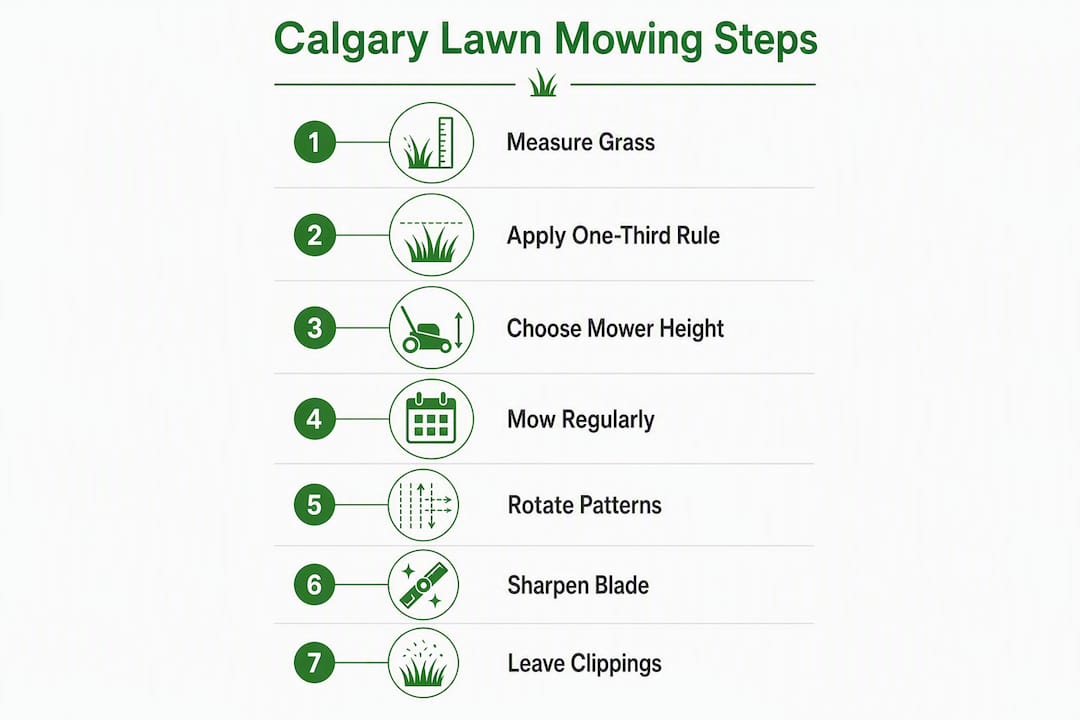
Five rules cover almost everything that goes wrong with a lawn: never cut more than one-third of the blade height in a single pass; mow at the right height for your grass type; keep blades sharp; leave clippings on the lawn unless they clump; and rotate your mowing pattern every session. Follow those and your grass stays thick, green, and weed-resistant through Calgary’s short growing season. Yearlong Property Maintenance has been helping Calgary homeowners and property managers get this right since 2017.
Quick rules at a glance:
- Never remove more than one-third of the blade in one cut
- Mow cool-season grasses at an appropriate medium height that supports healthy growth
- Sharpen blades regularly to maintain a clean cut and promote lawn health
- Leave grass clippings on the lawn when they do not form thick clumps to aid nutrient recycling
- Change your mowing direction every session
Table of Contents
- Before you mow: the safety and setup checklist
- The one-third rule: how to use it on any Calgary lawn
- How often to mow and what height to use for Calgary lawns
- Mowing technique: patterns, clippings, and blade care
- Choosing the right mower and deck settings for your yard
- Seasonal care and how to fix common Calgary lawn problems
- When to hire a lawn-care pro and what to ask them
- Yearlong Property Maintenance: local expertise since 2017
- Key takeaways
- A note from Yearlong
- Yearlong’s lawn care services for Calgary homeowners
- Further reading and trusted resources
Before you mow: the safety and setup checklist
Getting the prep right takes five minutes and prevents most mower damage and injuries.
- Walk the lawn first. Remove rocks, sticks, toys, and any debris the blade could throw. A stone ejected from a rotary mower travels fast enough to break glass or cause injury.
- Check your equipment. For gas mowers: confirm fuel and oil levels. For battery mowers: charge the pack fully. Check that the blade is secured and the deck is clear of packed grass from the last cut.
- Set the deck height before you start, not mid-lawn. Adjust gradually; one notch at a time is safer than a dramatic drop.
- Wear the right gear. Closed-toe shoes (ideally steel-toed), hearing protection for gas mowers, safety glasses, and gloves. The RHS recommends sturdy footwear every single time, regardless of how warm it is.
- Pick the right window. Mow when the grass is dry — wet grass clogs the deck, produces an uneven cut, and creates ruts. In Calgary, mid-morning (after dew lifts) or late afternoon works well. Avoid the hottest part of the afternoon in July and August; heat-stressed grass doesn’t recover as quickly from a cut.
- On slopes, mow across the face of the slope with a push mower, never straight up and down. On a riding mower, go up and down, not across.
The one-third rule: how to use it on any Calgary lawn
The one-third rule is the single most important piece of grass cutting advice you can apply. Never remove more than one-third of the grass blade height in a single mowing session. Cut more than that and the plant goes into shock, turns pale or brown, and opens gaps for weeds and moss to move in.
Here’s the math in practice: if your target height is 7.5 cm (3 in), you should mow once the grass reaches about 11 cm (4.5 in). That’s it. The calculation is simple: target height ÷ 0.67 = mow-trigger height.
Pro Tip: Before each mow, pull a ruler on a few blades across the lawn. If the grass hasn’t hit the trigger height yet, wait another day or two. Mowing on a schedule rather than by actual height is one of the most common mistakes Calgary homeowners make.
Overgrown lawns need a staged approach. Reduce height in stages: use a string trimmer to knock the grass down by roughly one-third, wait 3–5 days for the plant to recover, then mow again. Never try to reach your target height in a single pass on a neglected lawn.
How often to mow and what height to use for Calgary lawns
Calgary’s cool climate suits Kentucky bluegrass, perennial ryegrass, and fescue blends. All three are cool-season grasses that grow fastest in May, June, and September, and slow right down in July heat and again in October.
| Grass type | Recommended height | Spring/fall frequency | Summer frequency |
|---|---|---|---|
| Kentucky bluegrass | 6.5–10 cm (2.5–4 in) | Every 5–7 days | Every 7–10 days |
| Perennial ryegrass | 6.5–10 cm (2.5–4 in) | Every 5–7 days | Every 7–10 days |
| Fescue (fine/tall) | 7.5–10 cm (3–4 in) | Every 7 days | Every 10 days |
A few seasonal adjustments matter in Calgary specifically:
- Spring: Growth surges after snowmelt. Mow frequently to keep up with the one-third rule rather than letting the lawn get ahead of you.
- Summer heat: Raise the deck by one notch. Mowing higher fosters deeper roots and more resilient turf. This is especially true during Calgary’s dry July spells.
- Fall: Keep mowing until growth stops, usually late September or early October. The last cut of the season can be slightly lower than your summer height, but don’t scalp it going into winter.
- Drought or shade: Raise the deck. Taller grass shades the soil, holds moisture longer, and competes better against weeds. See Yearlong’s mowing height guide for more detail on seasonal adjustments.
Mowing technique: patterns, clippings, and blade care
Pattern rotation is one of those things that sounds minor until you see the ruts. Change your mowing direction routinely to prevent soil compaction and encourage upright blade growth — horizontal one week, vertical the next, diagonal after that. This prevents soil compaction along the same wheel tracks and encourages grass blades to grow upright rather than leaning. Yearlong’s mowing patterns guide shows ten practical designs if you want to get creative.
Clippings are free fertiliser. Leave them on the lawn when they don’t form thick clumps — they return nitrogen and nutrients and reduce how much fertiliser you need to apply. The exception is when you’ve let the grass get long and the clippings are heavy and matted. In that case, bag them or rake them off and compost. A mulching mower or mulching kit chops clippings finely enough that you can almost always leave them in place.
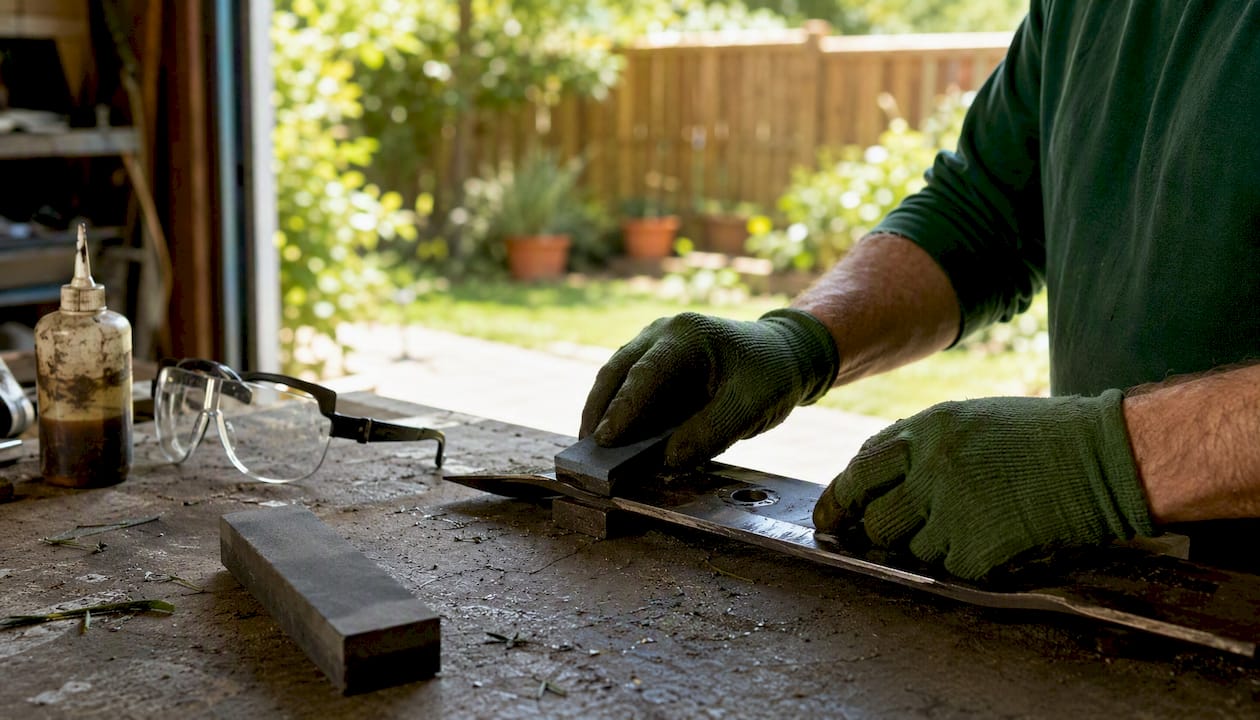
Blade sharpness matters more than most homeowners realise. Dull blades tear grass rather than cutting it cleanly, leaving frayed white tips that dry out and invite disease. Sharpen at least once per season for typical residential use; more often if you’re mowing a large property or hitting the occasional rock.
Pro Tip: Before each mow, spin the blade by hand (with the mower off and the spark plug disconnected or battery removed) and look at the cutting edge. If you can see nicks or the edge looks rounded, it’s time to sharpen. A sharp blade should have a clean bevel you can almost see your reflection in.
Choosing the right mower and deck settings for your yard
The right mower depends on your lot size, terrain, and how much time you want to spend.
| Mower type | Best for | Key consideration |
|---|---|---|
| Push rotary | Small to medium lots, flat terrain | Affordable; requires more effort on slopes |
| Self-propelled | Medium lots, gentle slopes | Reduces fatigue; worth the cost for larger yards |
| Riding/zero-turn | Large properties | Faster, but harder to manoeuvre around obstacles |
| Battery-powered | Any size; noise-sensitive areas | Buy a spare battery for larger lots |
A few practical points on settings and maintenance:
- Start your deck one notch higher than you think you need. You can always lower it; you can’t un-scalp a lawn.
- Good preseason and postseason maintenance — sharpening, oil changes, spark plug checks — prolongs machine life and keeps cut quality consistent.
- For battery mowers, store packs at partial charge over winter and avoid leaving them fully discharged.
- Check blade balance after sharpening. An unbalanced blade causes vibration that wears out the spindle bearing faster than a dull blade ever would.
Seasonal care and how to fix common Calgary lawn problems
Heat stress shows up as a blue-grey tinge before the grass turns brown. Raise the deck immediately, reduce mowing frequency, and water deeply (2.5 cm per week) rather than lightly every day. Shallow, frequent watering encourages shallow roots.
Moss is almost always a symptom of shade, compaction, or low soil pH, not a mowing problem on its own. Aerating in late August or early September helps with compaction. If shade is the issue, consider overseeding with a shade-tolerant fescue blend.
Weeds thrive when grass is cut too short. Raise the deck and overseed thin patches in early September, when Calgary soil temperatures are still warm enough for germination. Check Yearlong’s patchy lawn restoration guide for step-by-step overseeding instructions.
Scalping leaves brown, bare patches and happens when the deck is set too low, the lawn surface is uneven, or turns are taken too fast. Raise the deck and let the grass recover before mowing again. If scalping keeps happening in the same spots, those areas may need levelling, which can be a sign your home needs siding maintenance to protect its exterior from further damage. See the signs your home needs new siding for more information.
- Identify the symptom (colour, texture, pattern of damage).
- Raise the deck one notch as a first response.
- Adjust watering to deep and infrequent.
- Aerate if compaction is suspected.
- Overseed bare or thin patches in early fall.
- If the problem persists after two or three mowing cycles, call a pro.
When to hire a lawn-care pro and what to ask them
Some situations genuinely call for professional help. Scale, time, and equipment are the honest deciding factors.
Hire a pro when:
- Your property is large enough that mowing takes more than 90 minutes per session
- You manage multiple properties and scheduling becomes the bottleneck
- The lawn is severely overgrown, compacted, or needs power raking and aeration
- You don’t own (or don’t want to maintain) the right equipment
- Seasonal cleanups are piling up alongside regular mowing
Questions to ask any contractor:
- Are you insured, and does that cover property damage and liability?
- What grass height do you cut to, and do you follow the one-third rule?
- Do you mulch clippings or bag them?
- How often do you sharpen your blades?
- Do you offer aeration and overseeding, or just mowing?
- What’s included in a seasonal cleanup, and how is it priced?
- Can I book one-off visits, or is it a recurring package only?
Cost drivers in Calgary typically include lot size, frequency, access (gates, obstacles), and whether seasonal cleanups are bundled. Yearlong offers tailored packages with a satisfaction guarantee and serves the entire Calgary area. Their lawn care service page outlines what’s normally included in a quote.
Yearlong Property Maintenance: local expertise since 2017
Yearlong has many years of experience maintaining Calgary properties year-round, covering everything from weekly lawn mowing and bed maintenance to spring and fall cleanups, power raking, aeration, snow removal, and concrete cleaning and sealing.
Yearlong’s service guides and Q&A resources are available at yearlong.ca/questions-answers for homeowners who want to dig deeper before booking. For property managers handling multiple sites, the commercial lawn maintenance guide covers recurring service structures and what to include in a maintenance contract.
Key takeaways
Consistent mowing height, sharp blades, and pattern rotation are the three habits that separate a healthy Calgary lawn from one that struggles through summer.
| Point | Details |
|---|---|
| Follow the one-third rule | Never cut more than one-third of the blade height; mow when grass reaches 1.5× your target height. |
| Match height to grass type | Cool-season grasses in Calgary do best at 6.5–10 cm (2.5–4 in) for Kentucky bluegrass and perennial ryegrass, or 7.5–10 cm (3–4 in) for fescues; raise the deck in heat and drought. |
| Sharpen blades every season | Dull blades tear grass and invite disease; sharpen at least once per season for residential use. |
| Leave clippings on the lawn | Clippings return nitrogen and reduce fertiliser needs when they don’t form thick clumps. |
| Yearlong for professional care | Yearlong has served Calgary since 2017 with lawn mowing, seasonal cleanups, and year-round property maintenance. |
A note from Yearlong
After years of maintaining Calgary lawns, the pattern is clear: the homeowners with the healthiest grass aren’t necessarily doing more work. They’re mowing at the right height, keeping blades sharp, and adjusting for the season. The one-third rule alone fixes most of the problems we’re called in to correct. If you’d rather hand it off entirely, or just need help getting a neglected lawn back on track, we’re happy to come out and take a look.
Yearlong’s lawn care services for Calgary homeowners
Tired of fitting mowing into an already full schedule? Yearlong handles the whole thing, from weekly cuts and seasonal cleanups to power raking, aeration, and bed maintenance, all under one recurring package or as individual bookings. There’s no pressure to commit to a long-term contract; many Calgary homeowners start with a one-off cleanup and move to a recurring plan once they see the results.

Every quote covers lot size, frequency, and any extras like overseeding or fall cleanup, so you know exactly what you’re paying for. Yearlong’s satisfaction guarantee means if something isn’t right, it gets fixed. Serving the entire Calgary area, the team is ready to take the lawn off your list for good. Get a quote today and see what consistent, professional lawn care actually looks like.
Further reading and trusted resources
These are the primary sources used throughout this guide. All are science-based or professionally reviewed, and most apply directly to cool-season grass management relevant to Calgary’s climate.
- NDSU Agriculture Extension — How to mow your lawn: University-backed guidance on the one-third rule and height recommendations for cool-season grasses. Closest North American equivalent to Alberta conditions.
- Illinois Extension — Mowing your lawn: Practical advice on clippings management and nutrient cycling; directly applicable to Calgary lawn types.
- The Old Farmer’s Almanac — Lawn care mowing tips: Accessible, well-sourced overview of blade sharpness and mowing best practices.
- This Old House — How to mow a lawn: Covers pattern rotation and the staged approach for overgrown lawns; practical and well-illustrated.
- Lowe’s — Mowing lawns the right way: Equipment maintenance schedules and timing guidance; useful for homeowners managing their own mower upkeep.
- Lawnsmith — Ideal grass mowing height: Explains the root-depth relationship to mowing height; UK-based but the horticultural principles apply universally to cool-season grasses.
One Response