

TL;DR:
- Mowing patterns create visual texture by bending grass blades to produce light and dark contrasts. Rotating these patterns weekly helps prevent soil compaction and promotes a healthy lawn. Simpler designs like straight stripes are easiest for beginners and most effective for lawn health.
Lawn mowing patterns are deliberate mowing designs that create visual texture through an optical illusion: grass blades bent toward you absorb light and appear dark, while blades bent away reflect light and appear bright. The result is the striped, checkered, or spiralled look you see on professional sports fields and well-kept residential lawns. Beyond aesthetics, the right pattern rotation actively protects your turf. Cool-season grasses like Fescue and Bluegrass respond best to patterned mowing, producing sharper contrast and longer-lasting definition than warm-season varieties like Bermuda grass. This lawn mowing patterns list covers ten distinct designs, from beginner-friendly stripes to creative curves, so you can choose what suits your yard and your skill level.
What are the most popular lawn mowing patterns?
The best lawn mowing patterns range from simple parallel stripes to complex geometric layouts. Each one creates a different visual effect and suits different yard shapes. The table below compares the most common designs at a glance.
| Pattern | Best for | Difficulty | Visual effect |
|---|---|---|---|
| Straight stripes | Any rectangular lawn | Beginner | Classic light and dark bands |
| Checkerboard | Square or rectangular yards | Beginner | Bold grid of alternating squares |
| Diamond | Large open lawns | Intermediate | Diagonal grid, dramatic depth |
| Circular | Round yards or centrepieces | Intermediate | Concentric rings, flowing look |
| Spiral | Lawns with a central feature | Intermediate | Continuous inward curve |
| Wave | Curvy or irregular lawns | Intermediate | Soft, rippling lines |
| Perimeter and fill | Obstacle-heavy yards | Beginner | Neat border with filled interior |
| Criss-cross | Wide open spaces | Beginner | Subtle layered texture |
| Zigzag | Narrow or long yards | Advanced | Sharp angular lines |
| Custom combination | Any yard | Advanced | Personalised mixed design |
Each pattern works by bending grass in alternating directions. The viewing angle matters too. Patterns like vertical or diagonal stripes appear sharpest on sunny days when light hits the lawn at a low angle. Choosing your pattern orientation based on where you view the lawn from, whether the street, the porch, or a back window, determines how dramatic the effect looks in practice.
1. Straight stripes
Straight stripes are the foundation of every other pattern on this list. You mow in parallel lines across the lawn, reversing direction with each pass. The alternating blade direction bends grass toward and away from you, creating the light and dark contrast. Maintaining grass at 3–4 inches produces the best striping contrast because longer blades bend more fully and hold their position longer after mowing.
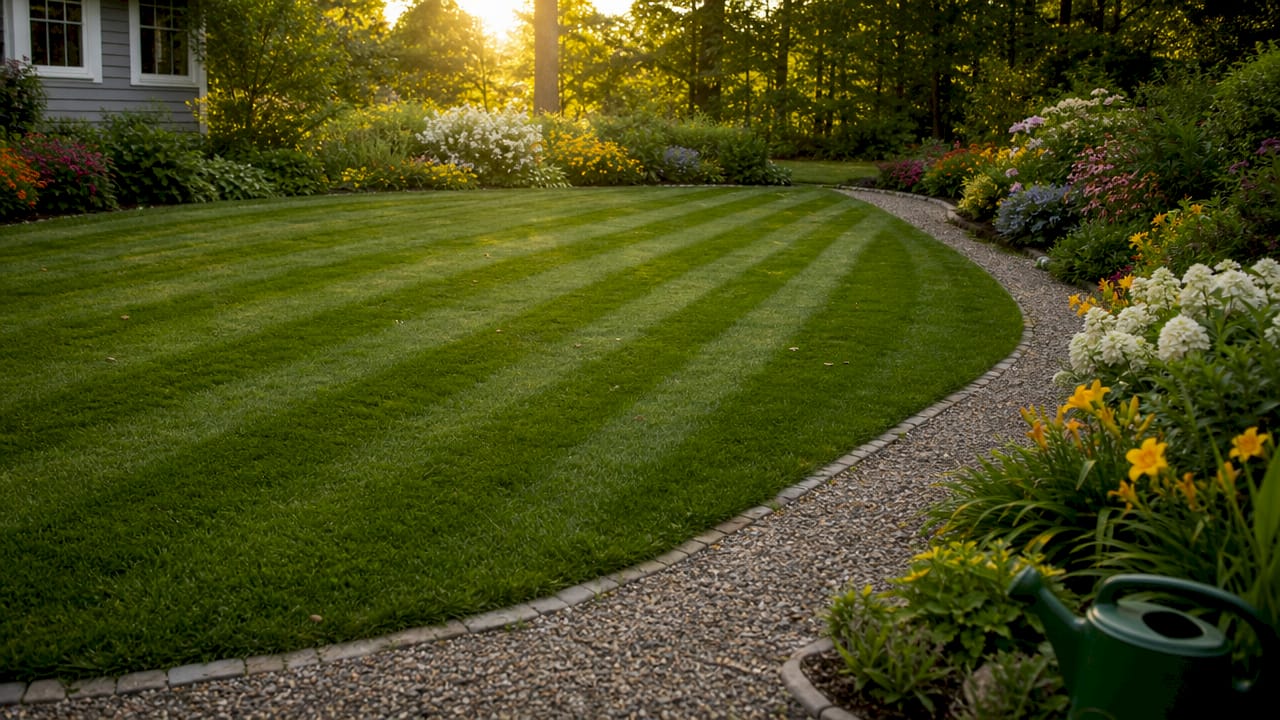
Straight stripes suit virtually any rectangular or square lawn. They are the ideal starting point for homeowners new to patterned mowing.
2. Checkerboard
The checkerboard pattern layers two sets of straight stripes at 90 degrees to each other. You mow the full lawn in one direction, then mow the entire lawn again perpendicular to your first pass. The result is a grid of alternating light and dark squares that looks sharp from any angle.
Checkerboard works best on rectangular lawns where the grid lines up cleanly with the yard’s edges. The pattern requires two full mowing sessions, so it takes more time than simple stripes. The visual payoff is significant, particularly on lawns viewed from a distance.
3. Diamond pattern
The diamond pattern is a diagonal checkerboard. You mow at 45 degrees to the lawn’s edges rather than parallel to them. After completing the diagonal passes in one direction, you mow the full lawn again at 90 degrees to your first diagonal. The crossing lines create a diamond grid across the turf.
Diamonds suit large, open lawns where the full pattern can spread out without being interrupted by obstacles. The diagonal orientation adds depth and makes the lawn appear wider. This is one of the most visually striking designs in any lawn mowing patterns list.
4. Circular pattern
Circular mowing creates concentric rings that radiate outward from a central point. You start at the centre of the lawn and mow in expanding circles, keeping each pass tight against the previous one. The rings create a flowing, almost hypnotic effect.
Circular patterns suit round lawns or yards with a central feature like a fountain or garden bed. The technique requires steady steering to keep circles even, but the result looks far more complex than the effort involved. Fescue and Bluegrass lawns show the circular contrast particularly well.
5. Spiral pattern
The spiral is a variation of the circular pattern, but instead of returning to the centre after each ring, you mow in one continuous inward path from the outer edge to the centre. Wave and spiral patterns complement curvy or irregular lawns and integrate naturally with landscaping features like trees or garden beds.
The spiral works well when your lawn has a single focal point, such as a mature tree or a decorative planter. Mowing around the feature in a tightening spiral frames it beautifully and draws the eye inward.
6. Wave pattern
Wave mowing replaces straight lines with gentle curves that flow across the lawn. Instead of turning sharply at the end of each pass, you guide the mower in a gradual S-curve. The result is a soft, rippling texture that suits yards with curved borders or natural landscaping.
Waves are forgiving on irregular lawns where straight lines would look awkward against curved garden beds or fences. The pattern requires a steady hand but no special equipment. It pairs well with naturalistic garden styles common in many Calgary neighbourhoods.
7. Perimeter and fill
Perimeter-and-fill mowing is the best approach for irregularly shaped lawns with landscaping obstacles. You mow two passes around the entire perimeter of the lawn first, then fill the interior with straight stripes or another pattern. Two perimeter passes hide turn marks and create a clean border that frames the interior design.
This method works around garden islands, trees, and irregular edges without leaving ragged corners. It is also the most practical choice for lawns that do not fit neatly into a rectangle. Many homeowners use perimeter-and-fill as their default approach and add interior pattern variety each week.
8. Criss-cross pattern
The criss-cross pattern layers two sets of diagonal stripes over each other without the full perpendicular pass of a checkerboard. You mow at roughly 45 degrees across the lawn, then mow again at the opposite 45-degree angle. The result is a subtle woven texture rather than a bold grid.
Criss-cross suits wide, open lawns where you want visual interest without the sharp geometry of a checkerboard or diamond. The pattern is less demanding than it looks and works well as a weekly rotation to prevent soil compaction.
9. Zigzag pattern
Zigzag mowing creates sharp angular lines by alternating the mower’s direction at acute angles rather than 90-degree turns. The pattern suits long, narrow lawns where straight stripes would look monotonous. Each pass angles sharply left or right, creating a dynamic, energetic texture across the turf.
Zigzag is one of the more advanced designs because maintaining consistent angles requires focus and a steady pace. Using a fixed distant point as a guide, such as a fence post or tree, keeps each pass aligned. The pattern rewards patience with a striking result.
10. Custom combination patterns
Custom combinations layer two or more simpler patterns to create a personalised design. A common example is a checkerboard border around a circular centre, or diagonal stripes inside a perimeter-and-fill frame. The only limit is your lawn’s shape and your willingness to experiment.
Custom patterns work best on larger lawns where each element has room to read clearly. Start with two patterns you are already comfortable mowing separately, then combine them in a single session. The result is a yard that looks genuinely unique without requiring professional equipment.
How do mowing patterns affect grass health?
Rotating your mowing pattern is not just about variety. Repeatedly mowing in the same direction causes wheel ruts and soil compaction that damage turf and slow recovery. Compacted soil restricts root growth and water absorption, which weakens the lawn over time.
Alternating patterns every seven days helps prevent rutting and allows any localised bare spots to recover. Rotating between horizontal, vertical, and diagonal passes distributes mower weight evenly across the soil. Adjusting your mower blade height seasonally also protects the turf. Taller grass in summer reduces heat stress, while a slightly lower cut in spring and autumn encourages denser growth.
Pro Tip: Avoid turning on the same spot each session. Vary where you start and end each pass to prevent worn patches at the corners of your lawn.
Step-by-step guide to creating clean mowing patterns
Follow these steps to execute any pattern from the list above with clean, defined results.
- Mow the perimeter first. Complete two full passes around the lawn’s edge. This frames the interior pattern and gives you room to turn without leaving marks inside the design.
- Choose your starting line. Pick a straight edge, such as a fence, driveway, or garden bed, as your reference. Your first pass sets the angle for every pass that follows.
- Focus on a fixed distant point. Looking at a tree or fence post in the distance keeps your lines straighter than watching the mower wheels. This is the single most effective technique for cleaner stripes.
- Overlap each pass slightly. A 5–10 centimetre overlap between passes prevents uncut strips and strengthens the contrast between light and dark bands.
- Reverse direction on each return pass. Turn the mower 180 degrees and mow back parallel to your first pass. The reversed blade direction creates the alternating light and dark effect.
- Adjust blade height for striping. Grass at 3–4 inches bends better and holds the pattern longer. Raise your mower deck if your current cut is too short for visible contrast.
- Use a striping kit if available, but do not wait for one. Consistent blade height and overlapping passes produce visible patterns on any mower. A striping kit or rear roller enhances definition but is not required to start.
Pro Tip: For diamond and checkerboard patterns, mark your diagonal starting angle with a string line or chalk before you begin. It takes two minutes and saves you from crooked grids.
Creative lawn mowing ideas for unique yards
Not every lawn is a flat rectangle, and the best creative lawn mowing designs account for what your yard actually looks like.
- Integrate natural features. Mow spiral or circular patterns around trees, garden beds, or water features rather than fighting their placement. The feature becomes the centrepiece of the design.
- Use curves on curved lawns. Wave patterns follow the natural contour of rounded borders and look far more intentional than straight stripes forced onto an irregular shape.
- Layer patterns seasonally. Mow stripes in spring, switch to a diamond in summer, and use a checkerboard in autumn. Seasonal rotation keeps the lawn looking fresh and supports turf renovation by preventing compaction in any one direction.
- Frame garden islands. Use the perimeter-and-fill method around raised beds or garden islands. The border pass creates a clean separation between the mowed lawn and the planted area.
- Combine simple patterns for a custom look. Mow the outer third of the lawn in one direction and the inner section in another. The contrast between the two zones creates a layered effect without advanced technique.
The key principle across all creative designs is that the pattern should suit the yard’s shape, not fight it. Selecting pattern orientation based on your primary viewing angle and light conditions determines whether the design reads clearly or disappears in shadow.
Key takeaways
The most effective lawn mowing patterns combine visual appeal with regular rotation to protect turf health and prevent soil compaction.
| Point | Details |
|---|---|
| Start with straight stripes | Stripes are the easiest pattern and the foundation for every more complex design. |
| Rotate patterns weekly | Changing direction every seven days prevents ruts and keeps soil healthy. |
| Grass height matters | Mow at 3–4 inches for the best striping contrast and blade flexibility. |
| Technique beats equipment | Overlapping passes and a fixed focal point produce cleaner results than any kit. |
| Match pattern to yard shape | Irregular lawns suit waves and spirals; rectangular lawns suit stripes and checkerboards. |
What I have learned from years of watching lawns get mowed
Most homeowners treat mowing patterns as a finishing touch. I think that gets it backwards. The pattern you choose and how often you rotate it has a direct effect on how healthy the lawn is six months from now. Compaction from repeated passes in the same direction is one of the most common causes of thin, patchy turf, and it is entirely preventable.
The advice I give most often is to start simpler than you think you need to. A clean set of straight stripes, mowed at the right height and rotated weekly, looks better than a complicated diamond pattern mowed at the wrong height and never changed. Get the fundamentals right first. Sharp blades, consistent height, a fixed focal point for straight lines, and a different direction each week. Once those habits are automatic, adding complexity is genuinely fun.
The other thing worth saying: your lawn’s shape should drive your pattern choice, not the other way around. I have seen homeowners fight their curved borders trying to force straight stripes, and the result always looks awkward. Wave and spiral patterns exist precisely because not every yard is a rectangle. Work with what you have, and the results will look intentional rather than forced.
— Lewie
Professional lawn mowing in Calgary, done right
Getting the pattern right takes practice, and not every homeowner has the time or equipment to do it consistently.

Yearlong has provided lawn mowing and bed maintenance across Calgary since 2017, with crews who understand local grass types, seasonal blade height adjustments, and pattern rotation schedules. Whether your yard is a simple rectangle or a complex layout with garden islands and trees, Yearlong brings the technique and consistency to make it look sharp every visit. Contact Yearlong for a quote on regular lawn care in Calgary and get a yard that looks well-kept all season.
FAQ
What is the easiest lawn mowing pattern for beginners?
Straight stripes are the easiest pattern to start with. Mow parallel passes across the lawn, reversing direction each time, and the light and dark contrast appears automatically.
How often should I change my mowing pattern?
Rotate your mowing pattern every seven days. Weekly rotation prevents soil compaction, wheel ruts, and grass grain damage that build up when you always mow in the same direction.
Do I need a striping kit to create lawn patterns?
No. Consistent blade height and overlapping passes produce visible patterns on any push mower or riding mower. A striping kit or rear roller enhances definition but is not required.
What grass types show mowing patterns best?
Cool-season grasses like Fescue and Bluegrass show the sharpest contrast and hold patterns longer than warm-season varieties like Bermuda grass, due to their blade structure and light reflection properties.
What mowing height works best for visible patterns?
Mow at 3–4 inches for the best striping effect. Longer blades bend more fully and hold their position after mowing, which makes the light and dark contrast more defined and longer-lasting.