

TL;DR:
- Proactive snow and ice management prevent ice bonding, reduce costs, and lower environmental impact through timely treatments.
- Documented, temperature-matched strategies improve safety, legal compliance, and preserve pavement condition, especially in cold climates.
Most property owners wait for snow to pile up before doing anything about it. That reactive habit costs more than you’d think. The role of preventive snow and ice management goes far beyond keeping pathways clear. It directly affects your legal liability, your operating costs, and the long-term condition of your concrete and pavement. Winter weather contributes to over 1.4 million crashes and more than 100,000 injuries annually. The gap between a property that is managed proactively and one that is not shows up fast once the temperature drops.
Table of Contents
- Key takeaways
- The role of preventive snow and ice management
- Legal responsibility and winter safety on your property
- Environmental and operational considerations
- Practical techniques for homeowners and property managers
- Comparing common ice control methods
- My honest take on preventive snow management
- Ready for a winter that does not catch you off guard?
- FAQ
Key takeaways
| Point | Details |
|---|---|
| Act before the storm hits | Applying anti-icing treatments before precipitation prevents ice from bonding to pavement in the first place. |
| Prevention cuts material use | Pre-storm brine treatments can reduce overall salt consumption by up to 50% compared to reactive salting. |
| Documentation protects you legally | Courts weigh detailed logs of treatment times and weather conditions when determining premises liability. |
| Choose products by temperature | Not all de-icers work at the same temperatures; matching product to conditions improves results and reduces waste. |
| Spring inspection closes the loop | Freeze-thaw damage is often hidden until spring, and catching it early prevents costly structural repairs. |
The role of preventive snow and ice management
Preventive snow and ice management means treating surfaces before a storm arrives rather than responding after the fact. The central technique is anti-icing: applying liquid brine or granular products to dry pavement in advance so that when snow or freezing rain comes down, it cannot form a hard bond with the surface below.
This is meaningfully different from de-icing, which is what most people picture when they think about winter maintenance. De-icing is applied after ice has already formed, requiring more product, more effort, and more passes with equipment to break the bond. Anti-icing works with the storm rather than against it.
The practical advantages stack up quickly:
- Fewer treatment applications are needed across an entire storm event
- Snow and slush lift off the surface faster and more completely
- Labour time and fuel consumption per storm drop noticeably
- Liquid treatments create a barrier that prevents bonding, making post-storm clearing faster and more thorough
Timing is everything. Anti-icing applications are most effective when pavement is dry and temperatures are expected to drop within a few hours. Applying too early risks the product washing away. Applying too late means ice has already started to form and you are back to de-icing.
Pro Tip: Check pavement temperature, not just air temperature. Pavement retains heat longer than the air above it, which affects when treatments will actually activate. A pavement thermometer or road weather service gives you more reliable timing than a regular forecast.
Legal responsibility and winter safety on your property
In Canada, property owners carry a legal duty to address snow and ice hazards in a reasonable timeframe after precipitation stops. Premises liability law expects timely removal particularly for commercial properties and those with heavy foot traffic. “Reasonable” shifts based on factors like how busy your property is, what kind of tenants or visitors use it, and whether the hazard is obvious.
For homeowners and property managers, this translates into a few concrete obligations:
- Develop a written snow and ice management plan before winter begins, covering which areas get treated first and what products you will use.
- Keep a log of every treatment. Record the date, time, weather conditions, what product was applied, and who performed the work.
- Photograph conditions before and after treatment when weather events are severe or unusual.
- Revisit treated areas after refreezing is possible, particularly in Calgary where daytime warming and overnight freezing are common.
Documented snow removal plans and treatment logs are not just good practice. Courts weigh this evidence directly when determining whether a property owner acted responsibly after a weather event. Without records, your only defence is memory.
The risk is not just financial. Unmanaged ice leads to genuine injuries, and those injuries fall on people who depend on your property being safe. Snow and ice safety tips that get put in writing and followed consistently are the single most reliable way to reduce both harm and legal exposure.
Environmental and operational considerations
Salt is the most widely used ice control product in North America, but it is also the most overused. Many crews apply 300 to 500 lbs of salt per lane-mile when calibrated anti-icing systems can achieve the same result at 150 to 250 lbs. That is not just waste. The excess chloride runs off into storm drains, groundwater, and the soil around your property, damaging vegetation and accelerating corrosion on vehicles and concrete.
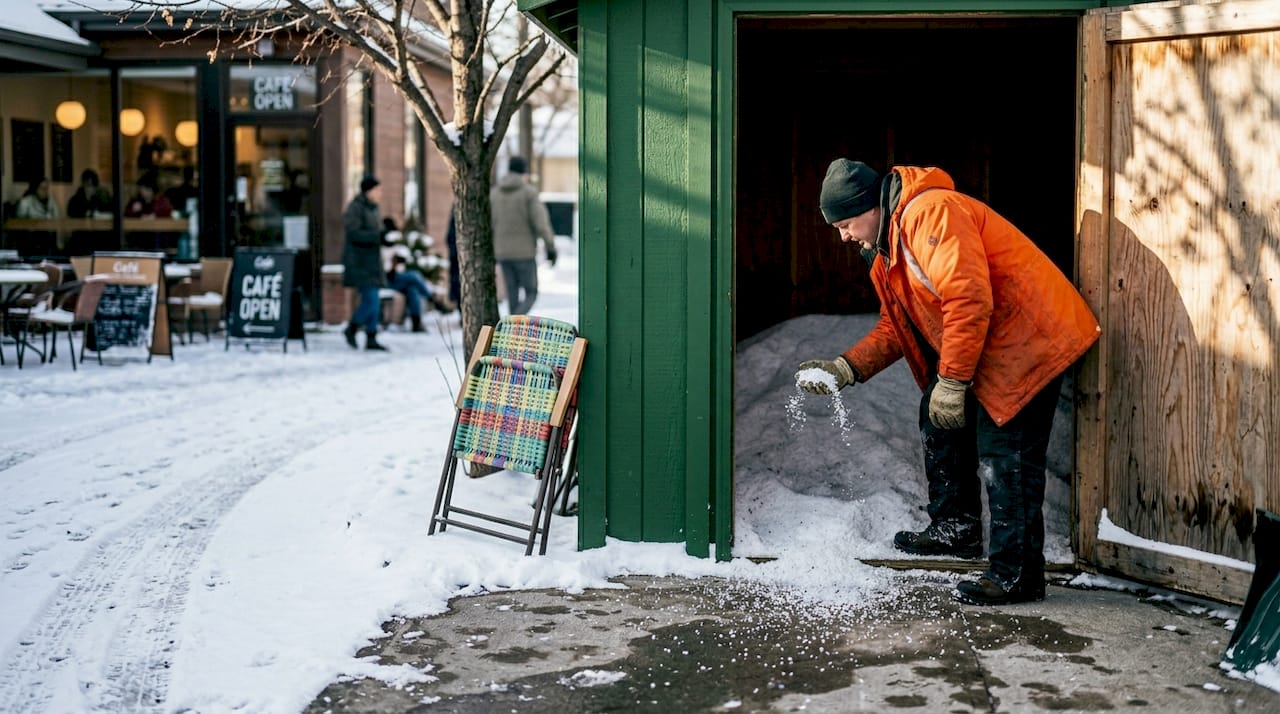
Preventive approaches change this equation substantially. When you apply a light pre-treatment before a storm, the product works at low volumes because it has time to penetrate the pavement texture before freezing begins. You are not fighting an ice sheet. You are preventing one.
| Product | Effective temp range | Environmental concern | Best use |
|---|---|---|---|
| Liquid brine (NaCl) | Down to about -10°C | Moderate chloride load | General road and driveway pre-treatment |
| Calcium chloride | Down to -29°C | Higher chloride load | Extreme cold, sidewalks, spot treatment |
| Magnesium chloride | Down to -15°C | Lower chloride, less corrosive | Walkways, near vegetation |
| Sand/grit | Any temperature | Minimal, but cleanup needed | Traction on non-treated surfaces |
Calibrated anti-icing programs reduce chloride loading and can eliminate the need for abrasive aggregates entirely in many situations, which cuts spring cleanup costs significantly. For homeowners who want to protect their gardens and lawn edges, eco-friendly surface protectants and lower-chloride alternatives are worth the modest price premium.
On the operational side, fewer plow passes means less wear on driveways and walkway edges, less fuel consumption, and less time your crew or contractor spends on site. Combining weather forecasts with pavement monitoring lets you time applications precisely, which reduces both waste and the number of call-outs required per season.
Pro Tip: In Calgary, watch for freeze-thaw cycles in late autumn and early spring. These transitions are when preventive treatments deliver the most value and when over-salting causes the most damage to concrete surfaces.
Practical techniques for homeowners and property managers
Knowing the theory behind anti-icing is one thing. Knowing what to actually do before a storm is another. Here is a realistic preventive maintenance routine for a residential or small commercial property in Calgary:
- Before the storm: Apply a liquid brine or granular anti-icer to driveways, walkways, and entry steps when the forecast calls for freezing precipitation within the next few hours. Keep the pavement dry when you apply. Focus on high-traffic areas and any spots with poor drainage.
- During the storm: Monitor conditions. If snowfall is heavy and sustained, a light mid-storm mechanical clearing followed by a second light treatment maintains the anti-icing barrier. Avoid over-applying product during snowfall, as dilution reduces effectiveness.
- After the storm: Clear snow mechanically before it compacts or refreezes. A pass with a shovel or snowblower on a surface that was pre-treated lifts cleanly and quickly. Apply a light follow-up treatment to walkway edges and shaded spots that do not get sun exposure.
- Managing runoff zones: Pay attention to where snow piles accumulate. Snow pushed to the edges of driveways or parking areas will melt and refreeze as water migrates toward walkways. Preventive maintenance for winter roads includes planning where melt water goes, not just where snow is moved.
- Gutter and drainage checks: Blocked gutters create ice dams and direct melt water onto pathways. Clearing gutters before winter begins is as much a part of snow and ice management as the chemicals you choose.
- Spring transition: Once winter ends, do a thorough walkthrough. Freeze-thaw damage to concrete and drainage is often invisible until spring, and catching cracks or shifting pavement early prevents them from becoming expensive repairs. Use this review to refine your approach for the following season.
Comparing common ice control methods
Understanding the strengths and weaknesses of each method lets you build a plan rather than grab whatever is on the shelf at the hardware store.
Liquid brine is the go-to choice for pre-storm anti-icing on driveways and general surfaces. It dries quickly after application, does not blow away in wind, and costs less per application than granular alternatives. The catch is that it requires application equipment and does not work effectively below about -10°C without additives.
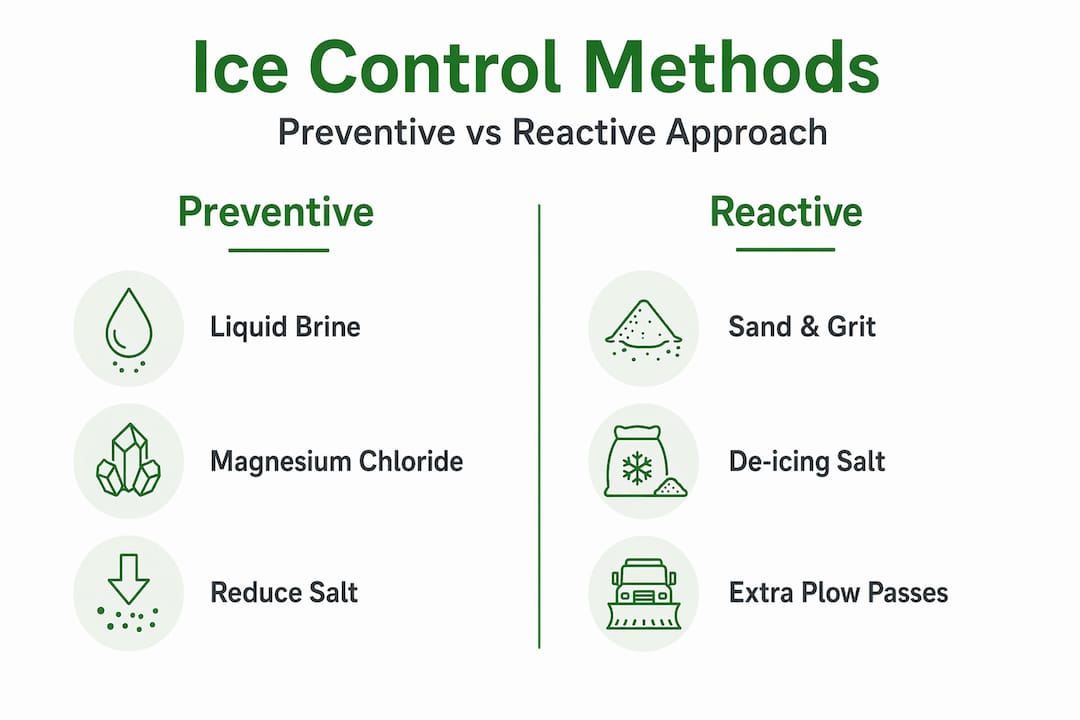
Calcium chloride works at much lower temperatures and generates its own heat on contact, making it faster-acting than sodium chloride. It costs more and carries a higher chloride load per application, so use it where temperature warrants it rather than as a default.
Magnesium chloride is a gentler option near lawn edges, garden beds, and concrete that shows signs of wear. It performs well down to around -15°C and is less corrosive than calcium chloride. Modern de-icers balance effectiveness and environmental impact, and magnesium chloride represents a reasonable middle ground for residential use.
Sand and grit provide traction but do not melt ice. They are useful in extreme cold where chemical products lose effectiveness, but they require cleanup and can clog drains. The most effective programmes combine chemical treatment for ice control with grit for traction in specific high-risk spots like steps and ramps.
My honest take on preventive snow management
I’ve watched a lot of property owners treat winter maintenance as something you deal with after it becomes a problem. Call someone when the driveway is a sheet of ice. Throw down salt once a slip happens. React, react, react. The hidden cost of that mindset is not just in salt and contractor hours. It shows up in concrete that deteriorates faster than it should, in a slip-and-fall claim that might have been avoided, and in the kind of stress that comes from scrambling during a storm.
What I’ve found after working through Calgary winters is that the properties that fare best are the ones where someone made a plan in October and stuck to it. That plan is not complicated. It is mostly about timing and documentation. Apply your pre-treatment at the right moment, keep a simple log, and do the spring check properly. Those three habits do more than any single product.
The thing that surprises people is how much less material you actually use when you are proactive. Less salt, less product, less equipment wear. It costs less to do it right than it does to keep fixing the consequences of doing it wrong.
— Lewie
Ready for a winter that does not catch you off guard?
If reading this has made you realise your current winter maintenance approach is more reactive than it should be, Yearlong is here to help you get ahead of it.

Yearlong provides professional snow removal in Calgary with services designed around preventive, calibrated approaches rather than just showing up after the storm. From pre-treatment applications to post-storm clearing, the team handles the timing, the products, and the documentation so you do not have to. For homeowners and property managers who want a structured winter maintenance checklist, Yearlong also provides the planning tools to keep you protected all season.
FAQ
What is the role of preventive snow and ice management?
Preventive snow and ice management means applying treatments before a storm to stop ice bonding to surfaces. It reduces material use, labour, and the risk of slip-and-fall injuries compared to reactive methods.
How does anti-icing differ from de-icing?
Anti-icing applies product to dry pavement before precipitation arrives to prevent ice formation. De-icing is applied after ice has formed, requiring more product and effort to break the bond.
What are the legal risks of ignoring snow and ice on your property?
Property owners must remove hazards within a reasonable time after precipitation, especially for commercial properties. Without documented removal efforts, you carry full liability for any resulting injuries.
Which ice control product works best in extreme cold?
Calcium chloride remains effective down to about -29°C and generates heat on contact, making it the best choice when temperatures drop significantly below freezing. It costs more than standard salt, so use it where conditions actually require it.
How does preventive snow management protect your concrete?
Pre-treatment reduces the need for heavy salt applications, lowering chloride runoff that corrodes concrete over time. Catching freeze-thaw damage early in spring also prevents minor cracks from becoming major structural problems.
One Response