

TL;DR:
- Maintaining outdoor property features consistently prevents costly water damage and structural repairs.
- Organizing tasks by frequency and property zones simplifies routine inspections and repairs, ensuring nothing is overlooked.
Keeping up with outdoor property maintenance is one of those tasks that feels manageable until it isn’t. A missed gutter cleaning leads to water pooling against your foundation. A cracked sealant line lets moisture creep behind your siding. Before long, you’re looking at repairs that cost ten times what prevention would have. A solid property maintenance checklist puts you back in control, turning an overwhelming to-do list into a structured routine that protects your investment and keeps your property looking its best through every season.
Table of Contents
- Key takeaways
- How to organise an effective property maintenance checklist
- The top 6 outdoor property maintenance checklist items
- Maintenance tasks by frequency and complexity
- Tailored advice for homeowners and property managers
- What I’ve learned from years of outdoor property work
- Let Yearlong take tasks off your checklist
- FAQ
Key takeaways
| Point | Details |
|---|---|
| Organise by frequency | Layer tasks into monthly, seasonal, and annual categories to avoid missing critical inspections. |
| Prioritise water management | Roof, gutters, grading, and seals are your highest-priority items to prevent costly water damage. |
| Budget consistently | Setting aside 1-3% of property value each year prevents emergency spending surprises. |
| Tailor to your role | Homeowners and property managers have different needs; adapt the checklist to your scale and delegation capacity. |
| Use digital tools | Digital checklists can push task completion above 90% by improving scheduling and accountability. |
How to organise an effective property maintenance checklist
A property maintenance checklist only works if it’s built around a clear system. The most common mistake people make is writing a long list of tasks with no structure, then wondering why things fall through the cracks every spring. The fix is straightforward: organise by property feature first, then layer tasks by frequency.
Start by dividing your property into distinct zones or systems: roof and gutters, exterior walls and sealants, windows and doors, landscaping and drainage, decks and outbuildings, and driveways or concrete surfaces. Each zone gets its own set of tasks at different intervals.
From there, assign tasks to one of three frequency tiers:
- Monthly: Visual inspections of gutters, downspouts, and drainage paths; checking for new cracks in concrete or sealant; monitoring any areas of concern identified in a previous inspection
- Seasonal (every three months): Detailed exterior walkaround, landscape grading checks, deck inspection, gutter cleaning, window and door frame examination, and seasonal service scheduling
- Annual: Roof inspection by a professional, full sealant replacement where needed, concrete sealing, and major landscaping adjustments
Pro Tip: Set a clear pass/fail standard for each inspection item. “Check gutters” is vague. “Gutters clear of debris with no visible sagging or separation at joints” is a standard you can actually measure against.
One detail that separates a useful checklist from a decorative one is the escalation path. When you spot a problem, what happens next? Write it into the checklist. For example: if granule loss is visible in gutters, contact a roofing professional within 30 days. If water pools near the foundation after rain, address grading before the next seasonal checklist cycle.
Finally, decide upfront which tasks are DIY-friendly and which require a professional. Consistent weekly inspections catch over 60% of developing issues before they escalate, and most of those inspections can be done by any observant homeowner. The professional calls come when you spot something that needs hands-on expertise.
The top 6 outdoor property maintenance checklist items
Water intrusion is the highest-priority issue in exterior maintenance, and it shows up in almost every task below. That’s not a coincidence. Most expensive outdoor repairs trace back to water getting somewhere it shouldn’t. These six items form the backbone of any outdoor property maintenance checklist.
1. Roof inspection
Your roof is your first line of defence against the elements. Inspect it twice a year, ideally in spring and fall. Look for missing or curling shingles, damaged flashing around chimneys and vents, and soft spots that could indicate rot beneath the surface. One specific sign to watch for: granule loss in gutters signals shingle aging or possible hail damage. In Calgary, hail is a real seasonal risk, and catching deterioration early puts you ahead of the claim and the repair bill.
2. Gutter and downspout cleaning
Clogged gutters are a direct path to foundation damage, fascia rot, and ice dam formation in winter. Clean them at minimum twice a year: once in late spring after trees finish releasing seeds, and again in late fall after the leaves drop. When you clear the gutters, check that your downspouts are discharging water at least four to six feet from your foundation. This single detail prevents an enormous amount of foundation trouble.
Pro Tip: Run water through your downspouts with a garden hose after cleaning. If it drains slowly or backs up, you have a blockage partway down the spout that a visual check alone won’t reveal.
3. Landscape grading and drainage
Proper grading directs water away from your home rather than toward it. The standard recommendation is a drop of six inches over the first ten feet away from your foundation. Check your grading during or immediately after heavy rainfall. That’s the only time you’ll actually see where water is pooling or where it’s being directed. If soil has settled against your foundation over winter, regrading in spring is a straightforward fix before it becomes an expensive one.
4. Sealant and caulking inspection
Sealants around windows, doors, vents, and where your siding meets other materials are your weatherproofing layer. They degrade over time, especially with temperature swings that are typical in Alberta. Walk the perimeter of your home annually and look for cracking, gaps, or areas where the sealant has pulled away from the surface. Recaulking is one of the most cost-effective property maintenance tasks you can do yourself, and it makes a significant difference in your heating costs and moisture protection.
5. Window and door frame examination
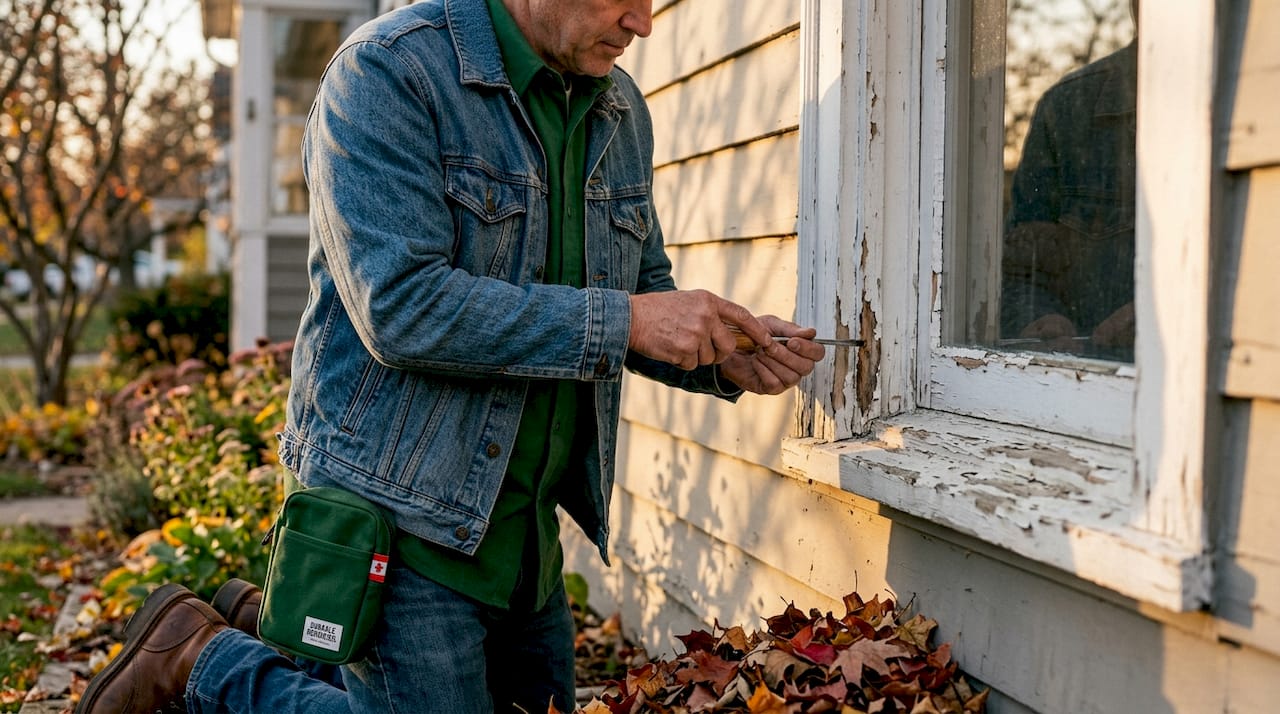
Frames settle, paint peels, and wood rots faster than most homeowners expect. Check every window and door frame for soft spots (press on painted wood to feel for give), separation at the corners, and fogging between double-paned glass, which indicates a failed seal. Drafts around doors are easy to detect in winter by holding your hand near the frame on a cold day. Addressing them with weatherstripping costs very little. Replacing a rotted frame costs considerably more.
6. Deck and outdoor structure maintenance
Decks, fences, pergolas, and garden sheds need seasonal attention. Check all fasteners and hardware for rust each spring. Look for boards that have warped, cracked, or splintered. Probe any wood that appears discoloured or soft with a screwdriver. If the screwdriver penetrates more than a centimetre without real resistance, that wood is rotting and needs to be replaced. Decks in particular benefit from a fresh seal or stain every two to three years to slow moisture absorption.
Maintenance tasks by frequency and complexity
This table gives you a quick-reference view of how to schedule your outdoor tasks. Use it alongside your seasonal checklist to prioritise time and budget.
| Task | Frequency | DIY or professional | Time estimate |
|---|---|---|---|
| Gutter and downspout cleaning | Twice yearly | DIY | 2-4 hours |
| Roof visual inspection | Twice yearly | DIY (professional annually) | 1 hour |
| Professional roof assessment | Annually | Professional | Half day |
| Sealant and caulking inspection | Annually | DIY | 2-3 hours |
| Landscape grading check | Each heavy rainfall | DIY | 30 minutes |
| Deck inspection and resealing | Annually (seal every 2-3 years) | DIY | 3-6 hours |
| Window and door frame check | Seasonally | DIY | 1-2 hours |
| Concrete cleaning and sealing | Every 2-3 years | DIY or professional | Half day |
| Lawn care and bed maintenance | Weekly to monthly | DIY or professional | Ongoing |
| Snow removal and de-icing | As needed (winter) | DIY or professional | Ongoing |
Preventive maintenance consistently reduces repair costs by 12 to 30% compared to reactive approaches. The table above reflects that logic. Professional help is reserved for tasks where expertise matters most, such as roof assessments and concrete sealing, while the frequent, lower-complexity tasks are well within DIY reach.
Tailored advice for homeowners and property managers
A one-size-fits-all checklist rarely works in practice. The right property maintenance checklist for a single-family home in Calgary looks quite different from the one a property manager uses across a multi-unit complex. Here’s how to adapt:
For homeowners:
- Prioritise tasks based on your property’s age. Homes over 20 years old need more frequent sealant inspections, roof checks, and drainage assessments
- Keep a simple maintenance log. A dated record of every inspection and repair is invaluable when selling and helps with insurance coverage eligibility, since neglect can void claims
- Set aside the recommended 1-3% of your property’s value each year for maintenance and minor repairs
- Use a year-round maintenance guide tailored to Calgary’s specific climate to keep your schedule accurate and relevant
For property managers:
- Delegate routine DIY inspections to on-site staff and reserve professional service contracts for HVAC, roofing, and electrical. Digital checklist tools push task completion rates above 90% by creating accountability and automated reminders
- Document everything. Detailed records protect you in disputes, support budget requests, and satisfy HOA requirements when operating within a shared property framework
- Build vendor relationships before you need them. Emergency calls to contractors cost significantly more than scheduled service visits
- Review your seasonal property care plan at the start of each quarter and adjust priorities based on what the previous season revealed
For both groups, the biggest budget mistake is treating maintenance as optional spending. The math is straightforward: deferred maintenance compounds into larger repairs. A $300 gutter cleaning prevents a $4,000 foundation repair. A $200 deck resealing adds years to a structure that would cost $15,000 to replace.
What I’ve learned from years of outdoor property work
In my experience, the properties that hold their value best aren’t always the most expensive ones. They’re the ones where someone has been paying attention. Consistently.
What I see most often is homeowners who do everything right for one or two years, then skip a season because life gets busy. That’s exactly when a small crack in a downspout extension turns into a drainage problem, or a soft spot on a deck board goes unnoticed until someone puts a foot through it.
The misconception I encounter regularly is that professional help is only necessary when something breaks. I’d push back on that. Having a professional assess your roof before you think you need to is far less stressful than discovering the problem after water has already worked its way into the structure. The same goes for concrete sealing and sealant work. Prevention isn’t just cheaper. It’s also calmer.
I’ve also noticed that the most effective maintenance routines are the ones that feel boring. No surprises. No emergency calls. Just a checklist that gets followed, tasks that get done, and a property that quietly stays in good shape year after year. That’s the goal. If your maintenance programme is generating drama, something in the routine needs to change.
— Lewie
Let Yearlong take tasks off your checklist

Working through a property maintenance checklist is far easier when you’re not doing every item alone. Yearlong has been serving Calgary homeowners and property managers since 2017, handling the outdoor tasks that need consistency, reliability, and local know-how. From lawn care and yard cleanup throughout the growing season to snow removal when Calgary winters hit hard, Yearlong keeps your property in shape without you having to track every detail yourself. If bed maintenance, seasonal cleanups, or lawn bed care are on your checklist, Yearlong offers flexible packages built around your schedule and property size. Get in touch to find the service combination that fits your property.
FAQ
What is a property maintenance checklist?
A property maintenance checklist is a structured list of inspection and upkeep tasks organised by property feature and frequency. It helps homeowners and property managers stay ahead of repairs, preserve property value, and avoid costly damage from deferred maintenance.
How often should outdoor property maintenance be done?
Most outdoor tasks fall into three categories: monthly visual checks, seasonal inspections every three months, and annual professional assessments. Higher-risk items like gutters and drainage should be checked at least twice yearly.
What is the most important item on a winter property maintenance checklist?
Managing water and ice is the top priority. That means clearing gutters before freeze-up, checking downspout discharge distances, and monitoring for ice dams on the roof, which form when heat escapes through the attic and melts snow that refreezes at the eaves.
How much should I budget for property maintenance annually?
Financial experts and property managers recommend setting aside 1-3% of your property’s value per year. For a $500,000 home, that’s $5,000 to $15,000, which covers routine upkeep and provides a buffer for unexpected repairs.
Can property maintenance checklists be used by HOAs?
Yes. A property maintenance checklist for HOAs typically mirrors a residential checklist but applies to shared spaces: common area landscaping, parking surfaces, drainage, lighting, and exterior building elements. Digital tools make it significantly easier to track compliance across multiple units or properties.