

TL;DR:
- Most HOA boards view seasonal maintenance as routine lawn and snow removal, but it actually involves broader responsibilities like liability protection and asset preservation. Proper planning around Calgary’s climate reduces costly repairs, enhances property value, and minimizes legal risks through documented preventive work. Implementing structured, schedule-driven maintenance ensures long-term community safety, financial savings, and operational efficiency.
Most HOA boards think of seasonal maintenance as lawn mowing and snow shovelling. That framing is costing communities thousands of dollars a year. The role of seasonal maintenance for HOAs is far broader: it governs liability protection, long-term asset care, predictable budgeting, and community safety. In Calgary, where temperatures swing from minus 30°C in January to plus 30°C in July, the stakes are higher than in most Canadian cities. Get the timing wrong on a single drainage issue in October and you may be facing a cracked foundation or an icy walkway claim by February.
Table of Contents
- Understanding the seasonal maintenance cycle for Calgary HOAs
- How seasonal maintenance protects property value and budget health
- Seasonal maintenance as a risk management and safety tool
- Vegetation management through seasonal maintenance to ensure safety and curb appeal
- Implementing preventive seasonal maintenance for long-term HOA asset protection
- Why many HOAs misunderstand seasonal maintenance and how to get it right
- How YearLong supports Calgary HOAs with expert seasonal maintenance
- Frequently asked questions
Key Takeaways
| Point | Details |
|---|---|
| Seasonal cycle overview | HOAs follow a detailed seasonal maintenance schedule specific to Calgary’s climate with defined tasks each season. |
| Financial benefits | Preventive maintenance saves 4 to 7 times more than reactive repairs and reduces overall HOA costs with competitive bidding. |
| Liability protection | Consistent documentation of maintenance activities is crucial for reducing HOA liability risks. |
| Vegetation control timing | Managing vegetation at least two to three times during the growing season maintains safety and aesthetics. |
| Preventive approach advantages | Structured preventive maintenance turns variable emergency expenses into predictable budgets and extends asset life. |
Understanding the seasonal maintenance cycle for Calgary HOAs
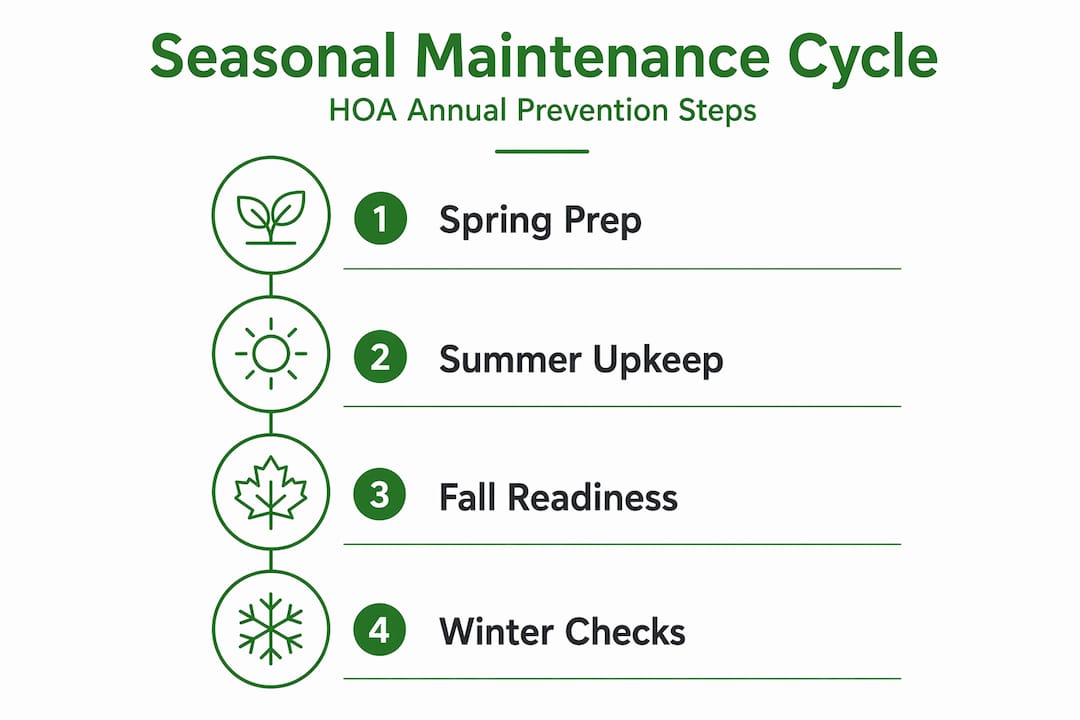
HOA seasonal maintenance runs as a recurring cycle of inspections and preventive work on common-area assets, organised around a calendarised schedule with specific spring, summer, fall, and winter priorities. Think of it less like a to-do list and more like an operating calendar where missing one month creates a ripple effect across the next.
For Calgary HOAs, seasonal property care breaks down into four distinct phases, each with non-negotiable tasks tied to climate realities:
Spring (April to May)
Spring in Calgary arrives fast and unforgivingly. Snow melt exposes months of accumulated damage. Priority tasks include:
- Irrigation system startup and head inspection
- Pest control treatment for common areas
- Pool or amenity space opening and chemical balancing
- Crack sealing on walkways and parking areas damaged by freeze-thaw cycles
- Post-winter roof and gutter inspection
Summer (June to August)
Summer is the maintenance window Calgary HOAs cannot afford to waste. Growth is rapid and conditions allow for major repairs.
- Fertilisation and weed control for lawns and beds
- Exterior repainting or caulking where needed
- Playground equipment safety inspections
- HVAC filter replacements for common buildings
- Irrigation scheduling adjustments for heat
Fall (September to October)
Fall is the most consequential season for Calgary boards. HOA outdoor maintenance tips consistently show that boards who front-load fall tasks avoid the most costly winter surprises.
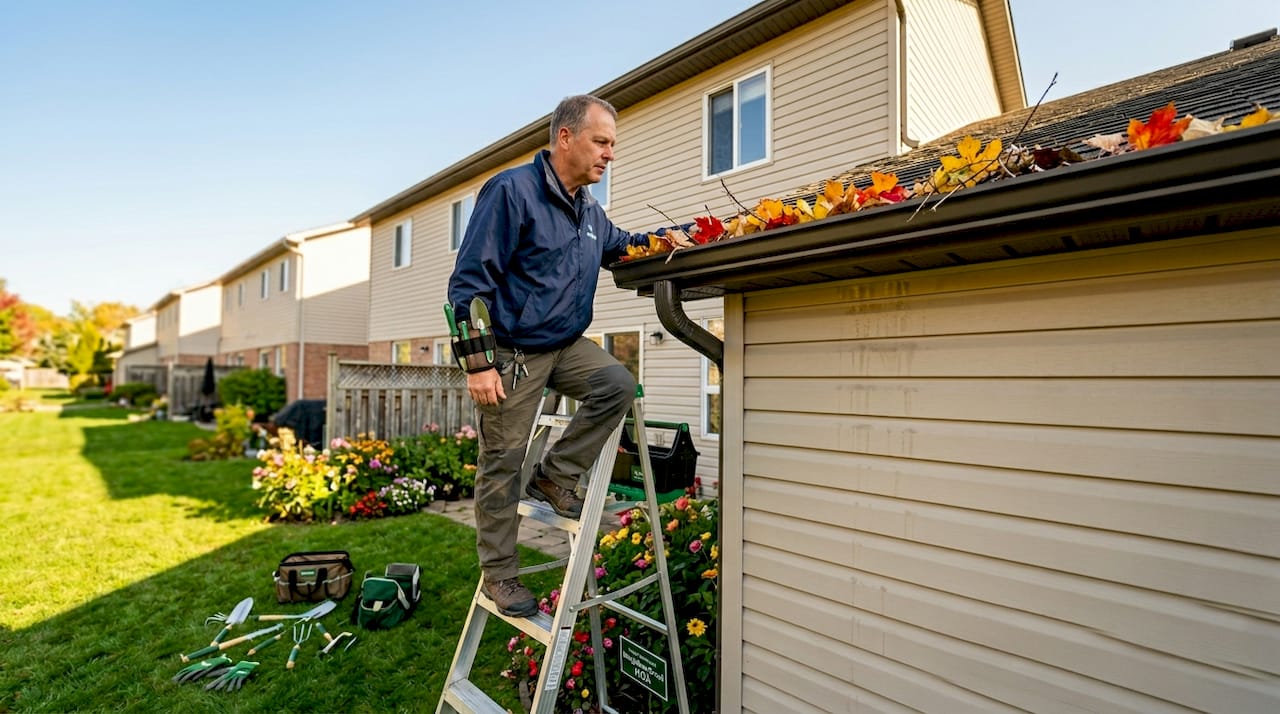
- Gutter and downspout clearing before freeze
- Irrigation winterisation (a missed step that accounts for a significant share of spring pipe repair costs)
- Leaf removal from drainage areas
- Exterior fire and smoke detector inspections
- Tree and shrub assessment for dead limbs before snowload
Winter (November to March)
Winter is not a pause. It is a planning and monitoring phase.
- Snow and ice management on common walkways and roadways
- Dormant pruning of hazardous trees
- Storm damage reviews after major weather events
- HVAC servicing for common-area buildings
- Budget preparation and contract review for the coming year
| Season | Priority tasks | Calgary-specific risk |
|---|---|---|
| Spring | Irrigation startup, crack sealing, pest control | Freeze-thaw pavement damage |
| Summer | Fertilisation, HVAC filters, safety inspections | Heat stress on turf and structures |
| Fall | Gutter clearing, irrigation winterisation, leaf removal | Ice dam formation, drainage blockage |
| Winter | Snow removal, dormant pruning, budget planning | Slip and fall liability, structural snowload |
Pro Tip: Build your annual maintenance calendar in September, not January. Booking contractors for spring work in fall locks in better rates and guarantees availability.
With this operational understanding, let’s explore the major value seasonal maintenance brings to HOAs.
How seasonal maintenance protects property value and budget health
This is where the numbers make the argument better than any analogy. Preventive maintenance savings show that every dollar spent on prevention saves roughly $4 to $7 compared to reactive repair costs, and consistent contract bidding can save 15% to 25% annually compared to simply renewing without competition.
For a mid-sized Calgary HOA managing 80 to 120 units, that 15% to 25% saving on contracts alone can represent $8,000 to $20,000 per year returned to reserves. That is money available for capital improvements, not emergencies.
Deferred maintenance follows a brutal compounding logic. A $300 gutter clearing job skipped in October becomes a $2,500 ice dam repair in February. A $150 crack sealing job skipped in spring becomes a $4,000 section of replaced asphalt two winters later. Seasonal maintenance budgeting examples from Calgary properties illustrate exactly this pattern.
Comparing preventive versus reactive repair costs
| Asset | Preventive cost | Reactive repair cost | Multiplier |
|---|---|---|---|
| Gutter clearing | $300 per visit | $2,500 ice dam repair | 8x |
| Crack sealing | $150 per area | $4,000 asphalt replacement | 27x |
| Irrigation winterisation | $200 | $1,800 pipe replacement | 9x |
| Annual HVAC service | $400 | $6,000 unit replacement | 15x |
Key benefits of seasonal upkeep for HOAs from a financial standpoint:
- Predictable operating costs instead of emergency budget draws
- Lower insurance premiums due to reduced claims history
- Maintained or improved property values across the community
- Stronger reserve fund health over time
Pro Tip: Review every vendor contract annually before the season begins. If you have not put a contract out for competitive bid in the last two years, you are almost certainly overpaying.
Understanding financial impacts, we now consider how seasonal maintenance reduces liability risks and supports community safety.
Seasonal maintenance as a risk management and safety tool
Here is a fact that rarely appears in HOA newsletters: documented maintenance records are among the most important evidence an HOA can produce if a safety incident leads to a liability claim, making seasonal maintenance central to both safety and liability protection.
A slip-and-fall on an icy walkway. A branch falling on a parked vehicle. A child injured on a deteriorated play structure. Each scenario carries significant legal exposure. What separates an HOA that loses a liability claim from one that successfully defends it is almost always the quality of its documentation.
“Consistent, documented maintenance schedules show that the board exercised its duty of care. Without records, even well-maintained properties can face successful negligence claims because there is no proof the work was done.”
Key practices for liability defence through seasonal upkeep:
- Keep signed completion records for every maintenance visit, including date, scope, and contractor name
- Photograph conditions before and after each seasonal task
- Log all hazard identifications and the response timeline
- Maintain a central file accessible to current and future board members
Year-round maintenance liability guidance makes clear that continuity matters as much as the work itself. A new board member should be able to pick up the records and immediately understand what was done and when.
Pro Tip: Attach measurable acceptance standards to every checklist item. “Gutters cleared” is weak. “Gutters cleared and downspouts flowing freely, confirmed by water test, October 12, 2026” is defensible.
Beyond legal risk, effective vegetation control is another crucial seasonal responsibility.
Vegetation management through seasonal maintenance to ensure safety and curb appeal
Calgary’s short growing season creates a misleading calm. Property owners underestimate how fast vegetation grows from May through August, and how much that growth matters for both safety and aesthetics. Spring and summer vegetation control requires the most active management due to rapid plant growth, while fall preparation prevents heavy buildup and maintains safe access routes and curb appeal.
Here is a practical step-by-step seasonal vegetation management plan for Calgary HOA boards:
- April: Assess winter damage to trees and shrubs. Remove dead wood before new growth obscures hazards.
- May: Begin scheduled mowing and edging. First weed control application for beds and lawn perimeters.
- June: Inspect all sight-line vegetation near exits, parking areas, and signage. Trim for access and visibility.
- July: Mid-summer pruning for ornamental shrubs. Second weed control application. Inspect for pest or disease signs.
- August: Assess any storm-damaged limbs. Begin planning fall cleanup schedule.
- September: First round of leaf removal. Trim back perennial beds. Clear vegetation from drainage paths before freeze.
- October: Final leaf and debris clearance. Cut back any vegetation contacting building exteriors or fences.
Smart seasonal planning keeps common areas looking maintained without requiring constant reactive intervention, which is both expensive and inconsistent.
Well-maintained vegetation does more than look good. It reduces insect habitat near common areas, keeps emergency access routes clear, prevents moisture damage to building foundations from overgrown plant material, and signals to prospective buyers that the community is managed with care.
Pro Tip: Schedule at least three vegetation inspections during the growing season rather than relying on a single summer visit. Calgary’s June-July growth rate regularly catches boards off guard.
With vegetation management clear, let’s explore how preventive maintenance strategies shift HOA operations from reactive to proactive.
Implementing preventive seasonal maintenance for long-term HOA asset protection
Every major asset in an HOA’s portfolio has a lifespan. The difference between reaching that lifespan and falling short of it is almost entirely a maintenance question. Preventive maintenance turns variable emergency expenses into predictable operating costs and extends long-term asset life, and it is almost always cheaper than emergency repairs.
Consider boilers servicing common-area buildings. A properly maintained boiler with annual servicing and seasonal inspections can operate reliably for 20 to 25 years. A neglected one commonly fails before 12 to 15 years. That difference represents $15,000 to $40,000 in premature capital expenditure for a community, depending on unit size.
Key principles of a preventive maintenance approach for Calgary HOA common-area assets:
- Match tasks to asset lifecycle stages. A five-year-old roof needs inspections. A fifteen-year-old roof needs active monitoring and reserve planning.
- Front-load fall maintenance. Calgary’s autumn window is narrow. Work that is not done in September and October often cannot be completed until spring.
- Integrate maintenance into reserve fund planning. Each asset’s maintenance history should inform the reserve study, not the other way around.
- Track vendor performance against measurable outcomes. Contracts that do not specify measurable results create disputes and inconsistent quality.
Pro Tip: Align every major maintenance task with the projected useful life of the asset it protects. This turns your seasonal maintenance checklist into a capital planning tool, not just a task list.
Having covered the core functions, we now offer a fresh perspective on elevating seasonal maintenance impact for Calgary HOAs.
Why many HOAs misunderstand seasonal maintenance and how to get it right
After years of working with Calgary communities, the pattern is clear: HOA boards treat seasonal maintenance as a facilities issue when it is actually a governance issue. Boards that do it well have documentation systems, measurable standards, and vendor accountability built into their contracts. Boards that struggle treat it as a list of tasks to hand off and forget.
The most underestimated element is timing. Calgary’s climate is unforgiving: early fall issues escalate into serious winter problems quickly, requiring proactive front-loading of maintenance tasks. Most boards discover this after their first expensive winter claim.
The second misunderstanding is the nature of the records. Seasonal maintenance should be documented operations, not informal tasks, creating clear accountability and protection against liability. A photo taken on a phone and stored in a personal email account is not documentation. A dated, signed completion record retained in a shared board file that survives board turnover is documentation.
The third misconception is that maintenance expense competes with reserve contributions. In reality, they are complementary. Proper maintenance extends asset life, reduces the capital replacement demand on reserves, and keeps annual assessments more stable for residents. Boards that prioritise HOA maintenance as a financial strategy rather than an operational afterthought consistently outperform their peers on property values and resident satisfaction.
The boards that get it right share one habit: they treat their seasonal maintenance checklist as a living governance document, reviewed annually, tied to contracts, and tracked against measurable outcomes. That shift from task management to programme governance is where the real value of seasonal upkeep for HOAs lives.
How YearLong supports Calgary HOAs with expert seasonal maintenance
Running a complete year-round maintenance programme is demanding, especially when board volunteers are managing it alongside full-time jobs. YearLong Property Maintenance has been supporting Calgary HOAs since 2017 with the kind of consistent, documented, and schedule-driven service that boards actually need.

From professional lawn care and bed maintenance that keep common-area landscapes healthy through the growing season, to seasonal clean-up services that prepare your property for Calgary’s demanding winters, YearLong provides service packages built around HOA operational needs. Every visit comes with completed documentation to support your liability records and board reporting. Reach out to YearLong for a consultation and get your community’s maintenance calendar aligned with what Calgary’s climate actually demands.
Frequently asked questions
What is the primary role of seasonal maintenance for HOAs?
Seasonal maintenance helps HOAs keep common areas safe, attractive, and functional by scheduling inspections and preventive tasks aligned with climate cycles to protect property value and reduce costly repairs.
How does preventive maintenance save money for HOAs?
Every dollar spent on prevention saves roughly $4 to $7 compared to reactive repair costs, and competitive contract bidding reduces annual costs by 15% to 25% compared to renewing without evaluating alternatives.
Why is documentation important in seasonal HOA maintenance?
Documented maintenance records are the primary evidence an HOA can present if a safety incident leads to a liability claim, and they ensure maintenance continuity when board members or contractors change.
How often should vegetation be managed during Calgary’s growing season?
Calgary vegetation should be inspected and managed at least two to three times during the growing season, particularly in spring and summer, to prevent overgrowth from blocking access routes or creating safety hazards.
What are key seasonal tasks for Calgary HOAs in fall?
Key fall tasks include gutter and drain clearing, irrigation winterisation, leaf removal from drainage paths, exterior caulking review, and annual fire and smoke detector inspections to ensure the community is fully prepared before winter conditions set in.